
How to Get the Texas Commercial Vehicle Crash Report (CR-3) in Bexar County
Quick Answer Key Takeaways The CR-3 Today: One Report Covers the Commercial Vehicle Data After a crash involving a commercial truck, delivery vehicle, or other commercial motor vehicle (CMV) on Bexar County roads, the responding officer completes a Texas Peace Officer’s Crash Report, Form CR-3. That is the crash report in Texas. There is no […]
Texas 18-Wheeler Crash Report: What to Capture From the CR-3 After a Truck Accident
Reviewed by Ryan Orsatti, Texas personal injury attorney. Quick Answer Key Takeaways Why the CR-3 Is Different in an 18-Wheeler Case The Texas Peace Officer’s Crash Report (Form CR-3) documents every reportable crash on a Texas roadway. When a commercial motor vehicle (CMV) is involved, the form expands to include fields that do not appear […]
Low-Ball Settlement Offer? Here’s How a Texas Personal Injury Lawyer Negotiates a Better Settlement

Quick Answer A low-ball settlement offer does not have to be accepted. A Texas personal injury lawyer negotiates by identifying why the insurer discounted the claim, correcting those weaknesses with reliable evidence, and presenting a counter-demand tied to fault, medical proof, wage loss, future care, coverage, and litigation risk. Do not sign a release before […]
Can the Insurance Company See My Medical Records Without Permission in Texas?
Quick Answer Usually, the at-fault driver’s insurance company cannot obtain your medical records directly from a doctor merely by asking. It normally needs a valid written authorization, records you voluntarily provide, or lawful court process. Different rules may apply to your health insurer, workers’ compensation carrier, or records requested after a Texas personal injury lawsuit […]
Should I Talk to the Company Man, Safety Man, HR, or Insurance Adjuster While I Am Medicated?
Quick Answer Generally, you should not give a detailed, recorded, or signed statement while pain medication, sedation, a head injury, severe pain, or shock may be affecting your memory or alertness. Report the injury, identify urgent safety hazards, and provide the basic facts needed for medical care, but ask to postpone the detailed interview until […]
What Should My Family Do While I Am Still in the Hospital After a Rig Accident?
Quick Answer While you are hospitalized after an onshore Texas rig accident, your family should protect three things at once: your medical care, the required work-injury notices, and time-sensitive evidence. A family member can report the injury on your behalf, identify every company working at the site, verify workers’ compensation coverage, preserve your phone and […]
What Counts as a Catastrophic Injury Under Texas Law? Why the Label Matters, but the Proof Matters More

Quick Answer Texas law does not give most negligence plaintiffs a separate damages category merely because an injury is called catastrophic. The term generally describes an injury that permanently changes a person’s ability to work, move, communicate, live independently, or care for themselves, but recovery still depends on proving fault, medical causation, and each past […]
Commercial Vehicle Black Box Data: What Does It Record and How Can It Help Your Texas Case?

Quick Answer Commercial vehicle black box data may show speed, braking, throttle position, engine RPM, gear selection, fault codes, and other vehicle inputs before a crash. An electronic logging device, or ELD, is different: it records information such as time, location, vehicle miles, engine hours, and driver-duty events. The exact information depends on the truck, […]
Common Car Accident Injuries That Don’t Show Up on X-Rays
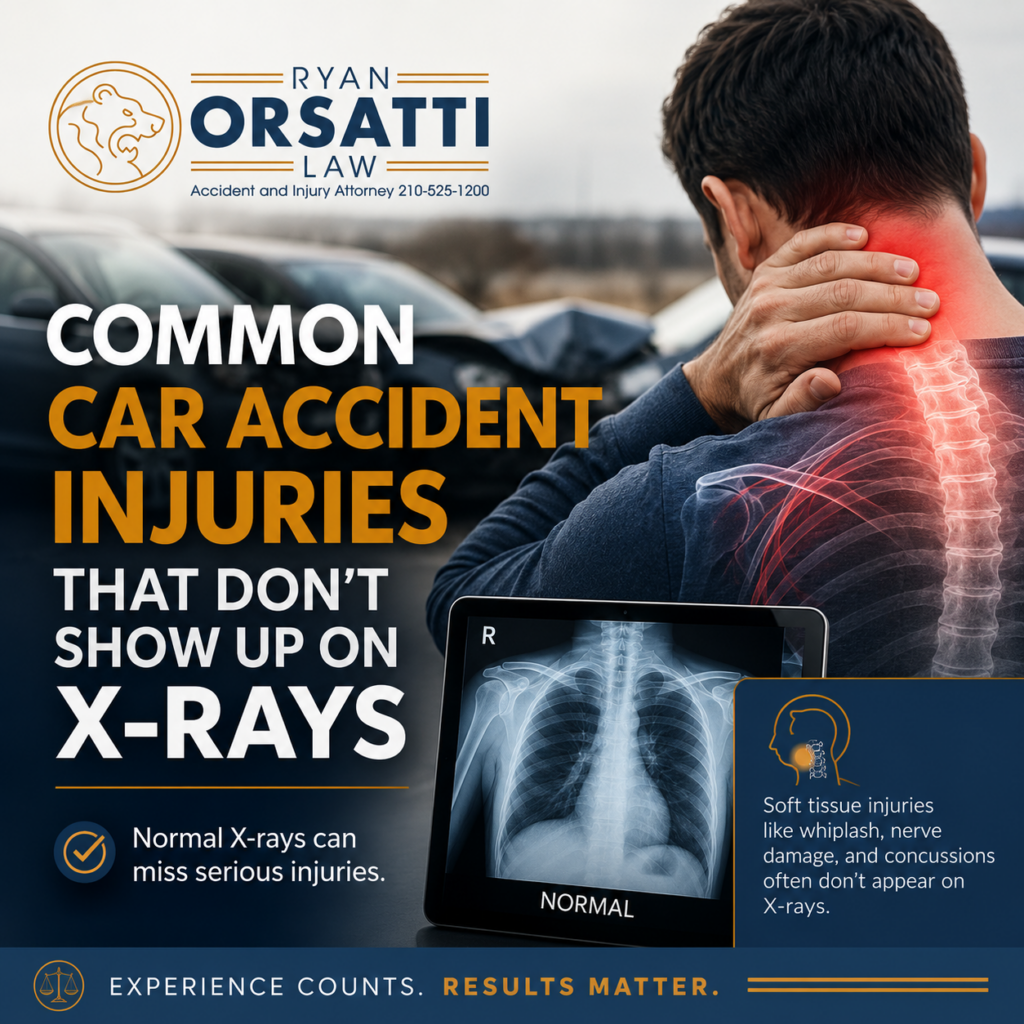
Quick Answer A normal X-ray after a car accident does not rule out whiplash, a herniated disc, ligament or tendon tears, concussion, nerve injury, or internal trauma. X-rays are best at showing bones and alignment, while MRI, CT, ultrasound, physical examinations, and neurocognitive testing may be needed for other injuries. TxDOT reported 251,977 people injured […]
I-35 and I-10 Interchange Wrecks: What San Antonio Drivers Should Know
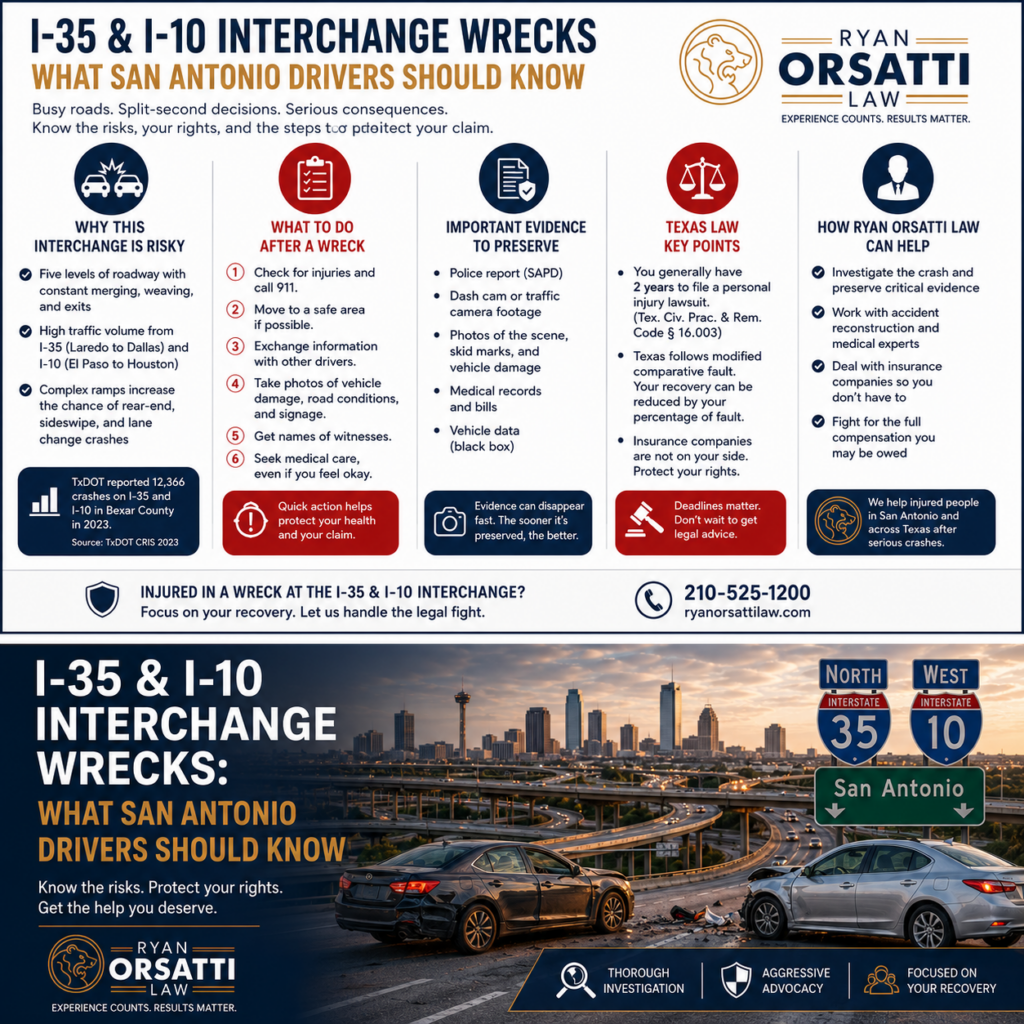
Quick Answer After an I-35 and I-10 interchange wreck in San Antonio, move to safety if possible, call 911 when anyone may be injured or a vehicle cannot be safely driven, and record the exact direction, level, ramp, and nearby exit. Fault is not automatic in a merge crash. Texas law asks whether each driver […]