
Quick Answer
An insurer’s first settlement offer after a Texas car accident is often low because it may be made before the full medical, wage-loss, liability, insurance-coverage, and lien picture is documented. Accepting the offer usually requires a release, and the Texas Department of Insurance warns that this release promises that you will not bring additional claims from the accident. Texas generally gives you two years to file a personal injury lawsuit, but evidence and policy deadlines can arise much sooner. Ryan Orsatti Law helps injured Texans evaluate whether an offer accounts for the claim’s documented risks and losses.
Key Takeaways
- The first offer is a starting position, not an independent valuation of everything you have lost.
- Early offers may omit future treatment, complete wage loss, physical limitations, liens, and additional insurance coverage.
- Do not sign a release until you understand exactly which claims, people, and insurance policies it covers.
- Texas fault rules can reduce or eliminate recovery, so the insurer’s liability analysis matters as much as the medical bills.
- Rejecting an offer usually continues the negotiation. It does not automatically end your claim.
- Most Texas car accident injury lawsuits must be filed within two years, but waiting can still cause important evidence to disappear.
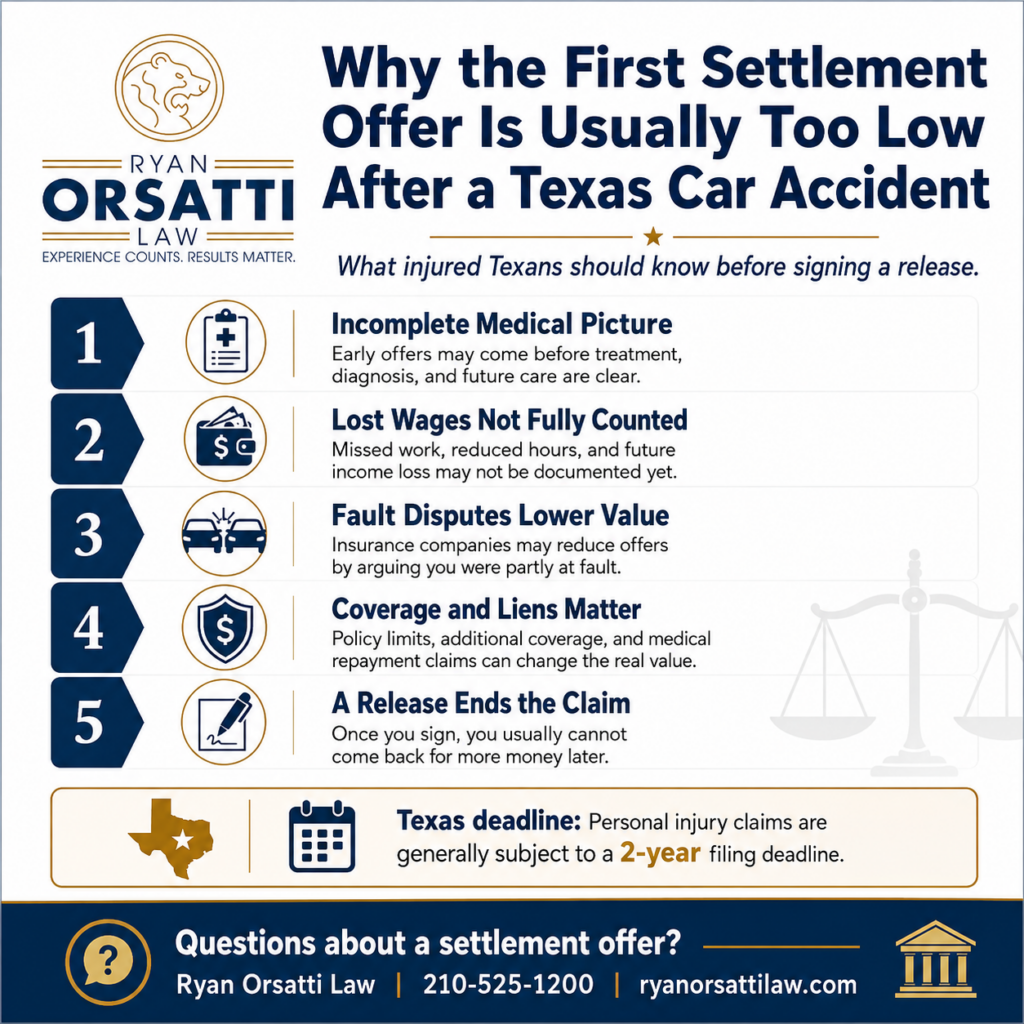
Why Do Insurance Companies Start With a Low Settlement Offer?
Insurance companies often start with a lower offer because the initial figure is part of a negotiation and may be based on an incomplete claim file. The adjuster may not yet have all medical records, bills, wage-loss documentation, photographs, witness statements, coverage information, or evidence of future medical needs.
The other driver’s insurer is not your insurance company. The Texas Department of Insurance explains that you do not have a contract with that carrier and therefore do not have the same rights and options you would have under your own policy. The adjuster’s job is to investigate the claim and determine what the insurer is willing to pay on behalf of its policyholder.
A first offer may also function as an anchor. An anchor is the first number placed into a negotiation, which can influence the numbers discussed afterward. A person dealing with medical bills, vehicle problems, and missed work may feel pressure to accept a quick payment before the full value of the claim is known.
Not every first offer is unreasonable. A property-damage-only offer may be appropriate when the valuation is supported, the vehicle issues are resolved, and the release does not affect an unresolved bodily injury claim. Injury settlements require more caution because the long-term consequences may not yet be clear.
What Is Commonly Missing From an Early Settlement Offer?
An early settlement offer may omit losses that have not yet been properly documented. A complete evaluation should address not only the bills already received, but also injury causation, future care, lost income, physical limitations, fault disputes, insurance limits, and amounts that may have to be repaid from the settlement.
| Claim issue | What an early offer may consider | What a complete evaluation may require |
|---|---|---|
| Medical treatment | Bills currently in the adjuster’s file | Diagnoses, imaging, treatment records, physician opinions, prognosis, and reasonably anticipated care |
| Lost income | A claimant’s estimate of missed work | Employer verification, payroll records, tax documents, work restrictions, and reduced earning ability |
| Pain and limitations | Brief descriptions or initial records | Consistent medical documentation, activity limitations, photographs, and credible witness information |
| Responsibility for the crash | Initial statements and the police report | Scene photographs, video, witnesses, vehicle damage, electronic data, and applicable traffic rules |
| Insurance coverage | The at-fault driver’s basic liability policy | Employer policies, commercial coverage, umbrella coverage, rideshare coverage, and UM/UIM insurance |
| Medical repayment claims | Sometimes not addressed in the opening offer | Health-plan subrogation, Medicare or Medicaid interests, hospital liens, and unpaid provider balances |
| Property damage | Repair estimate or total-loss valuation | Comparable vehicles, options, condition, taxes, towing, storage, rental expenses, and diminished value |
Key takeaway: A settlement number cannot be evaluated reliably until you know which losses were included, which were discounted, and which were left out.
Subrogation means a health insurer or benefit plan may claim a right to reimbursement from an injury settlement. A lien is a legal claim against part of the recovery. These issues do not necessarily increase the settlement value, but they can substantially affect how much money remains after medical obligations and case expenses are resolved.
Why Is Settling Before the Medical Picture Is Clear Risky?
Settling before the medical picture is reasonably clear can leave the injured person responsible for later treatment. The Texas Department of Insurance advises accident victims to discuss possible future treatment with their doctor before signing a release because the release generally prevents additional claims arising from the accident.
This does not mean every claimant must wait until every symptom disappears. It means the diagnosis, treatment plan, prognosis, and likely future expenses should be sufficiently developed to support an informed decision.
The risk is significant because crash injuries are common and can require extended care. According to TxDOT’s 2024 Texas Motor Vehicle Traffic Crash Facts, 251,977 people were injured in Texas traffic crashes during 2024, including 18,218 people who sustained serious injuries.
Medical documentation should explain:
- What conditions were diagnosed
- Whether the crash caused or aggravated those conditions
- What treatment has been completed
- Whether additional imaging, injections, surgery, therapy, or specialist care is being considered
- Whether the injuries affect work, sleep, mobility, household activities, or recreation
- Whether any permanent impairment or future restriction is expected
Treatment should be based on medical need, not on building a legal claim. At the same time, undocumented symptoms and unexplained treatment gaps often create disputes about whether the crash caused the claimed condition.
Does a Low First Offer Mean the Insurance Company Acted Illegally?
A low first offer, standing alone, does not prove bad faith, fraud, or an illegal claims practice. The dispute may involve missing records, disagreement about fault, a causation defense, prior medical conditions, treatment gaps, insurance limits, or a genuinely different assessment of the evidence.
The correct response is to identify the insurer’s reasoning. The Texas Department of Insurance recommends asking for a detailed written explanation when the other driver’s insurer refuses to pay or pays differently than expected. A written explanation can reveal whether the disagreement concerns liability, medical causation, treatment charges, wage loss, policy limits, or another issue.
A low offer becomes more concerning when the insurer:
- Misstates the policy or known evidence
- Ignores records that were provided
- Assigns fault without explaining the factual basis
- Pressures the claimant to sign an immediate release
- Treats a property-damage payment as a release of bodily injury claims
- Refuses to identify what documents are supposedly missing
- Repeatedly changes its stated reason for reducing the claim
What Happens If You Reject the First Settlement Offer?
Rejecting the first settlement offer usually means the claim remains open and negotiations continue. The insurer may make another offer, request more information, maintain its position, withdraw the offer, or require litigation before increasing the amount.
You do not have to accept an offer simply because the adjuster calls it fair, final, or time-sensitive. You should still respond within a reasonable period, confirm whether the offer has an expiration date, and continue monitoring the legal deadline.
A rejection should be professional and evidence-based. Anger does not establish damages. Medical records, photographs, wage documents, witness statements, coverage information, and a clear explanation of the disputed issues are more persuasive.
A concise response might state:
“I am not accepting the current offer. Please provide the valuation and factual basis for the offer in writing, including any reductions for responsibility, medical causation, treatment, prior conditions, policy limits, or other disputed items.”
If the insurer refuses to explain its position, the Texas Department of Insurance accepts complaints involving both a person’s own insurer and another driver’s insurer. TDI notes that a company responding to a third-party complaint must explain why it denied the claim or paid it in a particular way.
How Should You Respond to a Low Settlement Offer?
You should respond to a low settlement offer by requesting the insurer’s reasoning, reviewing the release, completing the necessary documentation, and calculating a supportable settlement position. Do not make an emotional counteroffer or choose an arbitrary multiplier without understanding the evidence.
- Get the offer in writing. Confirm the amount, the claims being settled, the people being released, and whether the offer includes property damage, bodily injury, or both.
- Request the insurer’s calculation. Ask what it allowed for medical expenses, lost income, pain and physical limitations, fault, prior conditions, future care, and other damages.
- Do not sign the release yet. Review whether it releases only the driver or also employers, vehicle owners, businesses, insurers, and unknown parties.
- Confirm the medical picture. Obtain the necessary records, bills, diagnoses, work restrictions, prognosis, and treatment recommendations.
- Document lost income. Use wage statements, payroll records, employer letters, tax returns, work schedules, and medical restrictions when appropriate.
- Investigate all available coverage. Determine whether liability, commercial, umbrella, rideshare, employer, personal injury protection, medical payments, or uninsured/underinsured motorist coverage may apply.
- Account for liens and repayment claims. Identify health-insurance subrogation, Medicare or Medicaid interests, hospital liens, and unpaid medical balances.
- Prepare an evidence-based counteroffer. Explain the disputed facts, attach supporting documents, and state a settlement demand that can be tied to the evidence.
- Track every deadline. Negotiations do not necessarily extend the statute of limitations or preserve evidence.
Do not deposit a settlement check until you know whether the payment is conditioned on a release or described as full and final settlement of the claim.
How Do Texas Fault Rules Affect the First Offer?
Texas proportionate responsibility rules can significantly reduce an insurer’s offer. Under Texas Civil Practice and Remedies Code § 33.001, a claimant generally cannot recover if the claimant’s percentage of responsibility is greater than 50 percent. A recoverable amount is ordinarily reduced by the claimant’s assigned percentage of responsibility.
For example, an insurer may reduce its offer if it contends that the injured driver was speeding, failed to maintain a proper lookout, changed lanes improperly, or could have avoided the collision. Those allegations should be compared against the crash report, photographs, video, vehicle damage, witness accounts, and applicable traffic rules.
An officer’s ticket or crash-report opinion can be relevant, but it does not automatically determine civil responsibility. The insurance company, attorneys, judge, and jury may analyze a broader set of evidence.
Learn more about fault, evidence, insurance coverage, and legal options in the firm’s San Antonio car accident guide.
How Do Insurance Limits Affect a Settlement Offer?
Insurance limits can restrict the amount available from a particular policy even when the documented losses are substantially higher. Texas requires minimum automobile liability limits of $30,000 per injured person, $60,000 per accident for bodily injury, and $25,000 for property damage, commonly called 30/60/25 coverage.
Policy limits are not the same as claim value. A serious injury claim may be worth more than the available liability insurance. The practical investigation should determine whether there are:
- Multiple responsible drivers
- A negligent employer
- A commercial vehicle policy
- An umbrella or excess policy
- A vehicle-owner liability theory
- Rideshare or delivery-company coverage
- Uninsured or underinsured motorist coverage
- Other responsible businesses or property owners
An offer for the apparent policy limit should not be accepted automatically. The claimant should confirm the limit, investigate other coverage, review the release, and address any legal requirements affecting claims against an underinsured-motorist carrier.
When Might the First Offer Be Reasonable?
A first offer may be reasonable when the claim is limited, all losses are known, the valuation is documented, and the proposed release does not extinguish unresolved claims. This is more common in straightforward property-damage claims than in bodily injury cases.
For a total-loss vehicle, the Texas Department of Insurance recommends asking which source the insurer used to value the vehicle. A claimant who believes the value is too low can provide local dealer quotes, advertisements for comparable vehicles, and documentation of options or custom equipment.
Before accepting, confirm:
- Whether the payment includes taxes and applicable fees
- How towing, storage, and rental expenses were handled
- Whether the vehicle’s options and pre-crash condition were accurate
- Whether the payment requires surrendering the vehicle
- Whether salvage value will be deducted
- Whether the release is limited to property damage
- Whether any bodily injury claim remains open
How Long Do You Have to Decide?
Most Texas personal injury lawsuits must be filed within two years after the claim accrues under Texas Civil Practice and Remedies Code § 16.003. Settlement discussions generally should not be assumed to pause that deadline, and claims involving governmental entities may have much earlier notice requirements.
Two years is not a safe waiting period. Surveillance video may be overwritten, vehicles may be repaired or destroyed, witnesses may move, electronic data may disappear, and memories may fade.
The insurer’s requested response date is different from the lawsuit deadline. Ask whether the offer expires, but do not allow an artificial deadline to force an uninformed release.
Read more about the Texas two-year personal injury deadline and its exceptions and how long a Texas car accident case may take.
When Should a Lawyer Review the First Settlement Offer?
A lawyer should review the offer when the crash caused an injury, future treatment is possible, fault is disputed, work has been affected, coverage is uncertain, or the proposed release is broad. Review is also useful in commercial-vehicle, rideshare, multiple-vehicle, serious-injury, and UM/UIM claims.
A Texas personal injury lawyer can:
- Compare the offer with the documented damages
- Investigate fault and proportionate responsibility
- Identify missing medical and employment evidence
- Review all potentially applicable insurance policies
- Evaluate liens and repayment obligations
- Determine whether additional parties may be responsible
- Prepare a supported demand or counteroffer
- File suit when needed to protect the claim or address disputed issues
Ryan Orsatti Law helps injured people in San Antonio, Bexar County, and across Texas evaluate settlement offers, fault evidence, insurance coverage, medical documentation, liens, releases, and claim deadlines. The firm’s approach emphasizes personal attention and direct attorney involvement in injury matters.
The firm also provides guidance about recorded statements after a Texas car accident because statements made before the evidence and medical picture are clear can influence the insurer’s valuation.
Attorney Insight: The most useful question after receiving a low first offer is not simply, “How much higher should the counteroffer be?” The better question is, “What evidence is still missing?” A counteroffer becomes more persuasive when each disputed part of the insurer’s evaluation is answered with a record, witness, photograph, policy provision, or reliable calculation.
Frequently Asked Questions
Is the first settlement offer from an insurance company final?
The first settlement offer is usually not final unless it has already been accepted and a binding settlement has been created. You may reject the offer, request an explanation, provide additional evidence, or make a counteroffer. The insurer may increase, maintain, or withdraw its offer depending on the evidence, negotiations, deadlines, and litigation risk.
Can I reject the first offer without making a counteroffer?
Yes. You can reject the first offer and ask the insurer to explain its valuation before providing a counteroffer. This may be appropriate when the offer does not identify how the insurer evaluated medical treatment, wage loss, fault, prior conditions, or future care. A counteroffer should be based on evidence rather than an arbitrary number.
Can I negotiate a Texas car accident settlement without a lawyer?
You may negotiate your own claim, particularly when it involves property damage only and no injuries. Legal review becomes more important when medical treatment, future care, disputed fault, lost income, commercial coverage, low policy limits, liens, or a broad release are involved. Once a bodily injury release is signed, reopening the claim may be extremely difficult.
What if the insurance company offers the policy limits?
A policy-limits offer may still require careful review. Confirm the limits in writing, investigate umbrella or commercial policies, identify other responsible parties, examine your own UM/UIM coverage, and review the release. The policy limit describes available coverage under one policy. It does not necessarily establish the full value of the injuries or prove that no other recovery source exists.
Can I reopen my claim after signing a settlement release?
Usually, a properly executed release is intended to end the claims described in the document, including the right to demand more money if symptoms worsen. The Texas Department of Insurance recommends discussing possible future treatment with your doctor before signing. Challenges to a release are fact-specific and should not be treated as a reliable way to correct an inadequate settlement.
Can the Texas Department of Insurance force the other driver’s insurer to increase its offer?
TDI can review complaints and require the insurance company to explain its handling of the claim, but it generally does not decide disputed fault or determine the value of a third-party bodily injury claim. If the insurer will not voluntarily resolve the dispute, legal action against the responsible party may be necessary.
Does rejecting an offer make me more likely to go to trial?
Rejecting an offer does not automatically lead to trial. Many claims continue through additional documentation and negotiation, and many lawsuits settle before a verdict. Litigation becomes more likely when the parties remain far apart about fault, injury causation, damages, policy interpretation, or the amount supported by the evidence.
Ryan Orsatti Law
4634 De Zavala Rd, San Antonio, TX 78249
Phone: 210-525-1200
ryanorsattilaw.com
This blog is for informational purposes only, not legal advice. Reading it does not create an attorney-client relationship. Past results do not guarantee future results.
Hurt in an accident in San Antonio? Learn how a San Antonio car accident lawyer can help with your claim. Call 210-525-1200 or request a free consultation.
The firm works on a contingency fee. You pay nothing unless the firm recovers money for you, and that covers case expenses as well as the fee: if there is no recovery, you owe no attorney's fee and no case expenses. Ask for the fee agreement and read the fee and expense section before you sign anything.
Related San Antonio legal resources
Primary legal and public-data sources
- TxDOT: Texas crash reports, data, and statistics
- Texas Civil Practice and Remedies Code Chapter 33: proportionate responsibility
Ryan Orsatti Law
4634 De Zavala Road, San Antonio, TX 78249
General reference links. Consult each source for its current text.