
Quick Answer
Multiple insurance companies may call after a Texas wreck because different policies could cover different parts of the loss. The callers may represent the other driver, the vehicle owner, an employer, your own collision or PIP coverage, or a possible UM/UIM claim.
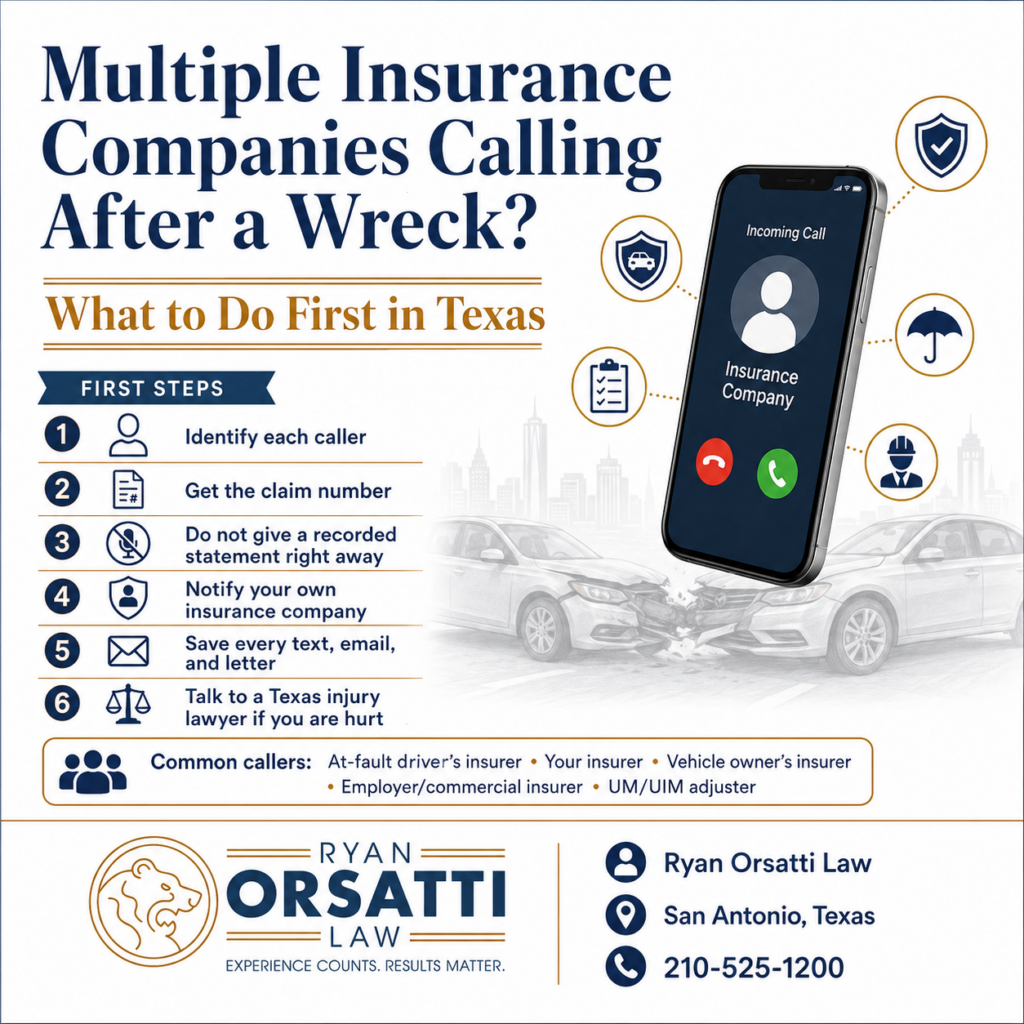
Do not give every adjuster an immediate, unscripted statement. Identify the caller, get the claim information, ask whether the call is being recorded, and determine whom the adjuster represents before discussing fault, injuries, treatment, or settlement. Ryan Orsatti Law helps injured Texans identify the available policies and coordinate these communications without unnecessarily jeopardizing a claim.
Key Takeaways
- Multiple adjusters do not necessarily mean multiple settlements. Each insurer may be investigating a different policy, person, vehicle, or category of damage.
- You generally do not have a contractual duty to give the other driver’s insurer a recorded statement.
- Your own insurance company is different. Your policy may require prompt notice, cooperation, documents, or a statement.
- Do not sign a medical authorization, property release, bodily injury release, or settlement agreement without understanding its full scope.
- Texas proportionate responsibility rules make inconsistent statements about fault especially dangerous.
- Keep one written log of every adjuster, claim number, request, document, and deadline.
Why Are Several Insurance Companies Calling After the Same Wreck?
Several insurance companies may call because one collision can trigger multiple policies covering different people and losses. A San Antonio crash involving a borrowed vehicle, company driver, rideshare vehicle, passenger, or underinsured driver can create separate claims for liability, vehicle damage, medical expenses, lost income, and uninsured or underinsured motorist benefits.
The volume of insurance activity reflects how common and consequential Texas crashes are. According to the Texas Department of Transportation’s 2024 crash facts, 251,977 people were injured in Texas motor vehicle crashes, and a reportable crash occurred approximately every 57 seconds.
| Possible caller | Whom the adjuster represents | What the adjuster may be investigating |
|---|---|---|
| Other driver’s liability insurer | The driver accused of causing the crash | Fault, injuries, medical treatment, vehicle damage, and possible settlement exposure |
| Vehicle owner’s insurer | The person or company that owned the vehicle | Whether the driver had permission, whether the policy covers the driver, and whether owner-related liability exists |
| Employer or commercial auto insurer | A business whose employee or vehicle was involved | Whether the driver was working, commercial coverage, company responsibility, and available policy limits |
| Your collision adjuster | Your own auto insurer | Repair cost, total-loss value, deductible, towing, storage, and rental benefits |
| Your PIP or MedPay adjuster | Your own auto insurer | Medical expenses, lost income under PIP, and supporting bills or records |
| Your UM/UIM adjuster | Your own auto insurer | Whether the other driver was uninsured or lacked enough coverage |
| Rideshare or delivery insurer | A platform, driver, or commercial carrier | The driver’s status in the app and which coverage period applies |
| Health insurer or benefits administrator | Your health plan | Medical bill processing and possible reimbursement rights from a later recovery |
Key takeaway: Each caller may have a different assignment and financial interest, so determine exactly whom the adjuster represents before answering substantive questions.
What Should I Say When an Insurance Adjuster First Calls?
Give only enough information to identify the claim and understand the purpose of the call. You can confirm your name, contact information, crash date, vehicle, claim number, and whether you were injured, while postponing detailed questions about fault, medical history, symptoms, or settlement until you understand the caller’s role.
A practical response is:
“Please give me your name, company, claim number, the person or business you represent, and the coverage you are handling. I am not prepared to give a recorded statement or sign any documents today. Please send your questions and requests to me in writing.”
That response does not mean you should ignore your own insurer. It creates time to review your policy obligations and prevents an unexpected conversation from becoming the first detailed account in several insurance files.
What Information Should I Collect From Each Adjuster?
Collect the same basic information from every caller so you can determine whether the calls relate to separate claims or duplicated investigations.
- Write down the adjuster’s full name, telephone number, email address, and insurance company.
- Ask whom the adjuster represents.
- Obtain the claim number and policy number, if available.
- Ask which coverage the adjuster is handling.
- Ask whether the call is being recorded.
- Ask what specific documents or information the adjuster wants.
- Request that all questions, authorizations, and settlement proposals be sent in writing.
- Record the date, time, and substance of every conversation.
Save voicemail messages, text messages, emails, letters, estimates, medical requests, and electronic signature links. A complete communication log helps prevent missed deadlines and shows exactly what each insurer requested.
Do I Have to Give Every Insurance Company a Recorded Statement?
You generally do not have a contractual duty to give the other driver’s insurance company a recorded statement because you are not that company’s policyholder. The Texas Department of Insurance specifically notes that you do not have a contract with the adverse carrier and therefore do not have the same relationship or remedies you have with your own company.
The other insurer can still investigate the claim. It may interview its insured, obtain the Texas Peace Officer’s Crash Report, review photographs, contact witnesses, inspect the vehicles, and ask you for information. Declining an immediate recorded interview does not prevent you from later providing a carefully prepared written account and supporting evidence.
Your own insurer is different. Your auto policy may require notice of the collision, reasonable cooperation, documents, proof of loss, medical information related to a covered claim, or a statement. Do not simply refuse your own carrier’s requests. Ask which policy provision applies, what information is needed, and whether you can schedule the statement after preparing.
Read more about the distinction in our guide to recorded statements after Texas car accidents.
Why Are the Adjusters Asking Me the Same Questions?
Adjusters ask overlapping questions because each company is independently evaluating fault, coverage, causation, and damages. They may compare your statements about vehicle positions, speed, traffic signals, symptoms, prior injuries, treatment dates, passengers, employment, and missed work.
Texas law makes fault statements particularly important. Under Texas Civil Practice and Remedies Code § 33.001, a claimant cannot recover damages if the claimant’s percentage of responsibility is greater than 50 percent. Responsibility of 50 percent or less can still reduce the recovery proportionately.
A person who speaks with four adjusters may describe the same event four slightly different ways. Normal differences in wording can later be characterized as inconsistencies. Statements such as “I never saw the other car,” “I am doing fine,” or “I might have been going a little fast” can take on significance that the speaker did not intend.
Attorney Insight
Adjusters often ask about injuries before the person has completed an examination, imaging, or specialist follow-up. The problem is not only what the injured person says. It is the timing. A statement that “my neck is just sore” may later be compared against an MRI, injection recommendation, or surgery consultation as though the early description disproves the later diagnosis.
Should I Use My Own Insurance Even If the Other Driver Caused the Wreck?
Using your own coverage may be appropriate even when the other driver appears responsible. Collision coverage can address vehicle damage, PIP or MedPay can assist with early medical expenses, and UM/UIM coverage may apply if the responsible driver has no insurance or insufficient limits.
The Texas Department of Insurance advises drivers to notify their own insurer and explains that collision, PIP, MedPay, and UM/UIM may provide benefits when the adverse insurer delays, disputes fault, or lacks sufficient coverage. Your company may later pursue reimbursement from the responsible party’s insurer, a process commonly called subrogation.
Texas law also provides important coverage protections:
- Texas Insurance Code § 1952.152 requires personal injury protection coverage to be included unless it is rejected in writing.
- Texas Insurance Code § 1952.101 similarly requires an insurer to provide UM/UIM coverage unless a named insured rejects it in writing.
PIP means personal injury protection. It can pay certain medical expenses and lost-income benefits without requiring you to first prove that another driver caused the crash. MedPay generally addresses covered medical expenses but does not necessarily provide the same lost-income benefits.
Learn more about who pays medical bills after a Texas car accident and what happens when the at-fault driver does not have enough insurance.
Can I Make Claims Under More Than One Insurance Policy?
More than one policy may provide benefits, but the claims must be coordinated carefully. Different policies can cover different losses, such as vehicle repairs, medical bills, lost wages, bodily injury damages, or an underinsured-driver shortfall. The availability and order of coverage depend on the policy language, the vehicles involved, and the relationship between the insured people.
For example, an injured passenger may have potential claims involving:
- The negligent driver’s liability policy
- The policy covering the vehicle in which the passenger was riding
- The passenger’s own household auto policy
- PIP or MedPay coverage
- UM/UIM coverage
- A commercial, employer, or rideshare policy
Multiple coverage sources do not normally permit duplicate payment for the same loss. Payments, deductibles, offsets, reimbursement rights, and policy limits must be reconciled before settlement.
Do Multiple Calls Mean the Insurance Companies Have Accepted Liability?
Multiple calls do not mean that any insurer has accepted fault, confirmed coverage, or agreed to pay the claim. The adjusters may still be determining whether the policy was active, whether the driver was covered, whether an exclusion applies, and whether another person or company should bear responsibility.
The adverse insurer may wait for its policyholder’s statement before deciding whether to accept liability. TDI advises that the other driver’s company may deny fault, assign partial fault, claim insufficient limits, or delay while trying to contact its insured. If it denies or limits payment, ask for the position and supporting reason in writing.
Your own first-party claim may be subject to statutory processing deadlines. Under Texas Insurance Code Chapter 542, an insurer generally must acknowledge a covered claim and begin its investigation within the applicable period, request reasonably necessary information, and then accept or reject the claim after receiving the requested materials. These rules should not be assumed to create the same deadlines for an adverse bodily injury claim.
What Documents Should I Avoid Signing Too Quickly?
Do not sign a document merely because an adjuster describes it as routine. Request a complete copy, identify the insurer and claim, and determine whether it affects only property damage or also releases injury, UM/UIM, medical-payment, or other claims.
Documents requiring particular attention include:
- A blanket medical authorization
- A wage or employment authorization
- A property damage release
- A bodily injury release
- A release of “all claims”
- A UM/UIM settlement or consent document
- A reimbursement or subrogation agreement
- A sworn proof of loss
- A settlement check containing release language
- An electronic signature request without the complete document attached
A broad medical authorization may permit access to records far beyond the treatment related to the collision. Relevant prior medical history can matter, but the scope, provider list, and time period should be reviewed before signing.
A release can also affect claims against people or companies that have not yet been fully identified. That risk is greater in commercial crashes, multi-vehicle collisions, rideshare cases, and wrecks involving a driver who was not the vehicle’s owner.
What Should I Do If One Adjuster Offers a Quick Settlement?
Do not evaluate a quick settlement solely by comparing the offer with the bills you have received so far. Consider whether your diagnosis is complete, future treatment is reasonably anticipated, lost income has been documented, vehicle issues are resolved, and every potentially applicable policy has been identified.
Ask these questions before signing:
- Is the settlement for property damage, bodily injury, or both?
- Which people, companies, and insurers will be released?
- Does the release include unknown injuries or future treatment?
- Are there unpaid medical bills, health-insurance reimbursement claims, or hospital liens?
- Could UM/UIM, PIP, MedPay, commercial, or excess coverage apply?
- Does accepting the settlement require consent from another insurer?
- Is the check conditioned on releasing all claims?
Subrogation means a health insurer or benefit plan may claim a right to reimbursement from part of a settlement. A hospital lien is a statutory claim that a qualifying hospital may assert against certain personal injury recoveries. These issues should be investigated before settlement funds are distributed. Read our guide to medical liens and subrogation in Texas injury settlements.
When Should a Texas Car Accident Lawyer Handle the Insurance Calls?
Legal help is especially useful when several insurers are calling, the crash caused injuries, fault is disputed, the driver was working, more than two vehicles were involved, or a commercial or UM/UIM policy may apply. A lawyer can identify the callers, obtain the policies, coordinate statements, preserve evidence, and prevent one claim from unintentionally interfering with another.
Ryan Orsatti Law helps injured people in San Antonio, Bexar County, and across Texas evaluate liability coverage, PIP, MedPay, UM/UIM, commercial policies, medical bills, and evidence after serious wrecks. The firm can also notify the insurers that communications concerning the injury claim should be directed through counsel.
Additional information is available in our guide explaining why an insurance adjuster is not acting as your adviser and on our San Antonio car accident lawyer page.
Frequently Asked Questions
Can I ignore insurance adjusters after a Texas car accident?
You should not ignore every insurance communication. Promptly notify your own insurer, preserve letters and emails, and respond to legitimate policy-related requests after reviewing them. You can decline an immediate substantive discussion with an adverse adjuster and request written communication. Missing a deadline or failing to cooperate with your own carrier may create avoidable coverage disputes.
Do I have to talk to the other driver’s insurance company?
You generally do not have a contractual obligation to give the other driver’s insurer a recorded statement. You may provide basic claim information and supporting documents without agreeing to an immediate interview. The adverse insurer may still investigate and could delay or deny the claim, so injured people should consider legal advice before discussing fault, medical history, symptoms, or settlement.
Can I file with my insurance and the other driver’s insurance?
Yes. Different coverages may address different losses. The other driver’s liability policy may cover injuries and vehicle damage, while your collision, PIP, MedPay, or UM/UIM coverage may provide separate benefits. The payments must be coordinated because deductibles, reimbursement rights, policy limits, and restrictions against duplicate recovery can affect the final accounting.
Why is my health insurance company calling after the wreck?
A health insurer or benefits administrator may be verifying whether another person or auto insurer is responsible for the medical expenses. It may also be investigating a possible reimbursement claim against a future settlement. Provide accurate information, but request all reimbursement documents and plan terms before agreeing that a claimed amount must be repaid.
What if the adjuster says a recorded statement is required before liability can be accepted?
Ask whether the adjuster represents your insurer or the other driver’s insurer. An adverse carrier may request a statement as part of its voluntary investigation, but that does not automatically create a contractual duty to provide one. A written account, crash report, photographs, witness information, and other evidence may provide the facts without an unprepared recorded interview.
Does talking with insurance companies extend the Texas filing deadline?
No. Insurance calls, negotiations, document requests, and settlement discussions generally do not stop the lawsuit deadline. Under Texas Civil Practice and Remedies Code § 16.003, most Texas personal injury lawsuits must be filed within two years after the claim accrues, although exceptions and shorter notice requirements can apply in particular cases.
Why would both a property adjuster and an injury adjuster call from the same company?
Insurance companies often assign vehicle damage and bodily injury claims to different adjusters. The property adjuster may handle repairs, total-loss valuation, towing, storage, rental expenses, and diminished value. The injury adjuster may investigate medical treatment, lost income, fault, causation, and settlement. Confirm which portion of the claim each adjuster controls.
Ryan Orsatti Law
4634 De Zavala Rd, San Antonio, TX 78249
Phone: 210-525-1200
ryanorsattilaw.com
This blog is for informational purposes only, not legal advice. Reading it does not create an attorney-client relationship. Past results do not guarantee future results.
Hurt in an accident in San Antonio? Learn how a San Antonio car accident lawyer can help with your claim. Call 210-525-1200 or request a free consultation.
The firm works on a contingency fee. You pay nothing unless the firm recovers money for you, and that covers case expenses as well as the fee: if there is no recovery, you owe no attorney's fee and no case expenses. Ask for the fee agreement and read the fee and expense section before you sign anything.
Related San Antonio legal resources
Primary legal and public-data sources
Ryan Orsatti Law
4634 De Zavala Road, San Antonio, TX 78249
General reference links. Consult each source for its current text.