
Quick Answer
The insurance adjuster is not on your side because the adjuster works for the insurance company and evaluates what, if anything, the company should pay. The Texas Office of Public Insurance Counsel expressly warns that, in a third-party claim, the other driver’s insurance company is on its driver’s side. You can report the claim without giving a recorded statement, signing a broad medical authorization, or accepting a settlement before you understand your injuries.
Key Takeaways
- The at-fault driver’s adjuster represents the insurance company’s interests, not yours.
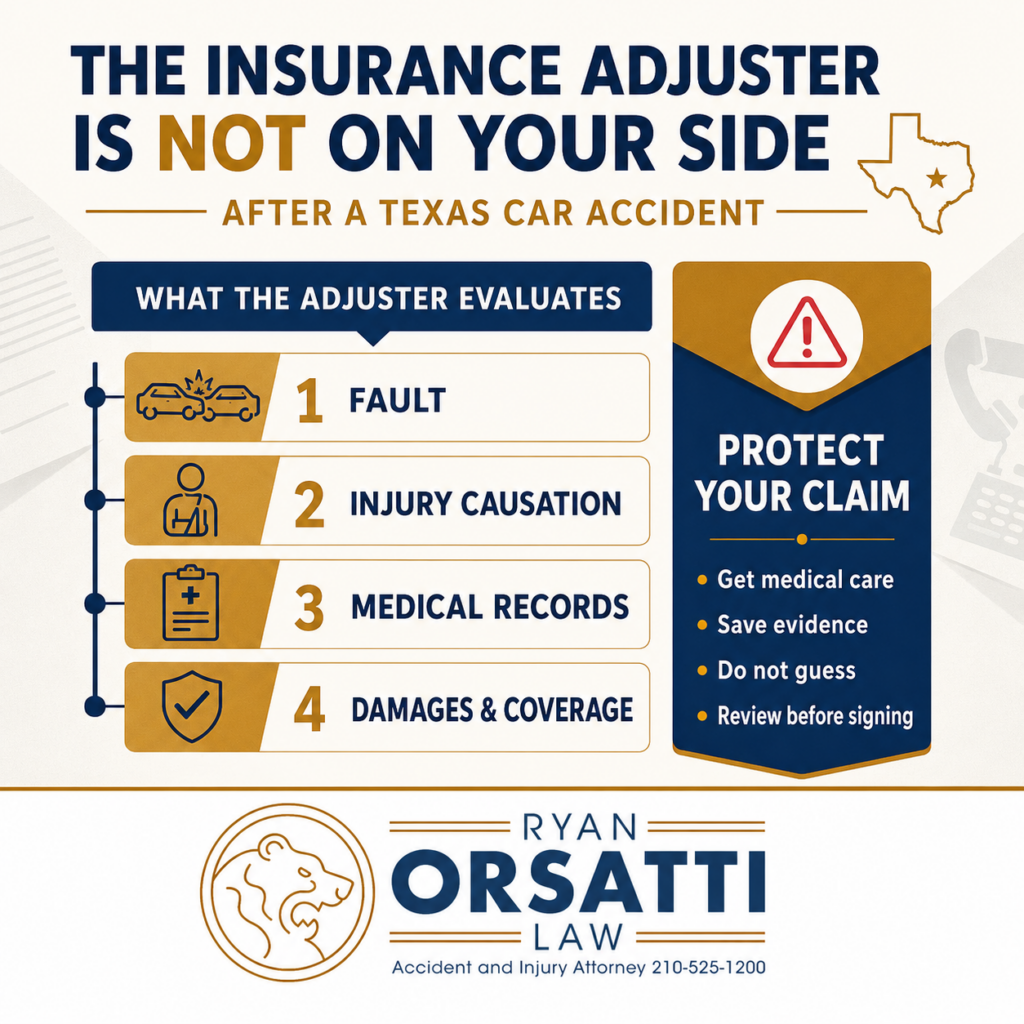
- Adjusters evaluate fault, medical causation, damages, coverage, and your credibility.
- Your words can be compared with crash reports, medical records, photographs, and later testimony.
- Texas proportionate responsibility rules make even small statements about fault important.
- Signing an injury release can permanently end the claims covered by the release.
- Your own insurer is different, but it is still not your personal legal adviser.
Why Is the Insurance Adjuster Not on Your Side?
The insurance adjuster is not on your side because the adjuster’s role is to investigate the claim for the insurance company. According to the Texas Office of Public Insurance Counsel, a claims adjuster determines what the policy covers, whether liability exists, and how much is owed.
That does not mean every adjuster is dishonest or hostile. Many adjusters are professional and courteous. Their tone, however, does not change their role.
In a third-party claim, which means a claim against someone else’s insurance policy, the adjuster may investigate whether the insurer can:
- Deny that its driver caused the crash
- Assign part of the fault to you
- Dispute whether the crash caused your injuries
- Attribute symptoms to a prior medical condition
- Question the necessity or cost of treatment
- Challenge claimed lost income
- Limit payment to the available policy coverage
- Obtain a complete release of the claim
This distinction matters in Texas, where insurance questions arise in thousands of injury claims each year. TxDOT reported that 251,977 people were injured in Texas motor vehicle crashes during 2024. Each injured person must still prove the specific fault, causation, and damages involved in that person’s claim.
What Is the Adjuster Actually Evaluating?
The adjuster is evaluating whether the insurer owes anything, how much exposure the claim presents, and what evidence supports or weakens each side. The adjuster is not simply collecting paperwork or helping you submit medical bills.
| What the adjuster evaluates | What it means | How it may affect the claim |
|---|---|---|
| Liability | Who caused the collision | The insurer may accept, dispute, or deny fault |
| Comparative responsibility | Whether you share responsibility | Your recovery may be reduced or barred |
| Causation | Whether the crash caused the injury | Prior symptoms, delayed care, or later events may be examined |
| Damages | Medical expenses, lost income, pain, impairment, and future needs | Documentation affects what losses can be proved |
| Coverage | Whether a policy applies and its limits | Available coverage may restrict what the insurer can pay |
| Credibility | Whether your statements remain consistent | Contradictions may be used during negotiation or litigation |
Key takeaway: Every conversation and document can become part of the insurer’s evaluation of fault, injuries, and damages, so accuracy matters more than speed.
A serious claim may involve much more than a police report and medical bills. Photographs, witness accounts, vehicle data, phone records, employment documentation, prior medical records, and treatment recommendations may all affect the evaluation. Ryan Orsatti Law’s guide to evidence in a Texas car accident case explains what should be preserved.
Attorney Insight: Adjusters frequently compare the first recorded description of the crash with the CR-3 report, vehicle photographs, medical intake forms, and later testimony. A claimant who guesses about speed, distance, symptoms, or prior treatment may create an inconsistency that did not need to exist. “I do not know” is more accurate than an estimate presented as fact.
How Can a Friendly Insurance Call Hurt Your Claim?
A friendly insurance call can hurt your claim if you treat it as an informal conversation instead of part of an investigation. The adjuster may document what you say about fault, pain, medical history, work, prior injuries, or activities after the crash.
The adjuster may ask questions such as:
- “How fast were you going?”
- “Why did you not see the other vehicle?”
- “Did you feel injured at the scene?”
- “Have you ever had neck or back pain before?”
- “Are you already feeling better?”
- “Did anyone tell you that you needed more treatment?”
- “Were you using your phone?”
- “Can we record your version so we can complete our investigation?”
These questions are not automatically improper. The risk comes from answering before you have reviewed the facts or know the full medical picture.
Can a Recorded Statement Be Used Against You?
A recorded statement can be used to dispute fault, injury severity, treatment timing, or credibility. If litigation follows, a claimant’s own statement may qualify as an opposing party’s statement under Texas Rule of Evidence 801(e)(2), although other evidentiary requirements can still apply.
You generally do not have a contractual duty to provide a recorded statement to the other driver’s insurer because you are not its policyholder. The Texas Department of Insurance explains that you do not have a contract with the other driver’s insurance company.
Your own insurer presents a different issue. Your policy may require reasonable cooperation, notice, documents, an examination, or a statement. Do not ignore a request from your insurer, but consider having the policy and request reviewed before providing a detailed recorded account.
Should You Sign the Adjuster’s Medical Authorization?
You should not automatically sign a broad medical authorization presented by the liability adjuster. A broad authorization may permit the insurer to obtain years of records unrelated to the collision and search for prior symptoms it can use in a causation dispute.
Medical causation means proving that the crash caused or aggravated the condition for which you seek damages. Prior conditions do not automatically defeat a claim, but the medical history must be handled accurately. Ask what records the insurer wants, why it wants them, and whether narrower documentation will address the request.
Why Does Texas Fault Law Make Your Words So Important?
Texas fault law makes your words important because your percentage of responsibility can reduce or eliminate a recovery. Under Texas Civil Practice and Remedies Code § 33.001, a claimant may not recover damages if the claimant’s responsibility is greater than 50 percent.
If the claimant is not barred, § 33.012 generally reduces the recoverable damages by the claimant’s percentage of responsibility. This is called proportionate responsibility, meaning the factfinder assigns percentages of fault among the responsible parties.
An adjuster may use an uncertain statement to argue that you:
- Failed to keep a proper lookout
- Drove too fast for the conditions
- Changed lanes unsafely
- Followed too closely
- Failed to brake or take evasive action
- Contributed to an intersection collision
Do not guess about time, speed, distance, traffic-signal phases, or vehicle position. Preserve photographs, dashcam video, witness information, and the crash report instead. Additional mistakes to avoid are addressed in what not to do after a Texas car accident.
Why Are Early Settlement Offers Risky?
Early settlement offers are risky because they may arrive before your diagnosis, future treatment, lost income, and medical-payment obligations are known. An offer cannot be evaluated responsibly without understanding both the amount offered and the rights the proposed release would end.
The Texas Office of Public Insurance Counsel cautions injured claimants to read checks and settlement documents carefully. Its guidance states that once a person signs the injury release, the person will not receive additional money for the released injury claim.
Before signing, determine whether the settlement accounts for:
- Completed and recommended medical care
- Future treatment that can be supported
- Lost wages or reduced earning ability
- Physical pain and limitations
- Health-insurance reimbursement claims
- Hospital liens
- PIP, MedPay, or UM/UIM coverage
- All responsible people or companies
- The precise claims covered by the release
Subrogation means a health insurer may seek repayment from a personal injury recovery. A hospital lien is a legal claim that a qualifying hospital may assert against part of that recovery. These obligations can affect what remains after settlement, as explained in the guide to medical liens and subrogation in Texas.
Is Your Own Insurance Adjuster on Your Side?
Your own insurance adjuster handles a first-party claim under your contract, but the adjuster is still not your personal advocate or legal adviser. Your insurer must evaluate coverage under the policy, and disagreements can arise over PIP, MedPay, collision, uninsured motorist, or underinsured motorist benefits.
The relationship is different because you have a contract with your insurer. That contract may require prompt notice and cooperation, while Texas law may impose claim-handling obligations. The Texas Department of Insurance’s auto insurance guide describes deadlines that may apply after an insurer receives the information needed for a first-party claim.
TDI also notes that Texas prompt-payment requirements do not apply when another driver’s insurer is paying a third-party claim. Do not assume that deadlines governing your own carrier apply in exactly the same way to the liability carrier.
What Should You Say When the Adjuster Calls?
You should provide basic identifying and claim information without guessing, minimizing symptoms, admitting fault, or agreeing immediately to a recorded statement. Ask the adjuster to send substantive requests in writing.
A practical response may be:
“I am reporting the claim, but I am not prepared to give a recorded statement today. I am still evaluating my injuries and gathering the records. Please send your questions and any documents you want me to sign in writing.”
If it is your own insurer, avoid a flat refusal that could create a cooperation dispute. Tell the adjuster you want to review the request and your policy before scheduling a statement.
What Should You Do After an Adjuster Contacts You?
You should preserve the claim file, document your injuries, and control what information is provided before making irreversible decisions. Use this checklist:
- Write down the adjuster’s name, company, phone number, email, claim number, and insured’s name.
- Ask whether the call is being recorded.
- Do not guess about fault, speed, distance, symptoms, or future medical needs.
- Request that all document and authorization requests be sent in writing.
- Save photographs, dashcam video, witness information, the CR-3 report, medical paperwork, bills, prescriptions, and work notes.
- Follow reasonable medical advice and accurately report all symptoms and prior conditions.
- Do not sign a medical authorization, settlement release, or check containing release language without reviewing its scope.
- Keep a communication log showing every call, email, letter, request, and response.
- Review all possible coverage, including liability, PIP, MedPay, collision, and UM/UIM.
- Speak with a Texas personal injury attorney if you were injured, fault is disputed, or a settlement or recorded statement has been requested.
How Long Do You Have to Protect a Texas Injury Claim?
Texas generally gives an injured person two years from the date the claim accrues to file a personal injury lawsuit under Texas Civil Practice and Remedies Code § 16.003. Exceptions may change the deadline, and claims involving governmental entities may have much earlier notice requirements.
The limitations period does not require an insurer to preserve video, vehicle data, or other evidence until the last day. Evidence can disappear within days or weeks. An adjuster’s ongoing negotiations also do not necessarily extend the filing deadline. The broader claim timeline is discussed in how long a Texas car accident case may take.
When Should You Contact a Texas Personal Injury Lawyer?
You should consider contacting a Texas personal injury lawyer when the crash caused injuries, medical treatment, missed work, disputed fault, significant property damage, or questions about coverage. Legal review is especially useful before a recorded statement, medical authorization, settlement, or release.
Ryan Orsatti Law helps injured people in San Antonio and across Texas investigate fault, preserve evidence, review insurance coverage, organize medical proof, address liens, communicate with adjusters, and evaluate settlement timing. The firm handles claims arising from crashes on San Antonio roads such as I-10, I-35, Loop 410, Loop 1604, and US-281, as well as claims elsewhere in Texas.
Representation does not guarantee a particular result. It gives the injured person an advocate whose role is different from the adjuster’s role. Learn more about working with a San Antonio car accident lawyer.
Frequently Asked Questions
Do I have to talk to the other driver’s insurance adjuster in Texas?
You generally do not have a contractual duty to give the other driver’s insurer a recorded statement because you are not its policyholder. You may report the claim and provide supporting information without agreeing to an immediate interview. If you were injured, consider obtaining legal advice before discussing fault, medical history, symptoms, or settlement.
What if I already gave the insurance adjuster a recorded statement?
Giving a recorded statement does not automatically defeat your claim. Write down what was discussed, request a copy or transcript, and avoid trying to “correct” the statement through repeated calls. Preserve the objective evidence and speak with an attorney about any inaccurate, incomplete, or potentially misleading answers before further communication.
Can the adjuster access all of my medical records?
An adjuster does not automatically have unrestricted access to your medical history. The insurer may request records, bills, or a signed authorization to investigate causation and damages. Review any authorization carefully because its scope may extend far beyond the injuries at issue. Relevant prior conditions should be disclosed accurately, but unrelated access may not be necessary.
Should I accept an insurance offer if it covers my current medical bills?
An offer covering current bills may still omit future treatment, lost income, pain, impairment, liens, subrogation, or additional coverage. The release matters as much as the dollar amount because it may permanently end the injury claim. Do not evaluate an offer until the medical and insurance picture is sufficiently clear.
Can the insurance adjuster blame me even if the police report favors me?
Yes. A police report is useful evidence, but the insurance company may conduct its own investigation and dispute the officer’s conclusions. Texas proportionate responsibility rules allow the defense to argue that you share fault. Photographs, video, witness testimony, vehicle damage, electronic data, and sworn testimony may become important if liability is contested.
Is my own insurance company required to treat me differently?
Your own insurer has contractual obligations under your policy and may be subject to Texas claim-handling requirements. You also may have duties to provide notice and cooperate. However, your insurer still evaluates whether the claimed loss is covered and what it owes. Review the policy before refusing a statement, examination, document request, or other cooperation demand.
Can an adjuster make me settle before the two-year deadline?
An adjuster cannot force you to accept a voluntary settlement, but the insurer may set deadlines for responding to a particular offer. Texas generally provides two years to file many personal injury lawsuits, subject to exceptions. Negotiations do not necessarily pause that limitations period, so track the legal deadline independently from the insurer’s offer dates.
Ryan Orsatti Law
4634 De Zavala Rd, San Antonio, TX 78249
Phone: 210-525-1200
ryanorsattilaw.com
This blog is for informational purposes only, not legal advice. Reading it does not create an attorney-client relationship. Past results do not guarantee future results.
Hurt in an accident in San Antonio? Learn how a San Antonio car accident lawyer can help with your claim. Call 210-525-1200 or request a free consultation.
The firm works on a contingency fee. You pay nothing unless the firm recovers money for you, and that covers case expenses as well as the fee: if there is no recovery, you owe no attorney's fee and no case expenses. Ask for the fee agreement and read the fee and expense section before you sign anything.
Related San Antonio legal resources
Primary legal and public-data sources
- TxDOT: Texas crash reports, data, and statistics
- Texas Civil Practice and Remedies Code Chapter 33: proportionate responsibility
Ryan Orsatti Law
4634 De Zavala Road, San Antonio, TX 78249
General reference links. Consult each source for its current text.