
Quick Answer: A Texas personal injury settlement does not follow one universal rule saying attorney fees or medical liens are always paid first. The settlement normally enters a trust account, then attorney fees, case expenses, and valid third-party claims are calculated under the fee agreement and the law governing each claim. Texas Rule 1.15 requires disputed funds to remain separate while undisputed funds are distributed. Ryan Orsatti Law helps injured Texans estimate this net recovery before they accept a settlement.
Key Takeaways
- A medical bill, statutory lien, and health-plan subrogation claim are different obligations.
- Hospital liens, Medicare, Medicaid, private insurance, ERISA plans, workers’ compensation, and letters of protection follow different rules.
- Not every unpaid medical bill creates a lien against settlement proceeds.
- The gross settlement is not the amount the client receives. The relevant number is the estimated net after fees, expenses, and valid claims.
- Valid claims may still be reviewed for unrelated treatment, duplicate charges, statutory limits, procurement-cost reductions, and negotiated adjustments.
- A lawyer generally must hold genuinely disputed settlement funds in trust while distributing any identifiable undisputed amount.
What Is the Difference Between a Medical Bill, a Lien, and Subrogation?
A medical bill is a debt for treatment, while a lien or reimbursement right may give another party a claim against settlement proceeds. These terms are often used interchangeably, but the legal distinction determines whether money must be protected before the client is paid.
- Medical bill: An amount a provider claims the patient owes for treatment.
- Lien: A legal or contractual claim against a cause of action, settlement, judgment, or specifically identified funds.
- Subrogation: A payor’s right to pursue money associated with benefits it paid because another party caused the injury.
- Reimbursement: A right to be repaid directly from the injured person’s recovery.
- Letter of protection: An agreement under which a provider delays collection in exchange for payment from a future recovery.
An ordinary unpaid bill does not automatically become a lien. The provider may still pursue the patient personally, but a claim against settlement funds generally requires a statute, contract, assignment, judgment, court order, or similar legal basis.
For a closer look at private insurance, see the firm’s guide to health-insurance subrogation in Texas injury claims.
What Gets Paid First From a Texas Personal Injury Settlement?
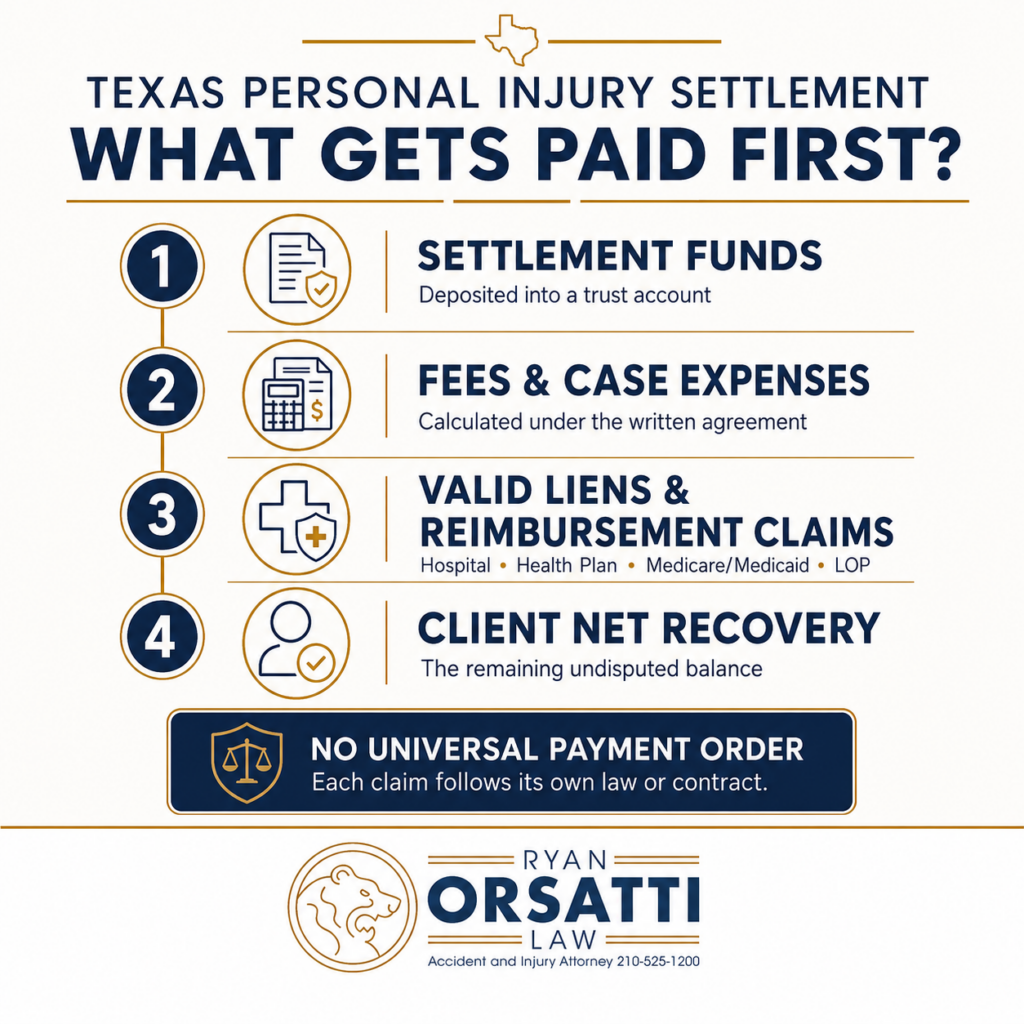
The settlement check is normally deposited into a lawyer’s trust account before anyone receives money. The lawyer then calculates contractual fees and expenses, identifies valid third-party interests, resolves or protects disputed amounts, and distributes the client’s remaining undisputed net recovery.
The following is a typical processing sequence, not a universal legal ranking:
| Settlement stage | What generally happens | Controlling authority |
|---|---|---|
| Settlement funds arrive | The money is deposited into a trust or escrow account | Texas Rule of Professional Conduct 1.15 |
| Fees and expenses are calculated | The written fee agreement determines the attorney fee and how case expenses are handled | Fee agreement and applicable law |
| Third-party claims are audited | Hospital liens, government benefits, health plans, workers’ compensation, and provider agreements are reviewed | Statute, federal law, plan documents, or contract |
| Disputes are addressed | The disputed amount remains protected while unrelated or excessive claims are challenged | Texas Rule 1.15 and governing lien law |
| Client funds are distributed | The client receives the remaining identifiable, undisputed amount with a closing statement | Fee agreement and trust-account rules |
Key takeaway: “What gets paid first” depends on the legal source of each claim, so the safest settlement decision is based on a written net-recovery estimate rather than the gross offer.
The basic calculation is:
Gross settlement − attorney fee − case expenses − valid lien, reimbursement, and protected provider payments = estimated client net
The written fee agreement matters because it should explain the percentage charged, whether expenses are deducted before or after the fee, and how other deductions are handled. The firm’s Texas contingency-fee guide explains the distinction between fees, expenses, and medical obligations.
Which Claims Can Affect a Texas Personal Injury Settlement?
The most common claims come from hospitals, health plans, government programs, workers’ compensation carriers, and providers who treated under payment-protection agreements. Each claimant must establish both the existence and amount of its right to payment.
| Claimant | Possible basis for payment | What should be verified |
|---|---|---|
| Hospital | Texas Property Code Chapter 55 lien | Treatment timing, filing, notice, covered charges, and statutory cap |
| Private health insurer | Contract and Texas CPRC Chapter 140 | Plan type, related payments, plan language, and statutory reductions |
| Self-funded ERISA plan | Federal law and plan documents | Funding status, governing plan terms, payments, and enforceable reimbursement language |
| Original Medicare | Medicare Secondary Payer law | Conditional-payment ledger, relatedness, procurement costs, and final demand |
| Texas Medicaid | State and federal third-party recovery law | Accident-related Medicaid payments and final recovery amount |
| Workers’ compensation carrier | Texas Labor Code Chapter 417 | Benefits paid, statutory priority, fees, expenses, and future credit |
| Medical provider | Letter of protection, assignment, contract, or judgment | Signed document, balance, billing history, relatedness, and agreed reduction |
Key takeaway: The name printed on a demand letter does not decide priority or amount. The governing statute, plan, contract, and payment ledger must be reviewed.
How Do Texas Hospital Liens Work?
A Texas hospital lien may attach when an injured person receives hospital treatment within 72 hours after an accident attributed to another person’s negligence. Under Texas Property Code §§ 55.0015 and 55.002, “admission” includes being allowed access to any hospital department for treatment, so formal inpatient admission is not required.
To secure the lien, the hospital generally must file written notice with the county clerk where services were provided before settlement money is paid and provide the required notice to the injured person. A valid lien can reach the third-party injury claim, judgment, or settlement proceeds.
Under Texas Property Code § 55.004, a hospital lien is limited to the lesser of:
- The hospital’s charges for services during the first 100 days of hospitalization;
- Fifty percent of the covered recovery; or
- If the factfinder separately awards hospital charges, that award less the applicable pro rata attorney fees and expenses.
The lien does not cover charges exceeding a reasonable and regular rate. Certain physician charges may be included for emergency hospital care during the first seven days.
Texas also authorizes a limited EMS lien only in counties with populations of 800,000 or less. Because the Census Bureau estimated Bexar County’s 2025 population at 2,160,088, that specific EMS lien provision does not apply in Bexar County. An ambulance provider may still assert a contractual balance or another legally supported claim.
A Chapter 55 hospital lien generally reaches a third-party liability recovery, not the injured person’s own PIP, MedPay, or UM/UIM proceeds. That distinction does not erase the underlying hospital bill.
Does Private Health Insurance Get Paid Back From the Settlement?
Private health insurance may be entitled to reimbursement if the plan contains enforceable language and paid accident-related benefits. The amount depends heavily on whether the plan is fully insured, self-funded under ERISA, governmental, or subject to another statutory framework.
For plans covered by Texas Civil Practice and Remedies Code Chapter 140, § 140.005 limits all payors’ recovery when the injured person has a lawyer. The statutory share is generally the lesser of one-half of the gross recovery or the directly related benefits paid, with attorney fees and procurement costs addressed under § 140.007.
Chapter 140 does not govern Medicare, Medicaid, CHIP, workers’ compensation, or a self-funded plan subject to the Employee Retirement Income Security Act, commonly called ERISA. A self-funded ERISA plan may be governed primarily by federal law and its written plan terms, even when a familiar insurance company administers the claims.
The correct plan documents matter. An insurance card, explanation of benefits, or summary alone may not establish whether an employer plan is self-funded or what reimbursement language controls.
How Are Medicare and Medicaid Repaid?
Original Medicare and Texas Medicaid may recover accident-related medical payments from a personal injury settlement under government recovery systems. Texas Chapter 140 does not control these claims, so they should not be calculated as if they were ordinary private-insurance subrogation demands.
For Original Medicare, the case is reported to the Benefits Coordination & Recovery Center. Medicare identifies conditional payments, allows disputes over unrelated charges, and issues a formal recovery demand after receiving the settlement information. The CMS Medicare recovery process also accounts for qualifying attorney fees and procurement costs.
Medicare recovery is an active national system. CMS reported that more than $1.05 billion was recovered through the Medicare Secondary Payer recovery process from October 2023 through August 2024 in its Fiscal Year 2024 Financial Report.
Texas Medicaid recovery is handled through the state’s third-party recovery process. The Texas Health and Human Services Office of Inspector General explains that its Third Party Recoveries team oversees the tort process through which Medicaid costs may be recovered from insurance settlements.
Medicare Advantage and Medicaid managed-care plans may involve different administrators and procedures. The claimant should obtain a final written amount from the correct entity rather than assuming a preliminary ledger is complete.
Do Letters of Protection Have to Be Paid From the Settlement?
A signed letter of protection may require the lawyer to protect a medical provider’s claimed interest in settlement funds. It is a contractual arrangement, not health insurance, and it is not automatically the same as a statutory hospital lien.
Before paying an LOP balance, the underlying documents and billing should be reviewed for:
- A valid signed agreement or assignment;
- The treatment connected to the accident;
- An accurate itemized balance;
- Duplicate or previously paid charges;
- Available insurance adjustments;
- Reasonable reductions; and
- A written zero-balance confirmation after payment.
Texas Civil Practice and Remedies Code Chapter 146 also affects some billing disputes. A provider that violates applicable timely-billing requirements may be barred from recovering amounts that proper billing would have covered. However, a provider treating a represented personal injury patient may satisfy part of the statute by timely submitting the bill to the patient’s attorney unless directed otherwise. Failure to bill health insurance does not automatically eliminate every provider balance.
For more information about paying treatment expenses during a claim, read who pays medical bills after a Texas car accident.
Can Medical Liens and Subrogation Claims Be Reduced?
Medical liens and reimbursement claims can sometimes be reduced, but a reduction is not automatic. The first step is determining what the claimant is legally entitled to receive before asking it to accept less.
A lien audit should examine:
- Whether the claimant has a valid legal interest in the settlement;
- Whether a hospital lien was properly filed and noticed;
- Whether the charges involve the same accident;
- Whether unrelated, duplicate, or later treatment was included;
- Whether the ledger reflects payments, adjustments, or credits;
- Whether statutory caps apply;
- Whether the health plan is fully insured or self-funded;
- Whether attorney-fee or procurement-cost reductions apply;
- Whether provider charges exceed the applicable reasonable and regular rate; and
- Whether a negotiated reduction is justified by disputed fault, limited coverage, or other case-specific facts.
Attorney Insight: A lien demand should not be treated as a final number merely because it appears on official letterhead. In practice, the most productive review often compares the demand against the actual payment ledger, dates of service, accident diagnoses, plan funding documents, county filing, and available insurance. Errors found after the release is signed are harder to use during settlement planning.
What Should Be Done Before Accepting a Texas Personal Injury Settlement?
Before accepting a settlement, the injured person should request a written estimate showing how fees, expenses, and known third-party claims affect the expected net. Final payoff amounts may not always be available, but significant uncertainty should be identified before the release is signed.
- List every medical provider that treated the injury.
- Collect bills, explanations of benefits, and payment ledgers.
- Identify every health plan that paid benefits.
- Confirm whether the person had Original Medicare, Medicare Advantage, Medicaid, or workers’ compensation.
- Determine whether an employer plan is fully insured or self-funded.
- Search for hospital liens in the county where hospital services were provided.
- Collect every letter of protection, assignment, or payment agreement.
- Remove unrelated and duplicate charges from reimbursement ledgers.
- Apply statutory caps, plan terms, and available fee or cost reductions.
- Prepare a written settlement-distribution estimate before accepting the offer.
If liability coverage is too small to address the injuries and medical obligations, additional coverage should be investigated. The firm’s Texas underinsured-driver guide explains possible UM/UIM, PIP, MedPay, and other insurance sources.
How Long Does Lien Resolution Take After Settlement?
Lien resolution has no single Texas-wide timeline because each claimant follows a different process. A simple provider balance may be confirmed quickly, while Medicare, Medicaid, ERISA, workers’ compensation, or disputed hospital charges may require additional records and formal review.
CMS advises allowing 45 calendar days for its ordinary conditional-payment dispute review. Its optional Final Conditional Payment process can address properly submitted claim disputes within 11 business days, but the process has strict timing requirements and can only be initiated once per case.
Under current Texas Rule of Professional Conduct 1.15, the disputed portion must remain separate until the dispute is resolved, while the undisputed portion should be distributed appropriately. That can permit a partial distribution when the genuinely disputed amount can be isolated.
How Can Ryan Orsatti Law Help With Settlement Liens and Subrogation?
Ryan Orsatti Law helps injured people in San Antonio, Bexar County, and across Texas identify third-party claims, review lien validity, audit accident-related charges, evaluate insurance-plan documents, and calculate projected net recovery. The firm can also seek supported reductions and obtain written payoff or release documentation before funds are disbursed.
This review is particularly valuable when medical charges approach the available policy limits, multiple health plans paid benefits, Medicare or Medicaid is involved, or providers treated under letters of protection. To discuss a specific claim, contact Ryan Orsatti Law.
Frequently Asked Questions
Can a Texas hospital take my entire personal injury settlement?
A Texas hospital lien is generally capped by Texas Property Code § 55.004 and cannot simply consume the entire recovery without analysis. The statutory lien is limited to the lesser of specified hospital charges, 50 percent of the covered recovery, or a separately specified award in applicable cases. Other valid claims may still reduce the remaining net.
Does my health insurance always get paid back after a Texas settlement?
Health insurance does not automatically receive every amount it demands. Repayment depends on the plan’s reimbursement language, payments connected to the accident, plan funding status, Texas Chapter 140, ERISA, and other governing law. The claimant should request the plan documents and itemized payment ledger before the demand is accepted as accurate.
Is every unpaid medical bill a lien against my settlement?
No. An unpaid medical bill is not automatically a lien against settlement proceeds. A provider generally needs a statutory lien, signed letter of protection, assignment, judgment, court order, or another enforceable interest in the funds. The patient may still owe an ordinary bill even when the provider has no direct claim against the settlement.
Can I receive part of my settlement while a lien is disputed?
Possibly. Texas Rule of Professional Conduct 1.15 says the disputed portion of funds must remain separate until the dispute is resolved, while the undisputed portion should be distributed appropriately. A partial distribution depends on whether the attorney can reliably identify the disputed amount without risking underpayment of a valid third-party claim.
How long does it take to resolve a Medicare lien after settlement?
The timeline depends on when Medicare was notified, whether the conditional-payment ledger is accurate, and whether charges are disputed. CMS advises allowing 45 calendar days for ordinary dispute review. The Final Conditional Payment process offers faster review for qualifying cases, but it has strict deadlines before and immediately after settlement.
Can a lawyer negotiate medical liens after a Texas accident?
A lawyer may seek reductions when supported by the law and facts, but no reduction is guaranteed. Useful grounds can include invalid filing, unrelated care, duplicate charges, statutory caps, limited coverage, billing errors, plan-based fee reductions, and negotiated compromise. The final agreement should be documented in writing before settlement funds are released.
Should I accept a settlement based only on the gross amount?
No. A settlement should be evaluated using the estimated client net after attorney fees, case expenses, hospital liens, insurance reimbursement, government claims, and protected provider balances. Two identical gross offers can produce very different client distributions depending on plan type, lien validity, available reductions, and unpaid medical obligations.
Ryan Orsatti Law
4634 De Zavala Rd, San Antonio, TX 78249
Phone: 210-525-1200
ryanorsattilaw.com
This blog is for informational purposes only, not legal advice. Reading it does not create an attorney-client relationship. Past results do not guarantee future results.
Hurt in an accident in San Antonio? Learn how a San Antonio traumatic brain injury lawyer can help with your claim. Call 210-525-1200 or request a free consultation.
The firm works on a contingency fee. You pay nothing unless the firm recovers money for you, and that covers case expenses as well as the fee: if there is no recovery, you owe no attorney's fee and no case expenses. Ask for the fee agreement and read the fee and expense section before you sign anything.
Related San Antonio legal resources
Primary legal and public-data sources
Ryan Orsatti Law
4634 De Zavala Road, San Antonio, TX 78249
General reference links. Consult each source for its current text.