
Quick Answer
Fault in a Texas car accident is determined by identifying whose negligent conduct caused the collision and assigning each responsible person a percentage of responsibility. Insurance adjusters make initial liability decisions, but a judge or jury can ultimately allocate fault under Texas Civil Practice and Remedies Code Chapter 33. A claimant may recover if the claimant is 50% or less responsible, but the recovery is reduced by that percentage.
Ryan Orsatti Law helps injured people in San Antonio and across Texas evaluate disputed fault, preserve crash evidence, identify available insurance coverage, and understand how an assigned percentage could affect an injury claim.
Key Takeaways
- A police officer’s crash report can influence the claim, but it does not make the final legal decision about fault.
- Insurance companies conduct their own investigations and may reach different conclusions about the same collision.
- Texas uses proportionate responsibility. Recovery is barred only when the injured claimant is more than 50% responsible.
- Video, physical vehicle damage, independent witnesses, crash-report details, electronic data, and roadway evidence can be more persuasive than competing driver statements.
- A traffic violation may support negligence, but the violation must also be connected to the collision and resulting injuries.
- Evidence can disappear long before the general two-year lawsuit deadline expires.
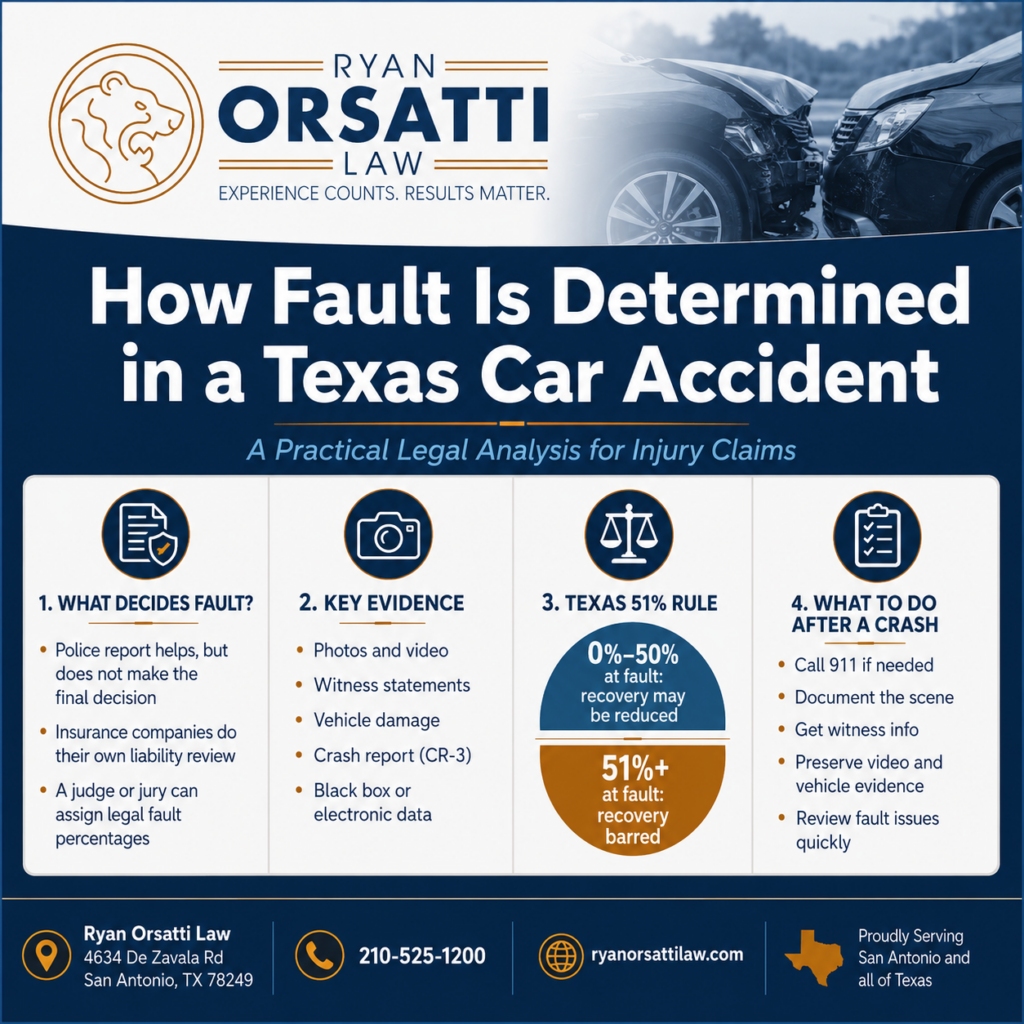
How Is Fault Legally Determined in a Texas Car Accident?
Fault is legally determined by applying Texas negligence and proportionate-responsibility rules to the available evidence. The injured person generally must show that another person owed a legal duty, breached that duty, and proximately caused compensable harm. The fact that a driver received a citation or made a poor decision does not eliminate the need to prove causation.
In practical terms, a Texas car accident claim usually requires proof of four connected points:
- Duty: The other driver had a legal obligation to operate the vehicle with reasonable care and follow applicable traffic laws.
- Breach: The driver failed to meet that obligation by speeding, following too closely, disregarding a signal, making an unsafe lane change, failing to yield, or engaging in other unreasonable conduct.
- Causation: The breach was a substantial factor in producing the collision and injuries.
- Damages: The collision caused identifiable losses, such as medical expenses, lost income, vehicle damage, physical impairment, or pain.
The Texas Supreme Court has emphasized that negligence must be a substantial factor in causing the ultimate harm. Conduct that merely created a background condition, without substantially causing the injury, may not support liability. That distinction becomes important in multi-vehicle crashes and cases involving several contributing events.
Who Actually Decides Who Was at Fault?
No single person automatically controls fault throughout a Texas car accident claim. The investigating officer documents the scene, each insurance company adopts a claim position, the attorneys evaluate the evidence, and a judge or jury may make the binding allocation if the dispute reaches litigation.
| Stage | Who evaluates fault? | Practical effect |
|---|---|---|
| Crash scene | Police officer or other investigating agency | Documents observations, statements, diagrams, citations, and contributing factors |
| Insurance investigation | Adjusters for each applicable insurer | Accepts, denies, or apportions liability for claim-handling purposes |
| Negotiation or mediation | Parties, insurers, and attorneys | Fault percentages may be disputed or negotiated |
| Lawsuit | Judge or jury as the trier of fact | Assigns legally controlling percentages under Chapter 33 |
| Final judgment | Court | Reduces or bars recovery based on the claimant’s percentage |
Key takeaway: An adjuster’s fault percentage is a claim position, not a final court judgment, and it can be challenged with stronger evidence.
Does the Police Officer Decide Fault?
The police officer does not make the final civil liability decision. A Texas Peace Officer’s Crash Report, commonly called a CR-3, may identify contributing factors, display a collision diagram, record statements, and show whether citations were issued. Insurers often use it as a starting point, but the report should be compared with photographs, video, witnesses, vehicle damage, and other evidence.
A report can also contain incomplete information. The officer may arrive after the collision, may not personally observe the impact, and may receive conflicting accounts from the drivers. An officer’s preliminary assessment can be persuasive, but it does not replace the proportionate-responsibility determination required under Texas law.
Ryan Orsatti Law’s guide to using the TxDOT crash code sheet explains how contributing-factor codes, points of impact, vehicle movements, and traffic-control information can be compared with the rest of the evidence.
What Do Insurance Adjusters Decide?
Insurance adjusters decide whether their companies will accept, dispute, or divide responsibility during the claim process. The Texas Department of Insurance warns that another driver’s insurer may deny that its insured was at fault, allege that both drivers contributed, or refuse to pay all claimed losses. TDI recommends requesting the insurer’s reasoning in detail and in writing when a claim is denied or reduced.
Different insurers can assign different percentages because each is protecting a separate financial interest. The injured person’s carrier might treat the other driver as responsible for collision-coverage purposes while the liability carrier disputes the same facts.
What Happens If the Case Goes to Court?
If a Texas car accident lawsuit reaches a fact-finder, the judge or jury can assign whole-number percentages of responsibility to the claimant, defendants, settling persons, and properly designated responsible third parties. The percentages must be supported by evidence showing that each person caused or contributed to the harm.
That means a jury could find one driver 100% responsible, divide responsibility between two drivers, or allocate fault among several drivers and other responsible parties.
What Evidence Is Most Important for Proving Fault?
The strongest evidence usually shows vehicle movement, timing, speed, visibility, right-of-way, and the sequence of impacts without depending solely on either driver’s memory. Video and physical evidence are often particularly valuable because they can confirm or contradict statements made after the collision.
TxDOT reported that distracted driving was responsible for 86,384 Texas crashes in 2025, resulting in more than 2,437 serious injuries and 299 deaths. In a disputed case, phone activity, witness observations, video, and vehicle data may help determine whether inattention contributed to the crash.
| Evidence | What it may establish | Common limitation |
| Dashcam, traffic-camera, or business video | Signal color, lane position, speed, braking, visibility, and impact sequence | May be overwritten within days or weeks |
| Vehicle damage and photographs | Impact angle, point of contact, direction of force, and consistency with driver accounts | Repairs or disposal can destroy evidence |
| CR-3 crash report | Driver information, diagram, contributing factors, citations, witnesses, and officer observations | Officer may not have witnessed the collision |
| Independent witnesses | What happened before and during impact | Contact information can be lost, and memory fades |
| 911 calls and dispatch records | Timing, immediate statements, reported hazards, and witness identities | May require a separate records request |
| Cellphone or electronic records | Possible calling, texting, navigation, or other activity | Usually requires consent, legal process, or narrowly tailored discovery |
| Vehicle event data | Speed, braking, throttle, steering, or restraint information, depending on the vehicle | Data availability varies by vehicle and may be overwritten |
| Roadway and signal records | Signal timing, construction configuration, lane controls, or visibility conditions | Different agencies may maintain different records |
| Medical records | Whether the collision caused or aggravated the claimed injuries | Do not independently establish who caused the crash |
Key takeaway: The most persuasive fault analysis combines independent evidence with physical facts, rather than relying on one driver’s account or one line in the police report.
For a fuller preservation list, review what evidence can help a Texas car accident case.
Attorney Insight
Adjusters often make an early liability decision before all available evidence has been collected. A clear photograph of lane positions, a neutral witness, a few seconds of business-surveillance video, or properly interpreted vehicle damage can change the analysis. The practical mistake is waiting for the insurer to gather evidence that may favor the injured person.
How Does Texas’s 51% Rule Affect an Injury Claim?
Texas permits an injured claimant to recover when the claimant is 50% or less responsible, but the recoverable damages are reduced by the claimant’s percentage. If the claimant is found more than 50% responsible, Texas Civil Practice and Remedies Code § 33.001 bars recovery from the other responsible parties.
This system is called proportionate responsibility, meaning responsibility and damages are allocated by percentage.
Assume the fact-finder determines that the claimant sustained $100,000 in damages:
| Claimant’s responsibility | Effect under Texas law | Potential recovery before other lawful adjustments |
| 0% | No reduction for claimant responsibility | $100,000 |
| 20% | Recovery reduced by 20% | $80,000 |
| 50% | Recovery reduced by 50% | $50,000 |
| 51% | Recovery barred | $0 |
| 75% | Recovery barred | $0 |
Key takeaway: A small change in the assigned percentage can produce a major difference, especially when the dispute is near the 50% threshold.
Can More Than One Driver Be Responsible?
Yes. Texas law allows responsibility to be divided among multiple people whose conduct caused or contributed to the harm. In a chain-reaction collision, one driver might cause the first impact, another might be following too closely, and a third might make an unsafe evasive movement.
A driver is not assigned responsibility merely because the driver was involved. There must be sufficient evidence connecting that driver’s conduct to the harm being claimed.
How Is Fault Evaluated in Common Texas Crash Scenarios?
Fault is evaluated by comparing each driver’s conduct with Texas traffic laws and then deciding whether any violation or unreasonable act caused the collision. Common crash patterns can suggest where the investigation should begin, but no crash type creates an automatic result in every case.
Is the Rear Driver Always at Fault in a Rear-End Collision?
The rear driver is not automatically at fault, but Texas law requires a following driver to maintain an assured clear distance that permits the vehicle to stop safely under the existing speed, traffic, and highway conditions. Rear-end damage, braking evidence, video, and the reason the front vehicle slowed or stopped all matter.
The lead driver’s conduct may also require investigation. Relevant issues can include an unsafe lane entry, nonfunctioning lights, an unnecessary sudden stop, or another maneuver that contributed to the impact.
Who Is Usually Responsible in a Left-Turn Collision?
A driver turning left must yield to an approaching vehicle that is already in the intersection or close enough to create an immediate hazard under Texas Transportation Code § 545.152. That rule often focuses the investigation on the turning driver, but the oncoming driver’s speed, signal compliance, visibility, and lane position can still affect the allocation.
For example, a turning driver may fail to yield, while the oncoming driver may also contribute by substantially exceeding a safe speed. The evidence must show how each act affected the collision.
How Is Fault Determined in an Unsafe Lane-Change Crash?
A lane-change dispute turns on whether the moving vehicle remained within its lane and whether the movement could be made safely. Texas Transportation Code § 545.060 requires a driver on a marked roadway to remain as nearly as practical within a single lane and not leave that lane unless the movement can be made safely.
Side-scrape patterns, mirror damage, wheel direction, turn-signal use, dashcam footage, and the vehicles’ resting positions can help identify which vehicle moved into the other’s path.
What Proves Fault in a Red-Light Collision?
A red-light collision is best evaluated using video, signal-sequence information, independent witnesses, vehicle speed, and the timing of each vehicle’s entry into the intersection. Texas Transportation Code § 544.007 defines the conduct required by red, yellow, green, and arrow signals, but the disputed factual question is usually which signal controlled each driver at the relevant moment.
A citation can support the investigation, but neutral evidence is often more persuasive when both drivers insist they had the green light.
How Is Fault Divided in a Multi-Vehicle Crash?
Fault in a multi-vehicle crash depends heavily on the order of impacts and whether each driver had a reasonable opportunity to avoid adding to the collision. The first impact does not necessarily explain every later impact, and the driver who started the chain may not be the only responsible person.
Investigators commonly compare the CR-3 sequence of events, damage locations, witness accounts, roadway debris, vehicle data, and the final resting positions of all vehicles.
What Should You Do to Protect the Fault Evidence?
Protect the evidence immediately, because video, electronic data, roadway marks, damaged vehicles, and witness recollections can disappear well before an insurance dispute is resolved. The first hours and days are often more important to the liability investigation than the months that follow.
- Call 911 when the collision involves injuries, an unsafe roadway condition, or a vehicle that cannot be driven safely.
- Photograph all vehicles from multiple angles. Include plates, impact areas, debris, skid marks, lanes, signals, signs, lighting, weather, and sight obstructions.
- Record the exact location and direction of travel. Identify the road, cross street, lane, and nearby businesses.
- Collect independent witness information. Obtain names, telephone numbers, email addresses, and a brief description of what each person observed.
- Save digital evidence. Download dashcam footage and ask nearby businesses or property owners to preserve relevant video.
- Avoid guessing about speed, distance, or fault. Provide truthful facts, but do not adopt an explanation when you do not know what happened.
- Obtain the CR-3 and supporting agency records. The crash report may take time to appear, so do not delay other preservation efforts while waiting.
- Keep the damaged vehicle available when fault is seriously disputed. Repairs, salvage, or disposal can remove useful physical or electronic evidence.
- Ask for an adverse insurer’s liability decision in writing. Request the facts and evidence supporting any denial or shared-fault percentage.
- Get legal advice before critical evidence disappears. This is particularly important in serious-injury, commercial-vehicle, rideshare, government-vehicle, or multi-vehicle cases.
Ryan Orsatti Law’s first 24 hours after a San Antonio car accident checklist provides additional steps for crashes on I-10, I-35, Loop 410, Loop 1604, US-281, and other Bexar County roads.
What Should You Do If the Insurance Company Assigns You Fault?
Ask the insurance company to identify its reasoning and evidence in writing, then compare that position with the physical evidence, traffic law, video, witnesses, and crash report. A liability decision based only on the insured driver’s statement or an incomplete report may be challenged by supplying additional reliable evidence.
Practical next steps include:
- Request the liability decision and assigned percentage in writing.
- Ask which evidence the adjuster relied upon.
- Correct factual errors with documents, photographs, or video.
- Provide independent witness information.
- Review the CR-3 for incorrect vehicle movements, contributing factors, or diagrams.
- Preserve your own vehicle and electronic evidence.
- Notify your own insurer and review collision, personal injury protection, medical payments, and uninsured or underinsured motorist coverage.
- Consider legal review before accepting a reduced settlement or signing a release.
TDI advises that another driver’s insurer may deny responsibility, allege shared responsibility, or claim insufficient coverage. TDI also explains that collision and uninsured or underinsured motorist coverage may provide another claim path, depending on the policy.
How Long Do You Have to File a Texas Car Accident Lawsuit?
Texas Civil Practice and Remedies Code § 16.003 generally requires a personal injury lawsuit to be filed no later than two years after the claim accrues. That deadline is not an evidence-preservation period, and waiting close to two years can make a disputed-fault case substantially harder to investigate.
Video may be overwritten, vehicles may be repaired or destroyed, witnesses may become unavailable, and electronic information may no longer exist. Certain claims, parties, or circumstances can also involve different rules, so the specific deadline should be reviewed rather than assumed.
For information about obtaining the investigating officer’s report, see how long a Texas police report may take to become available.
When Does Legal Help Matter in a Fault Dispute?
Legal help becomes especially important when the insurer denies responsibility, assigns substantial fault to the injured person, or relies on an incomplete version of events. It can also matter when the crash involves serious injuries, multiple vehicles, commercial vehicles, disputed traffic signals, unavailable witnesses, electronic evidence, or inadequate liability coverage.
A Texas personal injury lawyer can evaluate the traffic rules, obtain records, issue preservation requests, locate witnesses, inspect vehicles, analyze insurance policies, and present a supported liability position. Ryan Orsatti Law assists injured people in San Antonio and across Texas with these issues through a client-centered model that emphasizes direct attorney involvement and personalized service.
Additional information about the firm’s approach to motor-vehicle claims is available in the San Antonio car accident lawyer guide.
Frequently Asked Questions About Texas Car Accident Fault
Does the Texas police report determine who is at fault?
No. A Texas CR-3 crash report can influence an insurance investigation because it may contain a diagram, contributing factors, citations, witness information, and officer observations. It does not automatically create a binding civil fault determination. Insurers conduct their own reviews, and a judge or jury may ultimately assign percentages under Texas Civil Practice and Remedies Code Chapter 33.
Can I recover damages if I was partly at fault in Texas?
Yes, provided your percentage of responsibility is not greater than 50%. Texas reduces the recoverable damages by the claimant’s percentage. A claimant found 20% responsible would generally face a 20% reduction, while a claimant found 51% responsible would be barred from recovery under Texas Civil Practice and Remedies Code § 33.001.
Who pays when both drivers are at fault?
Each driver’s legal responsibility depends on the percentages assigned and the available claims and insurance coverage. An injured claimant who is 50% or less responsible may pursue recovery, subject to a reduction equal to that percentage. The actual payment analysis can also depend on the defendants, policy limits, settlements, and other applicable provisions of Chapter 33.
Is the rear driver always responsible for a rear-end crash in Texas?
No. Texas requires a following driver to maintain enough clear distance to stop safely under the existing speed, traffic, and roadway conditions, so the rear driver is often closely examined. Fault can still be shared if evidence shows the front driver made an unsafe maneuver or otherwise substantially contributed to the collision.
What if the other driver’s insurance denies fault?
Request the denial and its factual basis in writing. Then preserve and submit relevant photographs, video, independent witness information, vehicle damage evidence, and the CR-3. You should also notify your own insurer and review collision, personal injury protection, medical payments, and uninsured or underinsured motorist coverage. TDI accepts consumer complaints regarding claim handling.
Can both insurance companies reach different fault decisions?
Yes. Each insurance company performs its own investigation and protects its own contractual and financial interests. One carrier may accept that its insured caused the collision while another disputes the percentage or the amount of damage. Those claim positions can be negotiated and challenged, and they do not replace a binding allocation made by a judge or jury.
How long do I have to sue after a Texas car accident?
The general Texas limitations period for a personal injury lawsuit is two years from the date the cause of action accrues. Evidence-preservation deadlines are often much shorter in practice because video, vehicle data, physical damage, and witness recollections may disappear. The exact deadline should be evaluated promptly because exceptions and claim-specific rules may apply.
Ryan Orsatti Law
4634 De Zavala Rd, San Antonio, TX 78249
Phone: 210-525-1200
ryanorsattilaw.com
This blog is for informational purposes only, not legal advice. Reading it does not create an attorney-client relationship. Past results do not guarantee future results.
Hurt in an accident in San Antonio? Learn how a San Antonio car accident lawyer can help with your claim. Call 210-525-1200 or request a free consultation.
The firm works on a contingency fee. You pay nothing unless the firm recovers money for you, and that covers case expenses as well as the fee: if there is no recovery, you owe no attorney's fee and no case expenses. Ask for the fee agreement and read the fee and expense section before you sign anything.
Related San Antonio legal resources
Primary legal and public-data sources
- TxDOT: Texas crash reports, data, and statistics
- Texas Civil Practice and Remedies Code Chapter 33: proportionate responsibility
Ryan Orsatti Law
4634 De Zavala Road, San Antonio, TX 78249
General reference links. Consult each source for its current text.