
Quick Answer
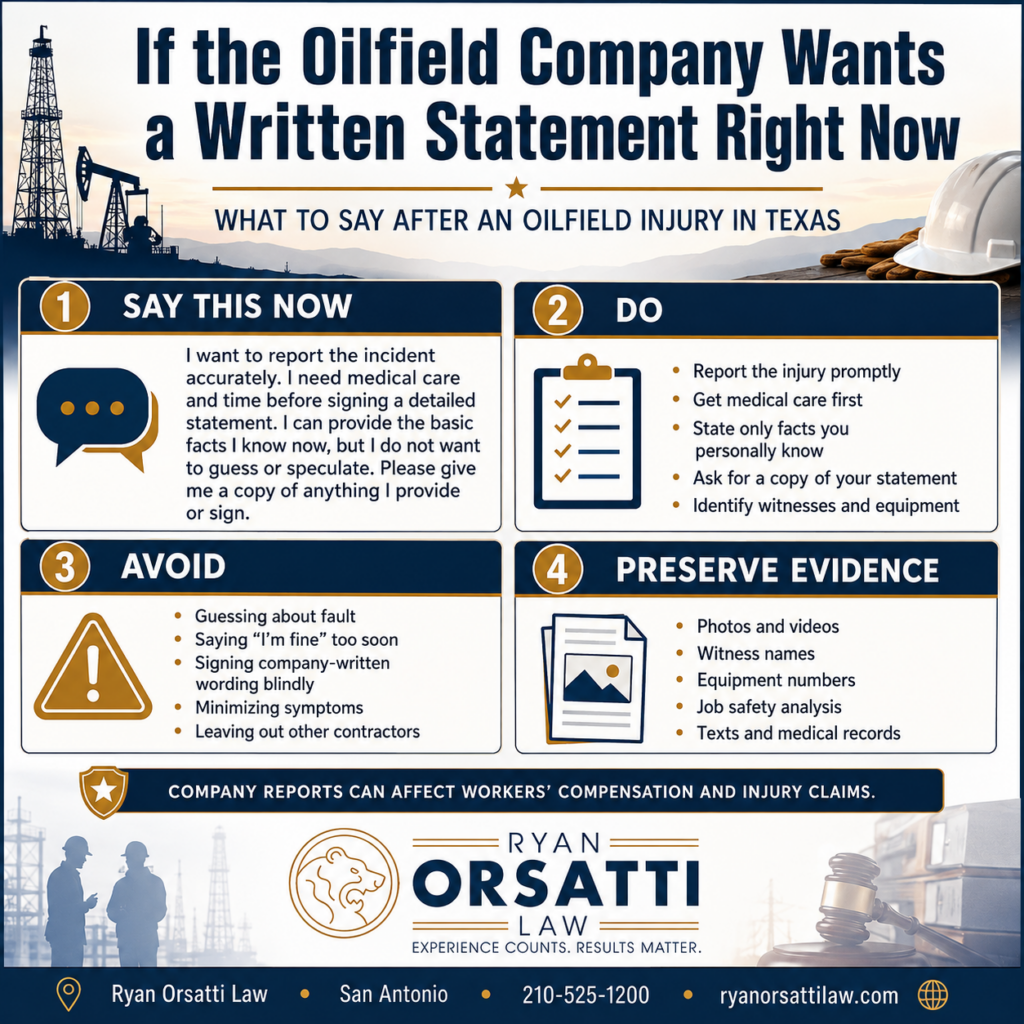
Tell the safety coordinator that you will report the incident accurately, but you need medical care and time to avoid guessing or leaving out important facts. Provide basic information about when, where, and how you were injured, but do not speculate about fault, sign an incomplete statement, or say you are uninjured before you understand your condition.
A written statement may later be reviewed by company management, insurers, OSHA, workers’ compensation personnel, and attorneys. Ryan Orsatti Law helps injured oilfield workers in San Antonio, the Eagle Ford Shale, and across Texas evaluate these requests before an avoidable wording mistake affects a claim.
Key Takeaways
- Report the injury promptly, but do not let anyone pressure you into guessing.
- Medical care takes priority over a detailed company interview.
- Describe only what you personally saw, heard, felt, and did.
- Do not sign language written or edited by someone else unless every sentence is accurate.
- Ask who the safety coordinator represents and request a copy of everything you provide.
- A company incident report is not necessarily the same as filing a Texas workers’ compensation claim.
Why Does the Oilfield Company Want a Written Statement Immediately?
The company may need basic information quickly for legitimate safety, insurance, and regulatory purposes, but its urgency does not make an inaccurate statement acceptable. OSHA requires employers to report a workplace fatality within eight hours and certain inpatient hospitalizations, amputations, and eye losses within 24 hours. Those deadlines apply to the employer, not to an injured worker’s obligation to provide a rushed fault analysis.
Oilfield companies also use statements to:
- Decide whether the event is OSHA-recordable
- Complete an internal incident report
- Notify a workers’ compensation carrier
- Identify equipment or procedures involved
- Determine whether work should stop
- Prepare for claims, regulatory inquiries, or litigation
- Evaluate whether the worker violated a company policy
The safety investigation may serve more than one purpose. The coordinator may be gathering facts to prevent another injury, but the same document may later be reviewed by risk management, an insurance carrier, or defense counsel.
The risk is not theoretical. The U.S. Bureau of Labor Statistics counted 65 fatal occupational injuries during 2024 in oil and gas extraction industries, including drilling oil and gas wells and support activities for oil and gas operations.
What Should I Say to the Safety Coordinator Right Now?
You should state clearly that you are reporting the incident and intend to cooperate, but that you will not guess or sign an inaccurate account. A practical response is:
“I want to report the incident accurately and cooperate with the investigation. I am injured and need medical evaluation before I can give a complete statement. I can provide the basic facts I know now, but I do not want to speculate or leave out information. Before I sign a detailed statement, I need time to review it and speak with counsel. Please give me a copy of anything I provide or sign.”
This response does four things:
- Confirms that you are reporting the injury.
- Avoids an unnecessary confrontation with your employer.
- Explains why an immediate detailed statement may be unreliable.
- Preserves your ability to provide a careful supplement later.
Do not falsely claim that you remember nothing. Do not exaggerate your injuries. Do not hide facts that you know are important. The goal is accuracy, not silence.
Should I Refuse to Give Any Statement?
You generally should not refuse to report the incident altogether. Texas workers may need to provide their employer with information about how, where, and when an injury occurred, and failing to report an injury promptly can create separate problems.
Instead, distinguish between basic incident reporting and a detailed liability statement. You can identify the incident, request medical care, name witnesses, and describe immediate symptoms without deciding who was legally responsible.
Whether you can delay a detailed interview or insist that an attorney be present may depend on your employer’s policies, a collective bargaining agreement, your employment status, and the seriousness of the incident. Do not assume that refusing every question carries no employment consequences.
What Basic Information Can I Provide?
You can usually provide objective facts that are necessary to identify the incident. Limit your answers to matters within your personal knowledge.
Examples include:
- Your name and job title
- The date, approximate time, and location
- The task you were performing
- The equipment involved
- The supervisor or person directing the work
- The names of known witnesses
- What happened immediately before the event
- The symptoms you are experiencing
- Whether you requested or received medical care
What Information Should Wait Until I Am Medically Stable?
Detailed conclusions should wait when pain, shock, medication, confusion, or an incomplete investigation may affect your accuracy. That includes conclusions about fault, causation, policy compliance, equipment condition, and the full extent of your injuries.
| Request from the company | Safer response | Reason |
|---|---|---|
| “Tell us exactly whose fault this was.” | “I can describe what I observed, but I am not prepared to assign fault.” | Legal responsibility may involve several companies, supervisors, or equipment providers. |
| “Write that you are okay.” | “I am experiencing these symptoms and need medical evaluation.” | Some injuries worsen after the initial event. |
| “Estimate the speed, pressure, weight, or distance.” | “I do not know the exact measurement.” | Estimates can later be treated as firm factual claims. |
| “Sign this statement now.” | “I need to read it carefully, correct anything inaccurate, and obtain a copy.” | Signing may be treated as adopting every sentence. |
| “This is only for safety.” | “Who will receive the statement, and may I have a copy?” | Internal reports may circulate beyond the safety department. |
| “Do not mention another contractor.” | “I need to identify every person, company, and piece of equipment involved.” | Another contractor may be legally responsible or hold critical evidence. |
Key takeaway: Cooperating with basic incident reporting does not require you to speculate about legal fault, minimize your symptoms, or sign someone else’s version of events.
What Should an Oilfield Accident Statement Include?
A careful statement should document observable facts, immediate symptoms, and the people and equipment involved without adding conclusions you cannot support. Use simple sentences and identify uncertainty directly.
A useful checklist is:
- Identify the location. Include the lease, pad, well, rig, facility, county, or other known site designation.
- State the date and approximate time. Use “approximately” when you do not know the exact time.
- Describe your assigned task. Explain what you had been directed to do and who gave the instruction.
- Identify the companies present. Name the operator, drilling contractor, service company, trucking company, equipment vendor, or other contractor when known.
- Identify the equipment. Record unit numbers, serial numbers, vehicle numbers, tool names, or other identifying information when safely available.
- Describe what you personally observed. Separate what you saw or heard from what another worker later told you.
- Describe the event in sequence. Explain what happened before, during, and immediately after the incident.
- List your symptoms. State what you currently feel without declaring that those are your only injuries.
- Identify witnesses and cameras. Include coworkers, supervisors, dash cameras, rig cameras, facility surveillance, and body-worn devices.
- Request a copy. Photograph the completed statement or ask that it be emailed to your personal account.
A useful final sentence is:
“This statement reflects what I presently remember. I am still receiving medical evaluation and may supplement or correct it if additional facts or symptoms become known.”
What Should I Avoid Writing in the Statement?
You should avoid conclusions, guesses, unnecessary apologies, and broad language that minimizes your injury. Statements made while a worker is shaken, medicated, or worried about losing a job often contain words that are more damaging than the worker realizes.
Avoid phrases such as:
- “It was completely my fault.”
- “Nobody else did anything wrong.”
- “I should have known better.”
- “I was not paying attention.”
- “The equipment was working perfectly.”
- “I am fine.”
- “I do not need a doctor.”
- “This was just a freak accident.”
- “I was not really hurt.”
- “I violated the procedure.”
Some of those statements may ultimately be true. The problem is making them before the documents, equipment, training history, job safety analysis, maintenance records, and witness accounts have been reviewed.
Also avoid technical opinions unless you are qualified and personally know the facts. Do not guess about pressure levels, mechanical failures, electrical conditions, hydrogen sulfide concentrations, load weight, equipment ratings, or regulatory compliance.
Attorney Insight: In oilfield cases, the most useful early statement often identifies systems rather than assigning blame. Record the job safety analysis, permit, toolbox talk, lockout procedure, spotter, supervisor, equipment number, prior malfunction, and person directing the task. Those details help locate evidence before equipment is repaired, moved, reprogrammed, or returned to service.
Can the Written Statement Be Used Against Me Later?
Yes. You should assume that a written statement may be compared with your medical records, workers’ compensation filings, deposition testimony, and later recollection. Texas workers’ compensation materials specifically recognize employer accident reports, recorded interviews, transcripts, and witness statements as documents that may be presented in a compensability dispute.
In a Texas civil lawsuit, Rule 801(e)(2) of the Texas Rules of Evidence provides that a statement made by a party and offered against that party is not excluded as hearsay merely because it was made outside court. A statement can therefore matter even if it does not contain a formal admission of fault.
The company may focus on small wording differences, such as:
- Whether you reported pain immediately
- Whether you identified a defective condition
- Whether you mentioned a missing guard or spotter
- Whether you said you were following instructions
- Whether your description changed after speaking with witnesses
- Whether the statement omits a contractor or supervisor
- Whether you described a symptom that later became significant
An omission does not necessarily mean you are dishonest. Injured people often remember additional details later. Still, preventing an unnecessary inconsistency is easier than explaining one months afterward.
Is the Company Incident Report the Same as a Texas Workers’ Compensation Claim?
No. Reporting the accident to a supervisor or safety coordinator is not necessarily the same as filing a claim with the Texas Division of Workers’ Compensation. For covered workers, Texas generally requires notice to the employer within 30 days and submission of DWC Form-041 within one year to protect workers’ compensation rights.
Do not wait for the safety coordinator to “handle everything.” Confirm whether:
- Your employer carries Texas workers’ compensation insurance
- An Employer’s First Report of Injury was completed
- You received a copy
- You received the injured employee rights notice
- A claim number and insurance carrier were assigned
- DWC received your Form-041
The Texas Department of Insurance provides an online method to verify workers’ compensation coverage and locate claim information.
Does It Matter Whether the Employer Has Workers’ Compensation Insurance?
Yes. Texas private employers may choose whether to carry workers’ compensation insurance, and the available claim may change substantially depending on that decision. An employer with coverage is commonly called a subscriber. An employer without coverage is called a non-subscriber.
If the employer is a subscriber, workers’ compensation is generally the employee’s exclusive remedy against the employer for a work-related injury. Claims against a separate negligent contractor, equipment manufacturer, trucking company, property owner, or other business may still exist.
If the employer is a non-subscriber, an injured employee may be able to bring a negligence claim directly against the employer. Texas Labor Code Section 406.033 limits several defenses that a non-subscriber employer might otherwise raise, including contributory negligence, assumption of the risk, and negligence of a fellow employee.
A third-party claim means a claim against a person or company other than the injured worker’s employer. These claims are especially important on oilfield sites because several businesses may share personnel, equipment, transportation, and operational control.
Ryan Orsatti Law evaluates these relationships in Texas oilfield accident cases, including incidents involving operators, drilling contractors, service companies, trucking companies, and equipment providers.
What Evidence Should I Preserve After Giving the Statement?
Preserve evidence independently because the company controls many records that an injured worker cannot access directly. Do not take confidential trade-secret materials or violate a lawful security policy, but retain personal records and information you may lawfully possess.
Important evidence may include:
- Photographs and videos of the scene
- Photographs of injuries and damaged protective equipment
- Text messages with supervisors or coworkers
- Work orders and dispatch messages
- The job safety analysis
- Toolbox-talk or pre-job meeting records
- Permits and lockout or tagout documents
- Training records
- Maintenance and inspection records
- Equipment identification numbers
- Electronic control or telematics data
- Vehicle dash-camera footage
- Witness names and personal contact information
- Your work schedule and pay records
- Medical instructions and work restrictions
- Every version of the incident statement
Use a personal device and personal email account for your own timeline, photographs, and communications with counsel. Do not alter original files or add information to an existing signed statement. Create a separate dated supplement instead.
Workers with burns, amputations, head injuries, spinal injuries, or other life-changing conditions may also benefit from reviewing the firm’s resources on catastrophic injury claims and traumatic brain injuries.
When Should I Contact a Texas Oilfield Injury Lawyer?
You should consider speaking with counsel before signing a detailed statement when the injury is serious, several companies were involved, equipment may be altered, or the company is pressuring you to accept blame. Early review can identify insurance coverage, responsible companies, evidence that must be preserved, and deadlines that do not appear on the employer’s incident form.
Legal review is particularly important when:
- You were hospitalized
- Surgery may be required
- You suffered a burn, amputation, brain injury, or spinal injury
- A coworker was killed
- The company prepared the statement for you
- You are being asked to waive rights
- Another contractor controlled the task or equipment
- The company denies that the injury occurred at work
- You are threatened with discipline for reporting the injury
- The equipment has already been moved or repaired
- You were asked to sign while medicated
- You do not know whether the employer carries workers’ compensation
Ryan Orsatti Law helps injured workers in San Antonio, Bexar County, the Eagle Ford Shale, and throughout Texas evaluate oil field accident claims. The firm can review the proposed statement, determine who employed and controlled each participant, investigate available insurance, and send appropriate evidence-preservation demands.
Frequently Asked Questions
Can my employer fire me for reporting an oilfield injury?
OSHA prohibits employers from discharging or discriminating against an employee for accurately reporting a work-related injury or illness. OSHA’s reporting procedure must also be reasonable and may not deter employees from reporting. Some federal retaliation complaints have a 30-day filing deadline, so a worker who is disciplined, threatened, demoted, or terminated should document the event and obtain advice promptly.
Should I sign a statement prepared by the safety coordinator?
Do not sign the statement unless you have read every sentence and confirmed that it accurately reflects your personal knowledge. Correct inaccurate wording, identify information you do not know, and avoid adopting conclusions written by management. Ask for a complete copy, including attachments and handwritten changes, before the document leaves your possession.
What if I already signed an inaccurate statement?
Prepare a separate written correction or supplement as soon as possible. Identify the original statement by date, explain the specific language that was incomplete or incorrect, and state the accurate facts without altering the original document. Keep proof that you delivered the correction and speak with counsel before providing further interviews.
What if I was in pain, in shock, or medicated when they questioned me?
State that condition in writing and request that the detailed interview be postponed until you are medically stable. Pain, shock, anesthesia, and medication can affect concentration and recall. Do not pretend to remember details you do not remember. Document the medication, treatment, and time of the interview so the circumstances are preserved.
Can I say “I don’t know” in an incident statement?
Yes. “I don’t know” is the correct answer when you do not personally know a fact. Do not estimate equipment pressure, vehicle speed, distance, load weight, mechanical condition, or another person’s intentions merely because the form demands an answer. You may state what you observed and leave technical conclusions for a qualified investigation.
What if another oilfield contractor caused the accident?
Identify the contractor, crew, supervisor, vehicle, and equipment as accurately as possible. Do not let the report describe the event as involving only your employer when another business controlled the work or created the hazard. A separate contractor may be responsible through a third-party claim and may possess important records, video, insurance, and electronic data.
Does the two-year Texas personal injury deadline mean I can wait?
No. Texas generally imposes a two-year deadline for personal injury lawsuits, but evidence can disappear within hours or days. Equipment may be repaired, surveillance may be overwritten, contractors may leave the site, and witnesses may become difficult to locate. Workers’ compensation notice and filing requirements may also apply much sooner than the civil lawsuit deadline.
Take the Next Step Before Signing
A safety coordinator’s request may look routine, but the wording of an oilfield incident statement can affect workers’ compensation, employment, third-party liability, and insurance disputes. Report the injury truthfully, obtain medical care, avoid speculation, preserve a copy, and seek advice before signing language that assigns fault or limits your injuries.
To discuss an incident report or proposed written statement, contact Ryan Orsatti Law.
Ryan Orsatti Law
4634 De Zavala Rd, San Antonio, TX 78249
Phone: 210-525-1200
ryanorsattilaw.com
This blog is for informational purposes only, not legal advice. Reading it does not create an attorney-client relationship. Past results do not guarantee future results.
Hurt in an accident in San Antonio? Learn how a San Antonio personal injury lawyer can help with your claim. Call 210-525-1200 or request a free consultation.
The firm works on a contingency fee. You pay nothing unless the firm recovers money for you, and that covers case expenses as well as the fee: if there is no recovery, you owe no attorney's fee and no case expenses. Ask for the fee agreement and read the fee and expense section before you sign anything.
Related San Antonio legal resources
- San Antonio construction-accident representation
- Texas personal-injury services
- Contact Ryan Orsatti Law
Primary legal and public-data sources
- Texas Civil Practice and Remedies Code Chapter 16: limitations
- Texas Civil Practice and Remedies Code Chapter 33: proportionate responsibility
Ryan Orsatti Law
4634 De Zavala Road, San Antonio, TX 78249
General reference links. Consult each source for its current text.