
Quick Answer
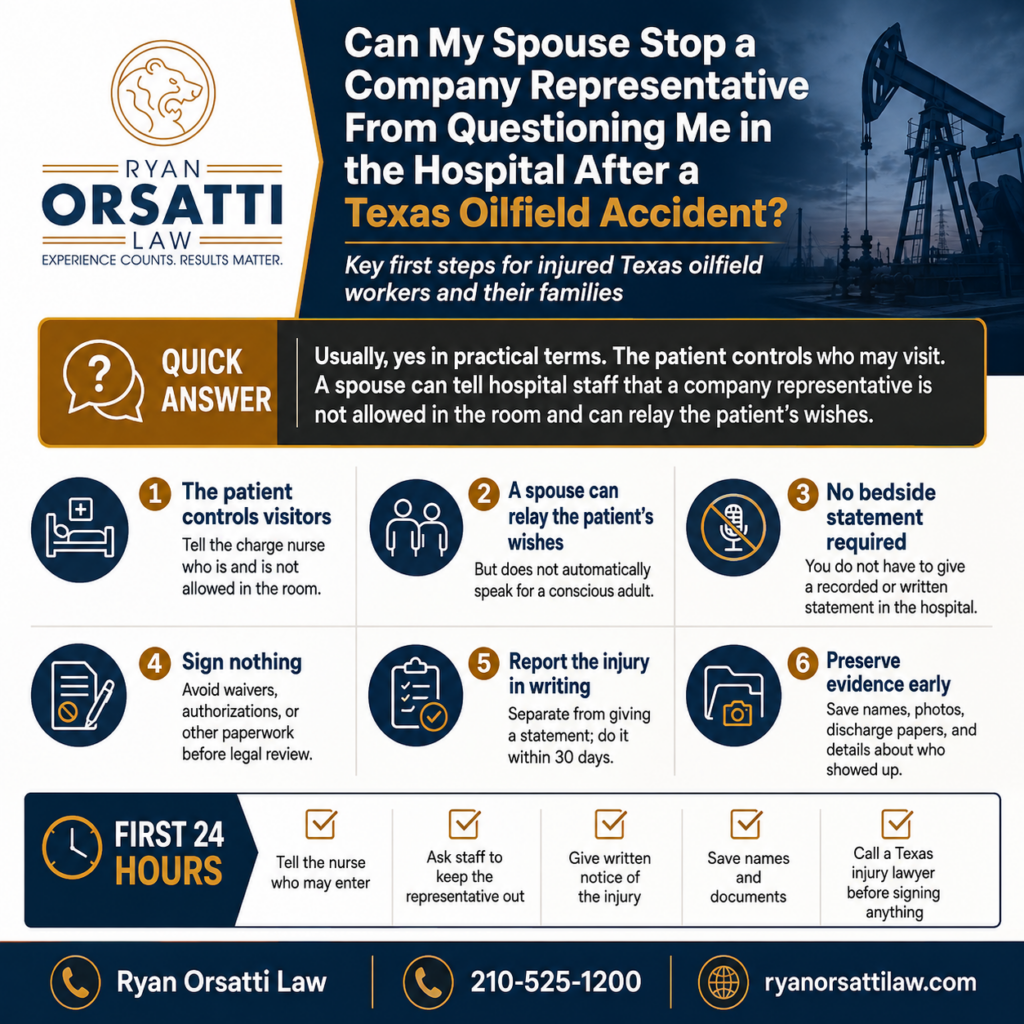
Yes, in practical terms. A hospital patient in Texas decides who may visit and can withdraw that consent at any time under 42 C.F.R. § 482.13(h)(2), and your spouse can relay that decision to the charge nurse and ask that the company representative be kept out of the room. No Texas law requires an injured oilfield worker to give a bedside interview or a recorded statement to an employer, a safety manager, or an insurance adjuster. Reporting the injury is a separate duty, and Texas Labor Code § 409.001 gives you 30 days to do that.
Key Takeaways
- The patient controls the visitor list. Federal hospital rules give the patient the right to receive the visitors he designates and to deny or withdraw consent at any time.
- A spouse has no automatic power to speak for a conscious adult, but a spouse can absolutely say “he is not doing an interview today, here is my number” and ask nursing staff to enforce it.
- Reporting the injury and giving a statement are two different things. One is required within 30 days. The other is not required at all before a lawsuit.
- A waiver signed at the bedside is a serious problem for the company, not for you. Texas Labor Code § 406.033(f) sets a floor of 10 business days after the initial injury report, plus a nonemergency care doctor’s evaluation, before a post-injury waiver can be valid.
- Texas generally allows two years to file an injury or wrongful death lawsuit under Civil Practice and Remedies Code § 16.003, but the evidence at a well site can disappear in days.
Can My Spouse Refuse to Let a Company Representative Question Me in the Hospital?
Functionally, yes. Under 42 C.F.R. § 482.13(h), a Medicare-participating hospital must tell each patient (or a support person, where appropriate) that the patient may receive the visitors he designates and may withdraw or deny that consent at any time. A hospital room is not a public space. If the injured worker says he does not want the company representative in the room, or if his spouse relays that instruction, the hospital is expected to honor the patient’s preference.
The practical move is simple. Tell the charge nurse or the unit clerk, by name, who is allowed in and who is not. Ask that it be documented in the chart. If a representative is already in the room and the worker is medicated, sedated, or in pain, the spouse can end the visit and step into the hallway to exchange contact information instead.
Texas hospital licensing rules point the same direction. 26 Tex. Admin. Code § 505.42(a)(1)(H) requires every licensed Texas hospital to adopt a written policy protecting the patient’s right, within the limits of law, to personal privacy and confidentiality of information. A recorded interview conducted while a patient is on pain medication is not a privacy-protective event.
Does My Spouse Actually Have Legal Authority to Speak for Me?
It depends on whether the worker can communicate. If he is awake and oriented, his spouse has no independent legal authority to make decisions for him, but she does not need any. She is simply passing along what he wants, and the hospital follows the patient. If he cannot communicate, Texas law gives the spouse a defined but narrow role.
Two rules matter here, and people mix them up constantly:
- Medical decisions. Texas Health and Safety Code § 313.004 lists the surrogate decision makers who may consent to medical treatment for an adult patient in a hospital who is comatose, incapacitated, or otherwise unable to communicate, and the spouse is first in priority when there is no guardian or medical power of attorney. A surrogate decision maker is a person the law lets stand in for the patient. That authority is about treatment, not about lawsuits.
- Patient rights generally. 26 Tex. Admin. Code § 505.42(a)(1)(J) requires hospital policy to let a patient’s guardian, next of kin, or legally authorized responsible person exercise the listed patient rights on the patient’s behalf, to the extent permitted by law, when the patient has been adjudicated incompetent, is found by a physician to be medically incapable of understanding a proposed procedure, or is unable to communicate his wishes.
Here is the part that protects the family. Neither of those rules lets a spouse sign away the worker’s legal claim, and neither lets the company treat a spouse’s silence as consent. If the worker cannot understand what he is signing, he cannot validly sign it. Signing legal paperwork for an incapacitated adult generally requires a statutory durable power of attorney or a court-appointed guardian, not a marriage license.
Why Does the Company Representative Get to the Hospital So Fast?
Because a clock is already running on the employer, and because the first version of the story is worth money. Under 29 C.F.R. § 1904.39, an employer must report a work-related death to OSHA within 8 hours, and must report an in-patient hospitalization, an amputation, or the loss of an eye within 24 hours. That 24-hour window is often the reason a safety manager is standing in a San Antonio emergency department the same night as a well-site injury.
The risk is real, and so is the volume. According to the Texas Department of Insurance report of Bureau of Labor Statistics census data published in March 2026, Texas recorded 557 fatal work injuries in 2024, including 36 in mining, quarrying, and oil and gas extraction and another 26 in support activities for oil and gas operations. Nationally, BLS counted 65 fatal work injuries in the oil and gas extraction industries in 2024. Workers hurt in the Eagle Ford Shale counties south and west of Bexar County are frequently transported to San Antonio hospitals for trauma care, which is why these bedside visits happen here so often.
| Who is at the door | What they usually want | Do you have to talk to them? |
|---|---|---|
| Employer safety manager or company representative | A written or recorded account of the incident for the internal investigation and the OSHA report | No. You must report that you were hurt. You do not have to sit for an interview. |
| Workers’ compensation adjuster | A recorded statement and signed medical authorizations | Not at the bedside. The Division of Workers’ Compensation process has its own steps and timelines. |
| Non-subscriber plan administrator | Signed benefit plan paperwork, sometimes containing a waiver or an arbitration clause | No. Early waivers can fail the requirements of Labor Code § 406.033(f). |
| Another contractor’s investigator or insurer | Facts that move blame away from their client and onto you or your employer | No. |
| OSHA compliance officer | Information for a federal safety inspection | Employees may speak with OSHA. You can also ask to do it when you are medically able. |
Key takeaway: Everyone in that hallway has a deadline or a defense to build, and none of those deadlines belong to you, so postponing the conversation until you are off pain medication and have talked to a lawyer costs you nothing.
Am I Required to Give a Statement to My Employer After a Texas Oilfield Accident?
No. There is no Texas statute requiring an injured worker to give a recorded or written statement to an employer or its insurer before a lawsuit is filed. What Texas law does require is notice that you were injured. Under Texas Labor Code § 409.001, an employee, or someone acting for him, must notify the employer within 30 days of the injury, and that notice may go to the employer or to any employee holding a supervisory or management position.
Notice is a short sentence. “I was hurt on the job on July 28 at the Karnes County site” satisfies it. That is very different from a recorded narrative about what you were told, who trained you, what your job safety analysis said, and whether you were wearing the right gear. A spouse or a family member can deliver that notice on the worker’s behalf, in writing, the same day. Do that, keep a copy, and the 30-day obligation is off the table.
If the case goes to litigation, sworn testimony becomes compulsory through a deposition. That is a formal proceeding with a court reporter, notice, and your own lawyer beside you. A hospital-room interview is none of those things.
What About the Papers the Company Wants Me to Sign in the Hospital?
Do not sign them, and understand that Texas law is on your side on this specific point. A post-injury waiver is a document in which an injured worker gives up the right to sue the employer. Under Texas Labor Code § 406.033, a pre-injury waiver of a claim against an employer that does not carry workers’ compensation insurance is void and unenforceable, and a post-injury waiver is valid only if all of the following are true: the employee entered it voluntarily and knowing its effect; it was entered no earlier than the 10th business day after the initial report of injury; the employee received a medical evaluation from a nonemergency care doctor before signing; the true intent of the parties is stated in writing; and the waiver language is conspicuous, in larger type or contrasting colors, on the face of the agreement.
Count the days. A form pushed across a hospital tray table on day one cannot satisfy the 10-business-day requirement, and a signature obtained before any nonemergency care doctor has evaluated the worker cannot satisfy the medical evaluation requirement. The same caution applies to broad medical authorizations, benefit plan enrollment forms, and arbitration agreements presented as routine paperwork.
Attorney Insight. In matters we handle, the bedside interview usually is not really about what happened. It is about building a “worker error” file: you skipped a step, you did not stop work, you did not complete the hazard analysis. What families rarely know is that when the employer carries no workers’ compensation insurance, Texas Labor Code § 406.033(a) removes contributory negligence, assumption of the risk, and the negligence of a fellow employee as defenses in that worker’s suit against the employer. A great deal of hospital-room questioning is aimed at defenses the employer may not even be allowed to raise. The answers still cause damage, because a version of events given while a worker is medicated and frightened gets quoted back at him for the next two years, and because those same answers can be used against him in a claim against a third-party contractor or equipment supplier, where fault allocation does matter.
Does It Matter Whether My Employer Carries Workers’ Compensation?
It changes almost everything about the case, which is why it is one of the first questions to answer. Texas does not require most private employers to carry workers’ compensation insurance. An employer that opts out is called a non-subscriber. If your employer is a non-subscriber, you can sue it directly for negligence, and under Labor Code § 406.033 it cannot defend on contributory negligence, assumption of the risk, or fellow-employee negligence. The statute leaves the employer able to argue that the injury was caused by an act the employee intended to bring about, or that it happened while the employee was intoxicated, and defense lawyers routinely argue that the worker’s own conduct was the sole cause of the incident. The plaintiff still has to prove the employer’s negligence.
If your employer is a subscriber, benefits come through the workers’ compensation system rather than a negligence suit against the employer, and a separate claim against a third party may still exist. Well sites are shared spaces. The operator, the drilling contractor, the wireline or workover company, a trucking company, and an equipment manufacturer may all be on the same pad. Sorting out who is a subscriber, who is a third party, and whose insurance applies is a records exercise, not a guess. That is also why the paperwork a representative brings to the hospital deserves a lawyer’s read rather than a signature.
Can I Be Fired for Refusing to Give a Statement?
Texas is an at-will employment state, so this is genuinely fact-specific, and it is worth getting individualized advice before you assume anything. That said, Texas has a targeted anti-retaliation statute for injured workers. Texas Labor Code § 451.001 provides that a person may not discharge or in any other manner discriminate against an employee because the employee filed a workers’ compensation claim in good faith, hired a lawyer to represent him in a claim, instituted a good faith proceeding under the Act, or testified or is about to testify in such a proceeding.
Read the second item again. Hiring a lawyer is expressly listed. If a supervisor’s tone changes the day after you retain counsel, write down the date, the words used, and who was present. Documentation created at the time is worth more than a memory reconstructed months later.
Does HIPAA Keep the Company Away From My Medical Records?
Partly, and less than most families assume. HIPAA restricts what a hospital may disclose, but it does not apply to your employer as an employer. Two provisions matter in the first 48 hours.
First, you can limit what the hospital tells callers. Under 45 C.F.R. § 164.510(a), a hospital may keep a facility directory with limited information such as location and general condition, but it must give the patient the chance to restrict or prohibit those disclosures. Ask registration to restrict the directory listing. That single request stops a stream of “just checking on him” calls that double as investigation.
Second, workers’ compensation is an exception, not a loophole in your favor. Under 45 C.F.R. § 164.512(l), a covered entity may disclose protected health information as authorized by and to the extent necessary to comply with workers’ compensation laws, and the U.S. Department of Health and Human Services has published guidance confirming that the disclosure must still be limited to the minimum necessary. The practical consequence: expect the carrier to obtain treatment records for the compensable injury, and do not hand over a blanket authorization covering your entire medical history.
What Deadlines Apply After a Texas Oilfield Accident?
Several run at once, and they are not the same length. A statute of limitations is the outside deadline to file a lawsuit; the shorter deadlines below are notice and claim-filing rules that operate independently of it. The dates that matter most in an oilfield file are usually the ones nobody mentions at the hospital.
| Deadline | What it governs | Authority |
|---|---|---|
| 8 hours / 24 hours | The employer’s duty to report a work-related death (8 hours) or an in-patient hospitalization, amputation, or loss of an eye (24 hours) to OSHA | 29 C.F.R. § 1904.39 |
| 10 business days | The earliest a post-injury waiver of a claim against a non-subscriber employer may be signed, and only after a nonemergency care doctor’s evaluation | Labor Code § 406.033(f) |
| 30 days | Notifying the employer of a work injury in the Texas workers’ compensation system | Labor Code § 409.001 |
| 1 year | Filing a workers’ compensation claim with the Division of Workers’ Compensation | Labor Code § 409.003 |
| 2 years | Filing most Texas personal injury lawsuits, and wrongful death suits, measured from accrual | Civ. Prac. & Rem. Code § 16.003 |
Key takeaway: The two-year filing deadline is the last one you should be worried about, because the 30-day notice duty and the physical evidence on the pad both expire long before it does.
What Your Spouse Can Do in the First 24 Hours
The goal is not confrontation. It is buying time so decisions get made when the injured worker is clear-headed. This sequence works in a real hospital hallway.
- Tell the charge nurse, by name, who may enter the room and who may not, and ask that it be noted in the chart.
- Ask hospital registration to restrict the facility directory listing so callers are not told the room or condition.
- Be polite and specific with the representative: “He is not giving a statement today. Here is my phone number.”
- Sign nothing. Not waivers, not arbitration agreements, not benefit plan forms, not broad medical authorizations.
- Give written notice of the injury to a supervisor or manager, by text or email, and keep a copy with the timestamp.
- Write down who came to the hospital, when, what they said, and what they asked the worker to sign.
- Ask the worker, while it is fresh, for the names of every crew member and every company that was on the pad.
- Photograph the discharge paperwork, the injuries, and any equipment or gear the worker still has.
- Do not post about the incident on social media, and ask family members to do the same.
- Call a Texas injury lawyer before the paperwork window opens, so a preservation letter can go out while the site and the equipment still exist.
That last step is time-sensitive for the same reason it is in a commercial vehicle case. Our discussion of why the first 72 hours matter for evidence preservation and of what a spoliation letter does applies directly to a well site, where equipment gets repaired, moved, or returned to a vendor within days.
How a Texas Oilfield Accident Lawyer Reviews This Kind of Problem
A bedside interview request looks like a small courtesy question and is usually the visible edge of a much larger record. The work behind it is confirming whether the employer is a subscriber or a non-subscriber, identifying every company that was on the pad and its insurer, sending preservation letters before equipment is repaired or released, pulling the OSHA report and any inspection file, and reading every document the worker was asked to sign against the requirements of Labor Code § 406.033. Ryan Orsatti Law reviews oil field accidents in San Antonio and across Texas for injured workers and their families, including catastrophic injury, burn, traumatic brain injury, and wrongful death matters, and handles these files on a contingency fee, with consultations in English and Spanish. If a company representative is at the hospital right now, you can talk through your options in a free consultation before anyone signs anything.
Frequently Asked Questions
Do I have to give a recorded statement to my employer’s insurance company in Texas?
No. Texas law does not require an injured worker to give a recorded statement to an employer or its insurer before litigation. You do have to report the injury, and Texas Labor Code § 409.001 gives you 30 days to notify the employer or a supervisor. Reporting that you were hurt and sitting for a recorded interview are different obligations, and only the first one is required.
Can my wife legally speak for me if I am sedated after an oilfield accident?
For medical treatment, yes in most cases. Texas Health and Safety Code § 313.004 places the spouse first among surrogate decision makers when an adult hospital patient cannot communicate and there is no guardian or medical power of attorney. That authority covers treatment decisions. It does not let a spouse give a statement about the incident for you or sign away your legal claim.
Can I be fired for refusing to give a statement after a Texas work injury?
Texas is an at-will state, so the answer depends on the facts. Texas Labor Code § 451.001 prohibits discharging or otherwise discriminating against an employee because the employee filed a workers’ compensation claim in good faith or hired a lawyer to represent him in a claim. If your treatment at work changes after you retain counsel, document the dates, the words used, and the witnesses.
Should I sign the papers the company representative brought to the hospital?
No. Have a lawyer read them first. Under Texas Labor Code § 406.033, a pre-injury waiver of a claim against a non-subscriber employer is void, and a post-injury waiver is valid only if it is signed no earlier than the 10th business day after the initial injury report and after a nonemergency care doctor has evaluated the worker. A form signed on day one cannot meet those requirements.
How do I know if my oilfield employer has workers’ compensation insurance?
Ask in writing, and verify independently rather than relying on what a supervisor says. Texas does not require most private employers to carry coverage, and an employer without it is called a non-subscriber. The answer changes your entire path: a non-subscriber can be sued directly for negligence, while a subscriber’s employees generally proceed through the Division of Workers’ Compensation.
What if I already gave a statement in the hospital before I knew any of this?
It is a problem to manage, not the end of the case. Get a copy or a transcript of what you said, write down what you actually remember now, and tell your lawyer exactly what was asked. Statements given on pain medication are often incomplete or wrong about details, and that context matters. Do not give a second statement to correct the first one without counsel.
How long do I have to file an oilfield injury lawsuit in Texas?
Most Texas personal injury and wrongful death claims must be filed within two years of accrual under Civil Practice and Remedies Code § 16.003, though other rules can shorten or alter that in specific situations. Waiting is still risky. Equipment gets repaired or returned to vendors, crews rotate off, and site conditions change within days, so the evidence deadline arrives long before the filing deadline.
Source Notes
- Patient visitation rights and the right to withdraw consent: 42 C.F.R. § 482.13
- Texas hospital patient rights, including privacy and exercise of rights by next of kin: 26 Tex. Admin. Code § 505.42 (transferred from 25 Tex. Admin. Code § 133.42 effective January 31, 2025)
- Non-subscriber defenses and waiver requirements: Tex. Labor Code § 406.033
- Injury notice and claim deadlines: Tex. Labor Code §§ 409.001, 409.003
- Anti-retaliation: Tex. Labor Code § 451.001
- Two-year limitations period: Tex. Civ. Prac. & Rem. Code § 16.003
- Employer reporting to OSHA: 29 C.F.R. § 1904.39; OSHA standard page
- HIPAA facility directory and workers’ compensation disclosures: 45 C.F.R. § 164.510; 45 C.F.R. § 164.512; HHS guidance
- Fatality data: Texas Department of Insurance, 2024 Census of Fatal Occupational Injuries (Texas); U.S. Bureau of Labor Statistics, CFOI, mining and oil and gas extraction
Contact
Ryan Orsatti Law
4634 De Zavala Rd, San Antonio, TX 78249
Phone: 210-525-1200
ryanorsattilaw.com
This blog is for informational purposes only, not legal advice. Reading it does not create an attorney-client relationship. Past results do not guarantee future results.
Hurt in an accident in San Antonio? Learn how a San Antonio personal injury lawyer can help with your claim. Call 210-525-1200 or request a free consultation.
The firm works on a contingency fee. You pay nothing unless the firm recovers money for you, and that covers case expenses as well as the fee: if there is no recovery, you owe no attorney's fee and no case expenses. Ask for the fee agreement and read the fee and expense section before you sign anything.
Related San Antonio legal resources
- San Antonio construction-accident representation
- Texas personal-injury services
- Contact Ryan Orsatti Law
Primary legal and public-data sources
- Texas Civil Practice and Remedies Code Chapter 16: limitations
- Texas Civil Practice and Remedies Code Chapter 33: proportionate responsibility
Ryan Orsatti Law
4634 De Zavala Road, San Antonio, TX 78249
General reference links. Consult each source for its current text.