
Quick Answer
A spoliation letter is a written evidence-preservation notice sent to a trucking company, driver, insurer, broker, maintenance company, or other party after a truck accident. It tells them to preserve evidence that may be relevant to an injury claim or lawsuit.
In a Texas truck accident case, this letter should be sent as soon as possible because key evidence can be overwritten, repaired, deleted, recycled, or lost through ordinary business practices. That may include dashcam video, electronic logging device data, driver logs, black-box/ECM data, dispatch records, maintenance records, drug and alcohol testing documents, and post-crash inspection materials.
Texas courts evaluate spoliation by asking whether a party had a duty to reasonably preserve evidence and whether that duty was intentionally or negligently breached. The Texas Supreme Court’s spoliation framework comes from Brookshire Bros., Ltd. v. Aldridge, which explains that courts—not juries—decide whether spoliation occurred and what remedy is appropriate. (Justia)
A truck accident lawyer should send a spoliation letter immediately because trucking cases often turn on evidence that the injured person cannot access on their own.
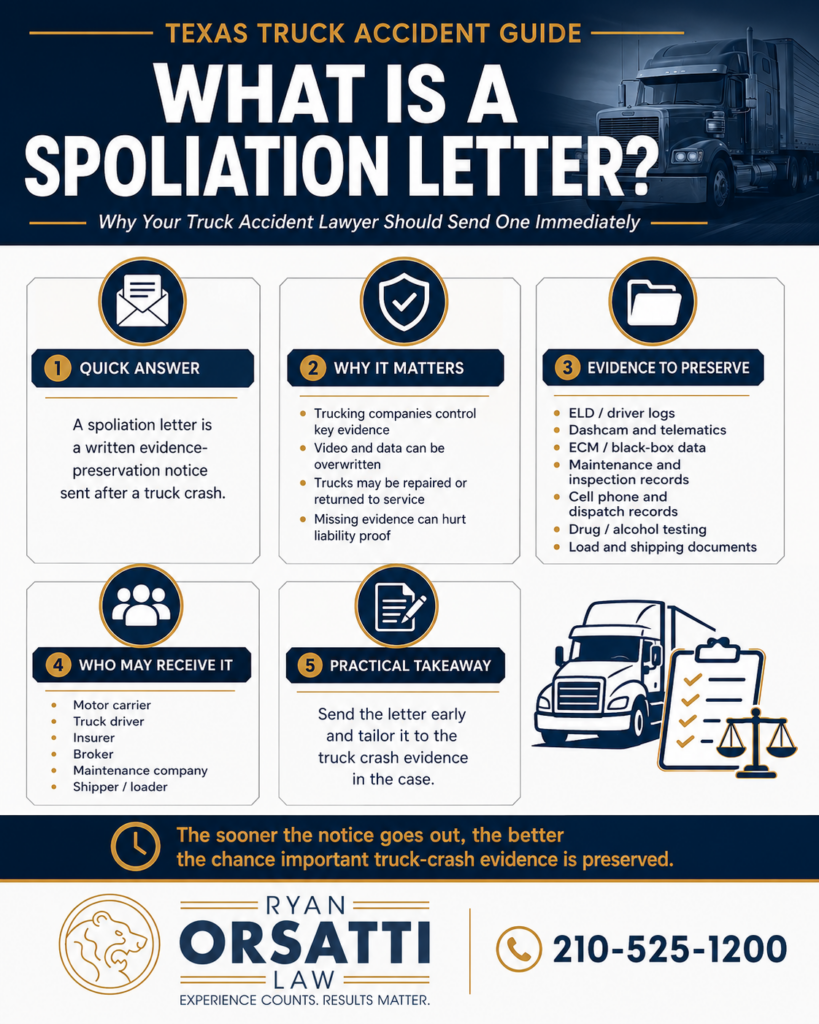
What Is a Spoliation Letter in a Truck Accident Case?
A spoliation letter is sometimes called a preservation letter, evidence preservation notice, or litigation hold letter. In plain English, it says:
A crash happened. A claim is likely. Do not destroy, alter, repair, overwrite, delete, recycle, or fail to preserve relevant evidence.
In an 18-wheeler accident, the letter is usually sent to the motor carrier, the driver, the insurance company, and sometimes other entities connected to the truck, trailer, load, route, maintenance, or dispatch.
The letter does not automatically prove fault. It does not replace formal discovery. But it creates a clear record that the trucking company was placed on notice to preserve evidence.
That notice can matter later if evidence disappears.
Why Evidence Disappears Quickly After a Truck Accident
Truck accident evidence is different from ordinary car wreck evidence. Commercial trucking companies often use electronic systems that automatically overwrite or purge information unless someone preserves it.
Some records may also be kept only for limited periods under federal trucking rules. For example, motor carriers must retain records of duty status and supporting documents for at least six months from receipt under 49 C.F.R. § 395.8(k). (eCFR) FMCSA guidance also explains that RODS and supporting documents are generally retained for six months. (FMCSA)
That does not mean a trucking company may destroy relevant evidence after getting notice of a likely claim. But it does mean a lawyer should act before routine retention periods, overwriting cycles, repairs, and internal cleanup processes create evidence problems.
What Evidence Should a Truck Accident Spoliation Letter Preserve?
A strong truck accident preservation letter should be tailored to the crash. A generic “preserve all evidence” letter may be too vague. Texas discovery rules require specificity when requesting electronic or magnetic data, and Rule 196.4 requires a requesting party to specifically request electronic or magnetic data and specify the form of production. (Texas Courts)
Here are common categories that should be considered:
| Evidence Category | Why It Matters in a Truck Accident Case |
|---|---|
| Electronic logging device data | Shows hours of service, driving time, on-duty time, edits, and possible fatigue issues. |
| Driver records of duty status | Helps compare the driver’s logs against dispatch, fuel, toll, GPS, and delivery records. |
| Supporting documents | Fuel receipts, bills of lading, toll records, dispatch records, scale tickets, and communication records can confirm or contradict logs. |
| Dashcam or inward-facing camera video | May show speed, lane position, distraction, braking, following distance, or driver behavior. |
| ECM/black-box data | May show speed, throttle, braking, engine RPM, hard-braking events, or other crash-related data depending on the system. |
| Maintenance and inspection records | May reveal brake, tire, lighting, steering, or other mechanical issues. |
| Driver qualification file | May show hiring, training, licensing, medical certification, prior violations, or safety history. |
| Drug and alcohol testing records | May be critical after serious commercial vehicle crashes. |
| Post-crash inspection reports | Can identify vehicle defects or safety violations. |
| Cell phone and communication records | May help prove distraction or dispatch pressure. |
| Load securement documents | Important in crashes involving shifting cargo, rollovers, jackknifes, or debris. |
| Accident register and internal reports | FMCSA materials explain that reportable crash records must be kept in an accident register for three years. (A&I Online) |
The point is not to ask for everything in existence. The point is to identify evidence that may reasonably bear on liability, causation, damages, company safety practices, and available insurance.
Why the Letter Should Be Sent Immediately After an 18-Wheeler Crash
1. Trucking companies control much of the evidence
The injured person usually does not have access to the truck, trailer, driver logs, dispatch system, internal safety file, camera footage, or electronic data. The trucking company does.
A preservation letter puts the company on notice that those materials may be evidence in a Texas injury claim.
2. Electronic data can be overwritten
Dashcam systems, GPS systems, ELD platforms, onboard telematics, and engine modules may retain data for limited periods or require specific steps to download and preserve it.
A delay can allow important data to be overwritten before anyone requests it.
3. Trucks get repaired and returned to service
Commercial trucks are business assets. After a crash, the company may want the tractor or trailer inspected, repaired, salvaged, moved, or placed back into service.
But physical evidence—impact points, underride damage, tire condition, brake components, lighting, reflective tape, coupling systems, and load securement—can be changed or lost during repairs.
4. Liability disputes often begin immediately
In Texas truck accident cases, the defense may argue that the injured person, another driver, road conditions, construction, weather, or an unknown third party caused or contributed to the crash. Texas proportionate responsibility law can reduce or bar recovery depending on assigned percentages of fault; a claimant may not recover if their percentage of responsibility is greater than 50%. (Texas Statutes)
Preserved evidence helps test those fault arguments.
5. Bexar County and San Antonio truck crashes often involve multiple entities
A crash on I-35, I-10, Loop 410, Highway 90, or Loop 1604 may involve a tractor owner, trailer owner, motor carrier, broker, shipper, maintenance vendor, cargo loader, safety contractor, or multiple insurers.
A good preservation strategy identifies who may have evidence before records disappear.
What Happens If a Trucking Company Ignores a Spoliation Letter?
If relevant evidence is destroyed or not preserved, the issue may later be raised with the court. Under Texas law, the judge decides whether spoliation occurred and what remedy, if any, is appropriate. In Brookshire Brothers, the Texas Supreme Court explained that the analysis involves determining whether the party had a duty to reasonably preserve evidence, whether that duty was breached intentionally or negligently, and what proportionate remedy fits the conduct and prejudice. (Justia)
Possible remedies may include:
- attorney’s fees;
- exclusion of certain evidence;
- limits on defenses;
- additional discovery;
- instructions to the jury in narrow circumstances;
- other sanctions tailored to the harm.
A spoliation instruction is a serious remedy. Texas courts do not automatically give one just because evidence is missing. The court looks closely at culpability, prejudice, and whether a lesser remedy can address the problem. (Justia)
Is a Spoliation Letter the Same as a Lawsuit?
No. A spoliation letter is not the same as filing a lawsuit.
It is usually sent before suit is filed. Its purpose is to preserve evidence while the claim is being investigated. A lawsuit may still become necessary if the insurance company disputes fault, undervalues the injuries, refuses to identify coverage, delays production of information, or the statute of limitations approaches.
In Texas, many personal injury claims must be filed within two years from the date the cause of action accrues, subject to exceptions and special rules. (Texas Statutes) But waiting two years to investigate a truck crash can be a serious mistake because critical evidence may not last that long.
What Should a Truck Accident Lawyer Do After Sending the Letter?
A preservation letter is only one step. In a serious truck accident case, the lawyer should also consider:
- Identifying all potentially responsible parties
This may include the driver, motor carrier, truck owner, trailer owner, shipper, broker, maintenance company, cargo loader, and others. - Sending targeted preservation notices
Each entity may hold different evidence. - Requesting insurance information
Commercial trucking cases may involve primary liability coverage, excess coverage, umbrella policies, MCS-90 issues, broker policies, or separate policies for different entities. - Inspecting the vehicles when appropriate
The tractor, trailer, passenger vehicle, cargo, tires, brakes, lighting, and underride damage may need inspection before repairs or salvage. - Securing crash-scene evidence
Photos, measurements, debris fields, skid marks, gouge marks, traffic signal data, business surveillance video, and 911 records can matter. - Reviewing medical causation and damages early
Truck crashes often cause spine injuries, traumatic brain injuries, fractures, surgical injuries, chronic pain, lost income, and future care needs. - Preparing for defense blame arguments
Texas juries can assign percentages of responsibility among claimants, defendants, settling persons, and responsible third parties under Chapter 33. (Texas Statutes)
Common Mistakes After a Truck Accident
Waiting too long to contact a lawyer
Delay can make it harder to preserve camera footage, ELD data, ECM data, and physical evidence.
Assuming the police report has everything
Police crash reports are important, but they rarely include the full trucking-company evidence trail. A report may not include driver qualification materials, dispatch messages, safety audits, maintenance history, load records, or ELD metadata.
Giving a recorded statement without preparation
Insurance adjusters may ask questions designed to create fault arguments, minimize injuries, or lock in incomplete facts before the injured person understands the full medical picture.
Letting the vehicle be destroyed too soon
The injured person’s vehicle may also be evidence. Vehicle damage can help show crash severity, impact angle, underride, intrusion, and occupant movement.
Posting about the crash online
Photos, comments, location tags, and activity posts may be used by insurers to dispute injury severity or daily limitations.
Attorney Insight: The Letter Should Match the Theory of the Case
In truck accident cases, the preservation letter should not read like a form copied from a general car accident file.
A rear-end 18-wheeler crash may require a focus on following distance, braking data, driver distraction, fatigue, dashcam video, and ECM downloads. A jackknife crash may require weather, speed, brake balance, load weight, tire condition, and driver training evidence. A crash involving a construction truck in San Antonio may require jobsite dispatch records, route instructions, maintenance vendors, and company safety policies.
The best preservation letters are built around the likely liability issues before the trucking company has a chance to narrow the story.
What Should Injured People Do While the Lawyer Preserves Trucking Evidence?
The injured person can help protect the claim by gathering and saving their own evidence:
- photos and videos of the crash scene;
- photos of vehicle damage before repairs;
- names and phone numbers of witnesses;
- medical records and discharge papers;
- prescription records;
- work absence records;
- photos of visible injuries over time;
- insurance letters and claim numbers;
- tow-yard and repair documents;
- dashcam footage from their own vehicle;
- screenshots of any communication with insurers.
Do not alter, delete, or edit evidence. Save originals when possible.
FAQs About Spoliation Letters in Texas Truck Accident Cases
What is spoliation in a Texas truck accident case?
Spoliation generally means the destruction, alteration, or failure to preserve evidence that may be relevant to a claim or lawsuit. In Texas, courts analyze whether there was a duty to preserve evidence, whether that duty was breached, and what remedy fits the harm. (Justia)
Who receives the spoliation letter after an 18-wheeler accident?
Usually the truck driver, motor carrier, insurer, and any company that may control relevant evidence. Depending on the facts, the letter may also go to the trailer owner, broker, shipper, cargo loader, maintenance company, tow yard, or camera/telematics vendor.
How soon should a truck accident lawyer send a preservation letter?
As soon as possible. Some evidence can be overwritten, deleted, repaired, or lost quickly. Early notice helps prevent the trucking company from later arguing that evidence disappeared through normal business processes before anyone requested preservation.
Does a spoliation letter force the trucking company to hand over documents immediately?
Not by itself. A preservation letter mainly tells the company to preserve evidence. Formal production may require insurance negotiations, pre-suit cooperation, subpoenas, discovery requests, court orders, or litigation.
What if the trucking company says the evidence no longer exists?
That answer should be tested. The lawyer may ask when the evidence was destroyed, who destroyed it, what retention policy applied, whether a litigation hold was issued, whether backup data exists, and whether vendors or third parties still have copies.
Can missing evidence help my truck accident case?
Sometimes, but it depends on the facts. Texas courts do not automatically punish a party because evidence is missing. The court evaluates duty, breach, culpability, prejudice, and proportionality before deciding on a remedy. (Justia)
Is ELD data important in a truck crash claim?
Yes. ELD data can help evaluate hours of service, fatigue, driving time, on-duty time, and possible edits. Motor carriers must retain RODS and supporting documents for at least six months from receipt under federal rules. (eCFR)
Should I send a spoliation letter myself?
You can try, but trucking preservation letters should be specific and properly directed. A lawyer can identify the right entities, evidence categories, electronic data formats, and follow-up steps.
Talk to a San Antonio Truck Accident Lawyer
Truck accident cases are evidence-heavy. The sooner preservation begins, the better the chance that critical records, data, video, and physical evidence can be protected.
Ryan Orsatti Law
4634 De Zavala Rd, San Antonio, TX 78249
Phone: 210-525-1200
This blog is for informational purposes only, not legal advice. Reading it does not create an attorney-client relationship. Past results do not guarantee future results.
Injured in a truck crash? See our San Antonio 18-wheeler accident lawyer page, or call (210) 525-1200 – calls answered 24/7.
Hurt in an accident in San Antonio? Learn how a San Antonio truck accident lawyer can help with your claim. Call 210-525-1200 or request a free consultation.
The firm works on a contingency fee. You pay nothing unless the firm recovers money for you, and that covers case expenses as well as the fee: if there is no recovery, you owe no attorney's fee and no case expenses. Ask for the fee agreement and read the fee and expense section before you sign anything.
Related San Antonio legal resources
Primary legal and public-data sources
Ryan Orsatti Law
4634 De Zavala Road, San Antonio, TX 78249
General reference links. Consult each source for its current text.