
Quick Answer
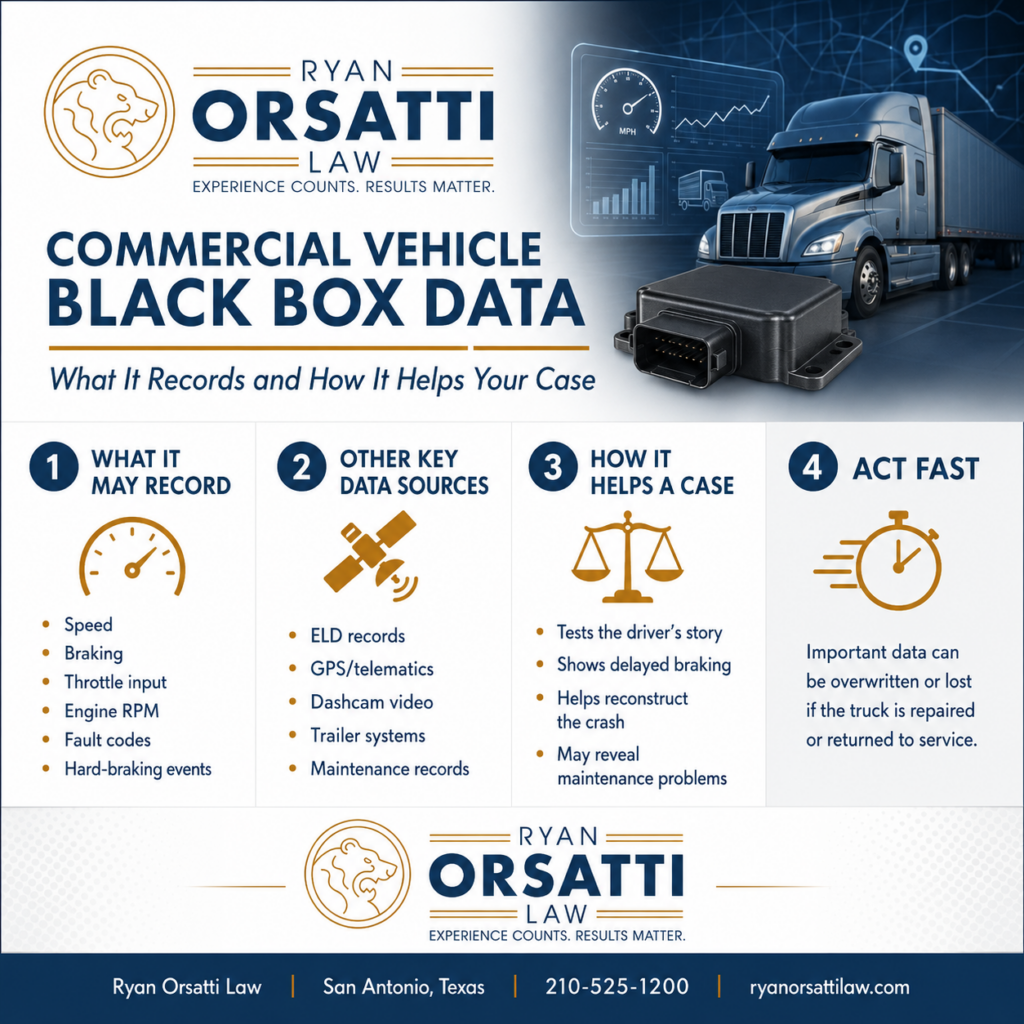
Commercial vehicle black box data may show speed, braking, throttle position, engine RPM, gear selection, fault codes, and other vehicle inputs before a crash. An electronic logging device, or ELD, is different: it records information such as time, location, vehicle miles, engine hours, and driver-duty events.
The exact information depends on the truck, its electronic modules, and the systems installed by the carrier. After a serious Texas commercial vehicle crash, a targeted preservation demand and prompt inspection may be necessary before the vehicle is repaired, returned to service, or its data is overwritten. Ryan Orsatti Law helps injured people in San Antonio and across Texas identify and preserve these electronic evidence sources.
Key Takeaways
- A commercial vehicle usually does not have one universal “black box.” Evidence may exist in several separate modules and cloud-based systems.
- An engine control module may record speed, braking status, throttle input, RPM, fault codes, and hard-braking events.
- An ELD primarily documents hours-of-service and vehicle movement information. It is not the same as a crash recorder.
- Federal regulations generally require motor carriers to retain ELD records for at least six months, but other electronic data may have a much shorter practical preservation window.
- Black box evidence can help test the driver’s account, reconstruct the collision, identify delayed braking, and uncover possible vehicle or maintenance problems.
- A preservation letter should identify the specific truck, modules, files, vendors, and data formats to be preserved.
What Is Commercial Vehicle Black Box Data?
Commercial vehicle black box data is an informal term for electronic information stored by the truck’s engine, braking, safety, logging, camera, and telematics systems. There may be no single device containing every relevant fact, and the available data can vary substantially by manufacturer, model year, engine, carrier, and installed equipment.
The National Highway Traffic Safety Administration distinguishes an event data recorder from systems that record video, audio, or hours-of-service information. That distinction matters because a lawyer investigating a serious truck crash should look beyond the engine module and identify every electronic system that may contain relevant evidence.
| Electronic system | Information it may contain | What the evidence may help establish | Common preservation concern |
|---|---|---|---|
| Engine control module or event recorder | Vehicle speed, RPM, throttle, brake status, gear selection, diagnostic codes, hard-brake or last-stop events | Speed, driver response, mechanical condition, and pre-impact vehicle operation | Later events, repairs, module replacement, or resetting may affect stored information |
| Electronic logging device | Time, date, location, engine hours, vehicle miles, driver identity, duty-status events | Driving time, rest periods, route, vehicle movement, and potential hours-of-service issues | Federal minimum retention is generally six months |
| GPS or fleet telematics | Location, route, speed reports, harsh braking, acceleration, geofencing, dispatch messages | Vehicle movement, dispatch decisions, route timing, and carrier knowledge | Data may be held by an outside vendor under a separate retention policy |
| Dashcam or driver-facing camera | Roadway video, cab video, audio, alerts, and driver behavior | Traffic conditions, distraction, following distance, lane position, and driver conduct | Video may overwrite quickly if it is not flagged or downloaded |
| ABS, stability-control, or trailer module | Wheel-speed signals, braking events, stability-control activation, and system faults | Braking performance, wheel behavior, trailer operation, or loss of control | Tractor and trailer modules may need separate inspection and downloads |
| Advanced driver-assistance system | Forward-collision warnings, lane alerts, automatic braking events, and object detection | Whether the system detected a hazard and whether warnings or interventions occurred | Proprietary tools or manufacturer involvement may be required |
Key takeaway: A complete commercial vehicle investigation should identify the tractor, trailer, engine module, ELD, cameras, telematics provider, braking systems, and safety technology rather than asking only for “the black box.”
For a broader comparison of these evidence sources, see Ryan Orsatti Law’s guide to ELD, black box, and dashcam evidence in Texas truck crashes.
What Does a Commercial Vehicle ECM or EDR Record?
A commercial vehicle engine control module or event data recorder may document how the truck was operating before and during a collision. Depending on the system, available fields may include vehicle speed, wheel speed, engine RPM, accelerator position, brake status, transmission gear, diagnostic faults, seat-belt status, and acceleration forces.
NHTSA’s truck and bus EDR technical work identified variables such as speed, wheel speeds, service-brake status, trailer-brake status, throttle position, gear selection, engine RPM, and occupant-restraint information. The report also emphasized that electronic data requires interpretation and will not answer every question by itself.
Can the Data Show Speed, Braking, Throttle, and RPM?
Black box data can often help determine how fast a commercial vehicle was traveling and whether the driver braked or released the accelerator before impact. A sequence showing continued throttle input, followed by late brake activation, may support a reconstruction of delayed hazard recognition or insufficient following distance.
The recorded brake field may show that a brake switch was activated, but it may not measure actual braking force or prove that the brakes worked effectively. Likewise, recorded vehicle speed may need to be checked against tire size, gearing, wheel slip, GPS information, roadway evidence, and other data sources.
Can the Module Show Fault Codes and Earlier Driving Events?
Some commercial vehicle modules can contain diagnostic codes, hard-braking incidents, last-stop information, maintenance intervals, and records of engine operation. Those records may help identify whether a mechanical problem existed before the crash, whether a warning was active, or whether the vehicle experienced another significant event.
The usefulness of those records depends on how the manufacturer stores them. Some information may be temporary, some may be overwritten by later events, and some files may be reset after a download or maintenance procedure.
Does Every Commercial Vehicle Record the Same Information?
No. Commercial vehicles do not all record the same fields, for the same duration, or in the same format. Two trucks involved in similar crashes may produce substantially different downloads because they have different engines, control modules, software versions, telematics subscriptions, cameras, or safety systems.
A proper inspection begins by identifying the tractor’s vehicle identification number, engine manufacturer, engine serial number, module type, software version, and installed fleet systems. The trailer should also be examined because its braking or stability-control equipment may contain separate information.
What Does an ELD Record, and What Does It Not Record?
An electronic logging device records driver-duty and vehicle-movement information, not a complete second-by-second account of the crash. Under 49 C.F.R. § 395.26, an ELD automatically records the date, time, geographic location, engine hours, vehicle miles, driver or user identity, vehicle identity, and motor-carrier identity at specified events.
Those events include duty-status changes, engine power-up and shutdown, driver login and logout, and periodic intervals while the vehicle is moving. The ELD may therefore help establish when and where the driver operated the truck, but it generally will not show steering input, precise impact forces, video, or whether the driver was looking at the roadway.
Federal regulations generally require a motor carrier to retain records of duty status and supporting documents for at least six months. Carriers must also maintain a backup copy of ELD records for that period on a separate device.
How Can Black Box Data Help a Texas Commercial Vehicle Injury Case?
Black box data can provide an objective timeline that either supports or contradicts statements made by the commercial driver, witnesses, or carrier. It may help show speed, delayed braking, continued acceleration, vehicle movement, hours of operation, warning codes, or safety-system activation.
The evidence is often most useful when compared with physical evidence and independent records, including:
- Police measurements and diagrams
- Scene photographs and surveillance video
- Skid marks, tire marks, gouges, and debris
- Vehicle damage and crush measurements
- ELD and GPS records
- Dispatch communications
- Driver qualification and training records
- Maintenance and inspection records
- Cellphone records
- Dashcam footage
- Witness testimony
- Medical records describing the occupant’s injuries
Black box data should not be treated as automatically accurate or conclusive. A qualified examiner may need to determine whether the correct vehicle was downloaded, whether the module clock was accurate, whether the event was properly identified, and whether the recorded values were affected by wheel slip, tire configuration, electrical interruption, repairs, or software limitations.
Can Black Box Data Prove the Truck Was Speeding?
Black box data can support a speeding allegation when the relevant module reliably recorded vehicle speed and the data can be tied to the collision. The analysis should compare the recorded speed with the posted limit, GPS or telematics records, roadway evidence, vehicle damage, witness accounts, and the module’s technical specifications.
A single speed value without context may be misleading. The key questions include when the value was recorded, how the vehicle calculated speed, whether the tires and gearing matched the programmed settings, and whether wheel lock or wheel spin affected the signal.
Can Black Box Data Show That the Driver Braked Too Late?
Black box data may show that the driver applied the brakes only shortly before impact, particularly when brake-status information can be synchronized with speed, throttle, RPM, and distance evidence. A reconstruction professional may use those values to estimate when the driver reacted and whether additional stopping distance was available.
Brake activation is not necessarily the same as effective braking. Investigators may also need to examine air-brake components, tires, ABS records, trailer brakes, maintenance history, road conditions, and the vehicle’s loaded weight.
Can Electronic Data Prove Driver Fatigue?
An engine module usually cannot prove that a driver was tired, but ELD records may show driving time, duty-status changes, vehicle movement, and possible inconsistencies in the driver’s log. Supporting documents such as fuel receipts, toll records, dispatch messages, bills of lading, and GPS records may reveal whether the driver’s reported schedule matches actual activity.
Even a technically compliant log does not prove that a driver was rested. Fatigue analysis may also consider sleep opportunity, work demands, communications, trip scheduling, medical issues, and witness observations.
Can Black Box Data Prove That the Crash Caused an Injury?
Black box data cannot independently diagnose an injury, but it may help explain the direction, timing, and severity of collision forces. That information can be compared with vehicle damage, occupant movement, emergency records, diagnostic imaging, physician findings, and the injured person’s symptoms.
Medical causation still depends on the individual facts and competent medical evidence. A high recorded speed does not automatically prove a particular injury, and a lower-speed impact does not automatically disprove one.
How Do You Obtain Commercial Vehicle Black Box Data in Texas?
Obtaining commercial vehicle black box data usually requires identifying who owns or controls the vehicle and then securing consent, an inspection agreement, formal discovery, a subpoena, or a court order. The correct procedure depends on whether the data is stored in the vehicle, held by the motor carrier, or maintained by an outside telematics or camera vendor.
Texas Transportation Code § 547.615 generally restricts retrieval of information from a manufacturer-installed recording device by someone other than the vehicle’s owner. The statute includes exceptions such as owner consent and a court order, along with provisions addressing emergency response, safety research, location information, and subscription services.
A practical preservation and retrieval checklist includes:
- Identify every commercial vehicle. Record the tractor and trailer license plates, VINs, unit numbers, USDOT number, carrier name, owner, lessee, and any visible camera or telematics equipment.
- Determine who possesses the vehicles. The tractor and trailer may be held by the carrier, a leasing company, an insurer, a repair facility, or a salvage yard.
- Send targeted preservation demands. Identify the ECM, EDR, ELD, GPS, telematics, dashcams, driver-facing cameras, ADAS systems, ABS modules, trailer modules, dispatch records, and vendor-hosted files.
- Request protection against alteration. Ask that the vehicles not be repaired, reflashed, powered up unnecessarily, moved, sold, salvaged, or returned to service before an inspection protocol is addressed.
- Arrange a documented inspection. The parties may agree to a joint inspection and download using appropriate hardware, software, and qualified personnel.
- Obtain native data and metadata. Request the original electronic files, not only a printed summary. Preserve audit logs, extraction reports, software versions, calibration information, and chain-of-custody documentation.
- Cross-check the download. Compare black box information with ELD records, GPS data, video, physical evidence, driver logs, repair documents, dispatch communications, and data from the other involved vehicles.
Attorney Insight: A vague letter asking a carrier to “preserve the black box” may miss critical evidence. The request should identify the tractor, trailer, VIN, engine module, ELD, telematics account, dashcams, driver-facing video, collision-warning systems, ABS modules, vendor data, native files, and post-crash repair records. It should also address inspection access before the vehicle is repaired or returned to service.
How Quickly Can Commercial Vehicle Black Box Data Disappear?
Commercial vehicle electronic evidence may be altered or lost well before the deadline to file a lawsuit. A truck may return to service quickly, and later driving events, repairs, module replacement, software changes, camera-loop overwriting, or vendor retention policies may affect the evidence.
ELD records have a federal six-month retention requirement, but that does not create a universal six-month preservation period for every ECM, camera, telematics platform, or safety module. Some video or event data may be retained for a much shorter period unless it is downloaded or placed on hold.
Most Texas personal injury and wrongful-death lawsuits are subject to a two-year limitations period under Texas Civil Practice and Remedies Code § 16.003. That filing deadline should not be confused with the practical deadline to preserve electronic evidence, which may arise immediately after the collision.
Why Does Black Box Evidence Matter in San Antonio Commercial Vehicle Crashes?
Black box evidence matters in San Antonio because commercial vehicle crashes occur frequently and often involve disputed accounts of speed, braking, lane position, and driver conduct. TxDOT recorded 2,684 CMV-involved crashes in Bexar County during 2024, including 18 fatal crashes and 34 crashes involving suspected serious injuries.
Statewide, TxDOT recorded 39,393 CMV-involved crashes in 2024. These figures count commercial vehicle involvement and do not determine who caused each crash, but they demonstrate the importance of preserving objective evidence when a serious collision occurs on I-10, I-35, Loop 410, Loop 1604, US-281, or another South Texas roadway.
People injured in these collisions may be dealing with several potentially responsible businesses, including the driver’s employer, an interstate motor carrier, a vehicle owner, a leasing company, a maintenance contractor, a freight broker, or another company involved in the trip. Each entity may control different documents or electronic systems.
Ryan Orsatti Law provides information about San Antonio commercial vehicle accident claims and San Antonio 18-wheeler accident claims, including the evidence and liability issues that may arise.
What Should You Do After a Serious Commercial Vehicle Crash?
After a serious commercial vehicle crash, protect your health first and begin documenting the vehicles and companies involved as soon as it is safe. Electronic evidence is important, but medical care, scene evidence, witness information, and accurate identification of the carrier are also essential.
Practical steps include:
- Call 911 and obtain appropriate medical evaluation.
- Photograph the tractor, trailer, company markings, license plates, unit numbers, USDOT number, damage, roadway, cargo, and debris.
- Obtain the driver’s name, employer, insurance information, and commercial driver’s license information when available.
- Identify witnesses and nearby businesses that may have surveillance video.
- Preserve your own vehicle and ask before authorizing destruction or salvage.
- Avoid guessing about speed, distance, or injuries in a recorded insurance statement.
- Keep medical records, bills, wage-loss documentation, photographs, and a written account of your symptoms.
- Seek legal advice promptly when injuries are serious, fault is disputed, or a commercial vehicle may be repaired or returned to service.
For additional information about investigating these cases, see the firm’s San Antonio truck accident lawyer resource.
When Should You Contact a Texas Commercial Vehicle Accident Lawyer?
Contacting a lawyer promptly may be appropriate when the crash caused significant injury, involved an 18-wheeler or company vehicle, resulted in disputed fault, or raised concerns that electronic evidence could be altered or lost. Early involvement may allow counsel to identify the responsible entities, send preservation demands, arrange inspections, and seek formal relief when voluntary cooperation is unavailable.
Ryan Orsatti Law helps injured people in San Antonio and across Texas evaluate fault, insurance coverage, medical documentation, commercial vehicle ownership, electronic evidence, and preservation issues. Information about requesting a case review is available through the firm’s contact page.
Frequently Asked Questions
Do All Commercial Vehicles Have a Black Box?
No. Commercial vehicles do not all have a separate, standardized crash recorder containing the same information. Many trucks have engine control modules that record operational data, while other evidence may be stored in an ELD, telematics system, dashcam, ABS module, trailer system, or advanced driver-assistance platform. The available data depends on the specific vehicle and equipment.
How Long Is Commercial Vehicle Black Box Data Stored?
There is no universal retention period for all commercial vehicle black box data. Some module information may remain until another event, repair, reset, or replacement affects it. Camera and telematics data may be subject to short vendor retention schedules. ELD records are different because federal regulations generally require motor carriers to retain them for at least six months.
Is an ELD the Same as a Commercial Vehicle Black Box?
No. An ELD primarily records driver-duty and vehicle-movement information, including time, location, vehicle miles, engine hours, driver identity, and duty-status events. An engine or crash module may record speed, throttle, RPM, braking status, gear selection, and diagnostic information. Both sources may be relevant, but they answer different investigative questions.
Can Black Box Data Prove a Truck Driver Was Speeding?
Black box data may help prove speeding if the module reliably recorded vehicle speed and the event can be connected to the collision. The recorded value should be compared with the speed limit, GPS data, tire and gearing information, roadway evidence, witness statements, and vehicle damage. A qualified examiner should evaluate the system’s limitations before conclusions are drawn.
Who Owns Commercial Vehicle Black Box Data in Texas?
Ownership and control depend on the vehicle, module, carrier relationship, lease, and data provider. Texas Transportation Code § 547.615 generally limits retrieval from a manufacturer-installed recording device by someone other than the vehicle owner, subject to statutory exceptions such as owner consent and a court order. Vendor-hosted GPS, ELD, or camera data may require separate requests.
Does Black Box Data Show Whether the Driver Was Using a Phone?
A truck’s engine control module generally does not show whether the driver was texting, calling, or using an application. Phone activity may instead be investigated through cellphone records, device data, carrier policies, driver-facing video, telematics alerts, dispatch communications, or admissions. Black box information may still help by showing that the driver failed to brake or react before impact.
Can Repairs or Later Driving Affect Commercial Vehicle Data?
Yes. Depending on the system, later driving events, diagnostic work, module replacement, software changes, power cycles, repairs, or resets may alter or overwrite relevant information. A serious crash should therefore be investigated promptly, with specific requests addressing the vehicle, electronic modules, vendor accounts, repair history, and original native files before routine operations continue.
Ryan Orsatti Law
4634 De Zavala Rd, San Antonio, TX 78249
Phone: 210-525-1200
ryanorsattilaw.com
This blog is for informational purposes only, not legal advice. Reading it does not create an attorney-client relationship. Past results do not guarantee future results.
Hurt in an accident in San Antonio? Learn how a San Antonio car accident lawyer can help with your claim. Call 210-525-1200 or request a free consultation.
The firm works on a contingency fee. You pay nothing unless the firm recovers money for you, and that covers case expenses as well as the fee: if there is no recovery, you owe no attorney's fee and no case expenses. Ask for the fee agreement and read the fee and expense section before you sign anything.
Related San Antonio legal resources
Primary legal and public-data sources
Ryan Orsatti Law
4634 De Zavala Road, San Antonio, TX 78249
General reference links. Consult each source for its current text.