
Quick Answer
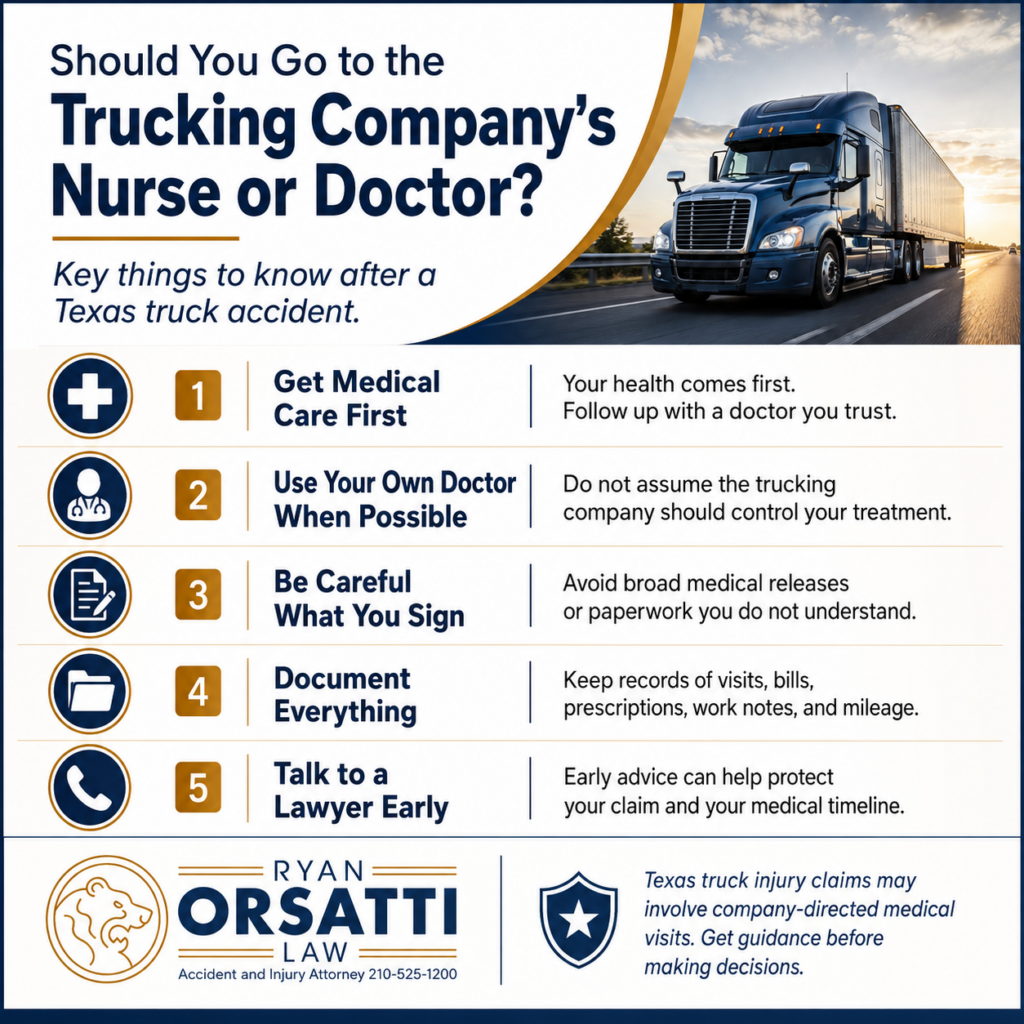
- In an ordinary Texas third-party truck-crash claim, a trucking-company nurse case manager generally has no automatic right to attend your private doctor appointment.
- The safer default is to meet with your doctor privately and provide relevant records through a controlled, written process.
- Do not cancel or delay needed care because a nurse case manager appears. Tell the clinic that you do not consent to the nurse entering the exam room or joining the medical discussion.
- Different rules may apply if your injury is also a Texas workers’ compensation claim, a required medical examination, or a court-ordered examination.
Key Takeaways
- A nurse case manager hired by the trucking company or its insurer is paid by an adverse party, even if the nurse is polite and offers to coordinate care.
- Silence can create a problem. Federal privacy rules allow a provider in some situations to infer that a patient does not object when another person is present.
- A written medical authorization can often be withdrawn in writing, but withdrawal does not erase information already disclosed.
- Excluding the nurse from the room does not hide relevant medical evidence. It keeps the visit focused and leaves later disclosure to a defined authorization, subpoena, court order, or other lawful process.
- Texas injury and trucking-evidence deadlines continue to run while medical treatment is underway.
Ryan Orsatti Law is a San Antonio personal injury firm that has represented injured Texans for more than a decade. The firm reviews trucking-company medical requests, privacy releases, and evidence-preservation issues in serious truck and commercial-vehicle claims.
Can a Trucking Company Nurse Sit in on My Doctor Appointment?
Usually not without your consent in a normal third-party injury claim. A third-party injury claim is a claim against the trucking company, driver, or another responsible business rather than a claim under your employer’s workers’ compensation policy.
Texas Occupations Code Section 159.002 makes a physician’s communications with a patient, along with records of the patient’s identity, diagnosis, evaluation, and treatment, confidential and privileged. Federal privacy rules also limit when a covered medical provider may disclose protected health information, or PHI, which is identifying information about a person’s health care.
HIPAA does not contain a sentence that simply says who may sit in an exam room. The practical rule comes from consent and disclosure limits. Under 45 C.F.R. Section 164.510, a provider may discuss relevant PHI with another person when the patient agrees, has an opportunity to object and does not object, or when the provider reasonably infers from the circumstances that the patient does not object. A patient who wants a private visit should say so clearly before the discussion starts.
Attorney Insight: The most damaging appointment issue is often not a dramatic confrontation. It is a short, incomplete sentence that enters the chart after the nurse frames the conversation around a prior condition, return-to-work date, missed visit, or treatment “plateau.” A private exam lets the patient describe symptoms and limitations in the patient’s own words before anyone else supplies the frame.
Why Does the Trucking Company Want a Nurse Case Manager There?
The trucking company’s strongest explanation is that a nurse can coordinate appointments, collect work restrictions, reduce communication delays, and help everyone understand the treatment plan. Those functions can be legitimate in a workers’ compensation system where the carrier is paying medical and income benefits and Texas regulates medical case management.
The incentives differ in a liability claim against the trucking company. The nurse may report the diagnosis, prognosis, work status, treatment recommendations, prior medical history, comments about pain, and statements about how the crash happened to the company paying for the nurse’s services. The carrier evaluates both liability, meaning who caused the crash, and damages, meaning the physical, financial, and personal harm caused by the crash.
A nursing license does not make the nurse the injured person’s independent advocate. Ask who hired the nurse, who receives the nurse’s reports, what information the nurse intends to collect, and whether the nurse has authority to approve care. A claimant should not assume the nurse’s role from the title alone.
When Is a Private Visit the Safer Choice?
A private visit is usually the safer choice when the nurse was hired by the trucking company, its liability insurer, a third-party administrator, or defense counsel. The answer may change when the nurse works for the patient, the patient’s own health plan, or a Texas workers’ compensation network.
| Situation | Usual approach | Main concern | Safer alternative |
|---|---|---|---|
| Third-party truck claim | Decline attendance unless counsel identifies a reason to allow it | Live access to symptoms, history, exam, and treatment planning | Private visit plus narrow, written record exchange |
| Texas workers’ compensation claim | Review the network, benefit, and case-management rules first | Care authorization and return-to-work communication may be involved | Private patient exam followed by a limited status discussion when appropriate |
| Patient-selected care coordinator | Consider attendance after confirming loyalty and confidentiality | Role confusion or unnecessary disclosure | Written limits on purpose, recipients, and reporting |
| Required or court-ordered examination | Follow the governing notice, order, and counsel’s instructions | This is an evaluation, not ordinary treatment | Prepare for the examination and document who attended |
What Should I Do if the Nurse Shows Up at the Clinic?
Keep the appointment and state your objection calmly and in writing. The goal is uninterrupted medical care, not a waiting-room argument.
- Tell the front desk before check-in. Say that you do not consent to the nurse entering the exam room, hearing the medical discussion, receiving an after-visit summary, or speaking privately with the doctor.
- Give the clinic a written notice. Ask staff to place the notice in your chart and identify the nurse and the company that hired the nurse.
- Repeat the request to the clinical staff. Tell the medical assistant and doctor that you want a private examination.
- Do not debate the claim during treatment. Give the doctor a complete and accurate history, including prior similar symptoms, but do not let the appointment become an insurer interview.
- Ask for the visit note and after-visit summary. HIPAA generally gives patients access to records in a designated record set, and a covered provider ordinarily must act on an access request within 30 days.
- Correct factual errors promptly. Send a short written message through the patient portal if the note incorrectly states the crash history, body part, prior condition, symptom onset, work status, or who attended.
- Save every message. Keep texts, emails, appointment notices, releases, nurse reports sent to you, and the names of clinic staff who handled the request.
- Have counsel review the arrangement. A lawyer can determine whether the nurse’s involvement is tied to liability insurance, workers’ compensation, an occupational accident policy, or another benefit program.
Can I Revoke a Medical Authorization I Already Signed?
A patient can often withdraw a medical authorization in writing, but the wording and the type of claim matter. A medical authorization is a written permission allowing specified health information to be released to identified people for a stated purpose.
Texas Occupations Code Section 159.005 requires a physician release to identify the information covered, the reason or purpose for the release, and the person receiving it. The same section says the patient may withdraw consent. Withdrawal does not affect information disclosed before the physician receives written notice.
HIPAA has a similar rule. Under 45 C.F.R. Section 164.508, an individual may revoke an authorization in writing, subject to action already taken in reliance on it and a limited insurance-coverage exception. A valid HIPAA authorization also must describe the information, identify who may disclose and receive it, state the purpose, include an expiration date or event, and contain a signature and date.
Send any revocation to the provider, the nurse, the adjuster, and every company named in the release. Ask the provider to confirm receipt and place the revocation in the chart. A verbal objection at the appointment is useful, but written notice creates a clearer record.
Does HIPAA Stop the Insurer From Ever Getting My Records?
No. Keeping a nurse out of a treatment visit does not prevent lawful access to relevant medical information later. Records may be produced through a valid authorization, a court order, a properly supported subpoena or discovery request, or another legal exception.
HIPAA Section 164.522 lets a patient request limits on uses and disclosures, but a covered provider generally does not have to agree to every requested restriction. That is why the strongest protection is a clear private-visit request, careful control of authorizations, written revocation when appropriate, and prompt review of the chart.
A patient can also obtain the patient’s own records. Texas law generally requires a physician who receives proper written consent to provide requested records or a summary no later than the 15th business day, subject to the statute’s exceptions. Reviewing the chart reveals what the provider documented and whether the nurse or adjuster contacted the office.
What Changes if the Crash Happened While I Was Working?
A work-related crash may involve a separate Texas workers’ compensation process, so the ordinary third-party answer may not be enough. Federal HIPAA rules permit disclosures that are authorized by and necessary to comply with workers’ compensation laws. The Texas Department of Insurance also recognizes regulated medical case management and return-to-work coordination in workers’ compensation networks.
A driver, road worker, delivery employee, or other person injured on the job may have both a workers’ compensation claim and a third-party claim against a negligent trucking company. The two systems have different payers, forms, medical-control rules, and incentives. Before revoking a release or refusing all case-manager contact, identify which claim the nurse is working on and whether the nurse controls any authorization or benefit process.
Why Medical Privacy Is Only One Part of a Truck Accident Claim
Medical privacy matters, but the trucking company also controls evidence that can affect fault. Federal rules require a motor carrier to retain driver records of duty status and supporting documents for at least six months. Texas Civil Practice and Remedies Code Section 16.003 generally gives an injured person two years to file a personal injury lawsuit, but the legal filing period is much longer than some trucking-data retention periods.
Someone injured in a San Antonio truck crash on I-10, I-35, Loop 410, or Loop 1604 should not let a dispute over a nurse distract from treatment or evidence preservation. Ryan Orsatti Law’s guide to truck evidence that can disappear quickly explains why ELD data, video, dispatch messages, vehicle data, and physical evidence need early attention.
How Ryan Orsatti Law Handles Nurse Case Manager Issues
Ryan Orsatti Law reviews who retained the nurse, what releases were signed, what the provider disclosed, and whether the nurse is connected to a liability claim, workers’ compensation claim, or occupational accident policy. In Texas truck accident cases and commercial vehicle accident claims, the firm can address medical communications while also preserving carrier records, identifying insurance, and investigating the driver and motor carrier.
Frequently Asked Questions
Can I tell the nurse case manager to wait outside?
Yes, in an ordinary third-party claim you can clearly tell the clinic and nurse that you do not consent to the nurse entering the exam room or hearing the medical discussion. Make the request before the visit starts and put it in writing. The provider still controls office procedures, but the trucking company’s nurse does not gain an automatic attendance right merely by arriving.
Should I sign the trucking insurer’s HIPAA release?
Do not sign a broad release without understanding its scope. A valid authorization should identify the information, sender, recipient, purpose, and expiration. A provider-specific and date-limited release may be appropriate later. A blanket release can expose unrelated history and allow direct communications. Have the proposed form reviewed before signing if the truck crash caused a serious injury.
Can the nurse speak to my doctor after I leave?
The nurse may try, but the provider’s ability to disclose information depends on your authorization and any applicable legal exception. Give the office written notice that you do not consent to private conversations or disclosures outside a specifically identified lawful process. Request your chart afterward and look for telephone notes, portal messages, scanned releases, or other entries showing outside contact.
What if the nurse says care will be delayed unless I cooperate?
Ask the nurse to identify the claim, payer, written rule, and specific authorization decision involved. In a third-party liability claim, the trucking insurer usually is not administering your ordinary medical care. A workers’ compensation or occupational accident claim can be different. Do not miss needed treatment while sorting it out, and get any threatened denial or delay in writing.
Should I wait until treatment ends before calling a truck accident lawyer?
No. Continue necessary medical care, but address privacy releases and trucking evidence early. Federal rules require carriers to keep certain duty-status records for at least six months, while other video or electronic data may follow shorter company cycles. Early review can separate the medical-communication issue from the immediate need to preserve evidence and identify every applicable insurance or benefit claim.
Source Notes
- Texas Occupations Code Chapter 159, including Sections 159.002, 159.005, and 159.006, on physician-patient confidentiality, consent, withdrawal, and access to records.
- 45 C.F.R. Section 164.508, governing authorizations for uses and disclosures of protected health information.
- 45 C.F.R. Section 164.510, governing disclosures when an individual may agree or object.
- 45 C.F.R. Section 164.512, including judicial-process and workers’ compensation disclosures.
- 45 C.F.R. Section 164.522, addressing requests for privacy restrictions and confidential communications.
- 45 C.F.R. Section 164.524, addressing access to protected health information.
- Texas Civil Practice and Remedies Code Section 16.003, the general limitations provision for personal injury claims.
- 49 C.F.R. Section 395.8, including the six-month minimum retention period for driver records of duty status and supporting documents.
- Texas Department of Insurance workers’ compensation health care network guidance, addressing medical case management and carrier responsibilities.
If you were injured in a truck or commercial vehicle crash in Texas, you can talk through the nurse case manager, medical-release, and evidence-preservation issues with Ryan Orsatti Law in a free consultation. Calls are answered 24/7, and consultations are available in English and Spanish.
Ryan Orsatti Law
4634 De Zavala Rd, San Antonio, TX 78249
Phone: 210-525-1200
ryanorsattilaw.com
This blog is for informational purposes only, not legal advice. Reading it does not create an attorney-client relationship. Past results do not guarantee future results.
Hurt in an accident in San Antonio? Learn how a San Antonio truck accident lawyer can help with your claim. Call 210-525-1200 or request a free consultation.
The firm works on a contingency fee. You pay nothing unless the firm recovers money for you, and that covers case expenses as well as the fee: if there is no recovery, you owe no attorney's fee and no case expenses. Ask for the fee agreement and read the fee and expense section before you sign anything.
Related San Antonio legal resources
Primary legal and public-data sources
Ryan Orsatti Law
4634 De Zavala Road, San Antonio, TX 78249
General reference links. Consult each source for its current text.