
Quick Answer
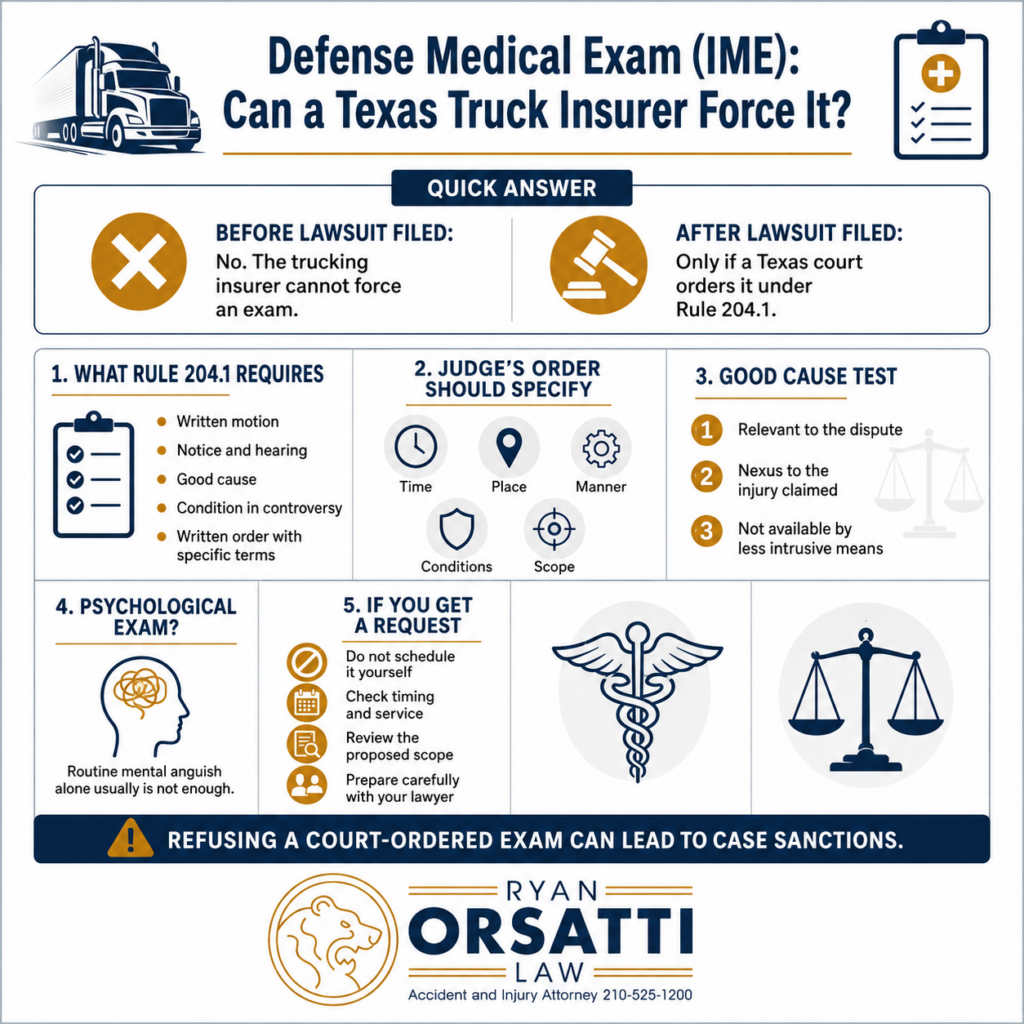
- Before a lawsuit is filed, no. A trucking company’s liability insurer has no contract with you and no authority to order you to a doctor of its choosing.
- After suit is filed, yes, but only by court order. Under Texas Rule of Civil Procedure 204.1, a defendant must file a motion, serve it on you, and show good cause at a hearing.
- The order must be in writing and must specify the time, place, manner, conditions, and scope of the examination and who performs it. Those terms are negotiable.
- It is a defense medical examination, not an independent one. The physician is chosen, retained, and paid by the trucking company’s side.
Key Takeaways
- Texas Rule of Civil Procedure 204.1 is the only route a defendant has to compel a physical or mental examination, and it requires a written court order.
- The motion must be filed no later than 30 days before the end of the applicable discovery period and served on the person to be examined and on all parties.
- Good cause has three parts under Texas Supreme Court authority: relevance, a reasonable nexus to the condition in controversy (the condition your lawsuit puts at issue), and proof that the information cannot be obtained by less intrusive means.
- A routine allegation of mental anguish does not, by itself, open the door to a psychological examination.
- If you request the defense examiner’s report under Rule 204.2, you trigger a reciprocal duty to produce your own doctors’ reports on the same condition.
- A Texas court cannot hold you in contempt for refusing a Rule 204 examination, but it can strike your pleadings, deem facts established, or dismiss your case.
Getting the terms of that examination right matters as much as the answer to whether you have to go. Ryan Orsatti Law handles Texas 18-wheeler and commercial vehicle injury cases and reviews defense examination notices for injured people in San Antonio and across the state, including negotiating the scope and conditions of the exam before anyone walks into that office.
Can the Trucking Company’s Insurer Make You See Their Doctor Before You File Suit?
No. Before a lawsuit exists, the motor carrier’s liability insurer has no legal mechanism to compel you to attend a medical examination. You have no contract with that carrier’s insurer, and the Texas Rules of Civil Procedure only apply once a case is on file.
Texas does allow limited discovery before suit, but it is narrow. Rule 202.1 lets a person petition a court for an order authorizing “the taking of a deposition on oral examination or written questions” to perpetuate testimony or to investigate a potential claim. That is testimony only. Rule 202 contains no companion procedure for a pre-suit physical or mental examination.
Adjusters know this, which is why the request usually arrives as an invitation rather than a demand. It gets framed as a step needed to “evaluate” or “move the file along,” sometimes bundled with a request for a recorded statement or a broad medical authorization. In matters we handle, that packaging is the point. A voluntary examination gives the defense a paid opinion before you have finished treating, before imaging is complete, and before anyone has taken the truck driver’s deposition.
Your own insurance policy is a different question
Watch the distinction between a third-party claim and a first-party claim. The trucking company’s insurer is a third party to you, so nothing binds you to it. Your own uninsured/underinsured motorist coverage (UM/UIM, which pays when the at-fault driver has no insurance or not enough) or personal injury protection coverage (PIP, no-fault medical and wage benefits under your own policy) is a contract you signed, and those policies commonly contain cooperation provisions that may include submitting to an examination. Whether such a provision applies here, and what it actually requires, depends on the wording of your specific policy. Have it read before you agree to anything or refuse anything.
| Stage | Can they compel an exam? | Source of the power |
|---|---|---|
| Pre-suit claim with the motor carrier’s insurer | No. Attendance is voluntary. | No contract with you, and no rule authorizes it. Rule 202 reaches depositions only. |
| After suit is filed against the driver and carrier | Yes, if the court signs an order. | Tex. R. Civ. P. 204.1, on motion and a showing of good cause. |
| Claim under your own UM/UIM or PIP coverage | Possibly, depending on policy language. | Your insurance contract, not the rules of procedure. |
| Exam set up by agreement of the lawyers | Yes, on whatever terms the agreement states. | Tex. R. Civ. P. 204.2(b) applies to agreed examinations unless the agreement says otherwise. |
What Rule 204.1 Requires Before a Court Can Order an Exam
Rule 204.1 requires four things: a timely motion, service, a good cause showing at a hearing, and a written order with specific terms. A Texas defendant cannot simply notice up an examination the way it notices a deposition, and each of the four checkpoints is a place where terms get set.
- A motion. A party may, no later than 30 days before the end of any applicable discovery period, move for an order compelling another party to submit to a physical or mental examination by a qualified physician, or to a mental examination by a qualified psychologist.
- Service. The motion and the notice of hearing must be served on the person to be examined and on all parties. In a truck case with a driver, a motor carrier, a trailer owner, and a broker all in the suit, every one of them is entitled to notice, and every one of them may want a say.
- Good cause, shown to the judge. The court may issue an order for examination only for good cause shown, and only when the mental or physical condition of a party is in controversy (or, for a psychological examination, when the responding party has designated a psychologist as a testifying expert or disclosed a psychologist’s records for possible use at trial).
- A written order with specifics. The order must be in writing and must specify the time, place, manner, conditions, and scope of the examination and the person or persons by whom it is to be made.
That fourth requirement is the one most people never hear about, and it is where a lawyer earns the fee on this issue. “Manner, conditions, and scope” are not decoration. They are the terms of the examination, and the judge has to put them in writing.
Good Cause and “In Controversy”: The Three-Part Test
Good cause in Texas has three parts, and the defense carries the burden on all three. In In re H.E.B. Grocery Co., 492 S.W.3d 300 (Tex. 2016), the Texas Supreme Court stated that the movant must (1) show the requested examination is relevant to issues in controversy and will produce or likely lead to relevant evidence, (2) establish a reasonable nexus between the requested examination and the condition in controversy, and (3) demonstrate that the desired information cannot be obtained by less intrusive means.
The same three-part framework came from Coates v. Whittington, 758 S.W.2d 749 (Tex. 1988), where the Court also drew a line that still matters in serious injury cases: a routine allegation of mental anguish or emotional distress does not place a party’s mental condition in controversy. To open that door, the claim has to assert a mental injury that exceeds the common emotional reaction to an injury or loss.
That distinction does real work in trucking cases. Plenty of people who survive an underride collision on I-35 or a rollover on Loop 410 have nightmares and avoid driving. Pleading ordinary mental anguish as part of your damages is not the same as putting a diagnosed psychological condition at issue, and the defense should not get a psychologist’s examination on the strength of the generic paragraph in a petition.
The strongest version of the defense argument
Here is the contrary position, stated fairly, because you should hear it before deciding to fight. Under H.E.B., when a plaintiff asserts a physical injury and intends to use expert medical testimony to prove that condition, the condition is in controversy and the defendant has good cause. Texas appellate courts have extended that reasoning to the less intrusive means prong. In In re Savoy, No. 03-19-00361-CV (Tex. App.—Austin July 30, 2020, orig. proceeding), the court accepted that records and depositions were not an adequate substitute, reasoning that requiring the defense physician to refute the plaintiff’s expert without an examination placed him at a distinct disadvantage.
Read together, those cases mean that in a truck case where you intend to put on medical testimony about your injuries, a Texas judge is likely to allow a physical examination. Fighting whether the examination happens usually loses. Fighting over its terms usually does not.
Attorney Insight: Treat the examination motion as a negotiation, not a yes-or-no fight. When we expect a court to grant the examination anyway, the productive move is to agree to a reasonable exam in exchange for written terms: a named physician in the correct specialty, no repeat imaging that duplicates studies already produced, a stated time limit, no questions about how the crash happened or about your lawyers, and no psychological or diagnostic testing unless the order specifically authorizes it. Judges sign agreed orders quickly. A contested hearing over whether the exam happens at all often ends with a broader order than the one you could have negotiated.
On What Terms: The Five Things the Order Must Specify
Rule 204.1(d) requires the order to specify time, place, manner, conditions, and scope, plus the person or persons performing the examination. Each one is worth attention.
- Time. A date and a duration. An examination scheduled the week before a mediation, or the day after a surgery, is worth moving.
- Place. The location. If you live in San Antonio and the defense wants an examiner in Dallas or Houston, raise travel, cost, and burden. Texas courts see this argument regularly in cases where the carrier is defended by out-of-town counsel.
- Manner. What the examiner may actually do. A physical examination is not a license to run a battery of psychological instruments or order new imaging.
- Conditions. The ground rules. Who may be present, whether anything may be recorded, whether the examiner may take a narrative history of the collision, and how long the exam may last.
- Scope, and who performs it. Which body parts and which conditions, performed by a named individual. Rule 204.1 speaks in terms of a qualified physician or, for mental examinations, a qualified psychologist. The order should name the person, not just a clinic.
Where the parties cannot agree, Rule 192.6(b) is the tool. It lets a court protect a person from undue burden, unnecessary expense, harassment, annoyance, or invasion of personal, constitutional, or property rights, and it authorizes orders limiting the extent or subject matter of discovery, changing the time or place, or directing that discovery proceed “only by such method or upon such terms and conditions or at the time and place directed by the court.”
Can You Record the Exam or Bring Someone With You?
Not automatically, and the burden is on you. In In re Society of Our Lady of the Most Holy Trinity, 622 S.W.3d 1 (Tex. App.—Corpus Christi–Edinburg 2019, orig. proceeding), the appellate court conditionally granted mandamus (an order from a higher court correcting a trial judge’s ruling before trial) and vacated a trial court order that had allowed a plaintiff to videotape a court-ordered psychological examination. The party seeking to record must show special circumstances or a particularized need, unique to that person’s situation and supported by specific facts. Generalized concerns about trauma were not enough on that record.
The practical lesson is to build the record before the hearing rather than asking for a camera as an afterthought. Specific facts about this person and this examination, such as a documented cognitive or language limitation, a treating provider’s written concern, or a documented history with the particular examiner, are what a court needs. Asking for a companion in the waiting room, or a written log of start and stop times, is a smaller request that often gets agreed to when a video request would not.
The Report Exchange Trap in Rule 204.2
Rule 204.2(a) sets up an exchange that catches people who ask for the defense examiner’s report without thinking it through. On request of the person examined, the party who caused the examination must deliver a detailed written report of the examining physician or psychologist, including findings, test results, diagnoses, and conclusions, along with like reports of all earlier examinations of the same condition. Once that happens, on request of the party who caused the examination, the examined party must produce like reports of any prior or subsequent examination of the same condition.
In other words, asking for their report can obligate you to hand over yours. The rule also gives the court authority to limit delivery of a report on such terms as are just, and it provides that if the physician or psychologist fails or refuses to make a report, the court may exclude that testimony at trial. Rule 204.2(b) applies the same framework to examinations made by agreement of the parties unless the agreement expressly says otherwise, which is one more reason to put agreed examinations in writing.
What Happens If You Refuse a Court-Ordered Exam?
You will not be jailed, but you can lose the case. Rule 215.2(b) lists the sanctions available when a party fails to comply with a discovery order, and it specifically carves out examinations from the contempt power: the court may treat as contempt the failure to obey any order “except an order to submit to a physical or mental examination.”
Everything else on that list still applies. A court may disallow further discovery by the disobedient party, charge discovery expenses or court costs against that party, order that designated facts be taken as established, refuse to allow the party to support or oppose designated claims or defenses, strike pleadings in whole or in part, stay the proceeding until the order is obeyed, or dismiss the action. The court must also order payment of reasonable expenses, including attorney fees, caused by the failure, unless the failure was substantially justified or an award would be unjust.
Rule 204.3 adds a quieter consequence that runs the other direction. If no examination is sought or ordered, the party whose physical or mental condition is in controversy must not comment to the court or jury about a willingness to be examined or about another party’s failure to seek an examination. Neither side gets to make theater out of the absence of an exam.
Why Truck Cases Draw Harder Exam Fights Than Car Cases
Commercial vehicle claims are worked up differently because more money and more defendants are involved. Under 49 C.F.R. 387.9, for-hire motor carriers operating in interstate commerce with a gross vehicle weight rating of 10,001 pounds or more must carry minimum financial responsibility of $750,000 for nonhazardous property, rising to $5,000,000 for certain hazardous materials. Those limits are several times the minimums behind a typical passenger car claim, and defense budgets scale with exposure.
The volume is real, too. TxDOT’s commercial motor vehicle county data reported 39,393 CMV-involved crashes statewide in 2024, including 546 fatal crashes and 608 fatalities. Bexar County accounted for 2,684 of those crashes, with 18 fatal crashes, 18 deaths, and 46 suspected serious injuries. Statewide, TxDOT reported 4,150 motor vehicle traffic fatalities in 2024.
Three practical differences follow. Multiple defendants can each seek an examination, so the order should address whether one exam covers all of them. Catastrophic injury allegations invite requests for several specialties, such as an orthopedist plus a neuropsychologist, and each request needs its own good cause showing. And the defense examination is usually paired with other attacks on causation, including arguments that your injuries came from a pre-existing conditionrather than the collision, so the report rarely arrives alone.
Attorney Insight: The defense examination report is written for a jury, not for your treatment. Adjusters and defense counsel use it to reprice the claim: to argue that treatment after a certain date was unrelated, that a recommended surgery is not reasonable and necessary, or that degenerative findings on imaging explain your symptoms. That is why the preparation matters more than the argument about whether to go. Be accurate, be complete about prior injuries and prior claims, do not perform beyond what you can tolerate, do not minimize your pain to be polite, and write down what happened as soon as you get to your car, including who was present and how many minutes the physician actually spent with you.
If You Get a Rule 204 Exam Notice: Eight Steps
- Do not confirm the appointment directly with the examiner’s office. Route it through your lawyer, because the date and location are terms of a court order, not scheduling logistics.
- Check the timing against the docket control order (the judge’s scheduling order setting the case deadlines). The motion has to be filed no later than 30 days before the end of the applicable discovery period, and a late motion is a real objection.
- Confirm the motion and hearing notice were served on you and on every party. Rule 204.1(b) requires it.
- Identify the examiner by name and specialty, and confirm the person is a qualified physician (or a qualified psychologist for a mental examination) for the condition actually at issue.
- Compare the proposed scope to your pleaded injuries. If your case involves a shoulder and a lumbar spine, an order that reaches your entire medical history is too broad.
- Decide the psychological question separately. If you have pleaded only ordinary mental anguish, Coates supports the position that a psychological examination is not on the table.
- Negotiate written conditions before the hearing: time limit, no new imaging or diagnostic testing without leave, no questions about liability or your attorney communications, and a stated start and stop time.
- Prepare the same way you would for a deposition. Review your own records, know your treatment timeline and prior injuries, and understand what the physician is retained to conclude. Our post on preparing for a deposition in a San Antonio personal injury case covers the same discipline.
Why Injured Texans Ask a Truck Accident Lawyer to Handle the Exam Terms
A defense medical examination in an 18-wheeler case is a discovery event with rules attached, and the fight worth having is usually about scope rather than attendance. A lawyer working this issue reviews the motion for timing and service defects, tests each prong of good cause against what has actually been pleaded and designated, separates the physical examination question from the psychological one, drafts the conditions that go into the written order, and preserves objections for the record if the court orders more than the rule allows. After the examination, the same lawyer reads the report against the treating records, decides whether to request it under Rule 204.2 given the reciprocal production it triggers, and prepares the examiner’s deposition. Ryan Orsatti Law handles truck and commercial vehicle collisions, car accidents, motorcycle crashes, pedestrian collisions, and catastrophic injury cases for injured people and families in San Antonio and across Texas, and works on a contingency fee, so you owe no attorney’s fee unless we recover for you.
Frequently Asked Questions
Do I have to go to the insurance company’s doctor after a truck accident in Texas?
Not before a lawsuit is filed. The trucking company’s liability insurer has no contract with you and no rule that lets it compel an examination during a pre-suit claim. After suit is filed, a defendant can obtain a court order under Texas Rule of Civil Procedure 204.1 by filing a motion, serving it, and showing good cause at a hearing. Your own UM/UIM or PIP policy is a separate question governed by the policy language.
What is the difference between an IME and a defense medical exam?
They describe the same event, but the second name is accurate. The physician is selected, retained, and paid by the defense to give an opinion for litigation, not to treat you. Texas Rule of Civil Procedure 204 never uses the phrase “independent medical examination.” Calling it a defense medical examination keeps the relationship clear for you and for a jury later.
Can I refuse a court-ordered medical exam in Texas?
You can refuse, but the consequences fall on your case rather than on your liberty. Rule 215.2(b) specifically excludes an order to submit to a physical or mental examination from the court’s contempt power. The same rule still allows a court to deem facts established, refuse to let you support your claims, strike your pleadings, dismiss the action, and award the other side its reasonable expenses and attorney fees.
Can I record the defense medical exam or bring someone with me?
Only if the order allows it, and you carry the burden to justify it. Texas appellate authority requires a party seeking to record an examination to show special circumstances or a particularized need, unique to that person, supported by specific facts. Generalized concerns are not enough. A companion, a written log of start and stop times, or a limit on the examination’s length are smaller requests that are often agreed to.
Can the defense make me see a psychologist if I claim emotional distress?
Not on a routine mental anguish allegation alone. Under Coates v. Whittington, a routine claim of mental anguish or emotional distress does not place your mental condition in controversy. The claim must assert a mental injury exceeding the common emotional reaction to an injury or loss. Rule 204.1 also permits a psychological examination when you have designated a psychologist as a testifying expert.
How long does the trucking company have to request an exam?
The motion must be filed no later than 30 days before the end of the applicable discovery period under Rule 204.1(a). The discovery period itself depends on the discovery control plan in your case and on the court’s scheduling order. A motion filed inside that 30-day window is subject to challenge, so the docket control order is worth checking as soon as the request arrives.
Should I wait to talk to a lawyer until the exam is scheduled?
No. By the time an examination notice arrives, the terms are already being set and the deadline to respond is short. Texas also imposes a general two-year deadline to file a personal injury suit under Civil Practice and Remedies Code Section 16.003, and evidence in truck cases, including electronic logging data and dashcam video, can be overwritten while a claim sits. Earlier involvement means more room to negotiate and preserve.
Source Notes
- Tex. R. Civ. P. 202.1, 204.1, 204.2, 204.3, 192.6, and 215.2, Texas Rules of Civil Procedure (Texas Judicial Branch).
- In re H.E.B. Grocery Co., L.P., 492 S.W.3d 300 (Tex. 2016) (per curiam) (No. 15-0625), opinion.
- Coates v. Whittington, 758 S.W.2d 749 (Tex. 1988).
- In re Society of Our Lady of the Most Holy Trinity, 622 S.W.3d 1 (Tex. App.—Corpus Christi–Edinburg 2019, orig. proceeding) (No. 13-19-00064-CV).
- In re Savoy, No. 03-19-00361-CV (Tex. App.—Austin July 30, 2020, orig. proceeding).
- Tex. Civ. Prac. & Rem. Code Sec. 16.003, Texas Constitution and Statutes.
- 49 C.F.R. 387.9 (minimum levels of financial responsibility for motor carriers), eCFR.
- TxDOT, Commercial Motor Vehicle Involved Crashes and Injuries by County, 2024, Crash Records.
- TxDOT, Texas Motor Vehicle Traffic Crash Facts, Calendar Year 2024, summary.
Talk Through Your Options
If a trucking company’s insurer has asked you to attend a medical examination after a Texas truck crash, or a defendant has filed a motion under Rule 204.1, you can talk through your options with Ryan Orsatti Law in a free consultation. Calls are answered 24 hours a day, in English and Spanish, and there is no attorney’s fee unless we recover for you. See our related guides on how insurance companies use the IME, what to do when the other driver’s insurance demands you see their doctor, and recorded statements to the motor carrier’s insurer.
Ryan Orsatti Law
4634 De Zavala Rd, San Antonio, TX 78249
Phone: 210-525-1200
ryanorsattilaw.com
This blog is for informational purposes only, not legal advice. Reading it does not create an attorney-client relationship. Past results do not guarantee future results.
Hurt in an accident in San Antonio? Learn how a San Antonio truck accident lawyer can help with your claim. Call 210-525-1200 or request a free consultation.
The firm works on a contingency fee. You pay nothing unless the firm recovers money for you, and that covers case expenses as well as the fee: if there is no recovery, you owe no attorney's fee and no case expenses. Ask for the fee agreement and read the fee and expense section before you sign anything.
Related San Antonio legal resources
Primary legal and public-data sources
Ryan Orsatti Law
4634 De Zavala Road, San Antonio, TX 78249
General reference links. Consult each source for its current text.