
Quick Answer
- If you are hurt in a Tesla Robotaxi accident in San Antonio, Texas law treats the driverless car like a rideshare driver for insurance purposes, so at least $1 million in liability coverage per incident applies while a ride is underway.
- When the robotaxi’s automated driving system is engaged, Texas law says the system itself is the “operator,” and any traffic ticket goes to the vehicle’s owner or the company authorized to run it.
- The Tesla Robotaxi app’s terms send rider disputes to private arbitration unless the rider opts out by letter within 30 days of accepting the terms.
- The general Texas deadline to file a personal injury lawsuit is two years from the crash.
Key Takeaways
- Texas classifies a company that sells rides in automated vehicles through an app as a transportation network company (TNC), the same legal category as Uber and Lyft.
- Texas requires every company running driverless vehicles for commercial passenger service to hold an authorization from the Texas Department of Motor Vehicles (TxDMV).
- TxDMV’s latest authorization report lists “Tesla Robotaxi, LLC” with 1,080 automated vehicles statewide.
- The robotaxi’s cameras and data recorder may hold the best evidence of the crash, but Tesla controls that data, not you.
- People hurt outside the car (another driver, a pedestrian, a cyclist) never agreed to Tesla’s app terms.
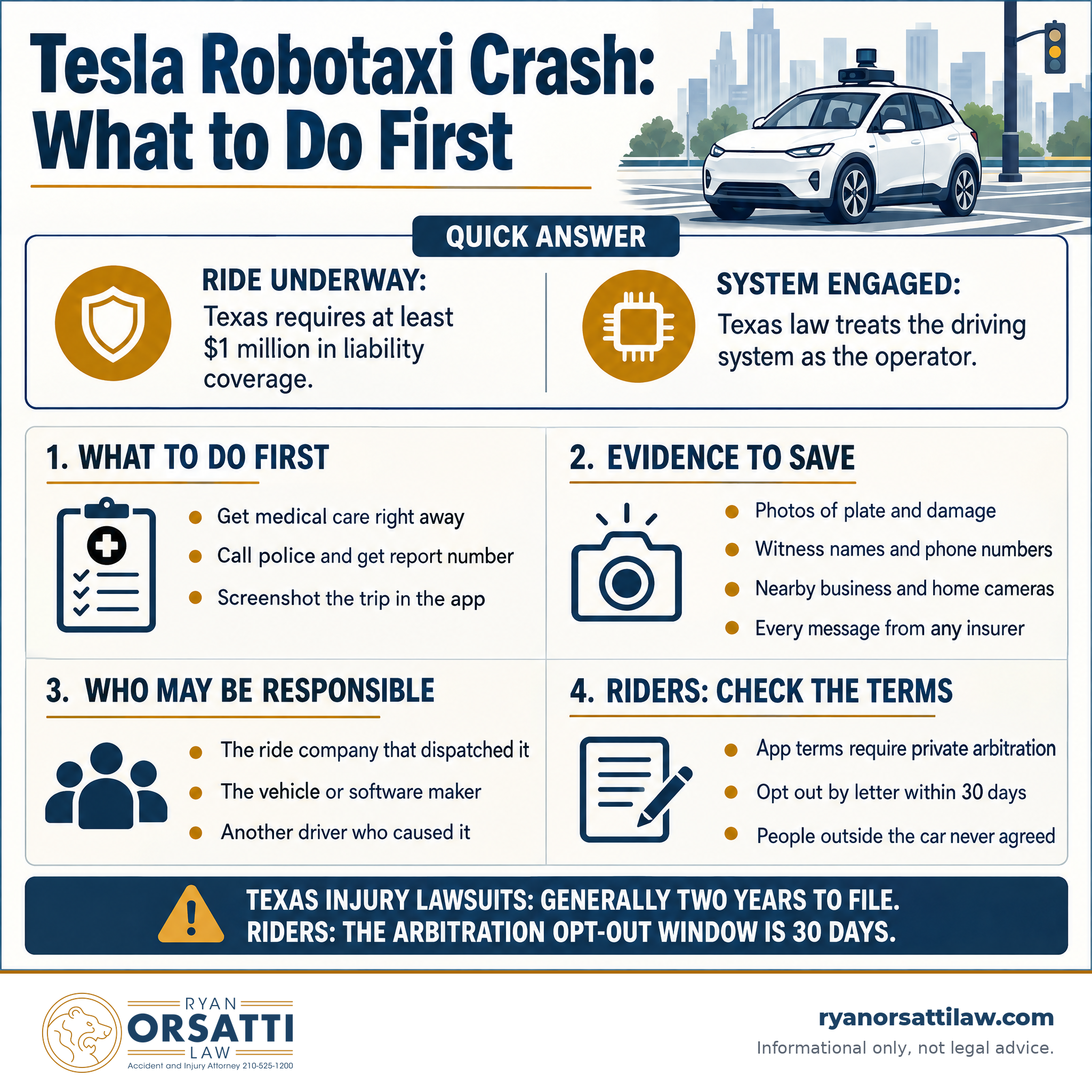
Tesla’s ride-hailing service is now picking up riders in San Antonio, and a crash involving a car with no one behind the wheel raises questions most people have never had to ask. Ryan Orsatti Law, a San Antonio personal injury firm that has represented injured Texans for more than a decade, can review a robotaxi crash claim with you in a free consultation, in English or Spanish.
Who Is Responsible When a Tesla Robotaxi Crashes in Texas?
Responsibility for a Tesla Robotaxi crash in Texas depends on what caused it, and more than one party can share the blame. A robotaxi can be hit by a careless human driver, it can make its own mistake, or both can happen in the same collision.
Texas Transportation Code Section 545.454 says that when an automated driving system (the hardware and software that drive the car) is engaged, that system is the operator of the vehicle. The same section says traffic citations go to the vehicle’s owner, or to the authorization holder if the car runs under a TxDMV authorization. Those rules settle who gets the ticket. They do not, by themselves, decide every question of civil fault in an injury claim.
In practice, an injury claim after a robotaxi crash usually looks at these possible sources of responsibility:
- The company running the ride service. The TxDMV authorization holder and TNC that dispatched the car and is responsible for the required insurance.
- The manufacturer or software developer. A product liability claim (a claim that a product was defectively designed, built, or labeled) can apply if the driving system or vehicle failed.
- Another driver. If a human driver ran a light or rear-ended the robotaxi, that driver and their insurer are in the picture too.
Texas uses proportionate responsibility (a system that splits fault by percentage). Under Civil Practice and Remedies Code Section 33.001, an injured person cannot recover damages if their own share of responsibility is greater than 50 percent.
Attorney Insight: In a normal wreck, the other driver tells their story and the police write it down. In a robotaxi wreck, the “driver” is a computer with cameras pointed in every direction, and the company that owns it decides what gets saved and what gets shared. The first thing we want in these files is a written demand that Tesla preserve the vehicle’s video, sensor data, and remote support records before any of it is overwritten. That letter costs nothing to send and can matter more than anything else in the case.
How Much Insurance Does a Tesla Robotaxi Have to Carry in Texas?
A Tesla Robotaxi must carry at least $1 million in total liability coverage per incident while it is on a prearranged ride in Texas. Texas Insurance Code Section 1954.003 says an automated motor vehicle is considered a TNC driver for insurance purposes, so the same coverage rules that apply to Uber and Lyft drivers apply to the robotaxi.
A “prearranged ride” starts when the ride is accepted and ends when the last rider gets out, so the $1 million minimum covers the trip to the pickup point as well as the ride itself. The amount of coverage is a legal minimum, not a promise of what any injured person will receive.
| Situation at the time of the crash | Minimum liability coverage Texas requires | Texas law |
|---|---|---|
| Robotaxi carrying a rider or heading to a pickup | $1,000,000 total per incident for death, bodily injury, and property damage, plus PIP and UM/UIM where the Insurance Code requires them | Ins. Code 1954.003, 1954.053 |
| Robotaxi logged on and available, no ride accepted | $50,000 per person and $100,000 per incident for bodily injury, $25,000 for property damage | Ins. Code 1954.003, 1954.052 |
| Any automated vehicle on a Texas road | Liability coverage or self-insurance at least equal to what state or federal law requires for that vehicle’s type and use | Transp. Code 545.455(b)(6) |
| A regular car that hits the robotaxi | $30,000 per person, $60,000 per crash for bodily injury, $25,000 for property damage | Transp. Code 601.072 |
PIP (personal injury protection, which pays some medical bills and lost income regardless of fault) and UM/UIM (uninsured and underinsured motorist coverage) are separate from liability coverage. Whether they apply in a given crash depends on the policies in force, so they need a policy-by-policy review.
Which Situation Fits You?
Your role in the crash changes which insurance to look at first and whether Tesla’s app terms affect your claim.
| Your role | Who may be responsible | Did you accept Tesla’s app terms? |
|---|---|---|
| Rider who booked the trip | The ride company, the vehicle or software maker, and any other driver who caused the crash | Yes. The arbitration clause and its 30-day opt-out window apply. |
| Guest riding on someone else’s booking | Same as a rider | Unclear. Ask a lawyer whether the terms reach you. |
| Driver or passenger in a car the robotaxi hit | The ride company and possibly the vehicle or software maker | No, unless you separately use the app. |
| Pedestrian or cyclist hit by a robotaxi | The ride company and possibly the vehicle or software maker | No, unless you separately use the app. |
| Rider when a human driver hit the robotaxi | The at-fault human driver first, plus the robotaxi side if its driving also contributed | Yes, for any claim against Tesla. |
If you were walking or biking, our San Antonio pedestrian accident lawyer page explains how those claims work. If you were in another car, the San Antonio car accident lawyer page covers the broader claim process.
Do Tesla Robotaxi Riders Have to Go to Arbitration?
Tesla’s Robotaxi Terms of Service require riders to resolve disputes with Tesla through individual arbitration (a private proceeding decided by one arbitrator instead of a judge or jury) unless the rider opts out. The terms first ask you to send a written notice of the dispute to Tesla and allow 60 days to resolve it before arbitration begins.
The same terms let a rider opt out of arbitration within 30 days after accepting them, by mailing a letter to Tesla, Inc., P.O. Box 15430, Fremont, CA 94539-7970 with your name, primary address, phone number, email address, and your intent to opt out. The terms also allow an individual dispute to go to small claims court instead.
Whether arbitration helps or hurts a particular injury claim depends on the facts. A lawyer can tell you how the clause affects your case, but the 30-day window does not wait for that conversation.
What to Do After a Tesla Robotaxi Crash in San Antonio
The first hours after a robotaxi crash decide what evidence you will have later. Do these things in order, as far as your injuries allow:
- Get medical care. Call 911 if anyone is hurt. Tell the doctor exactly how the crash happened and every place that hurts.
- Get police to the scene. Under Transportation Code Section 545.457, the robotaxi company must follow the same post-crash duties in Chapter 550 that apply to any driver. Ask the officer for the report number.
- Screenshot the trip in the app. Save the ride receipt, pickup time, route, fare, and any vehicle number shown, before the app updates.
- Photograph everything. Capture the robotaxi’s plate, any number on its body, the damage, where each car stopped, traffic signals, and the road.
- Collect witnesses and cameras. Get names and phone numbers, and note nearby businesses or homes with cameras.
- Keep every message from Tesla or an insurer. Do not sign a release or give a recorded statement about your injuries until you understand your claim.
- Order the crash report. The Texas Peace Officer’s Crash Report (CR-3) costs $6 for a regular copy and $8 for a certified copy through TxDOT.
- Check the arbitration window. If you are a rider, note the day you accepted the app’s terms and talk to a lawyer before 30 days pass.
For a deeper checklist on preserving passenger evidence in a driverless car, see our guide to a Waymo passenger accident in San Antonio and what to save. Most of it applies to Tesla riders too.
What Records Does a Robotaxi Crash Create?
A Tesla Robotaxi crash can create far more records than a normal wreck, but almost all of them sit with Tesla or a government agency. Here is what exists and who holds it:
- The vehicle’s recording device. Texas Transportation Code Section 545.455 requires an automated vehicle to carry a recording device installed by the manufacturer before it can drive itself on Texas roads. The law requires the device, not a set period for keeping its data.
- Federal crash reports. NHTSA’s Standing General Order requires named companies to report crashes when an automated driving system was in use within 30 seconds of the crash and the crash caused certain property damage or injury. NHTSA posts the data monthly, but a company can ask to keep the crash narrative confidential.
- The police crash report. Texas Transportation Code Section 550.062 requires an investigating officer to send a report to TxDOT within 10 days when a crash causes injury, death, or apparent property damage of $1,000 or more.
- App and trip records. Booking, routing, and support logs held by Tesla.
A crash report is an official record, not proof of fault. The same goes for a company’s federal filing, which is the company’s own account of what happened.
Can Tesla Argue the Robotaxi Was Not at Fault?
Yes, and an injured person should expect Tesla and its insurer to push back hard. The strongest defense arguments in a robotaxi case usually include:
- Another driver caused it. If a human driver ran a light or cut across lanes, the company will point to that driver.
- You share the blame. Under Texas proportionate responsibility, any fault assigned to you reduces your recovery, and more than 50 percent bars it.
- Federal standards compliance. In a product liability claim, Civil Practice and Remedies Code Section 82.008 creates a rebuttable presumption (one that can be overcome with evidence) that a manufacturer is not liable for a design risk covered by mandatory federal safety standards the product met.
- The app terms. For riders, Tesla can rely on its arbitration clause and the limits in its terms.
None of these defenses ends a claim on its own. Each one turns on evidence, and much of that evidence is in Tesla’s hands.
Attorney Insight: Robotaxi crashes are a different animal from the Autopilot cases people have read about. Autopilot is a driver-assist system with a human legally in charge, so the fight is often about what the human should have done. A driverless robotaxi has no human driver to blame, which shifts the focus to the company, the software, and the data. If you want the contrast, our post on whether Tesla is automatically liable when Autopilot is on walks through the driver-assist side.
How Long Do You Have to File a Robotaxi Injury Claim in Texas?
In Texas, you generally have two years from the date of the crash to file a personal injury lawsuit under Civil Practice and Remedies Code Section 16.003. The same two-year period generally applies to a wrongful death claim, counted from the date of death.
Two shorter clocks matter for robotaxi riders. The arbitration opt-out window in Tesla’s terms is 30 days from accepting them, and the terms ask for a written dispute notice and 60 days to resolve it before arbitration starts. Waiting also gives cameras, witness memories, and app records time to disappear.
How Ryan Orsatti Law Handles Driverless Car Crash Claims
A robotaxi crash can look simple on the surface and turn complicated the moment you ask who was driving. The first steps a lawyer takes are to identify the authorization holder and TNC behind the car, confirm the insurance Texas requires, send preservation demands for video and vehicle data, request the CR-3 and any federal crash filing, and check whether the rider’s app terms affect where the claim is heard. Ryan Orsatti Law represents people hurt in car accidents, rideshare crashes, pedestrian and cyclist collisions, and serious-injury cases in San Antonio and Bexar County and across Texas, with offices in Austin, Dallas, and Houston. Learn more on our San Antonio rideshare accident lawyer page.
Frequently Asked Questions
Who is at fault if a Tesla Robotaxi crashes in Texas?
Fault depends on what caused the crash. Texas law says the automated driving system is the vehicle’s operator when engaged, and traffic tickets go to the owner or authorization holder. In an injury claim, responsibility can fall on the ride company, the vehicle or software maker, another human driver, or several of them together, split by percentage under Texas proportionate responsibility rules.
Does Tesla have to carry insurance on its robotaxis in Texas?
Yes. Texas Insurance Code Section 1954.003 treats an automated vehicle as a rideshare driver for insurance purposes. That means at least $1 million in total liability coverage per incident during a prearranged ride, and $50,000 per person, $100,000 per incident, and $25,000 in property coverage while the car is logged on and waiting for a ride. These are minimums, not promised payouts.
Can I sue Tesla if I was hurt as a Robotaxi rider?
Tesla’s Robotaxi Terms of Service send rider disputes to individual arbitration before the American Arbitration Association unless the rider opts out by mailed letter within 30 days of accepting the terms. The terms also allow individual small claims cases. People hurt outside the car never accepted those terms. A lawyer can review which version of the terms applies to you.
What if a human driver hit the Tesla Robotaxi I was riding in?
The at-fault human driver and their insurer are usually the first place to look. Texas minimum liability coverage for an ordinary driver is $30,000 per person, $60,000 per crash, and $25,000 for property damage, which often falls short for serious injuries. Depending on the facts, the robotaxi’s own driving and the required rideshare coverage may also be part of the claim.
Does a Tesla Robotaxi record the crash?
Texas requires an automated vehicle to carry a manufacturer-installed recording device before it drives itself on public roads, and robotaxis typically carry multiple cameras and sensors. The law does not guarantee you access to that data or say how long it is kept. A prompt written preservation demand to Tesla is the usual first step to keep it from being lost.
Should I wait to see how bad my injuries are before calling a lawyer?
No. Medical care, evidence, and deadlines do not wait for your symptoms to settle. Robotaxi video and data sit with the company, the arbitration opt-out window for riders is only 30 days, and some injuries take days to show up. Getting checked by a doctor and talking to a lawyer early protects both your health and your options.
Source Notes
- Texas Transportation Code Section 545.454 (vehicle operators), Section 545.455 (automated vehicle operation, recording device, insurance, TxDMV authorization), and Section 545.457 (duties after a collision).
- Texas Insurance Code Section 1954.003 (automated vehicles treated as TNC drivers), Section 1954.052 (coverage between rides), and Section 1954.053 (coverage during prearranged rides).
- Texas Occupations Code Section 2402.005 (automated vehicle ride services as transportation network companies).
- Texas Transportation Code Section 601.072 (minimum auto liability coverage).
- Texas Civil Practice and Remedies Code Section 16.003 (two-year limitations period), Section 33.001 (proportionate responsibility), and Section 82.008 (compliance with government standards).
- Texas Department of Motor Vehicles, Automated Vehicles Regulatory Program and AV authorization company and vehicle report.
- Texas Department of Transportation, Crash reports and records (CR-3 copy fees and Transportation Code Section 550.062 reporting rule).
- National Highway Traffic Safety Administration, Standing General Order on Crash Reporting.
- Tesla, Robotaxi Terms of Service (agreement to arbitrate and opt-out).
If you were hurt in a Tesla Robotaxi crash or any driverless car collision in Texas, you can talk through your options with Ryan Orsatti Law in a free consultation. Call 210-525-1200. Calls are answered 24/7, and you owe no attorney’s fee unless we recover for you.
Ryan Orsatti Law
4634 De Zavala Rd, San Antonio, TX 78249
Phone: 210-525-1200
ryanorsattilaw.com
This blog is for informational purposes only, not legal advice. Reading it does not create an attorney-client relationship. Past results do not guarantee future results.
Hurt in an accident in San Antonio? Learn how a San Antonio personal injury lawyer can help with your claim. Call 210-525-1200 or request a free consultation.
The firm works on a contingency fee. You pay nothing unless the firm recovers money for you, and that covers case expenses as well as the fee: if there is no recovery, you owe no attorney's fee and no case expenses. Ask for the fee agreement and read the fee and expense section before you sign anything.
Related San Antonio legal resources
Primary legal and public-data sources
- TxDOT: Texas crash reports, data, and statistics
- Texas Civil Practice and Remedies Code Chapter 33: proportionate responsibility
Ryan Orsatti Law
4634 De Zavala Road, San Antonio, TX 78249
General reference links. Consult each source for its current text.