
Quick Answer
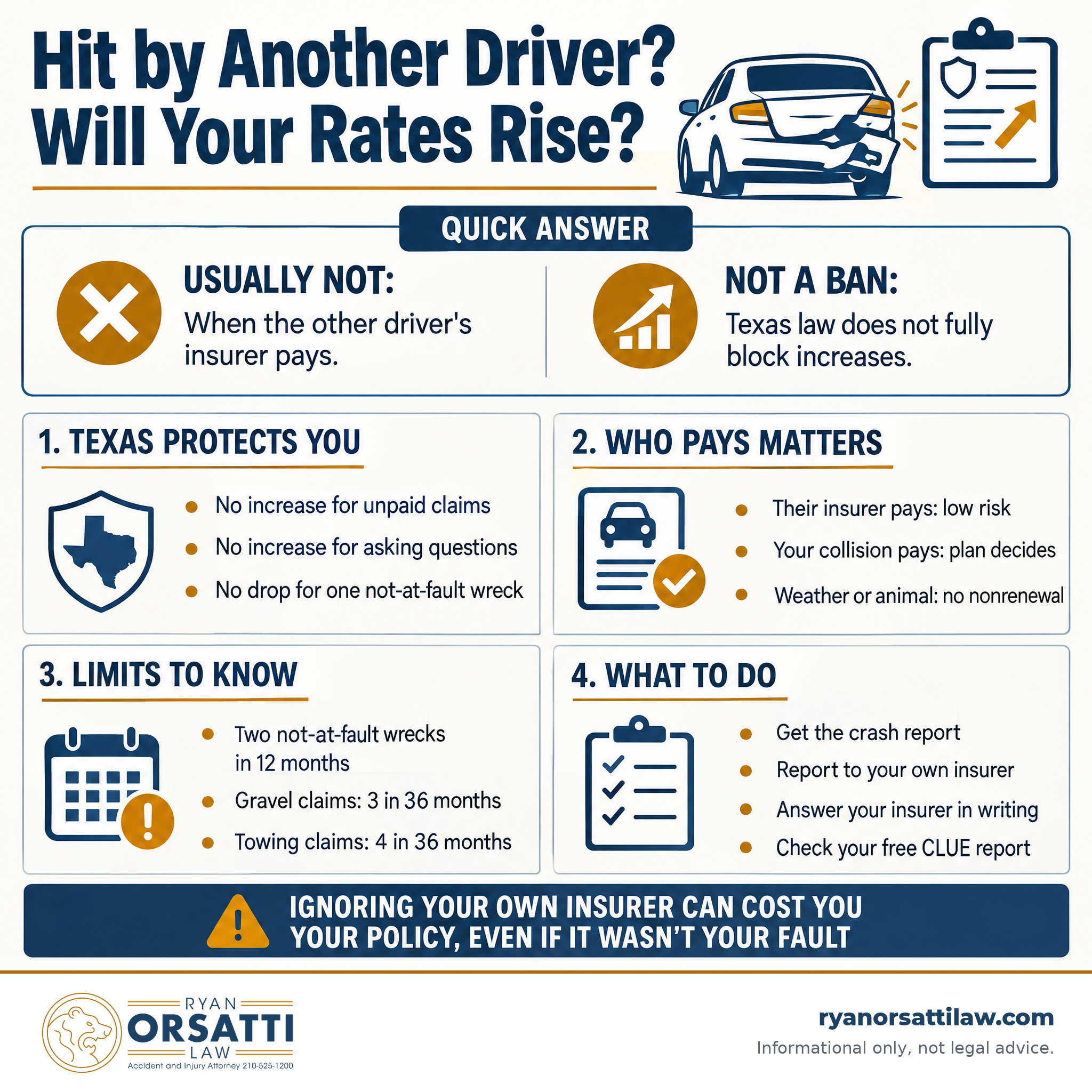
- Will your insurance go up if someone hits you in Texas? Usually not when the other driver’s insurer pays the claim, but Texas law does not flatly ban a rate increase after a wreck you did not cause.
- Texas bars an auto insurer from raising your rates solely because of a claim it did not pay, or solely because you called to ask about your coverage.
- Under a Texas Department of Insurance rule, your insurer cannot refuse to renew your policy over one accident you could not reasonably be blamed for. That protection ends if you have two or more in 12 months.
- Ignoring your own insurer’s requests for help with a claim the other driver makes against you can force a nonrenewal, even if you think the wreck was not your fault.
Key Takeaways
- In Texas, the driver who causes a wreck is responsible for the damage, usually through liability insurance with minimums of $30,000 per injured person and $25,000 for property damage.
- Your rate risk depends mostly on which insurer pays: the other driver’s company, your own company, or nobody.
- Weather and animal claims can never be the sole reason a Texas insurer refuses to renew your auto policy.
- Insurers see your claim history through the CLUE database, and you can get a free copy of your report once a year.
- Skipping a report to your own insurer to protect your rates can cost you coverage you may need later.
Nobody wants to pay more for car insurance because someone else ran a red light. That fear is real, and it pushes a lot of people into bad decisions after a wreck, like not reporting it, not using coverage they paid for, or ignoring calls from their own insurer.
Here is what Texas law actually protects, where the gaps are, and how to keep a not-at-fault wreck from following you. If you were hurt and the other driver’s insurer is disputing fault, Ryan Orsatti Law, a San Antonio personal injury firm, can review the claim in a free consultation before fault gets pinned on you.
Does Texas Law Stop Insurers From Raising Rates After a Not-at-Fault Wreck?
Texas law limits rate increases after a wreck but does not ban them outright for a not-at-fault accident. Texas Insurance Code Sec. 1953.051(b) says a personal auto rating plan may not raise your premium solely because of a claim you filed that was not paid or payable under your policy, or solely because of a consumer inquiry, such as a call asking whether something is covered.
Outside those protections, each company files its own rating plan. The Texas Department of Insurance (TDI) says companies will charge more if you have had accidents or tickets, and it does not draw a fault line in that statement. So whether a paid, not-at-fault claim affects your premium can depend on your company and how it records the claim.
That is why the real question is who pays.
Which Situation Fits You?
The insurer that pays the claim decides most of your rate risk. Here is how the common situations line up under Texas law and TDI rules.
| Your situation | Who pays | Rate or renewal risk |
|---|---|---|
| Other driver’s insurer accepts fault | Their liability coverage, at least 30/60/25 | Low. Your company pays nothing on the claim. |
| You use your collision coverage first | Your insurer, which then seeks repayment from the other side | Depends on your company’s rating plan |
| You report it, your insurer pays nothing | Nobody under your policy | No rate increase solely for that claim (Ins. Code Sec. 1953.051) |
| Weather or animal damage | Your comprehensive coverage | Cannot be the sole reason for nonrenewal |
| Flying gravel or falling objects | Your comprehensive coverage | Deductible can rise after 3 such claims in 36 months |
| Two or more not-at-fault wrecks in 12 months | Depends on the claims | Nonrenewal protection no longer applies |
Can My Insurance Company Drop Me After a Wreck That Wasn’t My Fault?
Not for one wreck you could not reasonably be blamed for. The Texas Department of Insurance rule on personal auto policies, 28 Texas Administrative Code Sec. 5.7016, says an insurer may not refuse to renew a policy solely because of claims or accidents where the insured cannot reasonably be considered at fault, unless the insured has two or more of them in any 12-month period.
The same rule sets these limits:
- Weather damage without a collision (hail, flood, wind) cannot be the sole basis for nonrenewal.
- Hitting an animal cannot be the sole basis for nonrenewal.
- Flying gravel or falling objects: after three such losses in 36 months, the insurer may raise your deductible at renewal to the higher of $250 or the next available step.
- Towing and labor: after four towing claims in 36 months, the insurer may drop that coverage.
“Not renewing” is different from raising your rate. The rule protects your ability to keep the policy. It does not freeze your premium.
Will Using My Own Collision Coverage Raise My Rates?
It can, depending on your company’s rating plan. When you use your own collision coverage, your insurer pays first and usually tries to get that money back from the at-fault driver’s insurer, a process called subrogation (your insurer stepping into your shoes to collect from the other side). TDI says that if the other company agrees to pay, you may get your deductible back.
Using your own coverage often makes sense when the other insurer is slow or disputing fault. Our guide on whether using your own insurance raises your rates in Texas walks through PIP, collision, and uninsured motorist claims in detail.
Attorney Insight: The rate problem we see most often is not the wreck. It is the paperwork after it. The other driver tells their insurer you caused it, a claim gets opened against your policy, and your own adjuster starts calling. People who think “it wasn’t my fault, so this isn’t my problem” stop answering. That silence is what hurts. Answer your insurer in writing, send them the photos and the crash report, and ask them to deny the other driver’s claim. A claim your company never pays is a claim Texas law will not let it charge you for.
What Happens If I Ignore My Own Insurer After the Wreck?
Ignoring your insurer can cost you the policy. Under Texas Insurance Code Sec. 551.1053, if you fail or refuse to cooperate with your insurer in investigating, settling, or defending a third-party liability claim against you, or the insurer cannot reach you with reasonable efforts, it must send you a written notice explaining the problem. If you keep failing to cooperate, the law says the insurer may not renew your policy.
TDI says this applies even when the other driver is the one who reported the claim to your company. In plain terms, a wreck you did not cause can still end your coverage if you go silent when your own insurer asks for help defending you.
How Do Insurers Find Out About My Claims?
Most insurers check your claim history through the Comprehensive Loss Underwriting Exchange (CLUE), a database of past auto and home insurance claims. TDI says a company can charge you more or refuse to sell you a policy based on what is in your CLUE report.
TDI also says you can get a free copy of your CLUE report each year by calling LexisNexis at 866-312-8076. Check it after a wreck. If a claim is listed wrong, or shows payments your insurer never made, ask the reporting company to correct it, and keep a copy of the other driver’s acceptance of fault.
How to Protect Your Rates After Someone Hits You in Texas
- Call police and get the crash report. The officer’s CR-3 is often the first thing an adjuster reads. See our guide on how to obtain a crash report in San Antonio.
- File with the other driver’s insurer first when fault is clear. Their liability coverage should pay for your damage.
- Still tell your own insurer about the wreck. Check the duties section of your policy. Auto policies commonly require prompt notice, and skipping it can create a coverage problem bigger than any rate change.
- Get fault decisions in writing. Ask the other insurer to confirm in writing that it accepted liability.
- Answer your own insurer promptly and in writing, especially if the other driver makes a claim against you.
- Use your collision coverage if the other side stalls, then ask your insurer to pursue repayment and your deductible.
- Pull your free CLUE report once the claim closes and correct any errors.
- If your premium jumps or you get a nonrenewal notice, ask the company for the reason in writing, then contact TDI if the reason does not fit the rules above.
Why Injured Texans Bring the Fault Fight to a Lawyer
Your insurance rates and your injury claim turn on the same question: who caused the wreck. A lawyer reviewing a not-at-fault crash should pull the CR-3, lock down photos and witness statements, push the other driver’s insurer to accept liability in writing, and answer any claim made against your policy before it gets paid as a split-fault loss. Ryan Orsatti Law represents people hurt in car accidents, truck accidents, motorcycle crashes, and pedestrian collisions in San Antonio, Bexar County, and across Texas, with offices in Austin, Dallas, and Houston. If the other side is blaming you, our post on combating false claims that you were partially at fault explains how those fights work. You can also start with our San Antonio car accident lawyer page or call 210-525-1200 for a free consultation.
Frequently Asked Questions
Will my insurance go up if someone hits me in Texas?
Usually not when the other driver’s insurer pays the claim, because your company pays nothing. Texas law does not flatly ban a rate increase after a not-at-fault wreck, but Insurance Code Sec. 1953.051 bars a rate increase based solely on a claim your insurer did not pay or solely on a call asking about coverage. Your company’s rating plan controls the rest.
Can my insurance drop me for an accident that wasn’t my fault?
Not for one. A Texas Department of Insurance rule, 28 TAC Sec. 5.7016, bars an insurer from refusing to renew your personal auto policy solely because of claims or accidents you could not reasonably be blamed for. That protection ends if you have two or more of those claims or accidents in any 12-month period.
Should I report a not-at-fault accident to my own insurance company?
Yes. Auto policies commonly require prompt notice of an accident, and skipping it can put your own coverage at risk if the other driver later claims you caused it. Reporting is not the same as filing a claim your insurer pays. Under Texas law, an insurer cannot raise your rates solely because of a claim it did not pay.
Does calling my insurance company to ask a question raise my rates?
No. Texas Insurance Code Sec. 1953.051 says a personal auto rating plan may not raise your premium solely because of a consumer inquiry, such as a call asking whether something is covered or how the claims process works. Asking questions before you decide whether to file a claim is protected.
What if the other driver says the wreck was my fault?
Answer your own insurer quickly and give it your photos, witness names, and the crash report so it can deny the claim. Under Texas Insurance Code Sec. 551.1053, refusing to cooperate with your insurer on a claim against you can lead to nonrenewal. If you were hurt, talk to an injury lawyer before giving any recorded statement.
Should I wait to see if my rates go up before calling a lawyer?
No, not if you were hurt. Fault is decided early, often from the first statements and the crash report, and that same fault decision drives both your injury claim and your insurance record. A free consultation early lets a lawyer protect the fault picture while your medical treatment stays the priority.
Source Notes
- Tex. Ins. Code Sec. 1953.051 (rating plans may not raise premiums solely for unpaid claims or consumer inquiries)
- Tex. Ins. Code Sec. 551.1053 (mandatory nonrenewal for failure to cooperate on a third-party liability claim)
- 28 Tex. Admin. Code Sec. 5.7016 (prohibition of nonrenewal for not-at-fault accidents or claims, personal auto policy)
- Tex. Transp. Code Sec. 601.072 (minimum liability coverage)
- Texas Department of Insurance, Auto Insurance Guide (nonrenewal limits, CLUE reports)
- Texas Department of Insurance, Auto Insurance FAQ (cooperation and nonrenewal, deductible recovery)
Ryan Orsatti Law
4634 De Zavala Rd, San Antonio, TX 78249
Phone: 210-525-1200
ryanorsattilaw.com
This blog is for informational purposes only, not legal advice. Reading it does not create an attorney-client relationship. Past results do not guarantee future results.
Hurt in an accident in San Antonio? Learn how a San Antonio personal injury lawyer can help with your claim. Call 210-525-1200 or request a free consultation.
The firm works on a contingency fee. You pay nothing unless the firm recovers money for you, and that covers case expenses as well as the fee: if there is no recovery, you owe no attorney's fee and no case expenses. Ask for the fee agreement and read the fee and expense section before you sign anything.
Related San Antonio legal resources
Primary legal and public-data sources
- TxDOT: Texas crash reports, data, and statistics
- Texas Civil Practice and Remedies Code Chapter 33: proportionate responsibility
Ryan Orsatti Law
4634 De Zavala Road, San Antonio, TX 78249
General reference links. Consult each source for its current text.