
Quick Answer
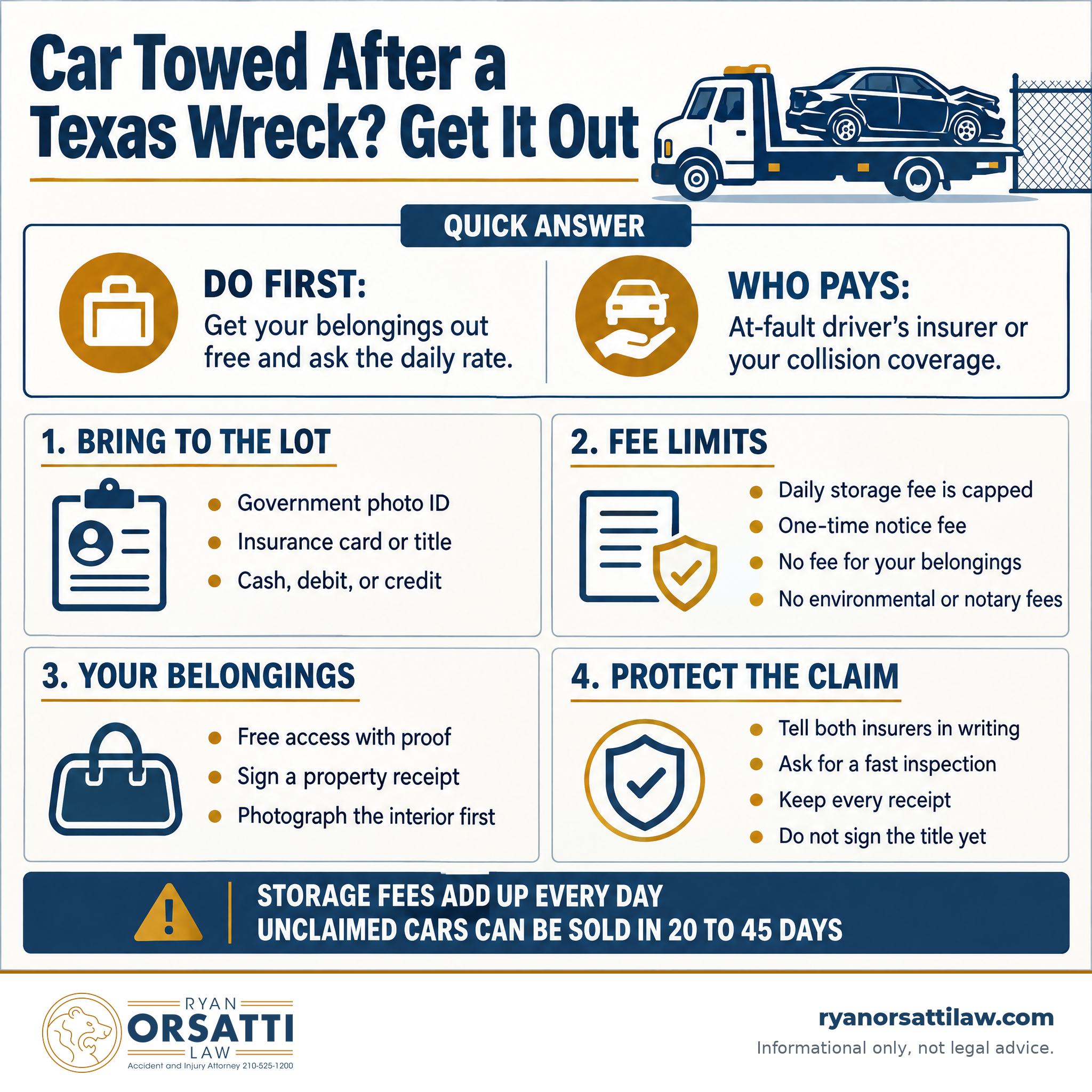
- A Texas storage lot can charge a daily fee for each day or part of a day your car sits there, so moving fast saves money. TDLR currently lists a maximum of $22.85 a day for a vehicle 25 feet or shorter.
- To get the car out, bring a government photo ID, a document showing you own or may possess the car (such as your insurance card or title), and payment. Texas storage lots must accept cash, debit cards, and credit cards.
- You can get your personal belongings out of the car for free once you show you own it or have the right to possess it.
- If the other driver caused the wreck, their insurer may pay reasonable towing and storage fees. Your own collision coverage can also pay them.
Key Takeaways
- Texas law sets the base storage fee at $20 a day for a vehicle 25 feet or shorter, and the state adjusts it for inflation every two years.
- A storage lot that fails to send the required notice to a Texas-registered owner can charge only 5 days of storage.
- Storage lots cannot charge you to get your personal property out of the car, and they cannot charge environmental or notary fees.
- Storage charges keep running while insurers argue over fault, so get the car inspected and moved as soon as you safely can.
- In a serious crash, the car itself can be evidence. Talk to a lawyer before you sell it, junk it, or sign the title over.
After a wreck, the car usually leaves on a tow truck while you leave in an ambulance, a friend’s car, or a police cruiser. By the time you think about it again, the car is sitting in a lot you have never heard of, and the fees are adding up every day.
This guide covers how to find the car, what the lot can legally charge, what to bring to get it out, and who should end up paying. If you were hurt in the crash, Ryan Orsatti Law can review the property damage and injury sides of the claim together in a free consultation, so the storage bill does not quietly eat into your recovery.
How Do I Find Where My Car Was Towed After a Crash?
Start with the tow receipt or anything the tow driver or officer handed you at the scene, since it usually names the tow company or storage lot. If you have nothing in writing, contact the police agency that worked the crash and ask where the vehicle was taken.
The storage lot also has to reach you. Under Texas Occupations Code Sec. 2303.151, a vehicle storage facility (a licensed lot that stores towed cars) that receives a Texas-registered vehicle must send written notice to the registered owner and the primary lienholder no earlier than 24 hours and no later than the fifth day after it receives the car.
Be careful with tow trucks nobody called. The Texas Department of Insurance warns about tow drivers who show up uninvited at a crash, steer the car to a particular shop or lot, and later send a bill for thousands of dollars in storage and other fees. If it is safe, drive the car home. If it is not, tell the driver where you want it to go, read anything you are asked to sign, and get a receipt.
How Much Do Tow Yards Charge Per Day in Texas?
Texas Occupations Code Sec. 2303.155 sets the base daily storage fee at $20 for each day or part of a day for a vehicle 25 feet or shorter, and Sec. 2303.1552 lets the Texas Department of Licensing and Regulation (TDLR) adjust storage and impoundment fees every two years based on inflation. TDLR’s fee page currently lists these maximums:
| Charge | What it covers | TDLR listed maximum |
|---|---|---|
| Daily storage (25 feet or shorter) | Each day or part of a day on the lot | $22.85 per day |
| Daily storage (over 25 feet) | Each day or part of a day on the lot | $39.99 per day |
| Impoundment fee | Actions needed to preserve or protect the vehicle | $22.85 |
| Notification fee | All required notices to the owner and lienholder | $50, one time |
| Personal property access | Getting your belongings out of the car | $0, no fee allowed |
Here is how those listed maximums add up over 10 days for a regular car, before the towing charge itself, for illustration only:
- Storage: 10 days x $22.85 = $228.50
- Impoundment fee: $22.85
- Notification fee: $50.00
- Total: $228.50 + $22.85 + $50.00 = $301.35
A few TDLR limits are worth knowing. If the lot never sends the required first notice to a Texas-registered owner and lienholder, it can charge only 5 days of storage. If the car is on the lot for two calendar days within a single 12-hour period, only one day can be charged. And the lot may not charge environmental fees, notary fees, or a fee to get to your personal property.
What Do I Need to Get My Car Out of the Tow Yard?
To get a towed car out of a Texas storage lot, bring three things: payment, a valid government photo ID, and one document showing you own the car or have the right to possess it. TDLR lists these ownership documents:
- An insurance card that names you as a named insured
- The certificate of title in your name
- A notarized power of attorney signed by the owner
- A tax collector’s receipt and a registration renewal card with matching information
- A current lease or rental agreement signed by the driver
- TDLR form VSF013, which the lot must make available
Under Occupations Code Sec. 2303.159, the lot must accept cash, debit cards, and credit cards for any charge tied to the tow or storage, and it must post a sign saying so. TDLR says a lot that is open 24 hours must let you claim the car starting within one hour of the tow. A lot that is not open 24 hours must give access from 8 a.m. to midnight Monday through Saturday and 8 a.m. to 5 p.m. on Sunday, except national holidays.
Can I Get My Belongings Out of a Towed Car?
Yes. Once you show that you own the car or have the right to possess it, a Texas storage lot must let you remove your personal property at no charge, unless law enforcement has said the items cannot be removed. The lot will ask you to sign a receipt listing what you took. If your ownership papers are inside the car, TDLR says you can get into the car to retrieve them, also at no charge.
Get your phone chargers, work tools, child car seats, medications, and paperwork out early, even if the car itself will stay put for a while. Photograph the interior before you remove anything.
Who Pays Towing and Storage Fees After a Texas Car Accident?
The driver who caused the crash is responsible for your property losses, and that includes reasonable towing and storage. The Texas Department of Insurance says the at-fault driver’s insurer might pay reasonable towing and storage fees, and that collision and comprehensive coverage on your own policy pays reasonable towing and storage. If you carry liability-only coverage, you pay those fees yourself and then seek repayment from the at-fault driver’s insurer.
The word that causes trouble is “reasonable.” In claims we handle, insurers often pay the first stretch of storage and push back on the rest, arguing that the owner should have moved the car sooner. Keep every receipt, write down each call with the lot and the adjuster, and put requests for inspection in writing. Our guide on what to do when the at-fault driver’s insurance won’t cover your full vehicle repair costs covers the property damage fight that often follows.
Attorney Insight: Storage disputes almost always come from the same gap: the car sits at the lot while the other driver’s insurer “investigates” liability, and nobody tells anyone to move it. Send the adjuster a short written message the first business day: where the car is, the daily rate, and a request to inspect it or authorize moving it within a few days. That one email shifts the argument about who let the bill grow.
Should I leave the car at the lot as evidence?
In a minor crash, no. Get it inspected and moved. In a serious crash, the car can matter as evidence: crush damage, airbag modules, and the event data recorder can all bear on how the crash happened. Our post on how insurance companies use your car’s event data recorder explains why. Talk to a lawyer before you let the car be sold, junked, or crushed, and before you sign the title over to an insurer.
If the car is a total loss and you still owe on it, read our guide to the gap trap when a totaled car is worth less than the loan.
What happens if nobody picks up the car?
TDLR says an unclaimed Texas-registered vehicle may be sold at a public sale 20 to 45 days after the owner is notified that it is stored at the lot. Charges keep running until then. Do not let the car sit unclaimed because the insurers have not sorted out fault.
Car Towed After an Accident: What to Do This Week
- Find the car. Check the tow receipt, then call the police agency that worked the crash if you need to.
- Call the lot. Ask for the daily rate, total charges so far, hours, and what documents they need.
- Get your belongings out. It is free once you prove ownership or the right to possess the car.
- Tell the insurers in writing. Give both your insurer and the other driver’s insurer the lot’s name, address, and daily rate.
- Push for a fast inspection. Ask the adjuster to inspect the car or authorize moving it within a few days.
- Keep every receipt. Towing, storage, and rental receipts all belong in the property damage claim.
- Do not sign the title or a release yet if you were hurt, until a lawyer has looked at what you are signing.
- Report overcharges. If a lot charges more than the law allows, you can file a complaint with TDLR.
For everything else in the first day after a wreck, see our guide to the first 24 hours after a San Antonio car accident.
Why Injured Texans Bring the Storage Bill to a Lawyer
The storage bill is small next to an injury claim, but it shows up early and it is often where the fight over fault starts. A lawyer reviewing the property side of a crash should confirm where the car is and what it is costing, put the insurers on written notice, decide whether the vehicle needs to be preserved as evidence, and keep the property damage settlement from turning into a release of the injury claim. Ryan Orsatti Law represents people hurt in car accidents, truck accidents, motorcycle crashes, and pedestrian collisions across San Antonio and Texas. If you were hurt, start with our San Antonio car accident lawyer page or call 210-525-1200 for a free consultation.
Frequently Asked Questions
How much do tow yards charge per day in Texas?
Texas law sets the base daily storage fee at $20 for a vehicle 25 feet or shorter, adjusted for inflation every two years. The Texas Department of Licensing and Regulation currently lists a maximum of $22.85 per day for those vehicles and $39.99 per day for vehicles over 25 feet. A lot can also charge an impoundment fee and a one-time $50 notification fee.
Who pays for towing and storage after a car accident in Texas?
The driver who caused the crash is responsible for reasonable towing and storage, usually through their liability insurer. Your own collision or comprehensive coverage can also pay reasonable towing and storage, according to the Texas Department of Insurance. With liability-only coverage, you may need to pay first and then seek repayment from the at-fault driver’s insurer.
Can a tow yard charge me to get my things out of my car?
No. Once you show that you own the car or have the right to possess it, a Texas vehicle storage facility must let you remove your personal property free of charge, unless law enforcement has said the items cannot be removed. The lot will ask you to sign a receipt listing what you took. You can also get ownership papers out of the car at no charge.
What do I need to get my car out of impound in Texas?
Bring a valid government photo ID, one document showing you own or may possess the car, and payment. Accepted ownership documents include an insurance card naming you as a named insured, the title, or a notarized power of attorney from the owner. Texas storage lots must accept cash, debit cards, and credit cards for towing and storage charges.
What if I think the tow yard overcharged me?
You can file a complaint with the Texas Department of Licensing and Regulation, which licenses tow companies and storage lots. TDLR also says you can request a hearing in a justice of the peace court in the county where the vehicle was towed, and that the request must come before the 14th day after the car was placed in storage. Request the hearing first.
Should I wait to talk to a lawyer until the car is sorted out?
No, not if you were hurt. Storage fees run daily, a property damage release can be worded to reach more than the car, and a badly damaged car may be evidence you need. A free consultation early lets you handle the car quickly without giving up anything on the injury side, and lets your medical care stay the priority.
Source Notes
- Tex. Occ. Code Sec. 2303.151 (notice to owner and lienholder), Sec. 2303.155 (charges related to storage), Sec. 2303.1552 (biennial fee adjustment), and Sec. 2303.159 (forms of payment)
- TDLR, VSF Fees and Other Charges
- TDLR, VSFs Providing Access to a Vehicle
- TDLR, I Got Towed: What Next?
- Texas Department of Insurance, Don’t Fall Victim to a Towing Scam
Ryan Orsatti Law
4634 De Zavala Rd, San Antonio, TX 78249
Phone: 210-525-1200
ryanorsattilaw.com
This blog is for informational purposes only, not legal advice. Reading it does not create an attorney-client relationship. Past results do not guarantee future results.
Hurt in an accident in San Antonio? Learn how a San Antonio personal injury lawyer can help with your claim. Call 210-525-1200 or request a free consultation.
The firm works on a contingency fee. You pay nothing unless the firm recovers money for you, and that covers case expenses as well as the fee: if there is no recovery, you owe no attorney's fee and no case expenses. Ask for the fee agreement and read the fee and expense section before you sign anything.
Related San Antonio legal resources
Primary legal and public-data sources
- TxDOT: Texas crash reports, data, and statistics
- Texas Civil Practice and Remedies Code Chapter 33: proportionate responsibility
Ryan Orsatti Law
4634 De Zavala Road, San Antonio, TX 78249
General reference links. Consult each source for its current text.