
Quick Answer
- Insurance bad faith after a Texas car accident usually means an insurance company unfairly denying, delaying, or underpaying a claim it owes.
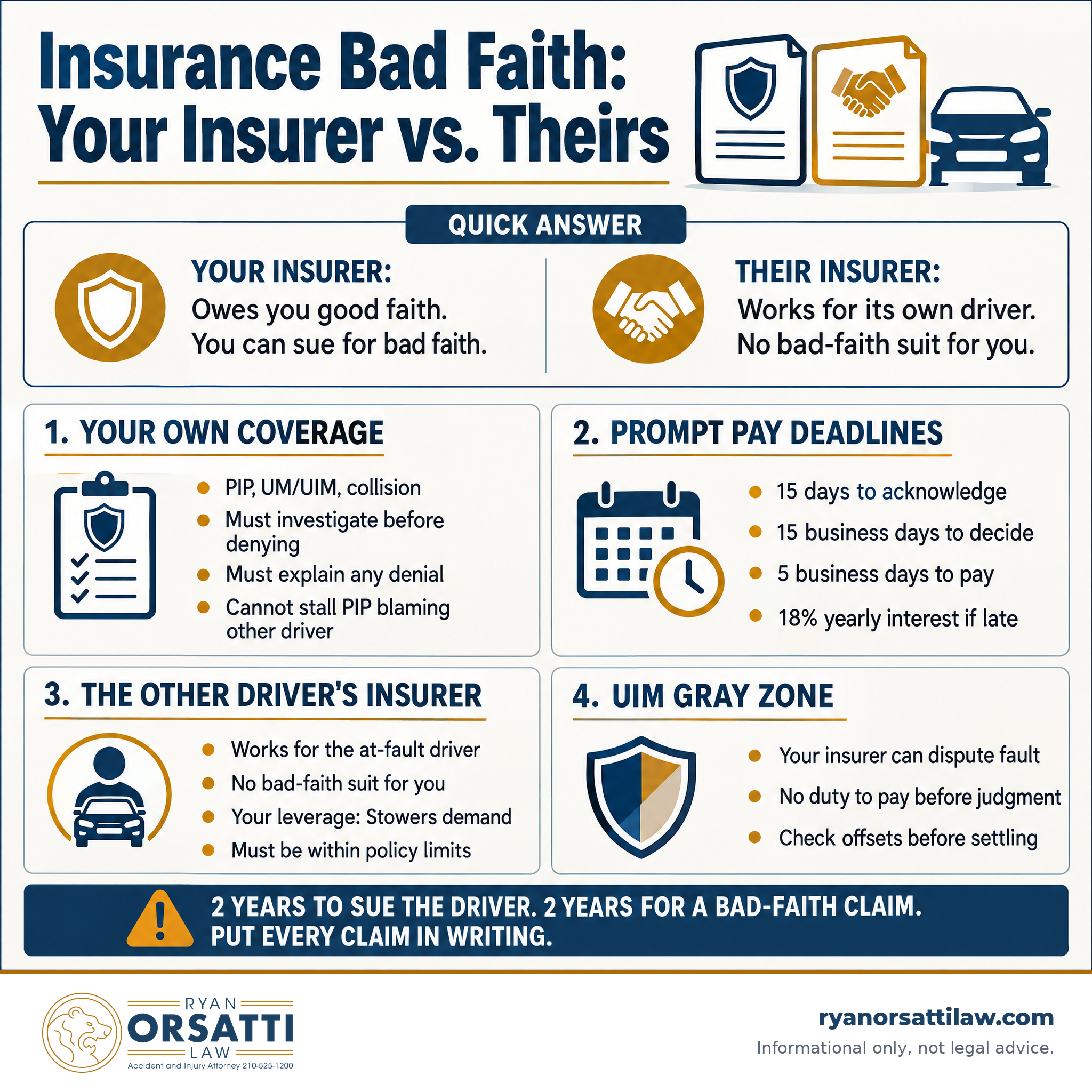
- Your own auto insurer (PIP, uninsured/underinsured motorist, collision) owes you a duty of good faith, and Texas law lets you sue it for unfair claim handling.
- The at-fault driver’s insurer owes its duties to its own policyholder, not to you, so Texas gives you no bad-faith claim against it for how it handles your claim.
- Your leverage against the other driver’s insurer is a properly built settlement demand within policy limits, known in Texas as a Stowers demand.
Key Takeaways
- Texas Insurance Code Sec. 541.060 lists unfair settlement practices “with respect to a claim by an insured or beneficiary,” and subsection (b) says it gives no cause of action to a third party suing an insured.
- The Texas Supreme Court held in Allstate Insurance Co. v. Watson (1994) that a third-party claimant lacks standing to sue an insurer for unfair claim settlement practices.
- Texas prompt-payment rules in Insurance Code Chapter 542 cover first-party claims only, and a late-paying insurer owes 18 percent annual interest plus attorney’s fees under Sec. 542.060.
- Under the Stowers doctrine, a liability insurer that unreasonably rejects a reasonable demand within limits can be liable for the entire judgment, including the part above the policy limits.
- Your own underinsured motorist (UIM) carrier has no contractual duty to pay until a judgment establishes the other driver’s liability and underinsured status, according to Brainard v. Trinity Universal Insurance Co. (Tex. 2006).
Ryan Orsatti Law is a San Antonio personal injury firm that has represented injured Texans for more than a decade, and sorting out which insurer owes what, and which one is breaking the rules, is a regular part of our car accident work. If an adjuster is stalling you right now, you can talk it through with us in a free consultation.
What Does “Insurance Bad Faith” Mean After a Car Accident?
Insurance bad faith is an insurance company’s unfair handling of a claim it has a duty to handle fairly, such as denying it without a real investigation, sitting on it, or misstating what the policy covers. The phrase gets thrown around after every lowball offer, but in Texas it has a specific legal meaning, and that meaning depends almost entirely on whose insurance company you are dealing with.
The distinction touches a lot of people. TxDOT’s Texas Motor Vehicle Traffic Crash Facts for 2025 reports 244,534 people injured and 3,769 people killed in Texas crashes, or one person injured every 2 minutes 9 seconds. Almost every one of those crashes creates at least two insurance relationships: one with your own company and one with the company that insures the driver who hit you.
Lawyers call these first-party and third-party claims. A first-party claim (a claim you make under your own policy) is a contract relationship. A third-party claim (a claim you make against someone else’s liability coverage) is not. You never bought that policy, and the company never promised you anything.
Your Own Insurance Company Owes You Good Faith
Your own auto insurer owes you a duty to deal fairly and in good faith when it processes and pays your claims. The Texas Supreme Court recognized that duty in Arnold v. National County Mutual Fire Insurance Co. in 1987, and the Texas Insurance Code backs it up with specific rules.
After a crash, your own policy may include several coverages:
- Personal injury protection (PIP): pays medical bills and lost income for you, your household, and passengers in your car. Texas insurers must include it unless a named insured rejects it in writing (Ins. Code Sec. 1952.152), the required amount tops out at $2,500 per person (Sec. 1952.153), and the insurer must pay benefits within 30 days after it receives satisfactory proof of a claim (Sec. 1952.156).
- Uninsured/underinsured motorist (UM/UIM) coverage: pays what you are legally entitled to recover from a driver with no insurance or too little insurance. It is also required unless a named insured rejects it in writing (Sec. 1952.101).
- Collision coverage: pays to repair your car under your own policy, subject to your deductible.
Texas Insurance Code Sec. 541.060 makes it an unfair settlement practice for an insurer to do any of the following on a claim by its insured:
- Misrepresent a material fact or policy provision about coverage.
- Fail to attempt in good faith a prompt, fair, and equitable settlement once its liability has become reasonably clear.
- Fail to give a reasonable explanation, based on the policy and the facts, for a denial or a compromise offer.
- Fail within a reasonable time to affirm or deny coverage.
- Refuse or delay a first-party settlement offer because other coverage may exist or because a third party is responsible for the damage, unless the policy specifically allows it.
- Refuse to pay a claim without a reasonable investigation.
That fifth item surprises people. Your own company generally cannot sit on your PIP claim just because the other driver was at fault and “their insurance should pay.”
When an insurer breaks these rules and it causes you actual damages, Sec. 541.151 lets you sue. Under Sec. 541.152, you can recover actual damages, court costs, and reasonable attorney’s fees, and up to three times your actual damages if a jury finds the insurer acted knowingly.
The Texas Prompt Payment Deadlines
Texas Insurance Code Chapter 542, Subchapter B sets hard deadlines for first-party claims. Sec. 542.051 defines a “claim” there as a first-party claim made by an insured that must be paid directly to the insured. The timeline works like this:
- Within 15 days of receiving notice of your claim, the insurer must acknowledge it, start investigating, and request the items it reasonably believes it needs (Sec. 542.055).
- Within 15 business days of receiving everything it asked for, it must accept or reject the claim in writing and state its reasons for any rejection (Sec. 542.056). If it needs more time, it must tell you why and then decide within 45 more days.
- Once it agrees to pay, it must pay within 5 business days (Sec. 542.057).
- If it delays payment more than 60 days after receiving everything it reasonably requested, with no other statute setting the period, it owes damages under Sec. 542.058.
- A noncompliant insurer that is liable for the claim owes 18 percent annual interest on the claim amount plus reasonable attorney’s fees (Sec. 542.060).
One newer change also helps policyholders. According to the Texas Department of Insurance, Senate Bill 458 (2025) requires personal auto policy forms issued or renewed after January 1, 2026 to include an appraisal provision for resolving disputes about the amount of a loss.
Can You Sue the At-Fault Driver’s Insurance Company for Bad Faith?
No. In Texas, you generally cannot sue the at-fault driver’s insurance company for bad faith in how it handles your injury claim. Insurance Code Sec. 541.060(b) states that the unfair settlement practices list does not provide a cause of action to a third party asserting claims against an insured. The Texas Supreme Court reached the same result in Allstate Insurance Co. v. Watson (1994), holding that a third-party claimant lacks standing to sue an insurer for unfair claim settlement practices.
The common law points the same way. Texas recognizes only one tort duty in third-party insurance cases, the Stowers duty to settle (see Maryland Insurance Co. v. Head Industrial Coatings & Services, Tex. 1996), and that duty runs to the insurer’s own policyholder, not to you.
So when the other driver’s adjuster ignores your calls, disputes your treatment, or offers a number that would not cover your ER bill, that conduct is frustrating and often unfair, but it is usually not something you can sue the adjuster’s company over. Your claim is against the driver. The insurer’s job is to defend and, if it chooses, settle on the driver’s behalf.
Two practical points follow. First, Texas law requires every driver to carry at least $30,000 per injured person, $60,000 per crash for bodily injury, and $25,000 for property damage (Transp. Code Sec. 601.072), so a serious injury can easily outrun the other driver’s coverage. Second, if the other driver’s insurer also happens to be your insurer, the two claims are still separate, as we explain in our post on whether the same insurance company can represent both drivers in Texas.
Your Own Insurer vs. the Other Driver’s Insurer: Side by Side
| Question | Your own insurer (PIP, UM/UIM, collision) | At-fault driver’s insurer |
|---|---|---|
| Who it owes duties to | You, its insured | Its own policyholder, the at-fault driver |
| Can you sue it for unfair claim handling? | Yes, under Ins. Code Sec. 541.151 and the common-law duty of good faith | No, under Sec. 541.060(b) and Allstate v. Watson |
| Prompt-payment deadlines (Ch. 542) | Yes, first-party claims only | No |
| Your main pressure tool | Written claim, proof of loss, statutory deadlines, 61-day notice letter | A Stowers demand within policy limits, then a lawsuit against the driver |
| Clock to watch | 2 years from the unfair act or its discovery (Sec. 541.162) | 2 years from the crash to sue the driver (CPRC Sec. 16.003) |
The Stowers Doctrine: Your Real Leverage Against Their Insurer
The Stowers doctrine is a Texas rule that makes a liability insurer responsible for a judgment above its policy limits if it unreasonably turns down a reasonable settlement offer within those limits. It comes from G.A. Stowers Furniture Co. v. American Indemnity Co., decided in 1929, and the Texas Supreme Court still applies it. In Phillips v. Bramlett (2009), the court described an insurer in that position as liable for the entire amount of the judgment, including the part exceeding the policy limits.
The duty belongs to the at-fault driver, not to you. But it changes the math for the adjuster. Turning down a fair offer within limits now risks the insurer’s own money, not just the driver’s.
The Texas Supreme Court set out when the duty is triggered in American Physicians Insurance Exchange v. Garcia (1994). All three must be true:
- The claim against the insured is within the scope of coverage.
- The demand is within the policy limits.
- The terms of the demand are such that an ordinarily prudent insurer would accept it, considering the likelihood and degree of the insured’s exposure to an excess judgment.
When the other driver’s limits are smaller than your losses, this is where the real negotiating leverage sits. We cover the coverage side in more detail in what happens when the defendant’s policy limits are less than your damages.
Attorney Insight: In our experience, the Stowers demands that move adjusters are written, specific, and complete. They stay within limits, offer a clear release of the insured, include the medical records and bills an adjuster needs to evaluate exposure, and give a reasonable deadline to respond. A phone call saying “just pay the limits” rarely creates real pressure. A sloppy demand can do worse than nothing, because it lets the insurer argue later that no reasonable insurer could have accepted it.
The Gray Zone: Underinsured Motorist Claims Against Your Own Company
An underinsured motorist claim is a first-party claim, but your own company steps into the at-fault driver’s shoes to decide what you were legally entitled to recover. That makes it the most confusing bad-faith situation after a Texas crash.
The Texas Supreme Court held in Brainard v. Trinity Universal Insurance Co. (2006) that a UIM carrier has no contractual duty to pay benefits until the insured obtains a judgment establishing the other motorist’s liability and underinsured status. The court repeated that in Allstate Insurance Co. v. Irwin (2021), noting that neither requesting UIM benefits nor filing suit against the insurer triggers a contractual duty to pay.
In practice, your own company can contest fault and damages on a UIM claim the same way the other driver’s insurer would, and a refusal to pay before those issues are decided is usually not a breach of the policy. This is why UIM disputes often end up as lawsuits against your own carrier, and why the offsets and credits explained in our post on Texas UM/UIM offsets matter before you settle with the at-fault driver.
PIP is different. Under Sec. 1952.151 it pays reasonable expenses arising from the accident, and it carries its own 30-day payment window, so delays there are easier to challenge.
What to Do If You Think an Insurer Is Acting in Bad Faith
If you think an insurer is mishandling your Texas car accident claim, start by identifying which company and which coverage you are dealing with, then build a paper trail. These eight steps apply to most situations:
- Name the insurer and the coverage. Write down whether the claim is under your policy (PIP, UM/UIM, collision) or the other driver’s liability policy. The rules are completely different.
- Put the claim in writing. Chapter 542 deadlines run from written notice and from the date the insurer receives the items it requested.
- Keep a dated log. Record every call, email, and request, including the adjuster’s name. Note the 15-day, 15-business-day, and 5-business-day marks.
- Ask for the reason in writing. Your own insurer must give a reasonable explanation for a denial or a compromise offer.
- Do not accept “the other driver should pay” as a PIP excuse. Sec. 541.060(a)(5) limits that delay on first-party coverage.
- Do not rely on a casual demand against the other driver’s insurer. A Stowers demand works only if it meets the Garcia requirements.
- Calendar the deadlines. You generally have two years from the crash to sue the at-fault driver (CPRC Sec. 16.003) and two years from an unfair act or its discovery to sue your own insurer under Chapter 541 (Sec. 541.162). A Chapter 541 suit also requires written notice at least 61 days before filing, unless limitations is about to run (Sec. 541.154).
- Consider a TDI complaint, and know its limits. The Texas Department of Insurance Consumer Help Line is 800-252-3439, weekdays 8 a.m. to 5 p.m. Central. TDI says it cannot decide who caused an accident and cannot force a company to pay a claim if the company did not violate the law.
Attorney Insight: The single most common mistake we see is aiming the anger at the wrong company. People threaten the other driver’s adjuster with a bad-faith suit that Texas law does not allow, while their own PIP claim sits unpaid past the statutory window and nobody pushes on it. Fix your own coverage first. That is where the good-faith duty, the deadlines, and the 18 percent interest live.
For a deeper look at the warning signs and remedies on the first-party side, see our guide on addressing insurance bad faith in Texas personal injury cases.
Why Injured Texans Ask a Lawyer to Sort Out the Insurance Picture
A single wreck can put three or four policies in play: the at-fault driver’s liability coverage, your PIP, your UM/UIM, and sometimes a commercial or rideshare policy. Each has different duties, different deadlines, and a different path to payment. A lawyer’s first move is to pull every declarations page, confirm the limits, check whether PIP or UM/UIM was rejected in writing, and decide whether and when to send a Stowers demand. Ryan Orsatti Law handles car accident, truck accident, motorcycle, pedestrian, and other serious-injury claims for people across San Antonio and Texas, with offices in Austin, Dallas, and Houston, and we spend much of that work making sure the right insurer is held to the right duty. Learn more about our San Antonio car accident lawyer services.
Frequently Asked Questions
Can I sue the other driver’s insurance company for bad faith in Texas?
Generally, no. Texas Insurance Code Sec. 541.060(b) says the unfair settlement practices rules give no cause of action to a third party suing an insured, and the Texas Supreme Court held in Allstate v. Watson that third-party claimants lack standing for those claims. Your claim is against the at-fault driver. Your leverage over that driver’s insurer is a proper Stowers demand within policy limits.
What counts as bad faith by my own car insurance company?
Bad faith by your own auto insurer includes denying a claim without a reasonable investigation, failing to explain a denial, misrepresenting what the policy covers, and stalling once its liability is reasonably clear. Texas Insurance Code Sec. 541.060 lists these practices. Your insurer also cannot delay first-party benefits like PIP just because another driver caused the crash, unless the policy specifically allows it.
How long does my insurance company have to pay a claim in Texas?
For first-party claims, Texas Insurance Code Chapter 542 requires the insurer to acknowledge and begin investigating within 15 days of notice, accept or reject in writing within 15 business days after receiving the items it requested, and pay within 5 business days of agreeing to pay. PIP benefits must be paid within 30 days after satisfactory proof. Late-paying insurers can owe 18 percent annual interest plus attorney’s fees.
What is a Stowers demand in Texas?
A Stowers demand is a settlement offer to the at-fault driver’s insurer that stays within the policy limits and is reasonable enough that a prudent insurer would accept it. If the insurer unreasonably rejects it and a jury later awards more, the insurer can be liable for the entire judgment, including the amount above the limits. The rule comes from a 1929 Texas case and still applies.
Is my insurance company acting in bad faith if it won’t pay my underinsured motorist claim?
Not necessarily. The Texas Supreme Court held in Brainard (2006) that a UIM carrier has no contractual duty to pay until a judgment establishes the other driver’s liability and underinsured status, and it reaffirmed that rule in Irwin (2021). Your insurer can contest fault and damages first. Unfair conduct in handling the claim is a separate question that depends on the specific facts.
Should I wait to talk to a lawyer until the insurance company makes a final offer?
No. Waiting usually costs leverage. Statutory deadlines on your own claims start running from written notice, a Stowers demand needs complete records and careful timing, and the two-year deadline to sue the at-fault driver keeps running regardless of negotiations. Talking to a lawyer early helps you preserve evidence, keep treatment on track, and send the right demand to the right insurer.
Source Notes
- Texas Insurance Code Sec. 541.060 (unfair settlement practices, including subsection (b) on third parties), Sec. 541.151 (private action), Sec. 541.152 (damages and attorney’s fees), Sec. 541.154 (prior notice), and Sec. 541.162 (limitations): Insurance Code Chapter 541
- Texas Insurance Code Secs. 542.051, 542.055, 542.056, 542.057, 542.058, and 542.060 (prompt payment of claims): Insurance Code Chapter 542
- Texas Insurance Code Secs. 1952.101 (UM/UIM coverage), 1952.152 and 1952.153 (PIP coverage and amount), and 1952.156 (PIP payment): Insurance Code Chapter 1952
- Texas Transportation Code Sec. 601.072 (minimum liability coverage): Transportation Code Chapter 601
- Texas Civil Practice and Remedies Code Sec. 16.003 (two-year limitations period): Civil Practice and Remedies Code Chapter 16
- Arnold v. National County Mutual Fire Insurance Co., 725 S.W.2d 165 (Tex. 1987)
- Allstate Insurance Co. v. Watson, 876 S.W.2d 145 (Tex. 1994)
- American Physicians Insurance Exchange v. Garcia, 876 S.W.2d 842 (Tex. 1994)
- Maryland Insurance Co. v. Head Industrial Coatings & Services, Inc., 938 S.W.2d 27 (Tex. 1996)
- G.A. Stowers Furniture Co. v. American Indemnity Co., 15 S.W.2d 544 (Tex. Comm’n App. 1929, holding approved)
- Brainard v. Trinity Universal Insurance Co., 216 S.W.3d 809 (Tex. 2006)
- Phillips v. Bramlett, 288 S.W.3d 876 (Tex. 2009)
- Allstate Insurance Co. v. Irwin, No. 19-0885 (Tex. May 21, 2021): Supreme Court of Texas opinion
- TxDOT, Texas Motor Vehicle Traffic Crash Facts, Calendar Year 2025: TxDOT Crash Facts
- Texas Department of Insurance, complaint help and limits: TDI insurance complaints
- Texas Department of Insurance, 89th Legislative Session Review (SB 458): TDI legislative review
If you were hurt in a crash in Texas and an insurance company is stalling, denying, or lowballing your claim, you can talk through your options with Ryan Orsatti Law in a free consultation. Call 210-525-1200.
Ryan Orsatti Law
4634 De Zavala Rd, San Antonio, TX 78249
Phone: 210-525-1200
ryanorsattilaw.com
This blog is for informational purposes only, not legal advice. Reading it does not create an attorney-client relationship. Past results do not guarantee future results.
Hurt in an accident in San Antonio? Learn how a San Antonio personal injury lawyer can help with your claim. Call 210-525-1200 or request a free consultation.
The firm works on a contingency fee. You pay nothing unless the firm recovers money for you, and that covers case expenses as well as the fee: if there is no recovery, you owe no attorney's fee and no case expenses. Ask for the fee agreement and read the fee and expense section before you sign anything.
Related San Antonio legal resources
Primary legal and public-data sources
- TxDOT: Texas crash reports, data, and statistics
- Texas Civil Practice and Remedies Code Chapter 33: proportionate responsibility
Ryan Orsatti Law
4634 De Zavala Road, San Antonio, TX 78249
General reference links. Consult each source for its current text.