
Quick Answer
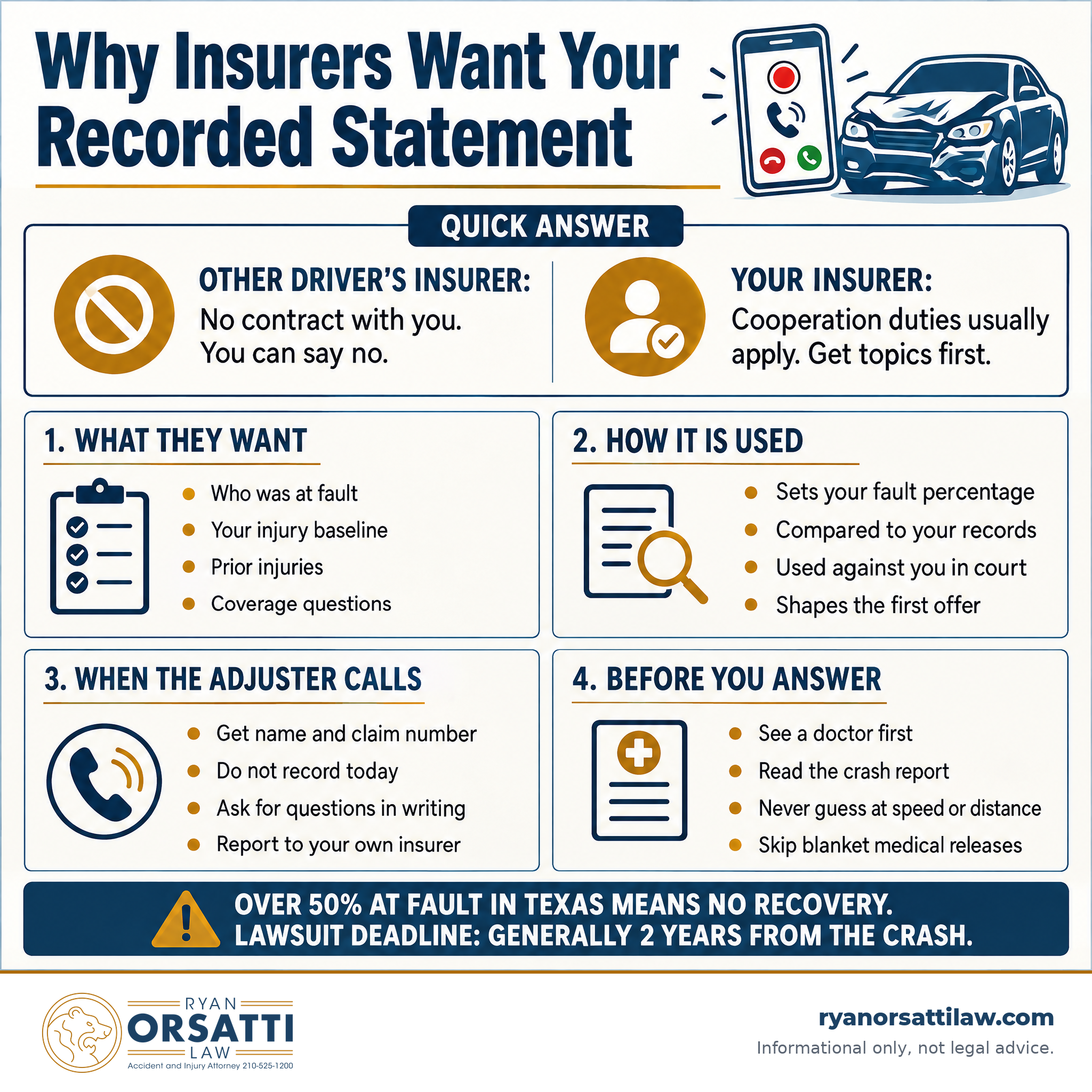
- Insurance companies ask for a recorded statement after a crash to lock in your version of events early, usually before you have seen a doctor, read the crash report, or talked to a lawyer.
- The recording feeds four decisions in the claim file: who was at fault, whether your injuries came from the crash, how much money to set aside for the claim, and whether anything in your story looks inconsistent.
- In a Texas lawsuit, your own recorded words can be offered against you, and they are not hearsay when the other side uses them (Texas Rule of Evidence 801(e)(2)(A)).
- Your own insurer can usually require you to cooperate under your policy. The other driver’s insurer cannot force you to give a statement, because you have no contract with that company.
Key Takeaways
- A recorded statement is an evidence-gathering interview, not a courtesy call, and the adjuster asking for it works for the company that pays the claim.
- In Texas, an injured person who is found more than 50 percent responsible for a crash recovers nothing (Tex. Civ. Prac. and Rem. Code Sec. 33.001), so fault questions on the recording carry real weight.
- Early statements about pain (“I’m fine,” “just sore”) are often used later to argue an injury was minor or came from something else.
- Who is asking matters: your own company, the other driver’s company, and your own company acting on a UM/UIM or PIP claim all play by different rules.
- You can say no to the other driver’s insurer, ask your own insurer for the questions in writing, and get legal advice before any recording starts.
If an adjuster is already calling, Ryan Orsatti Law can talk through the request with you in a free consultation before anything is said on tape. The firm is based in San Antonio, focuses on plaintiff-side personal injury, and serves injured people across Texas, with consultations in English and Spanish.
What Is a Recorded Statement After a Car Accident?
A recorded statement is a phone or in-person interview in which an insurance adjuster asks you questions about the crash and your injuries while a recorder runs. An adjuster is the insurance company employee or contractor who investigates the claim and recommends what the company pays. The Texas Department of Insurance describes the adjuster as someone who works for the insurance company paying the claim and who may review police reports, talk to witnesses, and ask for more information.
The call usually opens with the adjuster asking your permission to record. That permission is captured on the tape, so the recording later shows you agreed to it. Most requests come within days of the crash, sometimes within hours.
Adjusters handle these calls at volume. TxDOT’s 2025 Texas Motor Vehicle Traffic Crash Facts reported one reportable crash every 59 seconds and 244,534 people injured in Texas crashes that year. For the adjuster, your call is routine. For you, it may be the most important conversation in the first month of your claim.
Why Do Insurance Companies Want a Recorded Statement?
Insurance companies want a recorded statement because it gives them your account in your own words, at the moment you know the least about your injuries and the evidence. The recording then does several jobs inside the claim file.
1. It helps the insurer assign fault
Fault drives everything in a Texas injury claim. Under Tex. Civ. Prac. and Rem. Code Sec. 33.001, an injured person whose share of responsibility is greater than 50 percent cannot recover damages. Under Sec. 33.012(a), anyone below that line has their damages reduced by their own percentage. A single answer such as “I glanced at my GPS” or “I didn’t see him until the last second” can become the insurer’s basis for assigning you 20, 30, or even 51 percent of the blame.
2. It sets a baseline for your injuries
Many crash injuries, including soft-tissue, disc, and concussion injuries, show up or worsen over days and weeks. A statement taken two days after the wreck that says “I’m a little sore but okay” becomes the baseline the adjuster compares against every later medical record. If an MRI later shows a disc injury, the insurer may point to the recording and argue the injury was minor at first or came from somewhere else.
3. It screens for prior injuries and other causes
Questions about prior back pain, old accidents, or past chiropractic care are not small talk. They are the start of a “pre-existing condition” defense. Those questions often come paired with a request to sign a broad medical authorization, which is a release that lets the insurer pull your records. Our guide on protecting your medical privacy when the insurance company overreaches explains why that form deserves a careful read.
4. It helps the insurer set the claim’s reserve
A reserve is the amount an insurance company sets aside internally to pay a claim. Early information shapes it. A statement that minimizes fault questions or injuries can anchor the reserve low, and a low reserve tends to produce low offers. The other driver’s policy limits matter too. Texas minimum liability coverage is $30,000 for injury to one person in one crash (Tex. Transp. Code Sec. 601.072), which is why serious injury claims often reach your own uninsured/underinsured motorist coverage as well.
5. It checks coverage
Questions like “Where were you headed?” or “Were you working at the time?” can be coverage questions. Some Texas personal auto policies carry endorsements that exclude certain business use or driving while logged into a rideshare app. The answer you give on tape can decide which policy, if any, pays.
6. It creates a record to compare against everything else
The recording is later compared word for word against the crash report, your doctors’ intake notes, your written answers in a lawsuit, and your deposition. In a Texas civil case, a statement you made is not hearsay when the opposing party offers it against you (Texas Rule of Evidence 801(e)(2)(A)). Normal memory gaps after a trauma can then be framed as “changing your story.” Our post on why your memory of the accident can feel wrong covers why those gaps happen.
Attorney Insight: The question that hurts injured people most is not about the crash. It is “How are you feeling today?” Nobody lies when they answer it. They just answer it too early, before the soreness turns into numbness down an arm or the headache turns into a concussion diagnosis. In matters we handle, the recorded statement rarely shows dishonesty. What it shows is timing, and the insurer uses that timing. A short “I am still being evaluated by my doctor” protects you better than any description of your symptoms.
Your Insurer vs. the Other Driver’s Insurer: Who Can Require a Statement?
Whether you have to give a recorded statement depends on whose insurance company is asking and what kind of claim is open. The Texas Department of Insurance points out that you do not have a contract with the other driver’s insurance company, so you do not have the same options with that company that you have with your own.
| Who is asking | Contract with you? | Can they require a statement? | What they mainly want | Safer move |
|---|---|---|---|---|
| Other driver’s liability insurer | No | No | Fault, injury baseline, prior injuries | Decline politely and send facts in writing or through a lawyer |
| Your insurer on a PIP or MedPay claim | Yes | Policy cooperation duties usually apply | Confirm the crash, injuries, and lost income | Cooperate, but get the topics first and do not guess |
| Your insurer on a UM/UIM claim | Yes | Policy cooperation duties usually apply | Fault and full injury value, because it pays in place of the other driver | Treat it like an adverse claim and get legal advice first |
| Your insurer when you are accused of fault | Yes | Policy cooperation duties apply | Facts to defend you against the other driver | Cooperate fully and keep your own injury claim separate |
Why your own insurer gets involved even when you were not at fault
Your own policy likely includes coverages that pay you directly. Texas Insurance Code Sec. 1952.152 requires personal injury protection (PIP, which pays medical bills and part of your lost income under your own policy) in every auto liability policy unless a named insured rejects it in writing, and Sec. 1952.153 does not require insurers to provide more than $2,500 per person. Sec. 1952.101 requires uninsured/underinsured motorist (UM/UIM) coverage unless it is rejected in writing.
When you make a claim on your own policy, Texas Insurance Code Sec. 542.055 requires most insurers, within 15 days after receiving notice of the claim, to acknowledge it, begin an investigation, and request the items, statements, and forms they reasonably believe they need. That is one reason your own company asks for a statement so quickly.
What “cooperate” means in your policy
Most Texas auto policies have a section called “Duties After an Accident or Loss.” One Texas Personal Auto Policy form in current use requires a person seeking coverage to cooperate in the investigation, submit to physical exams by doctors the company selects, authorize medical records reasonably related to the injury, and, when required, give a sworn proof of loss or an examination under oath. An examination under oath is a formal, sworn interview, usually with a court reporter.
That form does not use the words “recorded statement.” Policies differ, so read yours or ask the adjuster to point to the exact language they rely on. Flatly refusing your own company can start a cooperation dispute, so the better approach is to cooperate on your terms: schedule the call, get the topics in advance, and have a lawyer on the line if you have one.
What Adjusters Ask, and What Each Question Measures
Every common recorded statement question maps to a defense the insurer may raise later. Knowing the purpose helps you answer accurately without volunteering guesses.
- “Do I have your permission to record this call?” Documents your consent on tape.
- “How fast were you going?” Speed estimates become fault percentages. “I don’t know exactly” is a complete answer if it is true.
- “When did you first see the other car?” Tests your lookout and reaction, a common comparative-fault argument.
- “Were you on your phone or using GPS?” Distraction is a frequent basis for shifting blame.
- “How are you feeling?” Sets the injury baseline.
- “Have you ever hurt your neck or back before?” Starts the pre-existing condition defense.
- “Where were you headed?” Can be a coverage question about business or rideshare use.
What to Do When the Adjuster Calls: A 7-Step Checklist
- Identify the caller. Write down the adjuster’s name, company, phone number, claim number, and whether they represent your insurer or the other driver’s.
- Do not agree to record on the first call. A simple line works: “I’m not giving a recorded statement today. Please send any questions in writing.”
- Report the crash to your own insurer promptly. Give the basic facts (date, time, location, vehicles involved, police agency). Prompt notice is a standard policy duty.
- Get medical care before describing injuries. Let a doctor evaluate you, and tell the adjuster you are “still being evaluated” until you have answers.
- Get the crash report. Read the officer’s narrative before you answer fault questions. Our guide on how to obtain a crash report in San Antonio walks through the request.
- Do not sign a blanket medical authorization. Your own policy form may limit records to those reasonably related to the injury, and the other driver’s insurer has no contract right to them at all.
- If you do give a statement, control it. Ask for the topics in writing, keep answers to what you personally know, say “I don’t know” instead of guessing, and ask for a copy. Texas law gives a defense to a person who records a conversation they are part of (Tex. Penal Code Sec. 16.02(c)(4)(A)), so you can record your side too. Say at the start of the call that you are recording, especially if the adjuster is in another state.
Already Gave a Recorded Statement? What Happens Next
A recorded statement you already gave is not the end of your claim, but it does need attention. Write down everything you remember saying while it is fresh. Ask the adjuster in writing for a copy of the recording or transcript. Do not agree to a second recorded statement to “clarify” the first one, because a second version creates more material to compare. Then have a lawyer review your claim before you speak with the insurer again.
Deadlines keep running while the insurer investigates. In Texas, the general deadline to file a personal injury lawsuit is two years from the day the claim accrues, usually the crash date (Tex. Civ. Prac. and Rem. Code Sec. 16.003(a)). An open insurance claim does not pause that deadline.
Why Injured Texans Have a Lawyer Handle the Recorded Statement Request
A recorded statement request looks simple, but it sits at the center of fault, causation, coverage, and claim value. A lawyer’s next steps are to identify every policy in play, including your own PIP and UM/UIM coverage, decide whether any statement should be given at all, provide facts in writing instead of on tape where possible, limit medical authorizations to what is relevant, and preserve the evidence that answers the fault questions for you. Ryan Orsatti Law handles these requests for people hurt in car accidents, truck accidents, motorcycle crashes, and pedestrian collisions across San Antonio and Texas, and works to keep the adjuster’s file focused on the evidence instead of a phone call made before the injuries were known. For more on the broader claim, see our San Antonio car accident lawyer page and our article on the risks of giving a recorded statement to the other driver’s insurer.
Frequently Asked Questions About Recorded Statements After a Crash
Do I have to give a recorded statement to the other driver’s insurance company in Texas?
No. You have no contract with the other driver’s insurance company, so it cannot require you to give a recorded statement. You can decline politely and provide basic facts in writing or through a lawyer. Declining does not end your claim. The insurer can still review the crash report, photos, witness statements, and medical records to evaluate it.
Can my own insurance company require a recorded statement?
Your own insurer can usually require you to cooperate with its investigation under your policy’s duties section, which may include exams, records, a sworn proof of loss, or an examination under oath. Some policy forms do not mention a “recorded statement” by name. Ask the adjuster to identify the policy language, get the topics in advance, and consider legal advice first, especially on a UM/UIM claim.
Can a recorded statement be used against me in court?
Yes. In a Texas civil case, a statement you made is not hearsay when the opposing party offers it against you under Texas Rule of Evidence 801(e)(2)(A). Defense lawyers commonly compare a recorded statement with the crash report, medical records, and deposition testimony to argue that details changed. That is why accurate, limited answers matter more than complete-sounding ones.
What should I say if an adjuster asks to record the call?
You can say, “I’m not giving a recorded statement today. Please send your questions in writing.” Then get the adjuster’s name, company, phone number, and claim number. If the caller is your own insurer, add that you will cooperate and ask what topics they need to cover. Avoid describing your injuries beyond saying you are still being evaluated.
Can I record the call with the insurance adjuster myself?
Generally yes. Texas Penal Code Sec. 16.02(c)(4)(A) provides a defense when the person recording is a party to the conversation, which is why Texas is often called a one-party-consent state. Some other states require everyone’s consent, so if the adjuster is located out of state, tell them at the start of the call that you are recording.
Should I wait to talk to a lawyer until after the insurance company calls?
No. The first adjuster call often happens within days, and the most damaging answers come before you know your diagnosis or have read the crash report. Medical care, evidence, and the two-year Texas filing deadline do not wait for the insurer. Talking to a lawyer before any recorded statement costs nothing at a free consultation and keeps your options open.
Source Notes
- Texas Civil Practice and Remedies Code Sec. 16.003 (two-year limitations period): statutes.capitol.texas.gov, CP 16.003
- Texas Civil Practice and Remedies Code Sec. 33.001 and Sec. 33.012 (proportionate responsibility): statutes.capitol.texas.gov, CP 33.001
- Texas Insurance Code Sec. 542.055 (first-party claim acknowledgment and investigation): statutes.capitol.texas.gov, IN 542.055
- Texas Insurance Code Sec. 1952.101, 1952.152, and 1952.153 (UM/UIM and PIP): statutes.capitol.texas.gov, IN 1952.152
- Texas Transportation Code Sec. 601.072 (minimum liability coverage): statutes.capitol.texas.gov, TN 601.072
- Texas Penal Code Sec. 16.02 (interception of communications): statutes.capitol.texas.gov, PE 16.02
- Texas Rules of Evidence, Rule 801(e)(2) (opposing party’s statement): Texas Rules of Evidence, txcourts.gov
- Texas Department of Insurance, working with an insurance adjuster: tdi.texas.gov
- Texas Department of Insurance, dealing with the other driver’s insurance: tdi.texas.gov
- TxDOT, 2025 Texas Motor Vehicle Traffic Crash Facts: txdot.gov
Talk to Ryan Orsatti Law
If an insurance adjuster is asking for your recorded statement after a crash in Texas, you can talk through your options with Ryan Orsatti Law in a free consultation before you say anything on tape. Call 210-525-1200.
Ryan Orsatti Law
4634 De Zavala Rd, San Antonio, TX 78249
Phone: 210-525-1200
ryanorsattilaw.com
This blog is for informational purposes only, not legal advice. Reading it does not create an attorney-client relationship. Past results do not guarantee future results.
Hurt in an accident in San Antonio? Learn how a San Antonio personal injury lawyer can help with your claim. Call 210-525-1200 or request a free consultation.
The firm works on a contingency fee. You pay nothing unless the firm recovers money for you, and that covers case expenses as well as the fee: if there is no recovery, you owe no attorney's fee and no case expenses. Ask for the fee agreement and read the fee and expense section before you sign anything.
Related San Antonio legal resources
Primary legal and public-data sources
- Texas Civil Practice and Remedies Code Chapter 16: limitations
- Texas Civil Practice and Remedies Code Chapter 33: proportionate responsibility
Ryan Orsatti Law
4634 De Zavala Road, San Antonio, TX 78249
General reference links. Consult each source for its current text.