
Quick Answer
- If you were hit by a City of San Antonio vehicle, you generally have 90 days from the crash to give the City written notice of your claim under Section 150 of the San Antonio City Charter.
- The notice goes to the City Manager or the City Clerk and must say when, where, and how the crash happened, how badly you were hurt, and the amount of your damages.
- That 90-day window is shorter than the six-month notice period in the Texas Tort Claims Act, and Texas law expressly approves city charter deadlines like San Antonio’s.
- Notice is a separate step from a lawsuit. The deadline to file suit for personal injury in Texas is generally two years from the crash.
Key Takeaways
- Texas lets you hold the City responsible when an on-duty City employee negligently drives a vehicle and causes injury (Tex. Civ. Prac. & Rem. Code Sec. 101.021(1)).
- City liability is capped at $250,000 per person, $500,000 per occurrence for injury or death, and $100,000 per occurrence for property damage (Sec. 101.023(c)).
- CPS Energy, SAWS, and VIA vehicle crashes are filed with those entities, not the City’s claims office.
- An emergency-response exception can defeat claims against police and fire drivers.
- Suing the City driver personally can wipe out your claim against the City.
- A police report does not automatically count as notice. Send written notice anyway.
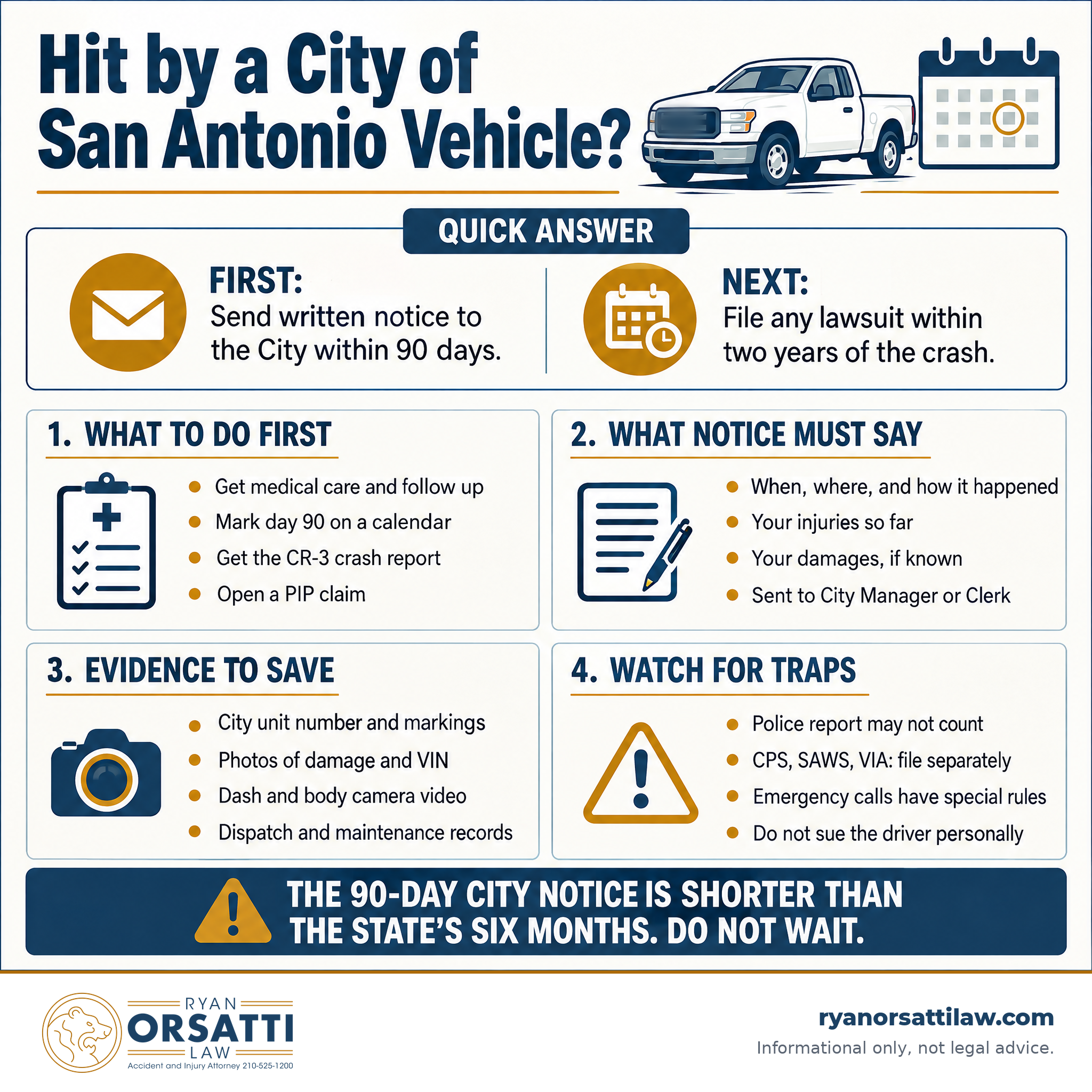
If a City truck, patrol car, or other City vehicle hit you, the clock started the moment the crash happened. Ryan Orsatti Law, a San Antonio personal injury firm that has represented injured Texans for more than a decade, reviews City vehicle crashes and can help you get proper notice to the City before day 90.
How Long Do You Have to File a Claim Against the City of San Antonio?
You have 90 days after the injury to give the City of San Antonio written notice of a claim for personal injury, death, or property damage. That rule comes from Section 150 of the San Antonio City Charter, the City’s founding document. The Texas Tort Claims Act (the state law that lets people sue government bodies in limited situations) sets a general six-month notice period in Tex. Civ. Prac. & Rem. Code Sec. 101.101(a). The same statute, in Sec. 101.101(b), ratifies city charter notice periods. For a City of San Antonio vehicle, plan on 90 days, not six months.
Ninety days is not the same as “about three months.” Calendar months run 28 to 31 days. Three months in a row can add up to as few as 89 days (28 + 31 + 30) or as many as 92 days (31 + 31 + 30). Count actual days on a calendar, and do not plan around the last one.
The lawsuit deadline is different. Under Tex. Civ. Prac. & Rem. Code Sec. 16.003, a personal injury suit generally must be filed within two years after the day the claim accrues. Giving notice does not stop that clock, and filing a claim with the City does not count as filing a lawsuit. Our guide to the Texas two-year statute of limitations and its exceptions covers the lawsuit side in more detail.
Attorney Insight: The most common mistake we see in City crash claims is not a late lawsuit. It is a person who assumes the City already knows. An officer wrote a report, a supervisor came to the scene, or a City adjuster called, so the person never sends written notice. Texas treats statutory notice as a jurisdictional requirement in suits against a government (Tex. Gov’t Code Sec. 311.034), which means a missed notice can get a case dismissed no matter how clear the fault is. A one-page written notice sent on time costs nothing. Fighting about whether the City “really knew” can cost the whole claim.
What Does the Notice of Claim Have to Say?
Section 150 of the City Charter requires written notice that states when, where, and how the injury happened, the apparent extent of the injury, and the amount of damages sustained. The City’s online Notice of Claim form asks for more detail than that, and it is smart to give it.
- Where: street names, nearest intersection, and direction of travel.
- When: date and time, plus the police case number if you have one.
- How: a short, factual description, with names and addresses of witnesses.
- Your injuries, as they are known so far.
- Your damages, to the extent known. If treatment is ongoing, say so.
- Documents: medical reports, bills, repair estimates, a photo of your VIN, and photos of the damage.
The City’s form also says it needs the claimant’s date of birth and Social Security number for Medicare reporting before it makes any payment. Send that only through the City’s official channel.
Where Do You Send a Claim to the City of San Antonio?
The City Charter names two recipients: the City Manager and the City Clerk. The City handles injury and damage claims through its Office of Risk Management, which takes claims on an online Notice of Claim form and lists this address and phone number:
Office of Risk Management/Liability Division
City of San Antonio
P.O. Box 839966
San Antonio, Texas 78283-3966
210-207-7204
According to the City, a claims adjuster should call within 5 to 7 days of filing. Keep proof of exactly what you sent, when, and to whom.
Was It Really a City Vehicle? Which Situation Fits You
The first question in any government crash claim is who owns the vehicle and who employs the driver, because the answer changes where the claim goes, how fast notice is due, and how much can be recovered. San Antonio has several public bodies whose trucks look official but are not handled by the City’s claims office.
| Vehicle that hit you | Where the claim goes | Notice deadline | Damage caps |
|---|---|---|---|
| City of San Antonio vehicle (police, fire, solid waste, public works, parks) | City Office of Risk Management | 90 days (City Charter Sec. 150) | $250,000 per person, $500,000 per occurrence, $100,000 property |
| CPS Energy, SAWS, or VIA vehicle | That entity’s own claims process | Confirm in writing with that entity. Do not assume more than 90 days. | Depends on the entity |
| State agency vehicle | That state agency | Six months (Sec. 101.101(a)) | $250,000 per person, $500,000 per occurrence, $100,000 property |
| Other local government unit | That unit’s claims office | Six months, or shorter if a charter applies | Often $100,000 per person, $300,000 per occurrence, $100,000 property (Sec. 101.023(b)) |
| Private contractor working for the City | The contractor and its insurer | No Tort Claims Act notice. Two-year lawsuit deadline. | No Tort Claims Act caps |
Write down the unit number, the department name on the door, and the driver’s name if you can get it. A City employee driving a personal car on City business can also create a City claim, so do not rule the City out just because the car had no logo. Claims based on a dangerous road, pothole, or broken signal rather than a City driver follow different rules, explained in our post on when the City of San Antonio may be liable for dangerous road conditions.
Can You Sue the City of San Antonio for a Car Accident?
Yes, in limited circumstances. Under Tex. Civ. Prac. & Rem. Code Sec. 101.021(1), a governmental unit is liable when an employee acting within the scope of employment negligently operates a motor vehicle, causes injury, death, or property damage, and would be personally liable under Texas law. In plain terms, if a City driver caused the crash while working, and a private driver who did the same thing would owe you, the City can be held responsible.
A suit under the Tort Claims Act must be brought in state court in the county where the claim arose (Sec. 101.102(a)). For a crash inside San Antonio, that usually means a Bexar County state court. The rest of the case, from proving fault to documenting injuries, works much like any other San Antonio car accident claim. If you were walking when a City vehicle hit you, the same notice rules apply to a San Antonio pedestrian accident claim.
How Much Can You Recover From the City?
A city’s liability under the Texas Tort Claims Act is limited to $250,000 for each person and $500,000 for each single occurrence for bodily injury or death, and $100,000 for each single occurrence for property damage, under Sec. 101.023(c). Those caps apply no matter how serious the injuries are. A crash that hurts several people can force everyone to share the $500,000 occurrence limit.
Your own insurance can matter more in a City crash than in an ordinary one. Personal injury protection (PIP, a no-fault medical and wage coverage on Texas auto policies) is payable without regard to fault under Tex. Ins. Code Sec. 1952.155, and the PIP coverage insurers are required to provide tops out at $2,500 per person under Sec. 1952.153 unless you bought more. Our guide to PIP and MedPay in Texas explains how to use it. Whether your uninsured or underinsured motorist coverage can apply depends on your policy’s definitions, so have someone read the actual policy.
What If a Police Car or Fire Truck Hit You During an Emergency?
A different rule applies when a City driver was responding to an emergency call or reacting to an emergency situation. Under Sec. 101.055(2), the Tort Claims Act does not apply to those claims if the employee’s action complied with the laws and ordinances that govern emergency action, or, where no such law applies, if the action was not taken with conscious indifference or reckless disregard for the safety of others.
This exception is fact-specific. Were the lights and siren on? Was the officer actually on an emergency call or just driving fast? Did the driver slow down at a red light before entering the intersection? The answers usually live in dash camera and body camera video, dispatch logs, and the vehicle’s own data. The City says records requests go through its open government request process, not the claim form.
Attorney Insight: In emergency-response crashes, the timing problem is not only notice. Video and dispatch records are kept on retention schedules, and some footage can be overwritten if nobody asks for it. We send preservation requests and public information requests early, before the City’s adjuster has decided what the case is worth. Officer statements written after the fact tend to describe the emergency in the strongest terms. The recordings show what actually happened.
Should You Sue the City Driver Personally?
Usually not, and doing it wrong can end the case. The Tort Claims Act’s election-of-remedies rule, Sec. 101.106, makes filing suit against the governmental unit an irrevocable choice that bars suit against the individual employee over the same subject matter. Filing against the employee first can bar recovery against the City unless the City consents. Settling with the City also bars a later suit against the employee. Choosing the right defendant is a decision to make before anything is filed.
Does a Police Report Count as Notice to the City?
Not automatically. Sec. 101.101(c) says the notice requirements do not apply when the governmental unit has actual notice of a death, an injury, or property damage. The Supreme Court of Texas has held that actual notice means the governmental unit is subjectively aware that it may be responsible for the injury in the manner the claimant later alleges (Worsdale v. City of Killeen, No. 18-0329). In that case the Court found actual notice on the specific facts, but the standard turns on what the government knew about its own possible fault, not just that a crash happened.
A crash report shows the City that a collision occurred. It may or may not show the City believed its driver caused it. Do not bet a claim on that argument. Send the written notice.
What to Do in the First 90 Days After a City Vehicle Crash
- Get medical care and follow up. Gaps in treatment are the first thing an adjuster points to, and your records become part of your damages proof.
- Put the deadline on a calendar. Count 90 days from the crash and set a target several weeks earlier.
- Photograph both vehicles. Capture the City unit number, department markings, and plate, plus your damage and your VIN, which the City’s form asks for. Note the driver’s name.
- Get the crash report. Texas officers must submit crash reports to TxDOT within 10 days, and TxDOT sells a regular copy of the CR-3 (the Texas Peace Officer’s Crash Report) for $6 and a certified copy for $8, plus a small surcharge and any card fees. Here is how to obtain a crash report in San Antonio.
- Send written notice. Cover when, where, and how it happened, your injuries, and your damages, and keep proof of delivery.
- Request the records. Ask for video, dispatch, and maintenance records through the City’s open records process, and ask that evidence be preserved.
- Open a PIP claim with your own insurer. It pays regardless of fault and can cover early medical bills and lost wages.
- Be careful with the City’s adjuster. Give basic facts if you choose to talk, but you do not have to give a recorded statement before you have spoken with a lawyer.
Why San Antonio Drivers Bring City Crash Claims to a Lawyer Early
A crash with a City of San Antonio vehicle looks like an ordinary wreck, but it runs on different rules: a 90-day charter notice, a damages cap, an emergency-response exception, an election-of-remedies trap, and a question about which public body owns the truck. A lawyer’s first moves are to confirm the owner, get compliant notice to the right office in time, preserve video and dispatch records, and line up every insurance source, including the injured person’s own. Ryan Orsatti Law is based in San Antonio and handles car accident, pedestrian, motorcycle, and commercial vehicle injury claims in Bexar County, including claims against government drivers, and serves injured people across Texas from offices in Austin, Dallas, and Houston. Consultations are free, in English and Spanish.
Frequently Asked Questions
How long do I have to file a claim against the City of San Antonio?
You generally have 90 days after the injury to give the City of San Antonio written notice of a claim, under Section 150 of the City Charter. The notice goes to the City Manager or City Clerk and should state when, where, and how the crash happened, your injuries, and your damages. The separate deadline to file a personal injury lawsuit in Texas is generally two years.
Does the police report count as notice to the City?
Not automatically. Texas law excuses formal notice only when the City has actual notice, which the Supreme Court of Texas has described as subjective awareness that the City may be responsible for the injury as the claimant alleges. A crash report proves a collision happened but may not prove the City knew it was at fault. Sending written notice within 90 days avoids that fight entirely.
What if a San Antonio police car hit me while responding to a call?
Emergency response can bar the claim. The Tort Claims Act does not apply to an employee’s actions while responding to an emergency call if the employee followed the laws governing emergency driving, or, where no such law applies, did not act with conscious indifference or reckless disregard for others’ safety. Lights, siren, speed, and how the officer entered the intersection often decide these cases, so early video preservation matters.
Is a VIA bus or CPS Energy truck crash a City of San Antonio claim?
Usually not through the City’s claims office. The City of San Antonio directs claims involving CPS Energy, SAWS, and VIA Metropolitan Transit to those entities. Each has its own claims process, and deadlines may differ, so confirm the deadline with the entity in writing and do not assume you have longer than 90 days. Identify the vehicle owner from the markings, unit number, and crash report.
How much money can you get from the City of San Antonio after a crash?
The Texas Tort Claims Act caps a city’s liability at $250,000 per person and $500,000 per occurrence for bodily injury or death, and $100,000 per occurrence for property damage. Those limits apply even in catastrophic cases, so a lawyer will also look for other coverage, including your own PIP and possibly your uninsured or underinsured motorist coverage, depending on your policy.
Should I wait until I finish treatment before notifying the City?
No. The 90-day notice deadline runs whether or not you are still treating. Send notice describing your injuries and damages as they are known so far, note that care is ongoing, and keep getting treatment. Waiting to finish medical care is one of the most common ways people lose a claim against a city. The evidence and the deadline will not wait, so talk to a lawyer early.
Source Notes
- San Antonio City Charter, Sec. 150 (Liability of the city and limitations thereon): City of San Antonio, City Charter
- City of San Antonio, Office of Risk Management, Notice of Claim form and FAQ: City of San Antonio Notice of Claim
- Tex. Civ. Prac. & Rem. Code Sec. 101.021 (governmental liability): Sec. 101.021
- Tex. Civ. Prac. & Rem. Code Sec. 101.023 (limits on amount of liability): Sec. 101.023
- Tex. Civ. Prac. & Rem. Code Sec. 101.055 (emergency response exception): Sec. 101.055
- Tex. Civ. Prac. & Rem. Code Sec. 101.101 (notice, charter periods, actual notice): Sec. 101.101
- Tex. Civ. Prac. & Rem. Code Sec. 101.102 (where suit is brought): Sec. 101.102
- Tex. Civ. Prac. & Rem. Code Sec. 101.106 (election of remedies): Sec. 101.106
- Tex. Civ. Prac. & Rem. Code Sec. 16.003 (two-year limitations period): Sec. 16.003
- Tex. Gov’t Code Sec. 311.034 (statutory notice is jurisdictional in suits against a governmental entity): Sec. 311.034
- Tex. Ins. Code Secs. 1952.153 and 1952.155 (personal injury protection): Sec. 1952.155 and Sec. 1952.153
- Worsdale v. City of Killeen, No. 18-0329 (Tex. June 14, 2019): Supreme Court of Texas opinion
- TxDOT, Crash reports and records (CR-3 fees, 10-day submission): TxDOT Crash Reports and Records
Ryan Orsatti Law
4634 De Zavala Rd, San Antonio, TX 78249
Phone: 210-525-1200
ryanorsattilaw.com
This blog is for informational purposes only, not legal advice. Reading it does not create an attorney-client relationship. Past results do not guarantee future results.
Hurt in an accident in San Antonio? Learn how a San Antonio personal injury lawyer can help with your claim. Call 210-525-1200 or request a free consultation.
The firm works on a contingency fee. You pay nothing unless the firm recovers money for you, and that covers case expenses as well as the fee: if there is no recovery, you owe no attorney's fee and no case expenses. Ask for the fee agreement and read the fee and expense section before you sign anything.
Related San Antonio legal resources
Primary legal and public-data sources
- TxDOT: Texas crash reports, data, and statistics
- Texas Civil Practice and Remedies Code Chapter 33: proportionate responsibility
Ryan Orsatti Law
4634 De Zavala Road, San Antonio, TX 78249
General reference links. Consult each source for its current text.