
Quick Answer
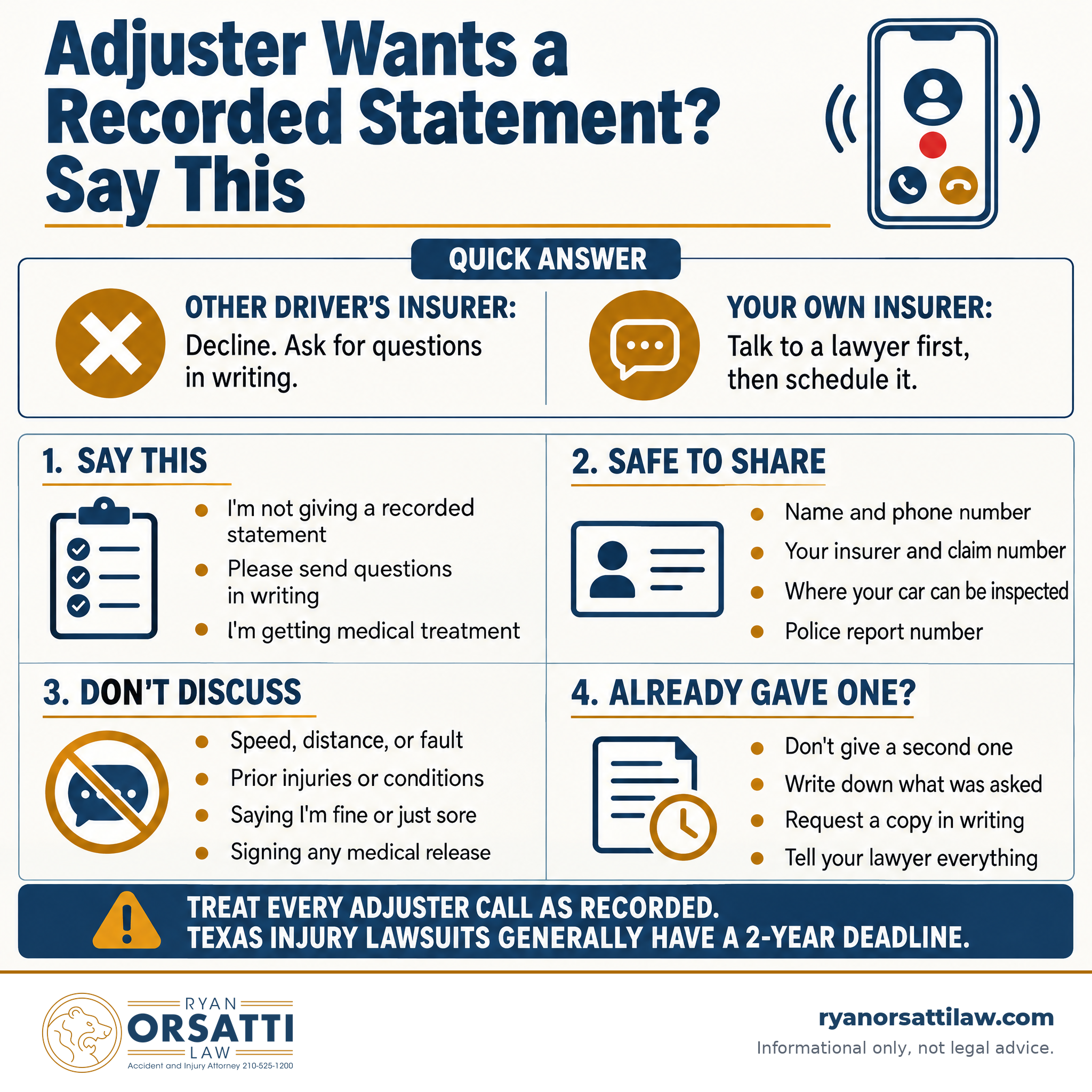
- Say no, politely, and ask for questions in writing: “I’m not going to give a recorded statement. If you need information, please send your request in writing.”
- The other driver’s insurance company is not your insurer. You have no policy with it, so its adjuster has no cooperation clause to hold over you.
- Your own insurance company is different. Your policy can require you to cooperate, so talk with a lawyer first and then schedule the statement instead of refusing it.
- Anything you say on a recorded call can be used against you later as your own statement under Texas Rule of Evidence 801(e)(2).
Key Takeaways
- Texas law generally allows a person who is part of a phone call to record it, so treat every call with an adjuster as recorded (Tex. Penal Code Sec. 16.02(c)(4)).
- Under Texas proportionate responsibility, an injured person who is found more than 50 percent responsible recovers nothing, and a smaller share of fault cuts the recovery by that percentage (Tex. Civ. Prac. & Rem. Code Secs. 33.001 and 33.012).
- For first-party claims such as personal injury protection (PIP), your own insurer must acknowledge the claim and request the items, statements, and forms it needs within 15 days of notice (Tex. Ins. Code Sec. 542.055).
- If someone else makes a claim against you, your own auto insurer may not renew your policy if you keep refusing to cooperate after written notice (Tex. Ins. Code Sec. 551.1053).
- The general deadline to file a Texas personal injury lawsuit is two years (Tex. Civ. Prac. & Rem. Code Sec. 16.003). Talking to an adjuster does not pause that clock.
A recorded statement request is one of the first moves an insurance adjuster makes after a crash, and the words you use on that call can follow your claim all the way to a courtroom. If an adjuster is already calling, Ryan Orsatti Law, a San Antonio personal injury firm that has represented injured Texans for more than a decade, can review the request with you in a free consultation before you say anything on the record.
Can I Refuse a Recorded Statement to the Other Driver’s Insurance Company?
Yes. You can decline a recorded statement to the at-fault driver’s insurance company. That company insures the other driver, not you. You never signed its policy, so you owe it none of the duties a policyholder owes.
The adjuster works for the company that would pay your claim. Every answer you give is weighed against what the company might owe. The Texas Department of Insurance (TDI) itself warns drivers that there is no guarantee the other driver’s insurer will pay, and it tells people to ask for any denial reason in writing.
The adjuster also has far more practice than you do. TxDOT’s 2025 Crash Facts report one reportable crash every 59 seconds in Texas and 244,534 people injured in traffic crashes that year. Adjusters handle these calls all day. Most injured people are doing it for the first time, often while hurting and short on sleep.
Exactly What to Say: Word-for-Word Scripts
A good answer to a recorded statement request is short, calm, and the same every time. You do not need to explain yourself or argue. Use these lines as written.
On the first call
“Thanks for calling. I’m not going to give a recorded statement. If you need information, please send your request in writing to the address or email I give you. Here is my contact information.”
When the adjuster says the claim can’t move forward without it
“Please send me, in writing, whatever rule or policy language you believe requires a recorded statement from me. Until then, my answer is no.”
The at-fault driver’s insurer has no policy with you, so it cannot point to a contract you signed. A written request also creates a paper trail if the company later stalls.
When the adjuster says it is “just a few quick questions”
“I understand. I’m still not answering questions about the crash or my injuries over the phone. Please put them in writing.”
A call does not need to be labeled “recorded” to be recorded. Texas law generally lets a person who is part of a call record it, and the adjuster’s notes go in the claim file either way.
When the adjuster asks “How are you feeling?”
“I’m getting medical treatment. My doctors will document my injuries.”
That answer is friendly and true. It also avoids “I’m fine,” a polite reflex that can be written down as a statement that you were not hurt.
When the adjuster asks you to sign a medical release
“I’m not signing a general medical authorization. If you need records related to this crash, send the request in writing.”
If you already have a lawyer
“I’m represented. Please contact my attorney, and here is the phone number.” Then end the call.
| Adjuster says | You say | Why it matters |
|---|---|---|
| “We just need your side of the story.” | “I’m not giving a recorded statement. Send questions in writing.” | Written answers can be reviewed before they go out. |
| “We can’t process the claim without it.” | “Send me the rule that requires it, in writing.” | The other driver’s insurer has no policy with you. |
| “How are you feeling today?” | “I’m getting treatment. My doctors will document it.” | “I’m fine” can be used to argue you were not hurt. |
| “How fast were you going?” | “I’m not discussing fault on the phone.” | Your share of fault can reduce or bar recovery. |
| “Just sign this medical release.” | “No general releases. Send a written request.” | A broad release can reach unrelated medical history. |
What You Can Safely Share With the Adjuster
You can share basic facts that do not touch fault or injuries. Giving these helps the claim move without handing over a statement.
- Your name, phone number, and mailing address
- Your own insurance company and claim number
- The date and general location of the crash
- Where your car is so the damage can be inspected
- The police report number, if you have it
Stay away from speed, distances, who saw whom first, what you said at the scene, prior injuries, and how you feel. Those topics drive fault and damages, and they are where an off-the-cuff answer causes the most harm.
Attorney Insight: A recorded statement rarely ends the claim on the spot. Its damage shows up months later. If the case goes to suit, the defense lawyer can read your recorded words back to you at a deposition and at trial, and Texas Rule of Evidence 613 lets a lawyer question a witness about an earlier statement that does not match current testimony. In matters we handle, the line that causes the most trouble is the casual one, said a day or two after the crash, before an MRI or a specialist visit, such as “I’m okay, just a little sore.” It was honest when you said it. It still gets framed as proof that the injury came from somewhere else.
What Changes When It Is Your Own Insurance Company?
Your own insurer can ask for a statement, and your policy may require you to cooperate. The answer is not “no.” The answer is “yes, on a schedule, after I talk to my lawyer.”
This comes up when you claim under your own coverage. Texas auto liability policies must include personal injury protection (PIP), coverage that pays reasonable expenses such as necessary medical care after a crash, unless an insured named in the policy rejects it in writing (Tex. Ins. Code Sec. 1952.152). It also comes up with collision coverage and uninsured/underinsured motorist (UM/UIM) coverage, which pays when the at-fault driver has no insurance or too little.
Texas sets deadlines for your own company on these first-party claims. Within 15 days of notice, the insurer must acknowledge the claim, start investigating, and request the items, statements, and forms it reasonably believes it needs (Tex. Ins. Code Sec. 542.055). It then generally has 15 business days after receiving everything it required to accept or reject the claim in writing (Tex. Ins. Code Sec. 542.056).
A good script for your own company: “I’ll cooperate with my claim. I’d like to speak with my lawyer first. Please send the request in writing so we can schedule it.”
A second situation matters even more. If the other driver blames you and makes a claim against you, your own insurer handles that claim and may defend you. Under a 2021 Texas law, if you keep failing or refusing to cooperate in that investigation or defense after written notice, the insurer may not renew your policy (Tex. Ins. Code Sec. 551.1053). Refusing your own company in that setting can cost you coverage, so tell your lawyer right away.
| Question | Other driver’s insurer | Your own insurer |
|---|---|---|
| Do you have a policy with it? | No | Yes |
| Can you decline the statement? | Yes | Your policy may require cooperation |
| Common coverages involved | The at-fault driver’s liability coverage | PIP, collision, UM/UIM |
| Smart response | Decline. Ask for questions in writing. | Talk to a lawyer, then schedule it. |
Attorney Insight: Do not assume your own company is on your side in every claim. In an uninsured or underinsured motorist claim, your insurer is deciding how much it has to pay you, so it looks at fault and injuries much like the other driver’s carrier would. We routinely see injured people treat that adjuster like a friend and volunteer details they would never give the other side. Cooperate, but prepare the same way, with your lawyer on the line.
Your 7-Step Plan When an Adjuster Calls After a Texas Crash
- Ask for the caller’s name, company, phone number, and which driver the company insures.
- If it is the other driver’s insurer, decline the recorded statement with the script above.
- Give only basic contact and vehicle information.
- Write down the date, time, caller, and what was asked, right after you hang up.
- Do not sign any release, medical authorization, or check sent by the other driver’s insurer until it has been reviewed.
- Keep getting medical care and follow your doctor’s plan, since gaps in treatment are a common argument against injury claims.
- Talk to a personal injury lawyer before you give any statement, especially if you were hurt or fault is disputed.
Already Gave a Recorded Statement? What to Do Now
If you already gave a recorded statement, do not panic and do not give a second one. One statement is a problem a lawyer can work with. Two statements that differ in small ways give the defense more to work with.
- Write down everything you remember about the call: the date, who called, and the questions asked.
- Ask the adjuster, in writing, for a copy of the recording or transcript.
- Tell your lawyer exactly what you said, including anything you now think was wrong or incomplete.
- If you signed a medical authorization, a HIPAA authorization can generally be revoked in writing under 45 C.F.R. Sec. 164.508(b)(5), though revocation does not undo records already released.
For more on how adjusters behave once a lawyer is involved, see how insurance adjusters change their tune when you hire a San Antonio personal injury attorney, and our broader guide to dealing with insurance adjusters after a San Antonio accident.
Why Injured Texans Let a Lawyer Handle the Recorded Statement Request
A recorded statement request looks like routine paperwork, but it is often the insurer’s first chance to lock in your version of fault and injuries before the evidence is in. A lawyer reviewing the request should identify which company is calling and which coverage is at stake, decide whether any statement is required, put communications in writing, and line up the crash report, photos, witness information, and medical records before anyone talks on the record. In commercial cases, the motor carrier’s insurer may call within days, which is why we explain why to refuse a recorded statement to a motor carrier’s insurer before consulting a lawyer. Ryan Orsatti Law handles San Antonio car accident claims, 18-wheeler and truck accident cases, motorcycle crashes, pedestrian collisions, and serious-injury claims for people in Bexar County and across Texas, with offices in Austin, Dallas, and Houston and consultations in English and Spanish.
Frequently Asked Questions About Recorded Statements
Can I refuse a recorded statement to the insurance company?
Yes, if it is the other driver’s insurance company. You have no policy with that company, so you owe it no duty to cooperate the way a policyholder does. A polite refusal works: “I’m not giving a recorded statement. Please send any questions in writing.” Your own insurance company is different, since your policy may require cooperation, so speak with a lawyer before you decide how to respond.
Do I have to give a recorded statement to my own insurance company?
Not automatically, but your policy may require you to cooperate, so refusing outright can create problems. Under Texas Insurance Code Section 551.1053, an auto insurer may not renew your policy if you keep refusing to cooperate in defending a claim made against you after written notice. The safer approach is to talk with a lawyer, ask for the request in writing, and schedule the statement with your lawyer involved.
Can an insurance adjuster record my call without telling me in Texas?
Texas generally allows a person who is part of a phone call to record it, under Texas Penal Code Section 16.02(c)(4). Many adjusters still announce the recording, but you should treat every call with an insurance company as recorded. Even an unrecorded call ends up in the adjuster’s written notes, so the safest approach is to keep conversations limited to basic contact and vehicle information.
What should I say if the adjuster asks how I’m feeling?
Say something accurate that does not minimize your injuries, such as “I’m getting medical treatment, and my doctors will document my injuries.” Avoid “I’m fine” or “just a little sore.” Those polite answers are often given before a full diagnosis, and an insurer can later point to them as evidence that you were not seriously hurt or that the injury came from something else.
Will refusing a recorded statement hurt or delay my claim?
Declining a recorded statement to the other driver’s insurer does not cancel your claim. You can still provide the crash report, photos, repair estimates, and medical records in writing. Written communication creates a record of what the insurer asked for and when. If the company refuses to pay, TDI advises asking for the reason in writing, and TDI accepts complaints against insurance companies.
Should I wait until the insurance company makes an offer before calling a lawyer?
No. The most damaging mistakes usually happen early, in the first calls, the first statement, and the first release form. Medical care, evidence, and legal deadlines do not wait for an offer, and the general Texas deadline to file a personal injury lawsuit is two years. Talking with a lawyer before any statement lets you protect the claim from the start.
Source Notes
- Tex. Civ. Prac. & Rem. Code Sec. 16.003 (two-year limitations period for personal injury)
- Tex. Civ. Prac. & Rem. Code Sec. 33.001 (no recovery if more than 50 percent responsible)
- Tex. Civ. Prac. & Rem. Code Sec. 33.012 (recovery reduced by percentage of responsibility)
- Tex. Penal Code Sec. 16.02(c)(4) (recording by a party to the communication)
- Tex. Ins. Code Sec. 542.055 and Sec. 542.056 (first-party claim acknowledgment and decision deadlines, with “claim” defined as a first-party claim in Sec. 542.051)
- Tex. Ins. Code Sec. 551.1053 (nonrenewal for failure to cooperate in a third-party liability claim)
- Tex. Ins. Code Sec. 1952.152 (PIP coverage required unless rejected in writing)
- Texas Rules of Evidence, Rules 613(a) and 801(e)(2)
- 45 C.F.R. Sec. 164.508 (HIPAA authorizations, including revocation in writing)
- TxDOT, Texas Motor Vehicle Traffic Crash Facts, Calendar Year 2025
- Texas Department of Insurance, How to deal with the other driver’s insurance
- Texas Department of Insurance, Auto insurance FAQ
Ryan Orsatti Law
4634 De Zavala Rd, San Antonio, TX 78249
Phone: 210-525-1200
ryanorsattilaw.com
This blog is for informational purposes only, not legal advice. Reading it does not create an attorney-client relationship. Past results do not guarantee future results.
Hurt in an accident in San Antonio? Learn how a San Antonio personal injury lawyer can help with your claim. Call 210-525-1200 or request a free consultation.
The firm works on a contingency fee. You pay nothing unless the firm recovers money for you, and that covers case expenses as well as the fee: if there is no recovery, you owe no attorney's fee and no case expenses. Ask for the fee agreement and read the fee and expense section before you sign anything.
Related San Antonio legal resources
Primary legal and public-data sources
- Texas Civil Practice and Remedies Code Chapter 16: limitations
- Texas Civil Practice and Remedies Code Chapter 33: proportionate responsibility
Ryan Orsatti Law
4634 De Zavala Road, San Antonio, TX 78249
General reference links. Consult each source for its current text.