
Quick Answer
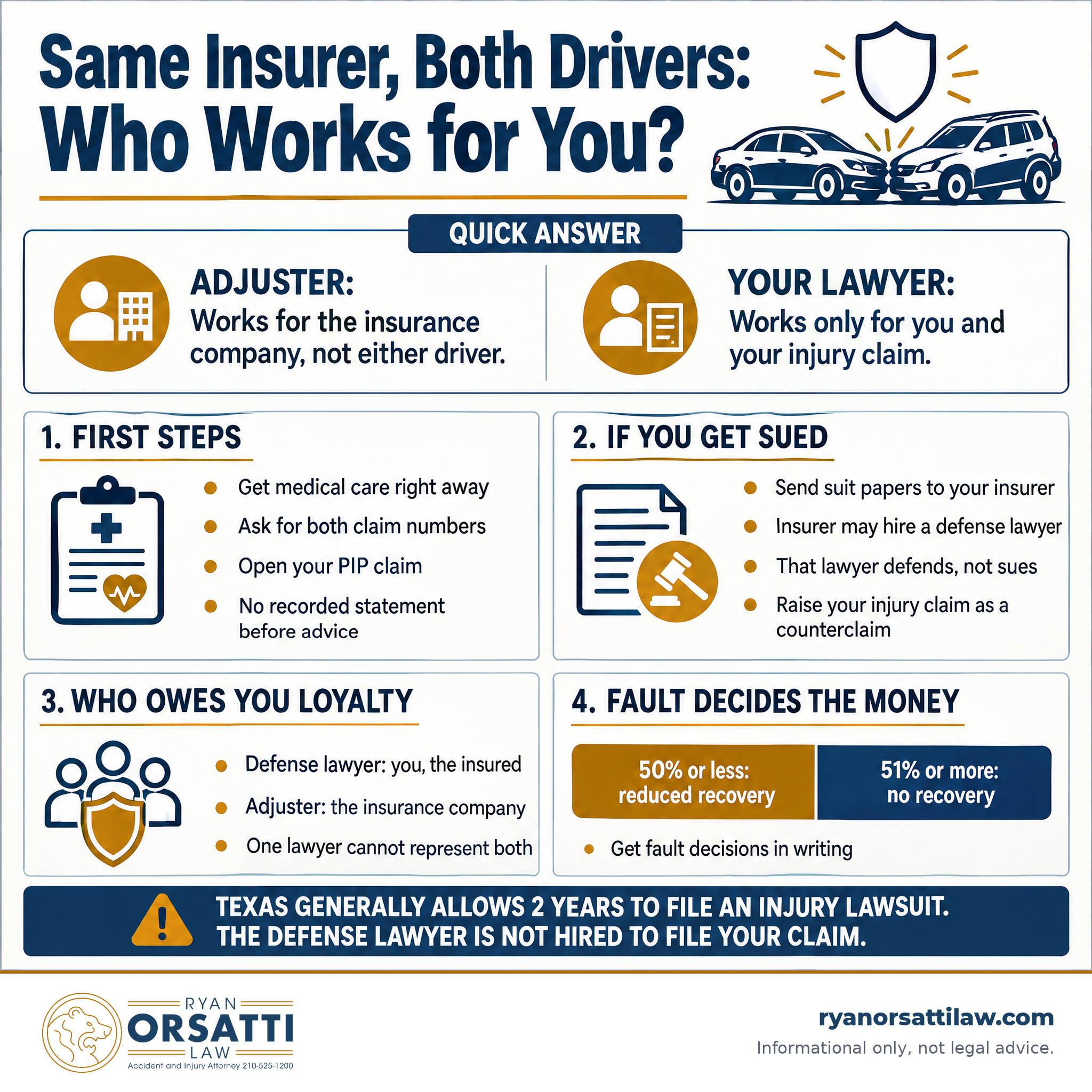
- Yes, the same insurance company can insure both drivers in a Texas car accident and handle claims on both policies. That does not mean it represents either driver the way a lawyer does. The adjuster works for the company.
- If one driver sues the other, the insurer may pay for a separate defense lawyer for each driver it insures. Each of those lawyers owes loyalty to the driver they defend, and Texas ethics rules bar one lawyer from representing opposing parties in the same lawsuit.
- The lawyer your insurer hires is there to defend you against the other driver’s claim. That lawyer is not hired to pursue your own injury claim.
- Texas generally gives you two years from the crash to file a personal injury lawsuit under Tex. Civ. Prac. & Rem. Code Sec. 16.003.
Key Takeaways
- An insurance adjuster represents the insurance company, even when you and the other driver both pay premiums to that company.
- In a lawsuit between two drivers with the same insurer, the company can end up paying two different defense lawyers on opposite sides of the same case.
- A defense lawyer hired by the insurer owes “unqualified loyalty” to the insured driver, according to the Texas Supreme Court in Employers Casualty Co. v. Tilley.
- Your own claim for medical bills, lost wages, and pain is a separate job, and no lawyer the insurer hires to defend you is assigned to bring it.
Ryan Orsatti Law reviews same-insurer car accident claims for injured drivers in San Antonio and across Texas, including cases where both drivers end up in the same lawsuit. A free consultation is a simple way to sort out who works for whom before you sign anything or give a statement.
Can the Same Insurance Company Represent Both Drivers After a Car Accident?
The same insurance company can insure both drivers and process claims on both policies, but “represent” depends on who you are talking to. The adjuster works for the insurer. A defense lawyer the insurer hires works for the driver being sued. Your own injury lawyer works for you.
Same-insurer crashes are common in Texas because a handful of companies write most auto policies. In TDI’s 2024 market report, Progressive Group held 21.08 percent and State Farm Group held 18.19 percent of Texas private passenger auto premiums, a combined 39.27 percent. The top five groups wrote 67.84 percent of the market. With TxDOT counting 48,522 crashes in Bexar County alone in 2024, plenty of San Antonio drivers find out after a wreck that the other car carries the same logo on its insurance card.
The firm has already written about what happens when the driver who hit you has the same insurance company during the claim stage. This guide picks up where the question turns to representation: who is actually on your side, and what changes if a lawsuit is filed.
Who Does the Adjuster Work For When Both Drivers Have the Same Insurer?
The adjuster works for the insurance company, not for you and not for the other driver. That is true whether the adjuster is handling your own coverage or the other driver’s liability coverage. The company may open separate claim numbers and assign separate adjusters, but it is still one company deciding how much it pays on both files.
It helps to separate two kinds of claims:
- First-party claims are claims under your own policy, such as personal injury protection (PIP, no-fault coverage for medical bills and lost income) or collision coverage. Under Tex. Ins. Code Sec. 1952.155, PIP benefits are payable without regard to who caused the crash. Texas requires auto liability policies to include PIP unless a named insured rejects it in writing (Sec. 1952.152), and the required amount is $2,500 per person (Sec. 1952.153).
- Third-party claims are claims you make against the at-fault driver’s liability coverage. Texas requires at least $30,000 per person and $60,000 per crash for bodily injury, plus $25,000 for property damage (Tex. Transp. Code Sec. 601.072).
On the third-party side, the insurer’s legal duties run mainly to its own policyholder, the at-fault driver. In Allstate Insurance Co. v. Watson, the Texas Supreme Court held that a third-party claimant has no direct cause of action under the former Insurance Code art. 21.21 for unfair claim settlement practices. Texas is also a “no direct action” state, which means an injured person generally cannot sue the at-fault driver’s insurer directly until that driver’s liability has been decided by agreement or judgment (In re Essex Insurance Co.). You sue the driver, and the insurer defends and pays within its limits.
That is why a recorded statement deserves care. Whether you give it on your PIP claim or the other driver’s liability claim, it lands with the same insurer. The firm’s guide to the risks of giving a recorded statement to the defendant’s insurance company covers what adjusters listen for.
Attorney Insight: When one company carries both policies, ask for every fault decision in writing, with the percentage it assigned to each driver. A phone call saying “we are splitting it” gives you nothing to challenge. The number matters: under Texas law a driver found 50 percent responsible can still recover a reduced amount, while a driver found 51 percent responsible recovers nothing.
| Person | Paid by | Owes loyalty to | Will not do for you |
|---|---|---|---|
| Liability adjuster on the other driver’s policy | Insurance company | Insurance company | Advise you or push for your full damages |
| Your PIP or collision adjuster | Insurance company | Insurance company, under your policy terms | Pursue your injury claim against the other driver |
| Defense lawyer the insurer hires for you | Insurance company | You, the insured driver | File your own injury claim unless separately agreed |
| Defense lawyer the insurer hires for the other driver | Insurance company | The other driver | Anything that helps your side |
| Your own injury lawyer | Your fee agreement with that lawyer | You | Answer to the insurance company |
What Happens If Both Drivers Sue Each Other and Have the Same Insurer?
If both drivers blame each other and one files suit, the same insurer may have to defend both of them in one case. When the other driver sues you, a claim you have from the same crash generally has to be raised as a counterclaim in that case. Texas Rule of Civil Procedure 97(a) requires a pleading to state as a counterclaim any claim that “arises out of the transaction or occurrence that is the subject matter of the opposing party’s claim,” with limited exceptions, including a claim already pending in another lawsuit.
Texas law treats a counterclaimant as a “claimant” for fault purposes (Tex. Civ. Prac. & Rem. Code Sec. 33.011), so the jury can assign a percentage of responsibility to each driver. Whether the insurer must defend a driver is generally decided by comparing the lawsuit’s allegations to the policy, which Texas courts call the “eight-corners rule” (GuideOne Elite Insurance Co. v. Fielder Road Baptist Church).
The result looks strange from the outside. One company pays a lawyer to defend you against the other driver’s claim and a different lawyer to defend the other driver against yours. It cannot use one lawyer for both, because Texas Disciplinary Rule 1.06(a) says a lawyer “shall not represent opposing parties to the same litigation.”
Attorney Insight: A common trap in same-insurer lawsuits is a driver who assumes the defense lawyer the insurer sent is handling everything. That lawyer was hired to defend the claim against you. Your own injury claim, your medical bills, and your lost wages may need to be filed as a counterclaim in that same case, and someone has to be hired to do it. Your own injury lawyer can coordinate with insurer-appointed defense counsel so your defense and your injury claim move together instead of working against each other. The longer that waits, the less time there is to build the injury side of the case.
Does the Lawyer the Insurance Company Hires Work for Me?
Yes. A defense lawyer the insurer hires to defend you owes loyalty to you, the insured. The Texas Supreme Court said in Employers Casualty Co. v. Tilley that this lawyer owes the insured “the same type of unqualified loyalty as if he had been originally employed by the insured,” and repeated the point in State Farm Mutual Automobile Insurance Co. v. Traver.
The ethics rules back that up. Rule 1.08(e) lets a lawyer accept payment from someone other than the client only if the client consents, the lawyer’s independent judgment is not affected, and client confidences are protected. Rule 5.04(c) bars a lawyer from letting the person who pays the lawyer “direct or regulate the lawyer’s professional judgment in rendering such legal services.”
The limit is scope. Defense counsel’s job is to defend the claim against you. If you were hurt, your claim for compensation is a separate task with a separate goal. Do not assume the lawyer hired to defend you will also bring your injury claim. Ask in writing what the defense lawyer will and will not handle.
How Does Fault Work When One Company Insures Both Drivers?
Fault controls the money in a same-insurer crash, and the same company is weighing both drivers’ versions of what happened. Under Tex. Civ. Prac. & Rem. Code Sec. 33.001, a claimant cannot recover damages if their percentage of responsibility is greater than 50 percent. If you are 50 percent or less responsible, Sec. 33.012(a) reduces your recovery by your percentage.
Here is how the math works, using hypothetical numbers for illustration only. If a jury found your damages were $40,000 and found you 20 percent responsible, your recovery would be reduced by 20 percent: $40,000 x 0.80 = $32,000. If the jury found you 51 percent responsible, you would recover nothing.
Fault is fact-specific. An adjuster’s early fault call is not the final word, and in a lawsuit a jury decides it from the crash report, photos, video, witnesses, and vehicle damage.
Settlement pressure also runs through the at-fault driver’s policy. Under the Texas Stowers doctrine, an insurer’s duty to accept a settlement demand is triggered when the claim is within coverage, the demand is within policy limits, and the terms are such that an ordinarily prudent insurer would accept them (American Physicians Insurance Exchange v. Garcia). That duty runs to the insurer’s own customer, the at-fault driver. A properly built demand on your behalf puts that duty in play, which is one reason the timing and content of a demand matter.
What to Do When the Other Driver Has the Same Insurance Company
- Get medical care right away and keep every record, bill, and note from your doctors.
- Ask the insurer, in writing, for the claim number and adjuster name on each claim: your own policy and the other driver’s liability policy.
- Open your PIP claim if you have PIP. It pays without regard to fault.
- Report the crash to your insurer as your policy requires, but hold off on a recorded statement about the other driver’s liability claim until you have talked with a lawyer.
- Save evidence: photos, dashcam video, the crash report, witness names, and your damaged property.
- If you are served with a lawsuit, read your policy’s notice terms and send the papers to your insurer right away so it can provide a defense.
- Ask any lawyer the insurer assigns, in writing, who they represent and whether they will handle your injury claim. Then hire your own lawyer for that claim well before the two-year deadline.
When Should You Get Your Own Lawyer in a Same-Insurer Crash?
Talk to your own lawyer as soon as you are hurt and the insurer starts discussing fault, and right away if anyone files a lawsuit. Those are the points where the company’s interests and yours can split. A lawyer who works only for you can handle the adjuster, preserve evidence, coordinate with defense counsel, and track the Sec. 16.003 deadline.
For more on your own coverage, see the firm’s post on whether it is a conflict of interest when your insurance company also insures the at-fault driver. To complain about how a company or adjuster handled a claim, call the Texas Department of Insurance Help Line at 800-252-3439. A TDI complaint is not the same as a lawyer pursuing your injury claim.
Why Injured Texans Ask a Car Accident Lawyer to Sort Out a Same-Insurer Claim
A same-insurer crash looks simple until both drivers blame each other or someone gets served. Then there may be two claim files, two defense lawyers, a counterclaim, and one company paying for all of it. A lawyer separates those threads: confirm every policy and limit, open the right first-party claims, decide whether your injury claim belongs in a pending lawsuit, and build the medical and fault evidence. Ryan Orsatti Law represents people hurt in car accidents, truck accidents, motorcycle crashes, and pedestrian collisions in San Antonio and across Texas. Learn more about the firm’s work as a San Antonio car accident lawyer.
Frequently Asked Questions
Can the same insurance company represent both drivers in a lawsuit?
The same insurance company can pay for the defense of both drivers, but it cannot have one lawyer represent both sides. Texas Disciplinary Rule 1.06(a) says a lawyer shall not represent opposing parties to the same litigation. In practice, the insurer hires a separate defense lawyer for each driver it insures, and each lawyer owes loyalty to the driver they defend.
Will my insurance company take my side if it also insures the other driver?
Your insurance company is not on either driver’s side in the way a lawyer would be. Adjusters work for the company. The company owes you what your policy promises, such as PIP benefits that Texas law makes payable without regard to fault. On the other driver’s liability claim, its duties run mainly to that driver, its policyholder.
Is the lawyer my insurance company hired my lawyer?
Yes, for the defense of the claim against you. The Texas Supreme Court has held that a defense lawyer hired by the insurer owes the insured unqualified loyalty. That lawyer’s job is defending you, though, not pursuing your own injury claim. Ask in writing what the defense lawyer will handle, and hire your own lawyer for your injury claim.
Can I sue the other driver if we have the same insurance company?
Yes. Having the same insurer does not take away your right to bring an injury claim against the at-fault driver. In Texas you generally sue the driver, not the insurance company, because of the no-direct-action rule. The driver’s insurer then provides a defense and pays any covered settlement or judgment up to the policy limits.
What if the other driver sues me first after a same-insurer crash?
Send the suit papers to your insurer right away so it can provide a defense. If you were hurt, your own claim from the same crash generally must be raised as a counterclaim in that lawsuit under Texas Rule of Civil Procedure 97(a), with limited exceptions. Talk to your own injury lawyer quickly so that claim is handled.
Should I wait to see what the insurance company decides before calling a lawyer?
No. Waiting gives the insurer time to set the fault story while evidence fades and deadlines run. Texas generally allows two years to file an injury lawsuit, and a fault finding above 50 percent bars recovery entirely. Getting medical care and talking with a lawyer early protects both your health and your claim.
Source Notes
- Tex. Civ. Prac. & Rem. Code Sec. 16.003 (two-year limitations period for personal injury)
- Tex. Civ. Prac. & Rem. Code Secs. 33.001, 33.011, 33.012 (proportionate responsibility)
- Tex. Ins. Code Secs. 1952.152, 1952.153, 1952.155 (personal injury protection)
- Tex. Transp. Code Sec. 601.072 (minimum liability coverage)
- Texas Rules of Civil Procedure, Rule 97(a) (compulsory counterclaims)
- Texas Disciplinary Rules of Professional Conduct, Rules 1.06(a), 1.08(e), 5.04(c)
- Employers Cas. Co. v. Tilley, 496 S.W.2d 552 (Tex. 1973)
- State Farm Mut. Auto. Ins. Co. v. Traver, 980 S.W.2d 625 (Tex. 1998)
- Allstate Ins. Co. v. Watson, 876 S.W.2d 145 (Tex. 1994)
- In re Essex Ins. Co., 450 S.W.3d 524 (Tex. 2014) (orig. proceeding) (per curiam)
- GuideOne Elite Ins. Co. v. Fielder Rd. Baptist Church, 197 S.W.3d 305 (Tex. 2006)
- G.A. Stowers Furniture Co. v. Am. Indem. Co., 15 S.W.2d 544 (Tex. Comm’n App. 1929, holding approved) and Am. Physicians Ins. Exch. v. Garcia, 876 S.W.2d 842 (Tex. 1994)
- Texas Department of Insurance, 2024 Market Conditions Annual Report (private passenger auto market share)
- TxDOT, Crashes and Injuries by County 2024 (Bexar County)
- Texas Department of Insurance, Get help with an insurance complaint
Ryan Orsatti Law
4634 De Zavala Rd, San Antonio, TX 78249
Phone: 210-525-1200
ryanorsattilaw.com
This blog is for informational purposes only, not legal advice. Reading it does not create an attorney-client relationship. Past results do not guarantee future results.
Hurt in an accident in San Antonio? Learn how a San Antonio personal injury lawyer can help with your claim. Call 210-525-1200 or request a free consultation.
The firm works on a contingency fee. You pay nothing unless the firm recovers money for you, and that covers case expenses as well as the fee: if there is no recovery, you owe no attorney's fee and no case expenses. Ask for the fee agreement and read the fee and expense section before you sign anything.
Related San Antonio legal resources
Primary legal and public-data sources
- Texas Civil Practice and Remedies Code Chapter 16: limitations
- Texas Civil Practice and Remedies Code Chapter 33: proportionate responsibility
Ryan Orsatti Law
4634 De Zavala Road, San Antonio, TX 78249
General reference links. Consult each source for its current text.