
Quick Answer
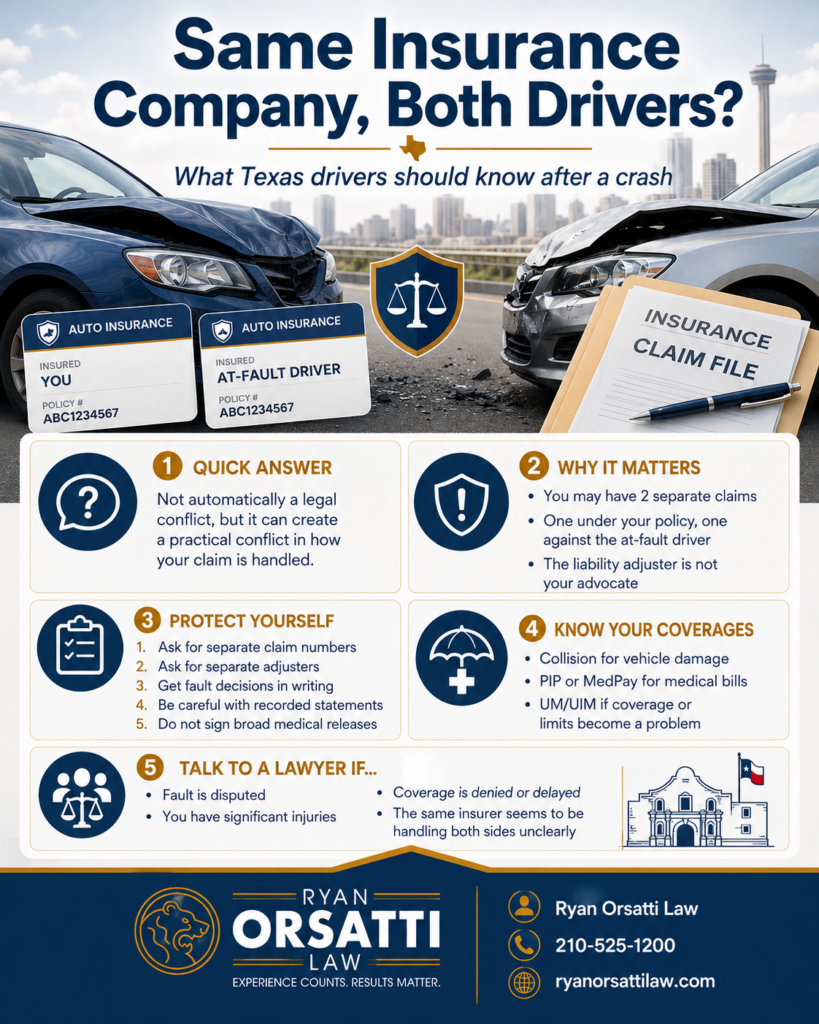
Usually, it is not automatically a legal conflict of interest if your insurance company also insures the at-fault driver. But it can create a serious practical conflict in how the claim is handled.
In Texas, you may have two different claims with the same company: a first-party claim under your own policy and a third-party liability claim against the other driver’s policy. Ask for separate claim numbers, separate adjusters, written explanations for any denial or shared-fault decision, and do not assume the adjuster is neutral just because the company name is familiar.
Key Takeaways
- The same insurance company can insure both drivers, but your rights depend on which policy and coverage apply.
- The at-fault driver’s liability adjuster is not your advocate, even if the insurer is also your company.
- Your own coverages, such as collision, PIP, MedPay, or UM/UIM, may help while the liability claim is disputed.
- Texas fault rules matter. If an insurer tries to put part of the blame on you, that can reduce or defeat recovery under Texas proportionate responsibility law.
- Get important claim decisions in writing, especially liability denials, shared-fault decisions, coverage positions, and deductible reimbursement issues.
Is It a Conflict of Interest if My Insurance Company Also Insures the At-Fault Driver?
It is usually not an automatic legal conflict of interest, but it can create divided incentives that you should treat carefully. The company may owe contractual duties to you under your policy while also defending or protecting the other driver under that driver’s policy.
That does not mean the insurer gets to ignore evidence, delay without explanation, or treat your claim unfairly. It does mean you should not assume the company is “on your side” simply because you pay premiums to the same carrier.
A same-insurer crash often involves two separate roles inside one company. Your own policy may cover your vehicle damage, medical payments, personal injury protection, or UM/UIM benefits. The other driver’s policy may provide liability coverage for your injury claim if that driver caused the crash.
Quotable passage: In a Texas same-insurer crash, the key issue is not the logo on the insurance card. The key issue is which policy is paying, which adjuster is handling each file, and whether liability is being evaluated under Texas Civil Practice and Remedies Code Chapter 33.
For broader help after a crash, see Ryan Orsatti Law’s San Antonio car accident lawyer resource.
What Is the Difference Between a First-Party Claim and a Third-Party Claim?
A first-party claim is your claim against your own insurance policy, while a third-party claim is your claim against the at-fault driver’s liability policy. This distinction matters because your rights, deadlines, coverages, and leverage are different.
A first-party claim may involve:
- Collision coverage for your vehicle damage
- Comprehensive coverage for non-collision losses
- Personal injury protection, often called PIP, for medical bills and lost income regardless of fault
- Medical payments coverage, often called MedPay, for medical bills
- Uninsured or underinsured motorist coverage, often called UM/UIM, if the at-fault driver has no insurance, not enough insurance, or a coverage problem
A third-party claim may involve:
- The at-fault driver’s bodily injury liability coverage
- The at-fault driver’s property damage liability coverage
- Disputes over fault, injury causation, medical bills, lost wages, and pain and suffering
The Texas Department of Insurance explains that liability coverage pays for the other driver’s car and medical expenses when you are at fault, and that Texas minimum liability limits are 30/60/25: $30,000 per injured person, $60,000 per accident, and $25,000 for property damage. Texas Department of Insurance auto insurance guide (Texas Department of Insurance)
What Can Go Wrong When the Same Insurance Company Handles Both Sides?
The main risk is not the shared company name by itself. The main risk is that the claim may be handled in a way that blurs roles, delays decisions, or pushes partial fault onto you.
The Texas Department of Insurance warns that the other driver’s insurer might say its driver was not at fault, say both drivers were at fault, claim the driver lacks enough coverage, delay contact, or fail to return calls. TDI also notes that you do not have a contract with the other driver’s insurance company, so you do not have the same options you would have with your own company. TDI guidance on dealing with the other driver’s insurance (Texas Department of Insurance)
Watch for these practical problems:
- One adjuster appears to speak for both sides
- The insurer delays the liability decision while waiting for its other policyholder
- The company suggests “shared fault” without explaining the evidence
- Your collision deductible is not addressed clearly
- The property damage claim moves quickly, but the injury claim stalls
- The company asks for a recorded statement before you know which file it will be used for
- The adjuster requests a broad medical authorization that reaches beyond accident-related care
Quotable passage: When the same insurance company insures both Texas drivers, ask whether separate adjusters and separate claim numbers have been assigned. A single company can have two policy files, but the injured person should know which adjuster handles the first-party claim and which handles the third-party liability claim.
Does Texas Law Still Let Me Sue the At-Fault Driver?
Yes, sharing the same insurance company does not by itself prevent you from bringing a claim or lawsuit against the at-fault driver. The defendant is usually the negligent driver, not the insurance company, although the insurer may pay for the defense and any covered settlement or judgment within policy limits.
Negligence means failing to use ordinary care. In a car wreck, negligence may include following too closely, unsafe lane changes, speeding, distracted driving, failure to yield, or running a red light.
Texas also uses proportionate responsibility, which means fault can be assigned by percentage. Under Texas Civil Practice and Remedies Code § 33.001, a claimant may not recover damages if the claimant’s percentage of responsibility is greater than 50 percent. Under Texas Civil Practice and Remedies Code § 33.012, damages are reduced by the claimant’s percentage of responsibility when recovery is not barred. (Texas Statutes)
That is why same-insurer fault decisions matter. A company that places 20 percent fault on you may reduce the claim. A company that places more than 50 percent fault on you may deny the injury claim entirely.
For more on disputed liability, read Ryan Orsatti Law’s guide to proving liability when an insurance company disputes fault.
Which Insurance Coverage Pays in a Same-Insurer Crash?
The paying coverage depends on fault, policy language, available limits, and the damages involved. Do not assume one claim number covers everything.
| Coverage or claim type | Whose policy is involved? | What it may cover | Common same-insurer issue |
|---|---|---|---|
| Third-party liability claim | At-fault driver’s policy | Injury damages, vehicle damage, rental, other covered losses | The insurer may dispute fault or claim both drivers share blame |
| Collision claim | Your policy | Repair or replacement of your vehicle, subject to deductible | You may pay a deductible first and seek reimbursement later |
| PIP or MedPay | Your policy | Medical bills, and PIP may also cover certain lost income | The insurer may ask for medical proof and policy documents |
| UM/UIM claim | Your policy | Damages when the at-fault driver is uninsured, underinsured, or sometimes when coverage fails | The insurer may require proof of the other driver’s liability and damages |
| Bodily injury liability limits issue | At-fault driver’s policy | Covered injury damages up to limits | Texas minimum limits may be too low for serious injuries |
Texas law requires insurers to offer uninsured and underinsured motorist coverage unless rejected in writing under Texas Insurance Code § 1952.101. Texas law also requires insurers to offer personal injury protection coverage unless rejected in writing under Texas Insurance Code § 1952.152. (Texas Statutes)
If the at-fault driver’s limits are too low, Ryan Orsatti Law’s guide on what happens when policy limits are less than your accident damages may help explain the next layer of coverage analysis.
Should I Give a Recorded Statement to the Same Insurance Company?
You should be cautious before giving a recorded statement, especially if you do not know which claim file the adjuster represents. A recorded statement is an audio or video interview that can later be compared against police reports, medical records, deposition testimony, and trial testimony.
You should always be honest. But honest does not mean unprepared, speculative, or rushed. After a crash on I-10, I-35, Loop 410, Loop 1604, or US-281, injured people may still be in pain, medicated, shaken, or missing key facts when the first adjuster call comes in.
Before agreeing to a recorded statement, ask:
- Are you handling my policy claim, the other driver’s liability claim, or both?
- What is the claim number?
- Is this statement required under my own policy?
- Will this statement be shared with the other driver’s liability file?
- Can you send the request in writing?
- Can I provide written facts instead of a recorded statement?
- Can I review the police report and photos first?
Quotable passage: A Texas crash victim should not treat a same-company adjuster as neutral. The adjuster may be polite and professional, but the legal effect of a statement depends on the file being handled, the coverage being claimed, and the disputed facts under Texas proportionate responsibility rules.
What Should I Do After a Crash Where Both Drivers Have the Same Insurer?
You should separate the claims early, document everything, and force important positions into writing. This reduces confusion and helps preserve your ability to challenge a bad liability decision.
After a same-insurer crash in Texas, do these 7 things:
- Get both policy details. Photograph the other driver’s insurance card, driver’s license, license plate, and vehicle damage.
- Report the crash to your insurer. Make clear you are reporting the crash under your policy, but you are not admitting fault.
- Ask for separate claim numbers. Request one for your policy and one for the at-fault driver’s liability policy.
- Ask who each adjuster represents. Get names, phone numbers, emails, and assigned claim roles.
- Request liability decisions in writing. If the insurer says you share fault, ask what evidence supports that position.
- Preserve medical and wage proof. Keep ER records, imaging reports, therapy referrals, work notes, pay stubs, and mileage logs.
- Avoid broad authorizations. Do not sign a blanket medical authorization without understanding what records the insurer can obtain.
For crashes where the insurer claims coverage does not apply, see Ryan Orsatti Law’s guide on coverage disputes after a San Antonio accident.
How Do Texas Crash Statistics Make This Issue More Important?
Texas has enough serious crashes that same-insurer situations are not rare. Large insurers cover thousands of Texas drivers, so it is common for two people in the same wreck to have policies with the same company.
TxDOT reported 14,905 serious injury crashes in Texas in 2024, with 18,218 people sustaining serious injuries. TxDOT states that crash statistics are generated from the Crash Records Information System, known as CRIS, using crash data submitted by law enforcement on the Texas Peace Officer’s Crash Report, form CR-3. TxDOT 2024 Texas Motor Vehicle Traffic Crash Facts and TxDOT crash data analysis and statistics (Texas Department of Transportation)
The practical point is simple: injury claims are evidence claims. The more serious the crash, the more important it becomes to separate property damage, injury causation, medical bills, lost income, liens, subrogation, and available insurance limits.
Subrogation means a health insurer, PIP carrier, MedPay carrier, or other payer may claim a right to be reimbursed from settlement funds. A hospital lien is a statutory claim by a hospital against certain injury recoveries. These issues can affect the net recovery after bills, liens, fees, and expenses are resolved.
How Long Do I Have to File a Texas Injury Lawsuit?
In many Texas car accident cases, the general personal injury deadline is two years from the date the claim accrues, but deadlines can vary by facts and claim type. Texas Civil Practice and Remedies Code § 16.003 provides a two-year limitations period for many personal injury and property damage claims. (Texas Statutes)
Do not confuse the lawsuit deadline with insurance notice duties. Your policy may require prompt notice, cooperation, proof of loss, medical documentation, or other steps much earlier than two years. Government vehicle claims, dram shop claims, product claims, minor claims, and wrongful death claims can involve additional rules.
Quotable passage: The Texas two-year statute of limitations in Civil Practice and Remedies Code § 16.003 is not the same as an insurance policy notice deadline. In a same-insurer crash, an injured person should preserve both the lawsuit deadline and any policy-based deadlines for collision, PIP, MedPay, or UM/UIM benefits.
When Should I Talk to a Lawyer About a Same-Insurer Crash?
You should consider speaking with a lawyer when fault is disputed, injuries are more than minor, medical bills are growing, the insurer asks for a recorded statement, or the same company seems to be blending both sides of the claim. The need is stronger when the crash involves surgery recommendations, lost income, commercial vehicles, disputed imaging, prior injuries, or limited insurance.
Attorney involvement can help with:
- Separating claim files and adjuster roles
- Preserving evidence before it disappears
- Requesting written coverage and liability positions
- Calculating damages before settlement discussions
- Identifying PIP, MedPay, collision, UM/UIM, health insurance, and lien issues
- Avoiding a release that accidentally gives up more than intended
For general car accident claim help, Ryan Orsatti Law also has a guide on why a lawyer may still matter when the other driver was clearly at fault.
Attorney Insight: In same-insurer cases, the first problem is often not open hostility. It is quiet file confusion. One adjuster discusses your collision deductible, another discusses liability, a medical authorization appears, and no one clearly explains which policy is being used. We try to separate those tracks early because confusion usually helps the insurer, not the injured person.
FAQ
Is it illegal for the same insurance company to insure both drivers in Texas?
No. It is not automatically illegal for the same company to insure both drivers after a Texas crash. The concern is claim handling, not the shared company name alone. You should ask for separate claim numbers, identify which adjuster handles each policy, and request written reasons for any denial, delay, or shared-fault decision.
Can the same adjuster handle both my claim and the at-fault driver’s claim?
You should ask the company to clarify that in writing. A same-company crash should be handled with clear separation between your first-party claim and the other driver’s liability claim. If one adjuster appears to be handling both sides, ask who the adjuster represents, which policy is involved, and whether separate file handling is available.
Should I use my own collision coverage if the other driver was at fault?
Using collision coverage can get your vehicle repaired faster, but it may require paying your deductible first. TDI notes that your insurer may try to recover what it paid from the other driver’s insurer, and you might get your deductible reimbursed if recovery is made. The right choice depends on urgency, coverage, deductible amount, and liability disputes.
Does UM/UIM apply just because we have the same insurance company?
No. UM/UIM does not apply merely because both drivers share the same insurer. UM/UIM usually matters when the at-fault driver has no insurance, lacks enough insurance, is involved in a hit-and-run, or has a coverage problem. Texas law requires insurers to offer UM/UIM coverage unless the named insured rejects it in writing.
Can the insurer blame me even if its other policyholder caused the crash?
Yes. The insurer can argue shared fault if it believes the evidence supports that position. In Texas, shared fault can reduce recovery, and fault greater than 50 percent can bar recovery under Texas Civil Practice and Remedies Code § 33.001. Ask the insurer to identify the specific facts supporting any percentage of fault assigned to you.
What should I not sign after a same-insurer crash?
Be careful with broad medical authorizations, full releases, property damage releases that mention injury claims, settlement checks marked as final payment, and forms you do not understand. A release can end claims permanently. Before signing, confirm which claim is being resolved, which policy is paying, and whether injury claims remain open.
What if the insurance company delays because it cannot reach the at-fault driver?
Delays can happen when the other driver will not respond, even when both drivers share the same insurer. TDI advises asking for detailed written reasons if the other insurance will not pay. You can also evaluate your own collision, PIP, MedPay, or UM/UIM coverage while the liability claim is pending.
Can I complain to the Texas Department of Insurance?
Yes. TDI accepts complaints about insurance companies. TDI states that if you file a complaint about another driver’s insurance company, the company must write back explaining why it denied a claim or paid a certain way. A TDI complaint is not the same as a lawsuit, but it can force a written response.
Ryan Orsatti Law
4634 De Zavala Rd, San Antonio, TX 78249
Phone: 210-525-1200
ryanorsattilaw.com
This blog is for informational purposes only, not legal advice. Reading it does not create an attorney-client relationship. Past results do not guarantee future results.
Hurt in an accident in San Antonio? Learn how a San Antonio personal injury lawyer can help with your claim. Call 210-525-1200 or request a free consultation.
The firm works on a contingency fee. You pay nothing unless the firm recovers money for you, and that covers case expenses as well as the fee: if there is no recovery, you owe no attorney's fee and no case expenses. Ask for the fee agreement and read the fee and expense section before you sign anything.
Related San Antonio legal resources
Primary legal and public-data sources
- Texas Civil Practice and Remedies Code Chapter 16: limitations
- Texas Civil Practice and Remedies Code Chapter 33: proportionate responsibility
Ryan Orsatti Law
4634 De Zavala Road, San Antonio, TX 78249
General reference links. Consult each source for its current text.