
Quick Answer: No. Texas law generally does not require you to bill your own health insurance before pursuing the trucking company’s insurer for medical costs after an 18-wheeler or commercial vehicle crash. But the trucking company’s liability insurer usually will not pay medical bills as they arrive, and using health insurance, PIP, MedPay, or a lien arrangement can affect unpaid balances, subrogation, and what medical expenses are recoverable under Texas law. In 2024, TxDOT reported 2,684 commercial motor vehicle involved crashes in Bexar County, including 18 fatal crashes and 34 suspected serious injury crashes, so this is a real issue for many San Antonio crash victims. Ryan Orsatti Law helps injured people in San Antonio and across Texas evaluate these payment sources before a truck accident claim is resolved.
Key Takeaways
- Texas law generally does not make billing health insurance a prerequisite before making a bodily injury claim against a trucking company or its insurer.
- The trucking company’s insurer is usually a third-party liability insurer, not your health insurer, so it usually evaluates payment after fault, damages, and coverage are investigated.
- Texas’s paid-or-incurred rule limits recovery of past medical expenses to amounts actually paid or still owed by or for the injured person. (Texas Statutes)
- Billing health insurance may reduce balances and protect you from collections, but it can create subrogation or reimbursement issues.
- PIP, MedPay, hospital liens, Medicare, Medicaid, ERISA plans, and letters of protection should be reviewed before settlement.
- In a serious truck crash, medical billing strategy should be coordinated with evidence preservation, liability proof, and insurance coverage analysis.
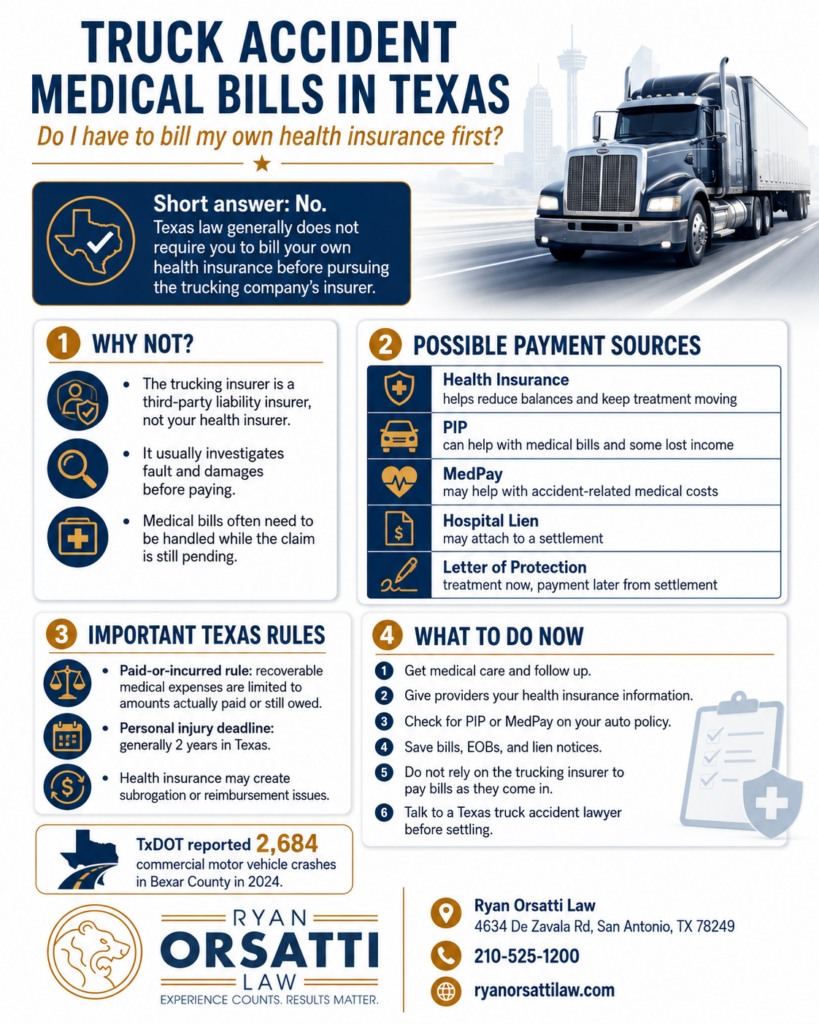
Does Texas law require me to bill my own health insurance before pursuing the trucking company’s insurer?
No, Texas law generally does not require you to bill your own health insurance before pursuing the trucking company’s insurer for medical costs. A truck accident claim is a liability claim against the negligent driver, trucking company, or another responsible party, while health insurance is a separate contract that may pay covered medical expenses along the way.
That said, “not required” does not always mean “not useful.” In many Texas trucking cases, health insurance can help keep bills from going unpaid while the injury claim is being investigated. The practical question is not only whether you can pursue the trucking company’s insurer. The practical question is how to keep medical treatment moving while preserving the value and accuracy of the injury claim.
Texas personal injury claims often involve several payment sources at the same time:
- Health insurance
- Personal injury protection, called PIP
- Medical payments coverage, called MedPay
- Hospital liens
- Letters of protection
- Medicare or Medicaid
- Workers’ compensation, if the crash happened during work
- The trucking company’s liability insurance
Each source has different rules. The wrong billing choice can create avoidable liens, reimbursement claims, collections risk, or proof problems later.
Why does the trucking company’s insurer usually not pay my medical bills as they come in?
The trucking company’s insurer usually does not pay your medical bills as they come in because it is a third-party liability insurer, not your health insurance company. The Texas Department of Insurance explains that the other driver’s insurer may be responsible if its insured was at fault, but there is no guarantee of payment because you do not have a contract with that insurer. (Texas Department of Insurance)
This is one of the biggest points injured people misunderstand. The truck insurer may eventually pay a settlement or judgment, but it usually wants to investigate fault, medical causation, claimed damages, available coverage, and possible defenses before paying anything.
In a trucking case, that investigation may include:
- The police crash report
- Driver qualification records
- Hours-of-service evidence
- Electronic logging device data
- Dispatch records
- Maintenance records
- Inspection reports
- Dash camera or onboard video
- Drug and alcohol testing issues
- Whether the driver was acting within the course and scope of employment
Texas also uses proportionate responsibility, which means an injured person’s recovery can be reduced by their percentage of fault, and recovery is barred if the claimant is more than 50% responsible. (Texas Statutes) That gives insurers a reason to investigate and dispute fault before paying medical costs.
For serious commercial vehicle crashes, Ryan Orsatti Law’s San Antonio truck accident lawyer page explains why trucking claims often require early investigation and preservation of evidence.
How does Texas’s paid-or-incurred rule affect medical bills in a truck accident claim?
Texas’s paid-or-incurred rule affects how past medical expenses are proven in a personal injury case. Under Texas Civil Practice and Remedies Code § 41.0105, recovery of medical or health care expenses is limited to the amount actually paid or incurred by or on behalf of the injured person. (Texas Statutes)
In plain English, the billed amount is not always the legally recoverable amount. If a hospital charges $80,000, but health insurance adjusts the allowed amount to $25,000 and pays part of it, the recoverable past medical expense evidence may look different than the original bill.
The Texas Supreme Court addressed this issue in Haygood v. De Escabedo, holding that Texas law limits recovery of past medical expenses to amounts actually paid or owed, not amounts written off and never owed. (Justia Law)
This rule does not say you must bill health insurance first. It says the medical expense proof in the case must match what Texas law allows. That is why lawyers, adjusters, and courts pay close attention to itemized bills, insurance adjustments, explanations of benefits, unpaid balances, and lien claims.
Does using health insurance reduce my truck accident claim?
Using health insurance does not automatically reduce the value of a Texas truck accident claim. It may reduce the gross medical balance, but it can also help document treatment, prevent collections, and clarify the actual amounts paid or still owed.
The more accurate answer is that health insurance changes the medical billing picture. It may create a reimbursement claim by the health plan. It may reduce inflated gross charges. It may also make the past medical expense claim easier to explain because the file shows what was actually paid, adjusted, denied, or left as patient responsibility.
Medical bills are only one part of the claim. A serious truck accident claim may also involve pain, physical impairment, lost income, reduced earning capacity, future medical care, disfigurement, and life disruption. Those categories are separate from whether health insurance paid part of the past bills.
What payment options should I compare after a Texas trucking crash?
After a Texas trucking crash, you should compare every available payment source before deciding how bills should be handled. The trucking company’s insurer may be the target of the liability claim, but health insurance, PIP, MedPay, and lien-based care may determine whether you can keep treating while the claim is pending.
| Payment source | What it may cover | Repayment or lien issue | Practical use in a Texas truck case |
|---|---|---|---|
| Health insurance | Covered medical treatment under the plan | May create subrogation or reimbursement rights | Often helps reduce balances and avoid collections while the truck claim is pending |
| PIP | Medical bills, some lost income, and certain accident expenses | Texas PIP generally has no subrogation right, with limited exceptions | Useful early money if available under your auto policy |
| MedPay | Accident-related medical bills, depending on the policy | May have reimbursement language | Can help with deductibles, copays, or bills health insurance does not cover |
| Hospital lien | Hospital charges connected to the accident | A lien may attach to the claim or settlement proceeds | Must be reviewed before settlement funds are disbursed |
| Letter of protection | Treatment with payment delayed until claim resolution | Provider expects payment from settlement proceeds | May help when insurance is unavailable, but charges and lien terms need review |
| Trucking company liability insurer | Settlement or judgment for covered liability damages | Usually pays only after liability and damages are evaluated | Not a reliable source for paying bills as they arrive |
Key takeaway: The trucking company’s liability insurer is usually the end-of-claim payment source, while health insurance, PIP, MedPay, and lien arrangements are bridge tools that should be coordinated before settlement.
Texas auto policies generally must include PIP unless the coverage is rejected in writing, and state consumer guidance describes standard PIP as at least $2,500 per person unless rejected. (Office of Public Insurance Counsel) PIP is different from the trucking company’s liability coverage because PIP is your own first-party coverage and can apply regardless of fault.
Ryan Orsatti Law discusses related payment issues in its guide on who pays medical bills after a car accident, which also applies to many practical billing problems after commercial vehicle crashes.
What if a hospital or doctor refuses to bill my health insurance?
If a hospital or doctor refuses to bill your health insurance after a truck crash, you should not assume the refusal is legally correct or financially harmless. Ask for the reason in writing, request an itemized bill, provide your insurance information, and keep copies of every bill, denial, explanation of benefits, and collection notice.
Some providers prefer lien-based billing in personal injury cases because they hope to be paid from the settlement rather than through contracted health insurance rates. That can create a larger outstanding balance, but it may not always be avoidable. The answer depends on the provider contract, health plan rules, timing, and whether the provider is legally or contractually required to submit the bill.
Texas also has medical billing timing rules. Texas Civil Practice and Remedies Code Chapter 146 requires certain health care providers to bill the patient, responsible person, health benefit plan, or third-party payor within specified time periods, and the 2025 version includes provisions addressing billing in personal injury claims when the patient is represented by an attorney. (Justia Law)
Do not ignore the bill just because you believe the truck driver was at fault. A provider can still send bills, assert liens, or send accounts to collections while the liability claim is unresolved.
What liens or reimbursement claims can reduce my trucking settlement?
Liens and reimbursement claims can reduce a trucking settlement if they are not identified and addressed before funds are disbursed. Common examples include health insurance subrogation, hospital liens, Medicare conditional payment claims, Medicaid third-party liability claims, workers’ compensation liens, and certain MedPay reimbursement claims.
Subrogation means a health insurer or benefit plan claims a right to be paid back from a personal injury recovery for medical bills it paid. Some Texas-regulated benefit plans are subject to Texas Civil Practice and Remedies Code Chapter 140, which limits certain contractual subrogation and reimbursement recoveries. (Texas Statutes) Other plans, especially self-funded ERISA plans, Medicare, Medicaid, and workers’ compensation, may involve different rules.
A hospital lien is a legal claim a hospital may assert against part of a personal injury recovery for accident-related hospital services. Texas Property Code Chapter 55 gives hospitals lien rights in certain injury cases, and the hospital lien rules include limits tied to the first 100 days of hospitalization. (Texas Statutes)
Medicare and Medicaid require separate attention. CMS describes Medicare Secondary Payer recovery as the process used when Medicare has made conditional payments and another entity has primary payment responsibility. (Centers for Medicare & Medicaid Services) Texas Medicaid’s Third Party Liability program is also designed to recover payments from third parties responsible for medical claims. (TMHP)
Ryan Orsatti Law has a separate discussion of Texas injury and health insurance subrogation for injured people trying to understand how health plan repayment claims can affect settlement planning.
What is subrogation in plain English?
Subrogation means your health insurer may claim a right to be repaid from your injury settlement for medical bills it paid because of the crash. It does not mean the insurer owns your whole case, but it can affect your net recovery if the claim is not reviewed and negotiated before settlement.
In practice, subrogation can be one of the most important financial issues in a truck accident case. The same settlement number can look very different depending on medical balances, lien reductions, attorney fees, case expenses, and health plan reimbursement claims.
What is a hospital lien in plain English?
A hospital lien is a legal claim a hospital may file against part of your injury claim or settlement proceeds for accident-related hospital care. In Texas, hospital liens are governed by Property Code Chapter 55, and they should be reviewed carefully before any truck accident settlement is finalized. (Texas Statutes)
Hospital liens matter because they can create payment obligations even if the trucking company’s insurer sends settlement funds later. If the lien is invalid, excessive, duplicative, or inconsistent with other billing, it should be identified before settlement funds are distributed.
What deadlines matter while medical bills are pending?
The main Texas lawsuit deadline for most personal injury claims is two years from the date the claim accrues, but medical billing and lien issues can have separate timing rules. Texas Civil Practice and Remedies Code § 16.003 generally requires personal injury lawsuits to be filed not later than two years after the cause of action accrues. (Texas Statutes)
Do not wait for every medical bill, health insurance appeal, or lien dispute to be finished before getting legal advice. Trucking evidence can disappear quickly, and liability deadlines are separate from provider billing deadlines.
Timing matters in at least four ways:
- The injury lawsuit deadline may expire even if medical bills are still being processed.
- Providers may have separate billing deadlines and collection practices.
- Health plans may have notice and reimbursement procedures.
- Trucking companies may control key evidence that should be preserved early.
TxDOT crash statistics are compiled from Texas Peace Officer’s Crash Reports, known as CR-3 reports, received and processed through the Crash Records Information System. (TxDOT) The CR-3 report is useful, but it is usually only the starting point in a commercial vehicle case.
What should I do now if I have medical bills after a San Antonio truck accident?
If you have medical bills after a San Antonio truck accident, you should organize every payment source and preserve every bill-related document before speaking in detail with the trucking company’s insurer. The goal is to keep treatment moving, avoid unnecessary collections, and make sure the medical damages proof matches Texas law.
Use this checklist:
- Get appropriate medical care first. Follow discharge instructions, attend follow-up appointments, and tell providers all symptoms connected to the crash.
- Give providers your health insurance information. Ask whether they will bill your plan and request the reason in writing if they refuse.
- Check your auto policy for PIP and MedPay. These coverages may help with early medical bills even while liability is disputed.
- Save every bill and explanation of benefits. Keep itemized bills, EOBs, denial letters, lien notices, collection letters, pharmacy receipts, and out-of-pocket payment records.
- Track unpaid balances separately from gross charges. Texas’s paid-or-incurred rule makes the distinction between billed charges, paid amounts, adjustments, and balances important.
- Do not assume the trucking insurer will pay bills immediately. Ask for written confirmation of any payment position, but do not rely on oral assurances.
- Avoid an unprepared recorded statement. Statements about symptoms, treatment gaps, prior injuries, or fault can affect both liability and medical causation.
- Request and review the CR-3 crash report. The report may identify drivers, companies, insurance information, citations, contributing factors, and crash facts.
- Preserve trucking evidence early. A lawyer may send a preservation letter for ELD data, dash camera footage, driver logs, dispatch records, maintenance records, and inspection materials.
- Review liens before settlement. Health insurance, hospitals, Medicare, Medicaid, workers’ compensation, and MedPay claims should be addressed before funds are distributed.
Attorney Insight: Adjusters often separate “who caused the crash” from “what bills are legally recoverable.” A clean medical damages file shows diagnosis, treatment plan, paid-or-incurred numbers, unpaid balances, lien status, health-plan reimbursement claims, and future care. Gaps in treatment or unclear billing make it easier for the insurer to argue the bills are unrelated, excessive, or not fully recoverable under Texas law.
When should I talk to a Texas truck accident lawyer about medical bills?
You should talk to a Texas truck accident lawyer early if you were seriously injured, hospitalized, placed on a lien, contacted by collections, asked for a recorded statement, or offered a quick settlement before treatment is complete. Medical billing choices can affect liens, subrogation, recoverable damages, and the timing of settlement discussions.
Legal help is especially important when:
- The crash involved an 18-wheeler, box truck, company vehicle, oilfield truck, delivery vehicle, or rideshare/commercial vehicle.
- The trucking company disputes fault.
- You have surgery, injections, fractures, spine injuries, brain injury symptoms, or long-term treatment.
- The hospital filed a lien.
- Health insurance paid bills and is requesting reimbursement.
- You are on Medicare, Medicaid, workers’ compensation, or an ERISA health plan.
- The trucking insurer wants a recorded statement or broad medical authorization.
- The trucking company’s insurer offers money before you know the full diagnosis and treatment plan.
Ryan Orsatti Law helps injured people in San Antonio and across Texas evaluate fault, trucking insurance, medical bills, liens, and settlement timing after serious commercial vehicle crashes. For more on timing, see when to hire a truck accident lawyer in San Antonio. If coverage may be too low for the injuries, the firm also explains what happens if the at-fault driver does not have enough insurance to cover medical bills.
FAQ
Do I have to use my health insurance after a Texas 18-wheeler crash?
No, Texas law generally does not require you to use health insurance before pursuing the trucking company’s insurer. But using health insurance may reduce balances, prevent collections, and document what was paid or still owed. The right choice depends on your plan, providers, PIP or MedPay coverage, lien risks, and the severity of your injuries.
Can I make the trucking company’s insurance pay my medical bills before settlement?
Usually, no. The trucking company’s insurer is normally a third-party liability insurer, not your health insurer, so it usually does not pay bills one by one while the claim is pending. TDI explains that payment by the other driver’s insurer is not guaranteed because you do not have a contract with that insurer. (Texas Department of Insurance)
Will health insurance take money from my truck accident settlement?
It might. Subrogation means a health insurer or benefit plan may claim reimbursement from your settlement for accident-related bills it paid. Some Texas-regulated plans are limited by Chapter 140, but ERISA plans, Medicare, Medicaid, workers’ compensation, and government plans may follow different rules. Review repayment claims before resolving the case.
Does Texas PIP have to be repaid from a trucking settlement?
Texas PIP generally does not have to be repaid from a trucking settlement, with limited exceptions. Texas Insurance Code § 1952.155 provides that PIP benefits are payable without regard to fault and generally gives the PIP insurer no subrogation right for benefits paid because of another person’s fault. (Justia Law)
What if a San Antonio hospital files a lien after a truck crash?
If a San Antonio hospital files a lien after a truck crash, do not ignore it. A Texas hospital lien may attach to the injury claim or settlement proceeds for accident-related hospital services, but the lien should be reviewed for validity, amount, timing, and overlap with insurance payments before settlement funds are distributed. (Texas Statutes)
Does billing health insurance hurt my pain and suffering claim?
Billing health insurance does not eliminate a pain and suffering claim. Pain, impairment, lost function, future care, and daily-life impact are separate damages issues. Health insurance mainly affects the medical bill proof, unpaid balances, and reimbursement claims. Good documentation still matters, including diagnoses, treatment consistency, work limits, and how injuries affect normal activities.
What documents should I send a lawyer about accident medical bills?
Send itemized bills, explanations of benefits, insurance denial letters, hospital lien notices, collection letters, pharmacy receipts, health plan reimbursement letters, Medicare or Medicaid notices, PIP or MedPay policy information, and any settlement offer from the trucking insurer. These documents help identify paid amounts, unpaid balances, lien risks, and recoverable medical expense issues under Texas law.
Ryan Orsatti Law
4634 De Zavala Rd, San Antonio, TX 78249
Phone: 210-525-1200
ryanorsattilaw.com
This blog is for informational purposes only, not legal advice. Reading it does not create an attorney-client relationship. Past results do not guarantee future results.
Hurt in an accident in San Antonio? Learn how a San Antonio personal injury lawyer can help with your claim. Call 210-525-1200 or request a free consultation.
The firm works on a contingency fee. You pay nothing unless the firm recovers money for you, and that covers case expenses as well as the fee: if there is no recovery, you owe no attorney's fee and no case expenses. Ask for the fee agreement and read the fee and expense section before you sign anything.
Related San Antonio legal resources
Primary legal and public-data sources
- Texas Civil Practice and Remedies Code Chapter 16: limitations
- Texas Civil Practice and Remedies Code Chapter 33: proportionate responsibility
Ryan Orsatti Law
4634 De Zavala Road, San Antonio, TX 78249
General reference links. Consult each source for its current text.