
Quick Answer
Usually, you should not decline medically necessary emergency care just because the trucking company points you to its designated occupational clinic. If you have head, neck, back, chest, abdominal, neurological symptoms, loss of consciousness, worsening pain, or any serious crash forces, go to the ER or call 911 first. A company clinic may be useful for work-status paperwork, a drug screen, or workers’ compensation routing, but it is not a substitute for an independent emergency evaluation after a serious Texas truck crash.
Key Takeaways
- A trucking company’s occupational clinic may have a role, but emergency care comes first when symptoms or crash forces justify it.
- If you are an injured third-party motorist, passenger, pedestrian, or family member, the trucking company usually does not get to choose your medical provider.
- If you are the truck driver or a trucking-company employee hurt while working, Texas workers’ compensation network rules may affect ongoing care, but emergency treatment is treated differently.
- Federal Motor Carrier Safety Administration post-accident testing rules do not require delaying necessary medical care.
- Early medical records can strongly influence how adjusters evaluate causation, injury severity, treatment gaps, and damages.
- Before signing broad medical releases, recorded statement forms, or claim documents at a company clinic, read them carefully and consider legal advice.
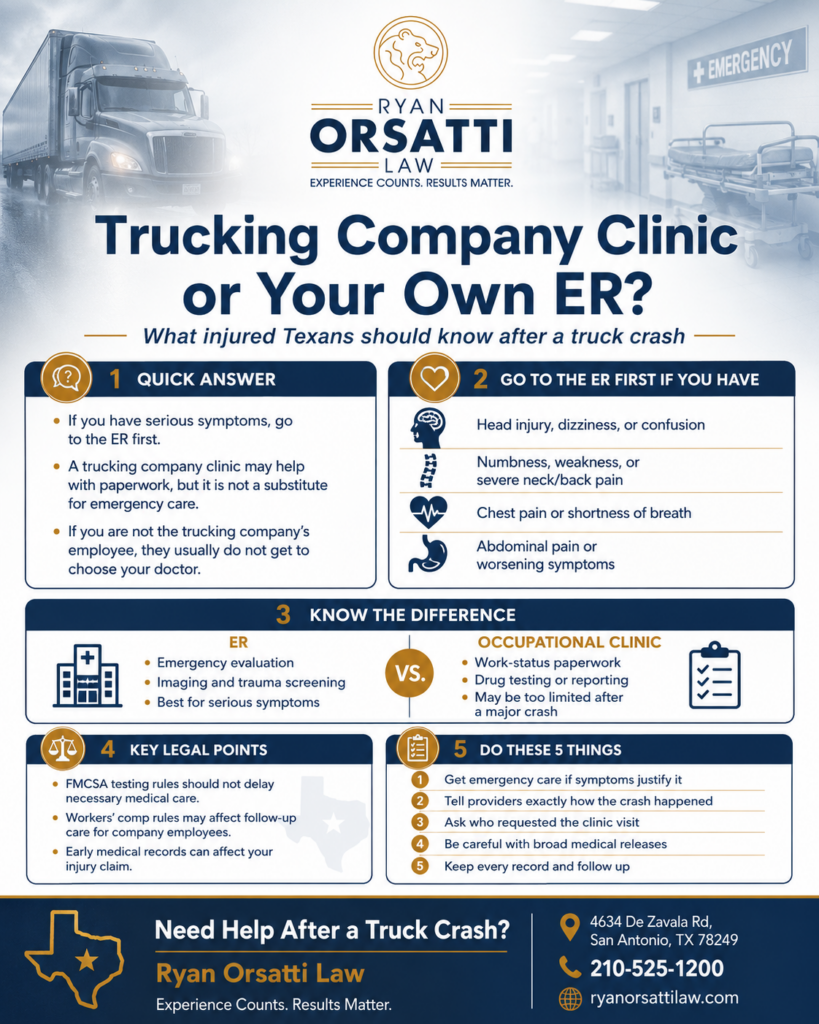
Should I decline to be evaluated at the trucking company’s designated occupational clinic instead of my own ER?
You should not let the trucking company’s preferred clinic replace medically necessary ER care after a serious 18-wheeler or commercial vehicle crash. In San Antonio truck wreck cases, the safer sequence is often: emergency evaluation first, then follow-up care, then any employment, insurance, or claim-related clinic visit if it is actually required.
A designated occupational clinic is usually built around employer needs: drug testing, return-to-work restrictions, workers’ compensation documentation, physicals, and work-status forms. That can be helpful in the right setting. It can also be too narrow if you were hit on I-35, Loop 410, Loop 1604, I-10, US-281, or another Texas corridor and need trauma screening, imaging, neurological assessment, or monitoring.
Federal law also recognizes the role of emergency departments. CMS explains that emergency departments covered by EMTALA must provide an appropriate medical screening exam and stabilizing treatment for emergency medical conditions, regardless of insurance or ability to pay. (CMS)
Quotable point: A trucking company clinic can document work status, drug testing, or basic injury complaints, but it does not control your right to seek emergency medical evaluation. In Texas truck crash claims, the first medical record often becomes a key causation document, so the first evaluation should match the seriousness of the crash and symptoms.
What is the difference between an ER, an occupational clinic, and your own doctor after a truck crash?
The ER is designed for urgent screening and stabilization, while an occupational clinic is usually designed for employer-directed work injury management. Your own doctor can be important for follow-up, but many primary-care offices are not set up to evaluate acute trauma the same day.
| Medical option | When it may fit | What it does well | Claim risk to watch |
|---|---|---|---|
| Emergency room | Serious symptoms, high-speed impact, airbag deployment, head strike, loss of consciousness, chest pain, abdominal pain, numbness, weakness, severe neck or back pain | Trauma evaluation, imaging, labs, neurological checks, referrals, emergency stabilization | Large bills, possible hospital lien, later disputes over whether every charge was reasonable |
| Occupational clinic | Work injury paperwork, return-to-work notes, drug testing, employer-required reporting, non-emergency strains | Work restrictions, basic exam, workers’ compensation documentation, employment forms | May under-document crash mechanics, delayed symptoms, head injury, radicular pain, or non-work-related claim issues |
| Urgent care | Non-life-threatening symptoms when ER is not needed and same-day care is available | Basic exam, X-rays in some clinics, prescriptions, referrals | Limited imaging, limited trauma workup, possible referral delay |
| Primary care doctor | Follow-up, medication management, referrals, ongoing symptom tracking | Continuity, referrals, treatment planning | May not be available quickly, may not handle crash documentation or workers’ compensation forms |
| Specialist referral | Persistent neurological, orthopedic, pain, spine, or brain-injury symptoms | Targeted diagnosis and treatment plan | Delays can be used by insurers to dispute causation |
If the crash involved a commercial truck, delivery vehicle, company van, dump truck, oilfield truck, or 18-wheeler, the medical decision should also account for the legal claim. Ryan Orsatti Law handles these issues in San Antonio commercial vehicle accident cases, including claims involving commercial insurers, driver logs, vehicle data, medical proof, and liability disputes.
What if I am not the trucking company’s employee?
If you are an injured member of the public, the trucking company generally cannot force you to use its occupational clinic. That includes an injured driver, passenger, pedestrian, motorcyclist, rideshare occupant, or family member in a separate vehicle.
The trucking company’s insurer may suggest a clinic because it wants quick documentation, a lower bill, or a record from a provider it knows. That suggestion is not the same as medical advice from your treating doctor. It is also not the same as a court-ordered medical examination later in litigation.
You can say something simple:
“I am going to get emergency medical care first. Please send any claim paperwork to me in writing.”
You should also ask:
- Who is requesting the clinic visit?
- Is it for treatment, drug testing, a recorded statement, work restrictions, or claim evaluation?
- Who will receive the medical records?
- Are you being asked to sign a broad medical authorization?
- Will the clinic send records to the trucking company, insurer, employer, or third-party administrator?
If you are not the company’s employee, be cautious with any document that gives the trucking company or its insurer broad access to your medical history. HIPAA authorizations must meet federal requirements, and an authorization can be defective if key terms are missing or expired. Federal HIPAA rules also recognize that a person may revoke a valid authorization in writing, subject to limits for actions already taken. (eCFR)
What if I am the truck driver or a trucking-company employee hurt while working?
If you are the truck driver or another employee hurt on the job, Texas workers’ compensation rules may affect your ongoing doctor choice, but emergency care still comes first. TDI tells injured employees to report a work injury to the employer within 30 days, and it explains that doctor choice depends on whether the employer uses a workers’ compensation health care network. (Texas Department of Insurance)
TDI also explains that if a certified workers’ compensation network applies, the worker generally chooses a treating doctor from the network list. But TDI recognizes exceptions for emergencies and some out-of-network situations, including emergencies, prior approval, and situations where the worker is not in the network’s service area. (Texas Department of Insurance)
Quotable point: For a Texas employee hurt while driving or riding in a company truck, the doctor-choice question may fall under Texas workers’ compensation rules. If a certified health care network applies, the worker usually must choose a treating doctor from the network list, but TDI recognizes emergency exceptions.
This distinction matters. A San Antonio driver hit by a tractor-trailer is usually dealing with a third-party injury claim. A truck driver hurt while working may be dealing with workers’ compensation, potential third-party claims, employer policies, and FMCSA testing. Those are different legal tracks.
Does FMCSA or DOT post-accident testing mean I have to skip the ER?
No. FMCSA post-accident testing rules do not require a commercial driver to delay necessary medical attention. Under 49 C.F.R. § 382.303, certain crashes trigger post-accident alcohol and controlled-substances testing for commercial drivers, including crashes involving fatalities or certain injury and tow-away situations. (eCFR)
The same regulation says a driver required to be tested must remain readily available, but it also states that nothing in the rule should be construed to require delaying necessary medical attention or to prohibit a driver from leaving the scene to obtain emergency medical care. (eCFR)
Quotable point: 49 C.F.R. § 382.303 requires certain commercial drivers to remain available for post-accident alcohol or drug testing, but the rule also says necessary medical attention must not be delayed. A Texas truck driver who needs emergency care should not treat a DOT testing request as a reason to skip the ER.
For injured third-party motorists, FMCSA post-accident testing rules are usually not your obligation. They apply to the regulated commercial driver, not the driver of the passenger car hit by the truck.
How can the first medical record affect a Texas truck accident claim?
The first medical record can become the anchor document adjusters use to accept, discount, or dispute injury causation. If the first note says “minor strain” but no one evaluated concussion symptoms, radiating pain, abdominal tenderness, dizziness, or numbness, the insurer may later argue those problems were unrelated or delayed.
TxDOT’s 2024 Commercial Motor Vehicle report listed 39,393 CMV-involved crashes statewide and 2,684 in Bexar County. Those numbers matter because truck crashes are not ordinary fender benders. Early medical decisions can affect both health and how a liability carrier evaluates injury causation. (TxDOT)
Texas injury claims also involve fault allocation. Under Texas Civil Practice and Remedies Code Chapter 33, a claimant’s recovery can be affected by assigned fault, and recovery can be barred if the claimant’s percentage of responsibility is greater than 50 percent. (Texas Statutes)
That means your medical record should be accurate, not exaggerated. Tell the provider:
- Where the impact occurred
- Whether the truck pushed, spun, rolled, or crushed the vehicle
- Whether airbags deployed
- Whether you hit your head
- Whether you lost consciousness or felt dazed
- Whether pain radiates into arms, hands, legs, or feet
- Whether symptoms worsened after the crash
- Whether you have prior injuries, and how this crash changed your condition
Attorney Insight: In truck crash matters we review, the first medical note often becomes the anchor record for adjusters. If an occupational clinic documents only a return-to-work screen while no one evaluates head, neck, abdominal, or neurological complaints, the claim may start with an incomplete record. Accurate symptoms, prompt care, and consistent follow-up matter more than choosing the cheapest or fastest clinic.
Can an occupational clinic hurt my case?
An occupational clinic can hurt the claim if it creates an incomplete or misleading record. That does not mean the clinic did anything wrong. It means the clinic’s purpose may not match the medical and legal issues created by a serious commercial vehicle crash.
Common problems include:
- The clinic focuses on work status, not crash trauma.
- The intake form has too little space for full symptoms.
- The provider documents “strain” without addressing head injury symptoms.
- The patient is told to return to work before diagnostic testing or specialist review.
- The clinic record goes directly to an employer, insurer, or claims administrator.
- The patient signs a broad authorization without understanding who receives the records.
- The visit creates a defense argument that the injury was minor because the patient did not go to the ER.
At the same time, an ER visit is not a magic legal fix. If you do not have emergency symptoms, an urgent care, primary-care visit, or occupational clinic may be medically appropriate. The issue is not “ER good, clinic bad.” The issue is whether the provider is appropriate for the symptoms, crash forces, and medical questions presented.
What red flags mean I should choose the ER first?
You should treat the ER or 911 as the first choice when symptoms suggest possible serious trauma. This is especially true after a crash with an 18-wheeler, concrete truck, dump truck, delivery truck, oilfield vehicle, or other heavy commercial vehicle.
Red flags include:
- Loss of consciousness, confusion, memory gaps, or feeling dazed
- Headache, vomiting, dizziness, vision changes, or balance problems
- Neck pain with numbness, tingling, weakness, or pain into the arms
- Back pain with numbness, tingling, weakness, or pain into the legs
- Chest pain, shortness of breath, rib pain, or seatbelt bruising
- Abdominal pain, swelling, bruising, or tenderness
- Severe pain that worsens over hours
- Suspected fracture, deformity, or inability to bear weight
- Pregnancy
- Blood thinner use
- Any symptom that makes you think, “something is not right”
If symptoms involve head trauma, memory issues, dizziness, light sensitivity, or personality changes, you may also need follow-up focused on traumatic brain injury. Ryan Orsatti Law provides information on San Antonio traumatic brain injury claims for people dealing with symptoms that are often disputed because they are not always visible on the outside.
Who pays for the ER or follow-up care if I choose my own doctor?
The trucking company’s liability insurer may eventually be responsible for crash-related medical damages if liability, causation, coverage, and damages are proven, but it usually does not pay your medical bills as they come due. TDI explains that the other driver’s insurance may pay medical bills, but there is no guarantee, and the company may deny the claim, not respond, or have limits too low to cover all losses. (Texas Department of Insurance)
Possible payment sources include:
- Health insurance
- Personal injury protection, called PIP
- Medical payments coverage, called MedPay
- Workers’ compensation, if the injury happened in the course and scope of employment
- UM/UIM coverage, if the at-fault driver lacks enough insurance
- A letter of protection, which is an agreement for a provider to wait for payment from a case recovery
- Out-of-pocket payment plans
- Later recovery from a liability settlement or judgment, if the claim succeeds
TDI explains that Texas auto policies include PIP unless rejected in writing, and that UM/UIM coverage must be offered and rejected in writing. TDI also notes that MedPay and PIP can help with medical bills after a crash. (Texas Department of Insurance)
Medical billing can also create reimbursement issues. Subrogation means an insurer or health plan may seek repayment from a recovery for bills it paid. An ERISA plan is a type of employer health plan governed by federal law that may claim reimbursement rights. A hospital lien is a statutory claim some hospitals may assert against a personal injury claim for accident-related hospital services. Texas Property Code Chapter 55 governs hospital and emergency medical services liens. (Texas Statutes)
Should I sign the occupational clinic’s forms?
You may need to sign ordinary treatment consent and billing forms before receiving care, but you should be careful with broad insurance, employment, recorded statement, or medical authorization documents. Do not sign something simply because it appears on a clipboard at the clinic.
Before signing, look for:
- A broad release of all past medical records
- Authorization for the trucking company, insurer, third-party administrator, or defense counsel to obtain records
- Language allowing recorded statements
- Language saying your injuries are minor or work-related only
- Settlement or release language
- Language giving up privacy rights beyond what is needed for treatment
- Any blank form or incomplete authorization
If you need emergency care, get care. If the form is not necessary for immediate treatment, ask to take a photo or copy and review it later.
After a trucking company tells you to use its clinic, do these 7 things
- Choose emergency care first if symptoms justify it. Call 911 or go to the ER for head injury signs, neurological symptoms, chest pain, abdominal pain, severe pain, weakness, numbness, or worsening symptoms.
- Tell the provider the full crash history. Say that the crash involved a commercial vehicle or 18-wheeler, where the impact occurred, and what symptoms started right away versus later.
- Ask what the clinic visit is for. Is it treatment, drug testing, work-status paperwork, workers’ compensation routing, or an insurance claim evaluation?
- Do not minimize symptoms to get out faster. If you feel pain, dizziness, numbness, confusion, or weakness, say so clearly and accurately.
- Keep every record. Save discharge papers, prescriptions, work-status notes, referral instructions, imaging orders, clinic forms, text messages, emails, and the name of anyone who directed you to the clinic.
- Follow medical instructions. Attend referrals, schedule follow-up care, fill prescriptions when medically appropriate, and report worsening symptoms promptly.
- Get legal advice before broad releases or recorded statements. A truck case can involve driver logs, electronic control module data, dashcam video, maintenance records, motor carrier policies, broker issues, and insurance coverage layers. Early decisions can affect what evidence is preserved.
For evidence-preservation issues after a serious crash, see Ryan Orsatti Law’s guide on when to contact an attorney after a serious truck accident.
When should you talk with a Texas truck accident attorney?
You should talk with a Texas truck accident attorney before giving a recorded statement, signing a broad medical release, accepting a quick settlement, or relying on the trucking company’s clinic as your only medical record. This is especially true when the crash caused ER care, missed work, concussion symptoms, spine pain, surgery recommendations, disputed fault, or a death in the family.
Texas Civil Practice and Remedies Code § 16.003 generally gives two years to bring a personal injury suit, but waiting can damage the evidence. (Texas Statutes) Trucking evidence can disappear quickly if no one sends preservation demands for driver logs, electronic data, inspection records, dashcam footage, dispatch records, and communications.
Ryan Orsatti Law handles truck and commercial vehicle injury claims from San Antonio and Bexar County to cases across Texas. You can contact Ryan Orsatti Law if you need help sorting out ER care, clinic paperwork, insurance forms, medical billing, or next steps after a truck crash.
FAQ
Can the trucking company force me to go to its occupational clinic after an 18-wheeler crash in Texas?
If you are an injured third-party motorist, the trucking company usually cannot force you to use its clinic instead of your own ER or doctor. If you are the company’s employee, workers’ compensation network rules may affect ongoing care, but TDI recognizes emergency exceptions and network-specific rules. (Texas Department of Insurance)
Will going to my own ER hurt my Texas truck accident claim?
Going to your own ER should not hurt your claim if emergency evaluation is medically appropriate. It may help document symptoms, crash history, imaging, diagnoses, prescriptions, and referrals. The key is accuracy. Do not exaggerate symptoms, but do not minimize them because a trucking company representative suggested a quicker clinic visit.
What if the occupational clinic says I am fine but I still hurt?
If you still have pain, numbness, dizziness, confusion, weakness, headaches, chest pain, abdominal pain, or worsening symptoms, seek follow-up care. A single clinic note does not end the medical issue. Keep the clinic record, tell the next provider what changed, and follow referral instructions so there is a clear timeline.
Do I have to take a DOT drug test after a trucking accident?
If you are the commercial driver, FMCSA rules may require post-accident alcohol or controlled-substances testing after certain crashes. But 49 C.F.R. § 382.303 says necessary medical attention should not be delayed. If you are the injured driver of the passenger vehicle, the trucking company’s DOT testing rules usually do not apply to you. (eCFR)
Who pays my ER bills after a truck accident in Texas?
The trucking insurer may eventually pay if the claim is proven, but it usually does not pay medical bills immediately. Health insurance, PIP, MedPay, workers’ compensation, UM/UIM, payment plans, or a letter of protection may be involved. TDI notes that PIP and MedPay can help with medical bills after a crash. (Texas Department of Insurance)
Should I sign a medical authorization at the trucking company clinic?
You may need to sign ordinary treatment forms, but be careful with broad authorizations that let the trucking company, insurer, or claim administrator obtain years of medical records. HIPAA authorizations must be specific enough to be valid, and federal rules discuss when an authorization is defective or revocable. (eCFR)
How quickly should I see a doctor after a truck crash in San Antonio?
For emergency symptoms, go immediately. For non-emergency pain after a serious commercial vehicle crash, same-day or next-day evaluation is often safer than waiting to see whether symptoms disappear. Delays can create medical risk and give insurers an argument that the injury was minor, unrelated, or caused by something else.
Is an occupational clinic the same as a defense medical examination?
No. A clinic visit right after a crash is not the same as a litigation medical examination. A defense medical examination is a court-related process that may arise later in a lawsuit and has separate procedural rules. Early after a crash, the immediate question is whether you need appropriate medical care, not whether the defense gets an exam.
Ryan Orsatti Law
4634 De Zavala Rd, San Antonio, TX 78249
Phone: 210-525-1200
ryanorsattilaw.com
This blog is for informational purposes only, not legal advice. Reading it does not create an attorney-client relationship. Past results do not guarantee future results.
Related: if you were hurt in a commercial vehicle crash, see our San Antonio truck accident lawyer page.
Hurt in an accident in San Antonio? Learn how a San Antonio personal injury lawyer can help with your claim. Call 210-525-1200 or request a free consultation.
The firm works on a contingency fee. You pay nothing unless the firm recovers money for you, and that covers case expenses as well as the fee: if there is no recovery, you owe no attorney's fee and no case expenses. Ask for the fee agreement and read the fee and expense section before you sign anything.
Related San Antonio legal resources
Primary legal and public-data sources
- Texas Civil Practice and Remedies Code Chapter 16: limitations
- Texas Civil Practice and Remedies Code Chapter 33: proportionate responsibility
Ryan Orsatti Law
4634 De Zavala Road, San Antonio, TX 78249
General reference links. Consult each source for its current text.