
Quick Answer
No, you generally should not sign a broad medical authorization from an insurance adjuster after an oilfield injury without first limiting it to records that are actually relevant to the injury. Under HIPAA’s authorization rule, a valid release must identify the records, who may disclose them, who may receive them, the purpose, an expiration, and your signature. In 2024, the U.S. Bureau of Labor Statistics reported 65 fatal work injuries in oil and gas extraction industries, so these claims often involve serious injuries, multiple insurers, and high-stakes medical proof. Ryan Orsatti Law helps injured workers in San Antonio and across Texas review claim paperwork and medical record requests before information is turned over. (eCFR)
Key Takeaways
- Do not sign a blank or “any and all medical records” authorization without review.
- Ask who the adjuster represents: workers’ compensation carrier, third-party insurer, employer, contractor, or another company.
- A narrow authorization may be appropriate, but it should usually be limited by provider, date range, injury, and purpose.
- You can often provide relevant records directly instead of giving the insurer unrestricted access.
- Texas workers’ compensation and third-party oilfield claims have different rules, deadlines, and risks.
- If you already signed a release, ask what records were obtained and consider revoking it in writing.
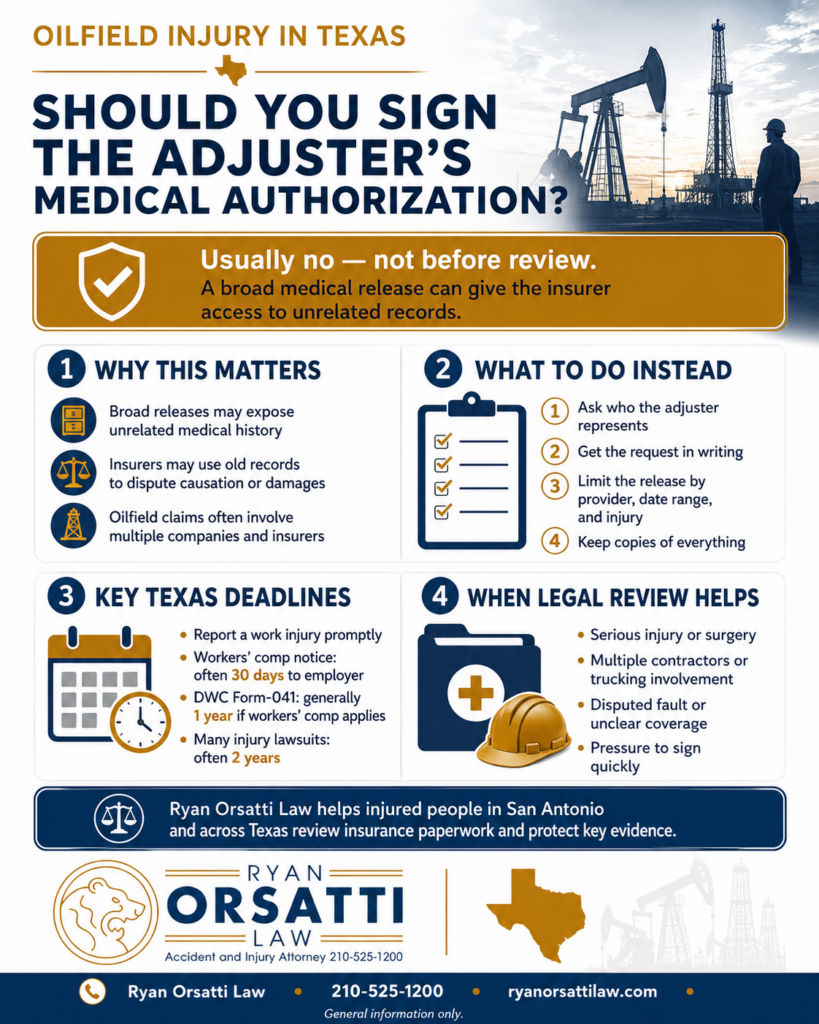
Should I sign a medical authorization from the insurance adjuster after an oilfield injury?
You should not sign a broad medical authorization from an insurance adjuster after an oilfield injury unless you understand exactly what records the adjuster can obtain, who will receive them, and how they may be used. A narrow, written authorization may be reasonable in some claims, but a blanket release can give the insurer access to unrelated medical history that may be used to dispute causation, damages, or credibility.
Oilfield injury claims in Texas often involve several possible responsible parties, including employers, operators, drilling contractors, trucking companies, equipment vendors, safety contractors, and insurance carriers. The person asking for your medical authorization may not be on your side. The safer approach is to pause, identify who is requesting the records, and provide only the medical information that is reasonably tied to the injury claim.
This is especially important after serious injuries near San Antonio, South Texas, the Eagle Ford Shale region, or lease-road crash sites where multiple companies may be involved.
Why does the oilfield insurance adjuster want my medical authorization?
The adjuster wants your medical authorization to evaluate the injury, compare your records to the incident report, and look for prior conditions or gaps in treatment. That does not automatically make the request improper, but it does mean the scope of the release matters.
In serious oilfield claims, medical records are often the center of the dispute. The insurer may look at emergency room records, imaging, orthopedic notes, physical therapy, surgery recommendations, work restrictions, and prior complaints involving the same body part.
The problem is that many insurance forms are written much broader than necessary. A release that covers “all records from all providers” can pull in years of unrelated history, including prior back pain, prior workplace injuries, mental health notes, prescription history, substance-use records, or records involving conditions that have nothing to do with the accident.
OSHA has identified highway vehicle crashes as a leading cause of fatalities in oil and gas extraction, and roughly 4 out of every 10 workers killed in the industry died in a highway vehicle incident. OSHA also reports that many on-site deaths involve struck-by, caught-in, or caught-between hazards. That kind of risk profile means oilfield claims often involve severe injuries, disputed responsibility, and aggressive claim investigation. (OSHA)
Who is asking: a workers’ compensation adjuster or a third-party liability adjuster?
Your answer depends heavily on who is asking for the medical authorization. A Texas workers’ compensation adjuster, a third-party liability insurer, and another company’s risk manager may all ask for records, but they do not all have the same role or the same legal relationship to you.
Workers’ compensation is a state-regulated benefit system that may provide medical and income benefits if your employer carries workers’ compensation insurance. TDI explains that not all Texas employers provide workers’ compensation coverage, and an injured worker must generally report the injury to the employer and work through the Division of Workers’ Compensation process when coverage applies. (Texas Department of Insurance)
A third-party liability insurer is different. That insurer may represent another company, driver, contractor, property owner, equipment provider, or operator whose conduct may have contributed to the injury. OPIC explains that a third-party claim can be harder because the other insurer is on its insured’s side, not yours. (Office of Public Insurance Counsel)
| Who is asking | What their role usually is | What to provide first | What to avoid signing blindly |
|---|---|---|---|
| Texas workers’ compensation carrier | Handles benefits if the employer has workers’ compensation coverage | Accident report, date of injury, treating provider information, work status, related medical records | Unlimited releases for unrelated treatment or providers |
| Third-party liability insurer | Represents another person or company that may be legally responsible | Targeted records tied to the injury, bills, work restrictions, and proof of damages | “Any and all records” releases, lifetime medical history, unrelated records |
| Your own auto, health, PIP, MedPay, or disability insurer | Reviews coverage under your own policy or plan | Policy-specific records required for benefits | Releases that go beyond the policy claim or permit broad redisclosure |
| Employer, operator, contractor, or safety department | Investigates the incident, OSHA issues, internal reporting, or job status | Incident report details, work restriction notes, claim-related updates | Broad medical access before fault, witnesses, and safety evidence are preserved |
Key takeaway: Identify the adjuster’s role before signing because Texas workers’ compensation, a third-party oilfield claim, and your own policy can create different duties, deadlines, and risks.
What should a valid medical authorization include under HIPAA?
A valid HIPAA medical authorization must be specific enough to show what information may be disclosed, who may disclose it, who may receive it, the purpose of the disclosure, an expiration date or event, and the patient’s signature and date. It must also include required statements about revocation, redisclosure, and the right to receive a copy.
In plain English, HIPAA does not require you to sign every authorization an insurance adjuster sends. It sets rules for when a covered entity, such as a medical provider, may disclose protected health information based on an authorization.
Under 45 C.F.R. § 164.508, a valid authorization must include core elements such as a meaningful description of the information, the person or class of persons authorized to disclose it, the recipient, the purpose, expiration, signature, and date. The regulation also requires statements about the right to revoke, possible redisclosure, and the ability or inability to condition treatment or payment on the authorization. (eCFR)
What are red flags in a medical authorization?
Red flags include phrases that let the insurer obtain all medical records from all providers for all time. A release is also risky if it allows broad redisclosure, has no clear expiration date, covers unrelated mental health or substance-use records, or does not say exactly who may receive the information.
Watch for language like:
- “Any and all medical records”
- “All providers”
- “From birth to present”
- “Any condition”
- “Any hospital, clinic, pharmacy, physician, or facility”
- “Any other information requested by insurer”
- No expiration date
- Permission to redisclose records to unknown people or entities
A narrowly drafted release is usually much safer than a broad form. For example, a limited authorization might identify the provider, a date range beginning shortly before the accident, the injured body parts, the specific claim number, and the exact insurer or attorney receiving the records.
What are the biggest risks of signing a broad medical authorization?
The biggest risk is that the insurer may obtain unrelated medical history and use it to argue your injury was preexisting, exaggerated, unrelated, or not caused by the oilfield incident. Even when the records do not destroy a claim, they can create side disputes that slow the case and shift attention away from the unsafe condition, negligent driver, defective equipment, or unsafe work practice.
Comparative responsibility means Texas can reduce or bar recovery based on the percentage of fault assigned to you. Under Texas Civil Practice and Remedies Code § 33.001, a claimant may not recover damages if the claimant’s percentage of responsibility is greater than 50 percent. That makes the wording of medical records important because insurers may use records to argue about mechanism of injury, work restrictions, prior symptoms, and credibility. (Texas Statutes)
Subrogation means a benefit payer may claim a right to be paid back from part of a recovery. In Texas workers’ compensation, TDI has explained that the carrier may be subrogated to the injured worker’s rights against a responsible third party and may seek reimbursement for benefits paid, including medical benefits. (Texas Department of Insurance)
A hospital lien is a legal claim a hospital may assert against part of a personal injury recovery for accident-related hospital services. Texas Property Code Chapter 55 governs hospital liens, and those lien issues can affect how medical bills and settlement funds are handled. (Texas Statutes)
Attorney Insight: In serious oilfield cases, the issue is rarely whether the insurer can see any medical records. The issue is scope, timing, and context. Adjusters often look for prior pain complaints, delayed treatment, old work restrictions, and inconsistent injury descriptions. A narrower production with a clear cover letter can give the insurer relevant proof without handing over unrelated history before fault, coverage, and future care are understood.
What should I do instead of signing the adjuster’s form?
Instead of signing the adjuster’s form immediately, ask for the request in writing, identify who the adjuster represents, and provide only targeted medical records that relate to the injury. If the insurer truly needs specific records to evaluate the claim, it should be able to identify the providers, dates, body parts, and reason for the request.
Use this checklist before signing anything:
- Ask who the adjuster represents. Confirm whether it is workers’ compensation, a third-party insurer, your own insurer, or an employer-related representative.
- Ask for the request in writing. The adjuster should identify what records are needed and why.
- Do not sign blank or unlimited forms. Avoid releases that cover all providers, all dates, or all conditions.
- Limit the date range. A reasonable range depends on the injury, but it should not automatically include your entire life history.
- Limit the providers. Identify the ER, hospital, orthopedic doctor, surgeon, imaging center, physical therapist, or other relevant provider.
- Limit the injury or body part. If the claim involves a crushed hand, a release for unrelated childhood medical records or unrelated counseling records may be excessive.
- Watch for redisclosure language. The form should not allow broad sharing with unknown people or entities.
- Keep a copy of everything. Save the signed form, cover letters, records sent, dates sent, and the claim number.
- Calendar deadlines. Medical authorization decisions should not distract you from Texas workers’ compensation and lawsuit deadlines.
- Get legal review before broad disclosure. This is especially important if the injury is serious, surgery is possible, multiple companies are involved, or fault is disputed.
Ryan Orsatti Law handles oil field accident cases in San Antonio and across Texas and helps injured workers evaluate medical documentation, insurance requests, and evidence preservation before a claim is shaped by the insurer’s paperwork.
What if the adjuster says my claim will be delayed unless I sign?
A claim may require medical proof, but pressure from an adjuster is not a good reason to give unlimited access to your medical history. Ask the adjuster to identify the specific missing records and offer to provide claim-related records directly or through your attorney.
TDI explains that, in a third-party claim, the other person’s insurance company may dispute fault or payment because you do not have a contract with that company. TDI also advises asking for the insurer’s reason in writing if it refuses to pay. (Texas Department of Insurance)
For injury releases, OPIC warns that if you were injured and the other insurer agrees to pay, you should read anything you are asked to sign carefully. A release can give up all claims and prevent additional payment for injuries after signing. (Office of Public Insurance Counsel)
Medical authorizations are not the same as settlement releases, but the same practical rule applies: do not sign insurance paperwork just because the adjuster says it is routine.
What if I already signed the medical authorization?
If you already signed a medical authorization, act quickly and ask for a copy of the form, a list of providers contacted, and copies of any records obtained. HIPAA allows an individual to revoke an authorization in writing, but revocation may not undo disclosures already made in reliance on the authorization.
Under 45 C.F.R. § 164.508, an individual may revoke an authorization in writing, except to the extent a covered entity has already acted in reliance on it. That means timing matters. The sooner you review the release and send a written revocation or limitation, the better your chance of stopping future record collection. (eCFR)
A simple written revocation should identify:
- Your name
- Date of birth
- Date of injury
- Claim number, if known
- The authorization being revoked
- The insurer or adjuster who received it
- A request that no further records be requested under that authorization
- A request for a list of records already obtained
Do not assume the insurer will stop using records it already received. Instead, focus on controlling future disclosures and preparing a clear explanation for any prior medical issues the insurer may raise.
How do Texas deadlines affect oilfield injury medical records?
Texas deadlines make medical record decisions urgent because waiting too long can affect benefits, evidence, and legal claims. In a workers’ compensation claim, TDI states that an injured worker should report the injury to the employer within 30 days and send DWC Form-041 to the Division of Workers’ Compensation within one year.
The DWC injured employee FAQ states that workers should report the injury to their employer within 30 days and send a completed DWC Form-041 to DWC within one year. The same resource explains that DWC Form-041 is the employee’s claim for compensation for a work-related injury or occupational disease. (Texas Department of Insurance)
For many Texas personal injury claims, Texas Civil Practice and Remedies Code § 16.003 provides a two-year limitations period for personal injury lawsuits. Some cases can have shorter notice issues, especially if a government entity, public vehicle, public property, or special statutory claim is involved, so the deadline should be checked early. (Texas Statutes)
What records should I gather after an oilfield injury?
You should gather the records that prove what happened, who was involved, what safety rules applied, and how the injury affected your body and work. Medical records are only one part of an oilfield injury file.
Important records may include:
- Incident report
- Supervisor report
- Witness names and phone numbers
- Job safety analysis
- Tool-box talk records
- Lease-road crash report, if a vehicle was involved
- Photos of the scene, equipment, mud, lighting, truck, rig, platform, or hazard
- ER records
- Hospital records
- Imaging reports
- Work-status notes
- Surgical recommendations
- Physical therapy notes
- Medication list
- Wage records
- Text messages about the incident
- Company safety policies
- Contractor names and company logos at the site
For lease-road crashes involving company trucks, water trucks, sand trucks, or other commercial vehicles, the evidence may overlap with trucking evidence. Ryan Orsatti Law also has a guide on lease-road crash recorded statement requestsfor injured people dealing with trucking company insurers.
How can Ryan Orsatti Law help before medical records go to the insurance company?
Ryan Orsatti Law helps injured people in San Antonio and across Texas evaluate who is asking for medical records, what records are actually relevant, and whether a proposed authorization is too broad. The goal is to provide necessary proof while reducing the risk that unrelated medical history becomes the focus of the claim.
In an oilfield injury case, legal review may include identifying all potentially responsible companies, preserving evidence, checking workers’ compensation status, reviewing third-party liability issues, evaluating medical bills and liens, and preparing a cleaner record production strategy. This can matter in cases involving well sites, lease roads, contractors, equipment failures, falls, explosions, fires, chemical exposure, crush injuries, and commercial vehicle crashes.
Ryan Orsatti Law also assists with catastrophic injury claims where the medical record may involve surgery, permanent impairment, future care, work restrictions, or long-term earning problems.
To discuss a medical authorization, insurance adjuster request, or oilfield injury claim, you can contact Ryan Orsatti Law for a case review.
FAQs About Medical Authorizations After Oilfield Injuries in Texas
Do I have to sign a medical authorization for the oilfield insurance adjuster in Texas?
No, you usually do not have to sign a broad medical authorization just because an oilfield insurance adjuster asks for one. The answer can change if the request comes from a workers’ compensation carrier, your own insurer, or a court process. Before signing, identify who is requesting the records and limit the authorization to claim-related information.
Can I send my own medical records instead of signing the adjuster’s release?
Yes, in many third-party injury claims, you can provide relevant medical records and bills yourself instead of signing an open-ended authorization. This gives you more control over what is sent, when it is sent, and how it is described. The records should still be accurate, complete for the claimed injury, and organized.
What if the Texas workers’ compensation adjuster asks for medical information?
A Texas workers’ compensation adjuster may need claim-related medical information to evaluate benefits, work restrictions, and treatment. That does not mean every broad release is appropriate. Workers should report the injury to the employer within 30 days and file DWC Form-041 within one year, but medical authorizations should still be reviewed for scope.
Can I revoke a HIPAA medical authorization after I sign it?
Yes, HIPAA generally allows you to revoke a medical authorization in writing. The problem is that revocation may not undo disclosures already made before the provider received the revocation. If you already signed a broad release, ask what records were requested, what records were received, and send a written revocation or limitation quickly.
Can old injuries hurt my oilfield injury claim?
Old injuries can affect an oilfield injury claim if the insurer argues your current symptoms were preexisting or unrelated to the incident. Prior conditions do not automatically defeat a claim. The key is explaining the difference between old symptoms and new injury, using records, imaging, work history, restrictions, and treating provider opinions.
Should I talk to a lawyer before signing medical records paperwork after an oilfield accident?
Yes, legal review is a good idea before signing broad medical records paperwork after a serious oilfield accident. This is especially true if surgery is possible, multiple companies were on site, fault is disputed, workers’ compensation is unclear, or the adjuster represents someone other than your employer or your own insurer.
Ryan Orsatti Law
4634 De Zavala Rd, San Antonio, TX 78249
Phone: 210-525-1200
ryanorsattilaw.com
This blog is for informational purposes only, not legal advice. Reading it does not create an attorney-client relationship. Past results do not guarantee future results.
Hurt in an accident in San Antonio? Learn how a San Antonio personal injury lawyer can help with your claim. Call 210-525-1200 or request a free consultation.
The firm works on a contingency fee. You pay nothing unless the firm recovers money for you, and that covers case expenses as well as the fee: if there is no recovery, you owe no attorney's fee and no case expenses. Ask for the fee agreement and read the fee and expense section before you sign anything.
Related San Antonio legal resources
- San Antonio construction-accident representation
- Texas personal-injury services
- Contact Ryan Orsatti Law
Primary legal and public-data sources
- Texas Civil Practice and Remedies Code Chapter 16: limitations
- Texas Civil Practice and Remedies Code Chapter 33: proportionate responsibility
Ryan Orsatti Law
4634 De Zavala Road, San Antonio, TX 78249
General reference links. Consult each source for its current text.