
Quick Answer
No, you usually do not have to give a recorded statement to the trucking company insurer after a lease-road crash in Texas. That insurer normally represents the trucking company, driver, site contractor, or another business, not you. You should identify yourself, preserve evidence, notify your own insurer if required, and get legal guidance before giving any recorded version of how the crash happened.
Key Takeaways
- A trucking company insurer is usually a third-party insurer, meaning you do not have the same duties you may owe your own insurance company.
- A lease-road crash can involve layered liability: the truck driver, motor carrier, lease operator, site owner, contractor, maintenance company, or another vehicle.
- Recorded statements are often requested before you know the full facts, before imaging confirms injuries, and before electronic trucking evidence is preserved.
- Texas proportionate responsibility matters. If the insurer can shift more fault onto you, it can reduce or defeat your claim under Texas Civil Practice and Remedies Code § 33.001. (Texas Statutes)
- Written communication, limited factual information, and a preservation letter are usually safer than a recorded interview with the other side.
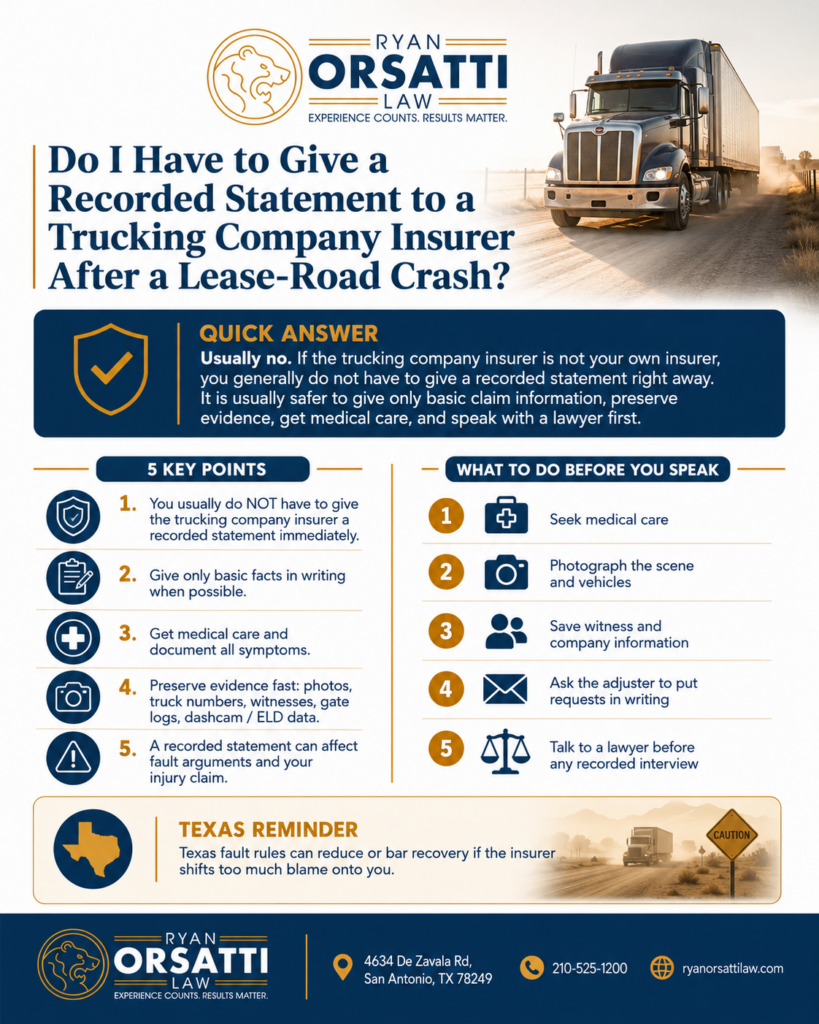
Do I have to give a recorded statement to a trucking company insurer after a lease-road crash?
You usually do not have to give a recorded statement to the trucking company insurer after a lease-road crash because that insurer is normally not your insurance company. The Texas Department of Insurance explains that when you deal with another driver’s insurance company, you do not have a contract with that company, so your options and duties are different from a claim under your own policy. (Texas Department of Insurance)
After a Texas lease-road truck crash, the trucking company’s insurer is usually a third-party insurer, not your insurer. That matters because the Texas Department of Insurance notes you do not have a contract with the other driver’s insurer, so your rights and duties differ from a claim under your own policy. (Texas Department of Insurance)
That does not mean you should ignore every call. It means you should separate basic claim setup from a recorded statement. Basic claim setup may include your name, contact information, vehicle information, date of crash, location, and the fact that you are seeking medical evaluation. A recorded statement is different. It is a question-and-answer interview designed to lock down your words.
If the request comes from your own insurer, the analysis changes. Your own policy may require cooperation, prompt notice, and reasonable claim information. Even then, you can usually ask to schedule the statement, review your facts, and have counsel involved before you answer detailed questions.
For related context, Ryan Orsatti Law has a Texas truck-crash coverage guide explaining common insurance denial tactics in trucking claims. (Ryan Orsatti Law)
Why are lease-road crashes different from normal highway crashes?
Lease-road crashes are different because the crash may happen on a private, industrial, ranch, oilfield, or construction access road where evidence is controlled by multiple businesses. In a San Antonio area case, that may involve a truck coming from I-35, Loop 1604, US-281, or I-10 before entering a caliche road, pad site, gate road, or industrial access point.
A lease road is often used by water haulers, sand trucks, vacuum trucks, casing crews, equipment haulers, company pickups, and contractors. The road may have dust, poor lighting, blind curves, soft shoulders, narrow passing areas, no centerline, or heavy truck traffic at shift change.
That creates questions a recorded statement may not answer fairly:
- Who controlled traffic on the lease road?
- Was the truck driver working for a motor carrier, operator, subcontractor, or broker?
- Was the road maintained by the lease operator, landowner, contractor, or another entity?
- Was the truck overloaded, poorly maintained, or operating outside safe speed for the road?
- Were there gate logs, dispatch records, electronic logging device data, GPS records, or dashcam footage?
- Did dust, lighting, signage, or road maintenance contribute to the crash?
TxDOT reports that in 2024 nearly 79,000 traffic crashes occurred in Texas’s five major energy regions, with 1,023 deaths, accounting for one in four traffic fatalities in the state. TxDOT identified failure to control speed and driver inattention as leading contributors in those regions. (Texas Department of Transportation)
That statistic matters because many lease-road crashes are not simple two-driver disputes. They often happen in the larger energy-sector traffic system, where commercial vehicles, contractors, changing shifts, rural roads, and site access routes overlap.
Ryan Orsatti Law has a related guide on what to do immediately after an oilfield accident in Texas. (Ryan Orsatti Law)
What can go wrong if I give a recorded statement too early?
A recorded statement can hurt your claim if you answer before you know the facts, the injury diagnosis, the other driver’s conduct, or the available evidence. The adjuster may ask questions that sound routine but are aimed at fault, injury severity, timing of medical care, prior conditions, work status, and whether the crash really happened the way you say it did.
A recorded statement can become a fault tool in Texas because Texas Civil Practice and Remedies Code § 33.001 bars recovery when a claimant is found more than 50 percent responsible. A vague answer about speed, dust, headlights, fatigue, or right-of-way can later be used to argue comparative fault. (Texas Statutes)
Common problems include:
- Saying “I’m okay” before adrenaline wears off or before medical evaluation.
- Guessing about vehicle speeds, distances, or whether headlights were on.
- Agreeing with the adjuster’s wording instead of using your own.
- Minimizing pain because you do not yet know whether you have a disc injury, concussion, fracture, torn ligament, or nerve symptoms.
- Forgetting details because the crash happened in dust, darkness, rain, or heavy truck traffic.
- Failing to mention a witness, dashcam, gate camera, or company truck unit number.
- Giving a broad medical history that lets the insurer blame old conditions instead of the crash.
In our experience with commercial-vehicle matters, early recorded statements often become less about “getting your side” and more about creating impeachment material. Impeachment means using a prior statement to challenge credibility later. If you say “I think I was going about 30” on day two, then a reconstruction later shows you were traveling 18, the insurer may still argue you were unreliable.
What should I say when the trucking insurer asks to record me?
You can politely decline the recorded statement and offer to communicate basic information in writing. You do not need to be rude, evasive, or combative. The safer approach is calm and narrow.
A practical response is:
“I am not giving a recorded statement right now. I will provide basic claim information in writing. Please send your request, claim number, insured name, policy information, and any forms you want reviewed.”
You can also say:
“I am still getting medical care and gathering information. I am not comfortable giving a recorded statement before I understand the crash evidence and my injuries.”
If you already have a lawyer, direct the adjuster to counsel. If you do not, you can still pause. Pausing is not the same as refusing to cooperate with the claim process. It means you are not letting the other side create a recorded interview before the facts are preserved.
What information is usually safe to provide without a recorded statement?
Basic identification and claim setup information is usually safer than a recorded narrative. Keep it factual, short, and written when possible.
| Information requested | Usually safer response | Why it matters |
|---|---|---|
| Your name and contact information | Provide it | Needed to identify the claim |
| Date, time, and general location | Provide it if accurate | Helps locate reports, gate logs, and witnesses |
| Vehicle information | Provide make, model, plate, and insurer if known | Helps property damage setup |
| Injury details | Say you are evaluating injuries and will supplement | Early injury statements are often incomplete |
| How the crash happened | Do not give a recorded narrative before review | Fault may depend on documents, site control, and trucking data |
| Prior medical history | Do not discuss broadly on an adjuster call | Broad answers can invite unrelated medical fishing |
| Medical authorization | Do not sign a broad release without review | It may request more than crash-related records |
| Settlement release | Do not sign until treatment and damages are understood | TDI warns a medical settlement release may affect future claims for that accident. (Texas Department of Insurance) |
The Texas Department of Insurance advises drivers to get the crash report, notify their own insurer, and understand that the other driver’s insurer may deny fault, delay, or claim both drivers were responsible. (Texas Department of Insurance) That is why written, limited communication is usually safer than a recorded interview.
What evidence should be preserved after a lease-road truck crash?
Lease-road crash evidence should be preserved quickly because the trucking company, operator, site owner, and subcontractors may each control different records. A preservation letter, sometimes called a spoliation letter, should identify the evidence that must not be deleted, destroyed, overwritten, repaired over, or discarded.
Lease-road crash evidence can disappear quickly because carriers, site operators, and subcontractors may hold different pieces of the record. A preservation letter should identify the tractor, trailer, driver, DOT number, jobsite, company man, dispatch records, ELD data, dashcam footage, load documents, and post-crash inspections.
A lease-road preservation checklist should include:
- Photos and videos of the vehicles, road, tire marks, dust conditions, lighting, signage, gates, shoulders, and debris.
- Names, phone numbers, employers, and roles of witnesses, including site workers and other drivers.
- Truck identifiers, including company name, unit number, license plate, USDOT number, trailer number, and placards.
- Gate logs, visitor logs, dispatch records, load tickets, water tickets, delivery records, and job safety paperwork.
- Electronic logging device data, GPS data, engine control module data, dashcam footage, and inward-facing camera footage.
- Driver qualification file materials, training records, drug and alcohol testing records, and hours-of-service records when applicable.
- Inspection, repair, brake, tire, lighting, and maintenance records.
- Site safety plans, traffic control rules, road maintenance records, dust control records, and contractor agreements.
- 911 records, law enforcement reports, EMS records, and body camera footage when available.
- Medical records, bills, work restrictions, wage loss proof, and out-of-pocket expense receipts.
TxDOT states that crash reports and crash data are retained for the previous 10 full calendar years plus the current calendar year, but lease-road cases can involve private video, contractor logs, and company data that may not be kept that long. (Texas Department of Transportation)
For broader trucking liability issues, Ryan Orsatti Law has a guide on when a trucking company may be liable after a Texas truck accident. (Ryan Orsatti Law)
What if the adjuster says my claim cannot move forward without a recorded statement?
If the trucking insurer says your claim cannot move forward without a recorded statement, ask for that position in writing and ask what policy language or law they are relying on. Many times, the statement request is a claims practice preference, not a legal requirement.
This is especially important with third-party insurers. TDI explains that the prompt payment rules that apply to your own insurer do not apply the same way when another driver’s insurance company is paying the claim. TDI also notes that another driver’s insurer may say its driver was not at fault, claim both drivers were at fault, or delay while waiting on its policyholder. (Texas Department of Insurance)
Instead of a recorded statement, you can offer:
- A short written notice of claim.
- Photos of vehicle damage.
- The crash report if available.
- Names of known witnesses.
- A statement that you are receiving medical evaluation.
- A request for the insured driver’s identity, employer, motor carrier, and coverage information.
- A request that all evidence be preserved.
A careful written response can move the claim forward without giving the insurer a recorded interview to pick apart later.
How do Texas fault rules affect recorded statements after a lease-road crash?
Texas fault rules make recorded statements risky because the insurer may use your words to assign you a percentage of responsibility. Texas uses proportionate responsibility, a fault-sharing system where damages can be reduced by a claimant’s percentage of fault, and recovery can be barred if the claimant’s responsibility is greater than 50 percent. (Texas Statutes)
In a lease-road case, fault arguments may focus on:
- Speed for conditions.
- Following distance behind a heavy truck.
- Whether dust blocked visibility.
- Whether the injured driver entered the lease road with permission.
- Whether headlights, hazard lights, or beacon lights were visible.
- Whether a truck crossed the center of a narrow road.
- Whether a driver ignored site traffic rules.
- Whether the road was unsafe because of poor maintenance or inadequate signage.
Small wording choices matter. “I didn’t see him until the last second” may be true because a sand truck created a dust cloud, but an insurer may later argue it means you failed to keep a proper lookout. “I was tired” may mean you were shaken after the crash, but the insurer may argue fatigue caused the collision.
What is the deadline to bring a Texas injury claim after a lease-road crash?
The general Texas personal-injury deadline is two years from the date the claim accrues, but specific facts can change the deadline analysis. Texas Civil Practice and Remedies Code § 16.003 sets a two-year limitations period for personal-injury and wrongful-death claims. (Texas Statutes)
Do not treat two years as permission to wait. Lease-road evidence can disappear in days or weeks. Vehicles get repaired, camera systems overwrite, workers change employers, site conditions change, and trucking documents may be controlled by different companies.
If the case involves a government vehicle, public entity, road contractor, workers’ compensation, a minor, a death claim, or an out-of-state motor carrier, additional rules may affect notice, parties, insurance, and timing. Those issues should be reviewed early.
Should I use my own insurance after a lease-road crash?
You may need to use your own insurance if the trucking insurer delays, denies fault, or does not have enough coverage to address the loss. Your own coverage may include collision, personal injury protection (PIP), medical payments coverage (MedPay), uninsured/underinsured motorist coverage (UM/UIM), rental reimbursement, or health insurance.
TDI explains that PIP pays medical bills and may pay lost wages and nonmedical costs, while UM/UIM may apply if the at-fault driver had no insurance or not enough insurance. TDI also notes Texas auto policies include PIP unless rejected in writing, and insurers must offer UM/UIM unless rejected in writing. (Texas Department of Insurance)
Using your own coverage can raise reimbursement issues. Subrogation means an insurer or health plan may seek repayment from a later settlement. An ERISA plan is an employer health plan governed by federal law, and it may claim reimbursement rights depending on the plan language. A hospital lien is a claimed right by a hospital or qualifying emergency medical services provider to be paid from an injury claim, and Texas Property Code Chapter 55 governs those liens. (Texas Statutes)
These issues do not mean you should avoid treatment or avoid using available benefits. They mean the claim should be tracked carefully so medical bills, liens, health insurance payments, PIP, MedPay, UM/UIM, and settlement funds are coordinated.
After a lease-road crash, do these 7 things before any recorded statement
You should protect health, evidence, and insurance rights before agreeing to a recorded statement. A trucking insurer’s early call often happens before the injured person has the information needed to answer safely.
- Get medical care first. Tell providers every symptom, including head pain, neck pain, back pain, numbness, dizziness, confusion, shoulder pain, knee pain, and sleep problems.
- Photograph the scene if safe. Capture the lease road, dust, lighting, gate, signs, shoulder, skid marks, debris, vehicle positions, and truck identifiers.
- Write down witness information. Include workers, other drivers, gate personnel, supervisors, and anyone who arrived soon after.
- Do not guess. If you do not know speed, distance, lighting, load status, employer, or road ownership, do not estimate for an adjuster.
- Ask for everything in writing. Get the claim number, insured name, driver name, motor carrier, and requested documents by email.
- Preserve evidence fast. Send a preservation letter before vehicles are repaired, cameras overwrite, or records are lost.
- Review your own coverage. Check PIP, MedPay, collision, UM/UIM, health insurance, disability coverage, and any employer benefits.
Attorney Insight: In lease-road cases, the first recorded statement often happens before anyone has sorted out the real defendants. The driver may not know whether the truck was controlled by a motor carrier, a lease operator, a subcontractor, or a brokered hauling company. I would rather preserve records first, identify the chain of control, and then decide whether any statement is necessary.
How can a lawyer help before a recorded statement?
A lawyer can help by controlling the information flow, identifying the right parties, preserving evidence, and preventing the insurer from turning an incomplete early statement into a fault defense. This is especially useful when the crash involves a commercial vehicle, an oilfield route, a construction site, or multiple contractors.
A lawyer can usually help with:
- Sending a preservation letter.
- Identifying the motor carrier, truck owner, trailer owner, driver employer, site operator, and subcontractors.
- Requesting policy and coverage information.
- Coordinating property damage without releasing injury claims.
- Protecting PIP, MedPay, UM/UIM, health insurance, and lien issues.
- Organizing medical records and wage loss proof.
- Evaluating whether a written statement is enough.
- Preparing you if a statement, deposition, or sworn testimony becomes necessary later.
Ryan Orsatti Law handles commercial vehicle and truck crash matters in San Antonio, Bexar County, and across Texas. You can read more about the firm’s commercial vehicle practice here. (Ryan Orsatti Law)
FAQ
Do I have to give a recorded statement to the trucking company’s insurance adjuster in Texas?
Usually, no. If the adjuster represents the trucking company, driver, or another business, that is normally a third-party insurer. You can provide basic claim information without agreeing to a recorded interview. Your own insurer is different because your policy may require cooperation, but you can still request time to prepare and involve counsel.
Can the trucking insurer deny my claim if I refuse a recorded statement?
The trucking insurer may deny, delay, or dispute a claim for many reasons, but refusal to give a recorded statement to the other side is not the same as refusing to provide claim information. Ask the adjuster to put the request and legal basis in writing. You can usually provide a written notice, documents, and evidence instead.
What should I say if the adjuster calls me right after the lease-road crash?
Keep the call short. Confirm your identity, the date of the crash, and that you are seeking medical evaluation. Ask for the claim number, insured name, policy information, and all requests in writing. Say you are not giving a recorded statement at this time and will respond after reviewing the evidence and your injuries.
Is a lease-road crash handled differently if it happened on private property?
Yes, private or industrial property can change the evidence and liability analysis. A lease-road crash may involve site rules, road maintenance, contractors, gate logs, camera footage, and multiple companies. Public crash-report systems may not capture every private-road detail, so early evidence preservation is especially important.
Can my own insurance company require a recorded statement?
Your own insurance policy may require cooperation, notice, and reasonable claim information. That does not mean you should answer detailed questions without preparation. If your own carrier requests a recorded statement for PIP, MedPay, collision, UM/UIM, or liability coverage, review the policy, gather facts, and consider having counsel involved.
What if I already gave a recorded statement?
Do not panic, but do not give another recorded statement without review. Write down when it happened, who recorded it, the claim number, and the main topics discussed. Request a copy of the recording or transcript. A lawyer can compare the statement against medical records, photos, crash reports, and trucking data to address inaccuracies.
How soon should a preservation letter be sent after a lease-road truck crash?
A preservation letter should be sent as soon as possible. Lease-road cases may involve dashcam footage, gate logs, ELD data, dispatch records, jobsite logs, maintenance records, and vehicle data controlled by different companies. Waiting can allow video to overwrite, vehicles to be repaired, and site conditions to change.
Can Ryan Orsatti Law help with a lease-road crash outside San Antonio?
Yes. Ryan Orsatti Law is based in San Antonio and handles Texas personal-injury matters involving truck crashes, commercial vehicles, and oilfield-related accidents. The firm can evaluate crashes in Bexar County and surrounding areas, including Atascosa, Wilson, Guadalupe, Comal, Medina, Kendall, and other Texas counties depending on the facts. (Ryan Orsatti Law)
Ryan Orsatti Law
4634 De Zavala Rd, San Antonio, TX 78249
Phone: 210-525-1200
ryanorsattilaw.com
This blog is for informational purposes only, not legal advice. Reading it does not create an attorney-client relationship. Past results do not guarantee future results.
Hurt in an accident in San Antonio? Learn how a San Antonio truck accident lawyer can help with your claim. Call 210-525-1200 or request a free consultation.
The firm works on a contingency fee. You pay nothing unless the firm recovers money for you, and that covers case expenses as well as the fee: if there is no recovery, you owe no attorney's fee and no case expenses. Ask for the fee agreement and read the fee and expense section before you sign anything.
Related San Antonio legal resources
Primary legal and public-data sources
Ryan Orsatti Law
4634 De Zavala Road, San Antonio, TX 78249
General reference links. Consult each source for its current text.