
Quick Answer
A normal X-ray after a car accident does not rule out whiplash, a herniated disc, ligament or tendon tears, concussion, nerve injury, or internal trauma. X-rays are best at showing bones and alignment, while MRI, CT, ultrasound, physical examinations, and neurocognitive testing may be needed for other injuries. TxDOT reported 251,977 people injured in Texas crashes in 2024, and Texas Civil Practice and Remedies Code § 16.003 generally gives an injured person two years to file suit. Ryan Orsatti Law helps San Antonio crash victims assess medical-documentation and insurance issues when normal X-rays do not explain continuing symptoms.
Key Takeaways
- A negative X-ray usually means no obvious fracture or dislocation was identified. It does not prove that every part of the body is uninjured.
- Whiplash, disc injuries, concussions, torn ligaments, rotator cuff injuries, meniscus tears, and nerve irritation may not appear on ordinary X-rays.
- Persistent pain, weakness, numbness, headaches, dizziness, or reduced movement should be reported to a healthcare provider.
- MRI, CT, ultrasound, clinical examinations, and neurocognitive testing answer different questions. A healthcare provider should decide which tests are appropriate.
- Insurance adjusters often examine the timing, consistency, and medical documentation of symptoms, not merely whether the first X-ray was normal.
- Most Texas personal injury lawsuits are subject to a two-year filing deadline, but some circumstances create different or earlier deadlines.
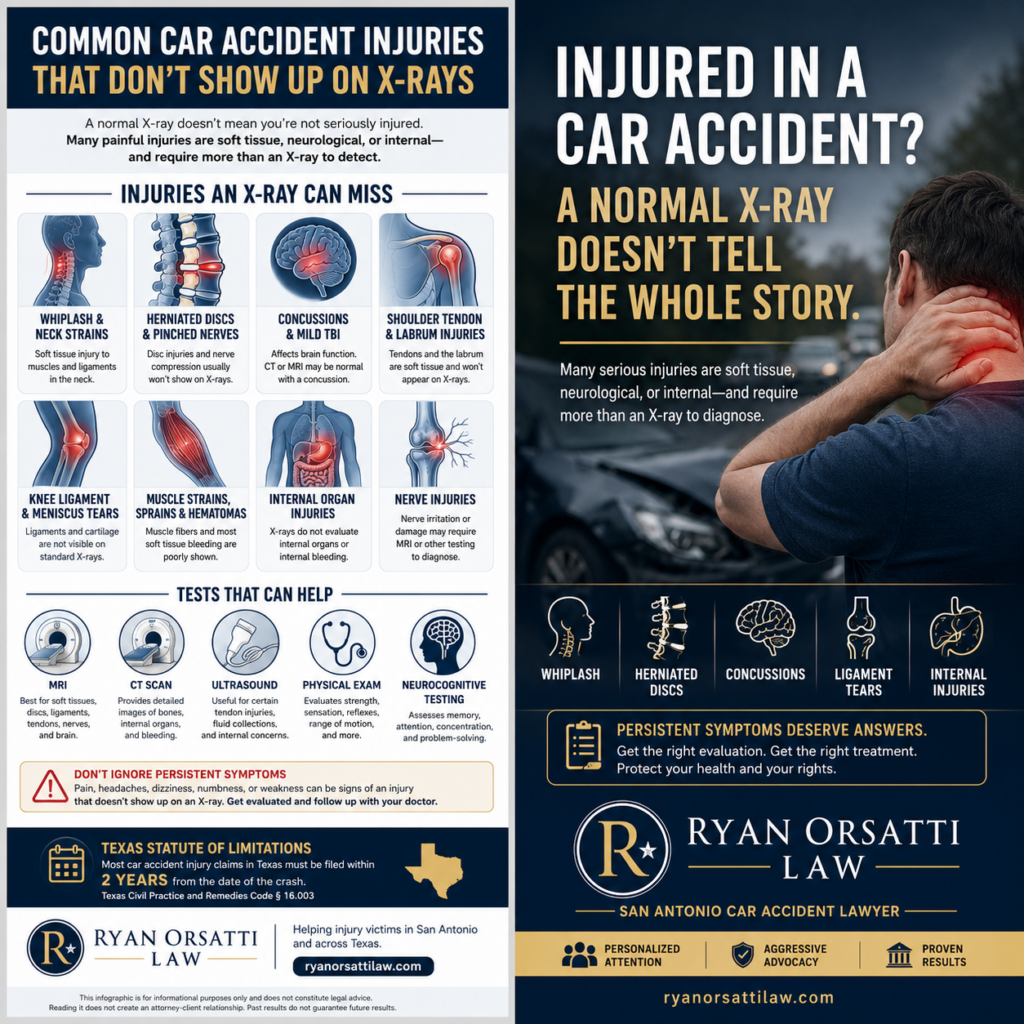
What Does a Normal X-Ray Mean After a Car Accident?
A normal X-ray generally means the images did not reveal an obvious bone fracture, dislocation, or other condition that the test was designed to detect. It does not mean that muscles, tendons, ligaments, spinal discs, nerves, the brain, or internal organs were fully evaluated.
X-rays remain useful after a collision because fractures and alignment problems can require immediate treatment. Their limitation is that less-dense soft tissues do not appear with the same detail as bones. The American Academy of Orthopaedic Surgeons explains that X-rays may provide less detail than more advanced imaging, while the American College of Radiology and Radiological Society of North America identify MRI as a primary tool for examining muscles, tendons, ligaments, spinal discs, and major joints.
A radiology report also must be interpreted in context. The report describes the images taken on that date. It does not replace a physical examination, symptom history, neurological testing, or follow-up evaluation when symptoms continue.
Which Car Accident Injuries May Not Show Up on X-Rays?
The injuries most likely to be missed by ordinary X-rays involve soft tissue, neurological function, spinal discs, or internal organs. Some injuries are diagnosed primarily through symptoms and examination, while others may require MRI, CT, ultrasound, or additional testing.
| Injury | Why an X-ray may be normal | Findings that may lead to further evaluation |
|---|---|---|
| Whiplash or cervical strain | Muscles and ligaments are soft tissue | Neck pain, stiffness, headaches, spasms, reduced movement |
| Herniated or injured spinal disc | Ordinary X-rays do not directly show disc material or nerve compression | Back or neck pain, radiating pain, numbness, tingling, weakness |
| Concussion or mild TBI | A concussion affects brain function and may occur without visible structural damage | Headache, dizziness, confusion, memory problems, light sensitivity |
| Rotator cuff or shoulder-labrum injury | Tendons and the labrum are soft tissue | Shoulder weakness, pain when lifting, nighttime pain, limited motion |
| Knee ligament or meniscus tear | Ligaments, cartilage, and menisci are not adequately shown | Swelling, instability, locking, difficulty bearing weight |
| Muscle strain, sprain, or hematoma | Muscle fibers and most soft-tissue bleeding are poorly shown | Bruising, tenderness, spasms, swelling, reduced function |
| Internal-organ injury | A standard X-ray does not comprehensively evaluate abdominal organs or internal bleeding | Abdominal pain, swelling, faintness, rapid pulse, worsening weakness |
Key takeaway: A normal X-ray can rule out certain bone problems, but it does not rule out many injuries that commonly cause continuing pain, weakness, neurological symptoms, or functional limitations after a crash.
Can Whiplash Exist With Normal X-Rays?
Yes. Whiplash is a soft-tissue neck injury, often described medically as a cervical sprain or strain, and ordinary X-rays may be normal because they primarily evaluate bones and alignment.
Whiplash can affect neck muscles, ligaments, joints, and surrounding structures. Symptoms can include:
- Neck pain or stiffness
- Muscle spasms
- Headaches, particularly near the base of the skull
- Shoulder or upper-back pain
- Dizziness
- Reduced range of motion
- Pain that develops or worsens after the initial emergency visit
A normal X-ray can still be valuable because it may help exclude a fracture. The diagnosis and treatment plan may instead depend on the collision history, physical examination, range-of-motion findings, neurological symptoms, and the person’s response to treatment. MedlinePlus describes whiplash as a soft-tissue neck injury also known as a neck sprain or strain.
Can a Herniated Disc or Pinched Nerve Show Up on an X-Ray?
A standard X-ray does not directly show a herniated disc or most forms of nerve compression. It may show bone alignment, narrowed spaces, arthritis, or other skeletal findings, but MRI is usually more informative when a healthcare provider suspects injured discs, ligaments, nerve roots, or the spinal cord.
A herniated disc occurs when disc material extends beyond its usual position. If it irritates or compresses a nerve, the person may develop radiculopathy, which means pain, weakness, numbness, or tingling that travels along the affected nerve.
The American College of Radiology and Radiological Society of North America identify MRI as a tool for evaluating herniated discs, spinal-cord integrity, ligament injuries, and small soft-tissue abnormalities that may not be visible on X-rays.
Symptoms that may warrant follow-up include:
- Pain traveling into an arm or leg
- Numbness or tingling
- Grip weakness
- Leg weakness
- Problems walking
- Changes in reflexes
- Pain that increases with sitting, bending, coughing, or certain movements
Can a Concussion Show Up on an X-Ray?
No. An ordinary X-ray cannot diagnose a concussion because it does not evaluate brain function. Even CT or MRI scans may be normal in a person who has a mild traumatic brain injury.
The Centers for Disease Control and Prevention explains that concussion testing may include an assessment of memory, learning, concentration, and problem-solving. A brain scan may be ordered when a provider is concerned about bleeding or another structural injury, but a CT scan is not required to identify every concussion.
Concussion symptoms may include:
- Headache or pressure in the head
- Dizziness or balance problems
- Confusion or feeling mentally slowed
- Memory or concentration problems
- Nausea
- Sensitivity to light or sound
- Sleep disruption
- Irritability or mood changes
- Blurred vision
Some symptoms begin immediately. Others may emerge hours or days later. People experiencing these symptoms can review Ryan Orsatti Law’s information about San Antonio traumatic brain injury cases, but medical concerns should first be evaluated by an appropriate healthcare provider.
Can Shoulder Tendon or Labrum Injuries Be Missed?
Yes. A shoulder X-ray may be normal even when the rotator cuff, labrum, or another soft-tissue structure has been injured. The rotator cuff consists of muscles and tendons that stabilize the shoulder and help raise and rotate the arm.
The American Academy of Orthopaedic Surgeons states that ordinary X-rays do not show the soft tissues of the rotator cuff and that shoulder X-rays are often normal in patients with rotator cuff pain. MRI or ultrasound can provide better images of the tendons and surrounding tissues.
Possible symptoms include:
- Pain when lifting or lowering the arm
- Weakness during lifting or rotation
- Pain while lying on the injured shoulder
- Clicking or catching
- Difficulty reaching overhead or behind the back
- Pain where the seat belt crossed the shoulder
Can Knee Ligament or Meniscus Tears Be Missed?
Yes. Knee X-rays may identify fractures, dislocations, or arthritis, but they do not adequately show the anterior cruciate ligament, other major ligaments, or the meniscus. MRI may be used when the examination suggests a ligament, cartilage, or meniscus injury.
The meniscus is cartilage that cushions and stabilizes the knee. Ligaments connect bones and control joint stability. A dashboard impact, twisting movement, or force transmitted through the foot can injure these structures even when no fracture appears.
Common complaints include:
- Rapid or recurring swelling
- Instability or the knee “giving out”
- Locking or catching
- Pain with twisting or stairs
- Reduced ability to bend or straighten the knee
- Difficulty bearing weight
RadiologyInfo identifies tears of the knee’s menisci, ligaments, and tendons as conditions commonly evaluated with MRI.
Can Internal Injuries Be Present With a Normal X-Ray?
Yes. A normal bone or chest X-ray does not exclude every internal-organ injury or source of internal bleeding. Depending on the symptoms and collision forces, emergency clinicians may use CT, ultrasound, laboratory testing, repeated examinations, or monitoring.
CT can provide detailed images of bone, soft tissue, blood vessels, and internal organs. RadiologyInfo notes that emergency CT examinations can reveal internal injuries and bleeding that conventional X-rays may not adequately show.
Internal injuries require prompt medical attention. Warning symptoms can include worsening abdominal or chest pain, abdominal swelling, faintness, confusion, shortness of breath, rapid pulse, unusual weakness, or vomiting blood.
What Tests Can Detect Injuries That an X-Ray Misses?
MRI, CT, ultrasound, neurological examinations, and neurocognitive testing can identify conditions that ordinary X-rays may not show. The correct test depends on the body part, symptoms, examination findings, medical history, and suspected injury.
| Evaluation | What it commonly helps assess | Important limitation |
|---|---|---|
| X-ray | Fractures, dislocations, bone alignment | Limited soft-tissue detail |
| MRI | Discs, spinal cord, ligaments, tendons, muscles, menisci, labrum | Not required for every injury and may be unsuitable with certain implanted devices |
| CT scan | Detailed bone injury, internal organs, bleeding, blood vessels | Uses ionizing radiation and may not show some soft tissues as clearly as MRI |
| Ultrasound | Certain tendon injuries, fluid collections, blood flow, some abdominal concerns | Results can depend on the structure examined and operator technique |
| Physical or neurological examination | Strength, sensation, reflexes, range of motion, balance, coordination | Findings may require follow-up or imaging for clarification |
| Neurocognitive testing | Memory, attention, processing, concentration, problem-solving | A normal result does not automatically exclude every mild TBI |
Key takeaway: Different tests answer different medical questions, so a person should not assume that an MRI, CT, or other test is automatically necessary merely because an X-ray was normal.
When Do Symptoms Require Emergency Medical Attention?
Symptoms involving breathing difficulty, loss of consciousness, severe or worsening pain, neurological changes, uncontrolled bleeding, or possible internal bleeding require emergency evaluation. Call 911 or go to an emergency department when symptoms appear life-threatening or rapidly worsen.
The CDC identifies concussion danger signs such as repeated vomiting, seizures, slurred speech, worsening headache, unusual confusion, increasing drowsiness, weakness or numbness, poor coordination, and one pupil becoming larger than the other. MedlinePlus also treats breathing problems, fainting, severe abdominal pain, chest pain, sudden confusion, and serious head or spine injuries as potential medical emergencies.
This article cannot determine whether a particular symptom is an emergency. Medical decisions should be made with a qualified healthcare provider.
What Should You Do if Your X-Rays Are Normal but You Still Hurt?
You should continue communicating with your healthcare provider and accurately report any persistent, worsening, or newly developing symptoms. Do not assume that pain is insignificant merely because an emergency-room X-ray did not identify a fracture.
- Read the discharge instructions. Confirm what body parts were imaged, what the report actually said, and what follow-up was recommended.
- Track your symptoms. Record when pain, headaches, numbness, weakness, dizziness, sleep problems, or limitations began and whether they are improving.
- Report new or worsening problems. Tell the provider exactly where the symptoms occur, what movements trigger them, and how they affect daily activities.
- Attend reasonable follow-up care. A healthcare provider may repeat the examination, recommend therapy, refer you to another provider, or order additional testing when medically appropriate.
- Be accurate about prior conditions. A pre-existing condition does not automatically eliminate a claim, but the medical history should accurately distinguish old symptoms from new or worsened symptoms. Learn more about insurers’ pre-existing-condition arguments.
- Keep records and bills. Save discharge papers, imaging reports, prescriptions, work notes, referrals, bills, photographs, and mileage records.
- Avoid exaggeration or minimization. Describe symptoms truthfully and consistently. Do not guess at a diagnosis.
- Do not ignore delayed symptoms. Headaches, stiffness, concentration problems, and other complaints can appear after the initial crash evaluation. Review the firm’s guide to delayed symptoms after a car accident.
Can You Have a Texas Car Accident Claim With Normal X-Rays?
Yes. A Texas injury claim is not automatically defeated because initial X-rays were normal. The issue is whether reliable evidence shows that the collision caused a new injury or aggravated an existing condition and produced legally recoverable harm.
Causation means the connection between the crash and the claimed injury. An aggravation means the collision materially worsened a condition that already existed. Medical records, examination findings, symptom history, diagnostic testing, provider opinions, work restrictions, photographs, and testimony may all affect that analysis.
The insurer may still dispute:
- Whether the collision caused the symptoms
- Whether the condition existed before the crash
- Whether treatment was reasonable and related
- Whether a delay in treatment suggests another cause
- Whether imaging findings are traumatic, degenerative, or incidental
- Whether the symptoms caused measurable limitations or financial loss
Ryan Orsatti Law evaluates these issues in San Antonio car accident claims, including cases involving soft-tissue injuries, delayed symptoms, pre-existing conditions, disputed causation, and insurance-coverage questions.
How Do Insurance Adjusters Evaluate Injuries That Are Not Visible on X-Rays?
Insurance adjusters commonly examine the complete medical timeline rather than relying on a single X-ray. They may compare the date symptoms were first reported, consistency across providers, prior medical history, examination findings, treatment compliance, work limitations, and whether the records clearly connect the complaints to the collision.
A normal X-ray can become an insurer’s talking point, especially when later records are vague. It should not be mischaracterized as proof that no injury occurred, but the claimant still needs credible medical and factual evidence.
Attorney Insight: In soft-tissue cases, adjusters often focus less on the first X-ray and more on whether complaints were documented promptly, whether symptoms remained consistent, whether follow-up was reasonable, and whether the records address prior conditions. A normal X-ray is not fatal to a claim, but an unexplained treatment gap or vague medical history gives the insurer a stronger causation argument.
What Evidence Helps Document an Injury That an X-Ray Did Not Show?
The strongest documentation usually combines medical evidence with proof of how the injury changed the person’s activities. No single record is decisive, and an MRI finding alone does not automatically prove that a collision caused the condition.
Helpful evidence may include:
- Emergency-room and urgent-care records
- Primary-care and specialist examinations
- Imaging reports and actual imaging files
- Physical-therapy evaluations and progress notes
- Range-of-motion, strength, reflex, and sensory findings
- Headache, sleep, or symptom logs
- Photographs of bruising or swelling
- Work restrictions and wage records
- Statements from people who observed functional changes
- Vehicle photographs and evidence showing the direction and severity of impact
- Pre-crash records establishing the person’s prior baseline
The goal is not to accumulate unnecessary treatment. The goal is to create an accurate record of what happened, what symptoms developed, how clinicians evaluated them, and how the condition affected the injured person.
How Long Do You Have to File a Texas Car Accident Lawsuit?
Most Texas personal injury lawsuits must be filed within two years after the cause of action accrues, which is commonly the date of the collision. Texas Civil Practice and Remedies Code § 16.003 controls the general deadline, but exceptions, tolling rules, governmental claims, unidentified defendants, and other issues can change the analysis.
A statute of limitations is the deadline for filing a lawsuit, not simply the deadline for opening an insurance claim. Waiting until the final weeks can create problems with investigation, medical documentation, service of process, and identifying all responsible parties.
Ryan Orsatti Law’s explanation of the Texas two-year personal injury deadline discusses the general rule and why exceptions should be evaluated individually.
When Should You Contact Ryan Orsatti Law?
Legal guidance may be useful when symptoms continue despite normal X-rays, the insurer disputes causation, a pre-existing condition is involved, treatment or insurance coverage is unclear, or the collision caused significant work and daily-life limitations.
Ryan Orsatti Law helps injured people in San Antonio, Bexar County, and across Texas evaluate:
- Liability and proportionate-responsibility issues
- Medical-documentation problems
- Delayed or disputed diagnoses
- Prior-injury and aggravation arguments
- Available liability, PIP, MedPay, and UM/UIM coverage
- Medical bills, health-insurance reimbursement claims, and liens
- Evidence preservation and filing deadlines
A consultation allows the firm to review the specific collision, symptoms, records, insurance policies, and deadlines. It does not guarantee that a claim exists or predict how a particular matter will be resolved. Prospective clients can contact Ryan Orsatti Law for an individual case evaluation.
Frequently Asked Questions
Does Whiplash Show Up on an X-Ray?
Whiplash usually does not appear directly on an ordinary X-ray because it commonly involves muscles, ligaments, and other soft tissues. An X-ray may still be ordered to check for fractures, dislocations, or alignment problems. Doctors generally diagnose whiplash through the crash history, symptoms, physical examination, neurological findings, and follow-up testing when medically appropriate.
Can an X-Ray Show a Herniated Disc?
An ordinary X-ray does not directly show a herniated spinal disc or most forms of nerve-root compression. It may reveal bone alignment, arthritis, fractures, or reduced disc-space height. MRI is generally better suited to showing spinal discs, ligaments, the spinal cord, and nearby soft tissues when a healthcare provider determines that additional imaging is appropriate.
Can You Have a Concussion With Normal Imaging?
Yes. A person can have a concussion even when CT or MRI findings are normal, and an ordinary X-ray cannot diagnose a concussion. The CDC explains that mild traumatic brain injury is evaluated through symptoms and tests of memory, concentration, learning, and problem-solving. CT may be used when clinicians are concerned about bleeding or another structural brain injury.
Should Everyone Get an MRI After a Car Accident?
No. An MRI is not automatically required after every collision or every normal X-ray. The appropriate test depends on the symptoms, physical examination, body part involved, medical history, safety considerations, and suspected injury. A healthcare provider may recommend observation, follow-up examination, therapy, MRI, CT, ultrasound, or another evaluation based on the individual circumstances.
Will Normal X-Rays Ruin My Texas Car Accident Claim?
Normal X-rays do not automatically defeat a Texas car accident claim. They may establish that no obvious fracture or dislocation was seen, but they do not exclude many soft-tissue, disc, nerve, brain, or internal injuries. The claim will usually depend on causation, medical documentation, consistent symptoms, treatment history, functional limitations, and other evidence.
What if My Pain Began the Day After the Crash?
Pain that begins the next day can still require medical evaluation and may be related to the collision. Some symptoms become noticeable after the initial stress and activity surrounding a crash. Tell the healthcare provider when the symptoms began, how they changed, and what activities they affect. Do not wait if symptoms are severe, neurological, or worsening.
How Long Do I Have to File a Car Accident Lawsuit in Texas?
Texas Civil Practice and Remedies Code § 16.003 generally requires a personal injury lawsuit to be filed within two years after the claim accrues, commonly the collision date. Exceptions and shorter notice requirements may apply in some cases. Because investigating the crash and filing suit take time, an injured person should not treat the two-year date as a safe waiting period.
Ryan Orsatti Law
4634 De Zavala Rd, San Antonio, TX 78249
Phone: 210-525-1200
ryanorsattilaw.com
This blog is for informational purposes only, not legal advice. Reading it does not create an attorney-client relationship. Past results do not guarantee future results.
Hurt in an accident in San Antonio? Learn how a San Antonio car accident lawyer can help with your claim. Call 210-525-1200 or request a free consultation.
The firm works on a contingency fee. You pay nothing unless the firm recovers money for you, and that covers case expenses as well as the fee: if there is no recovery, you owe no attorney's fee and no case expenses. Ask for the fee agreement and read the fee and expense section before you sign anything.
Related San Antonio legal resources
Primary legal and public-data sources
- TxDOT: Texas crash reports, data, and statistics
- Texas Civil Practice and Remedies Code Chapter 33: proportionate responsibility
Ryan Orsatti Law
4634 De Zavala Road, San Antonio, TX 78249
General reference links. Consult each source for its current text.