
Quick Answer
If the at-fault driver does not have enough insurance to cover your injuries, that driver’s liability limit is not necessarily the end of your claim. You may be able to use underinsured motorist coverage, PIP, MedPay, health insurance, additional liability policies, or claims against other responsible parties. The driver may also remain personally liable above the insurance limit.
Before accepting policy limits or signing a release, identify every available policy, notify your own insurer, and evaluate your full medical outlook. Ryan Orsatti Law helps injured people in San Antonio and across Texas investigate these coverage issues after serious crashes.
Key Takeaways
- Texas drivers may legally carry only $30,000 in bodily injury liability coverage for one injured person.
- Underinsured motorist coverage, called UIM, may pay uncompensated damages up to your own policy limit.
- A liability policy limit does not automatically cap the at-fault driver’s legal responsibility.
- Other coverage may exist through an employer, commercial policy, umbrella policy, rideshare company, household policy, PIP, or MedPay.
- Do not sign a release until you understand what claims, parties, and insurance rights the document could affect.
- Texas generally gives an injured person two years to file the underlying personal injury lawsuit, but insurance notice requirements may apply much earlier.
Why Can a Texas Driver’s Insurance Run Out So Quickly?
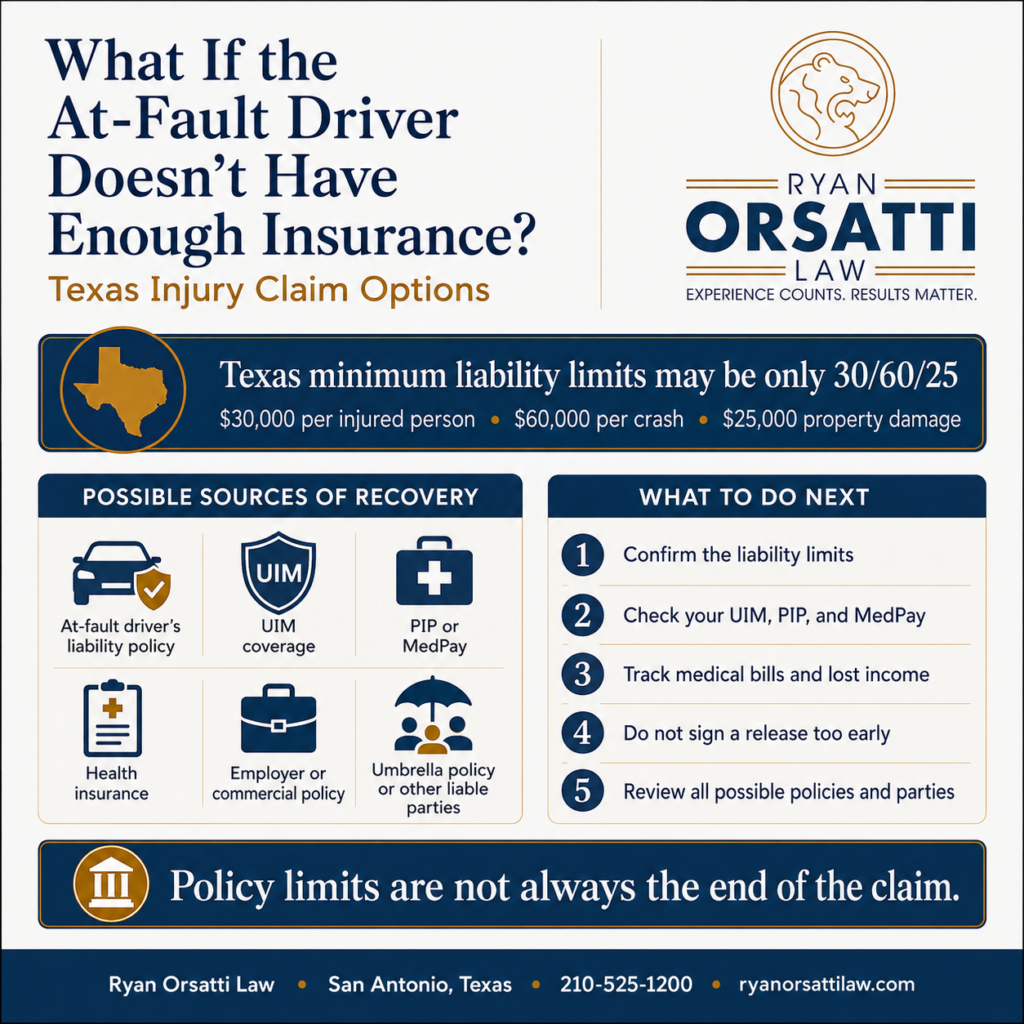
Texas permits drivers to carry bodily injury liability limits of only $30,000 per injured person and $60,000 total per accident. A surgery, hospital stay, extended rehabilitation, or significant period away from work can exceed the per-person limit before future medical expenses, impairment, pain, and other losses are considered.
The minimum is commonly described as 30/60/25 coverage:
- $30,000 for each injured person
- $60,000 total for all bodily injury claims from one accident
- $25,000 for property damage
The $60,000 limit is shared by everyone injured in the same crash. If three people are seriously hurt, they may be competing for the same total bodily injury limit, even though each person’s losses exceed $30,000. The Office of Public Insurance Counsel’s Texas auto insurance guide explains these minimum limits.
Insufficient insurance is not a rare concern. The Texas Department of Insurance reported in 2025 that more than 2.4 million state-registered vehicles were not matched to an insurance policy, representing approximately 12% of registered vehicles. That figure addresses uninsured vehicles, but it also shows why Texans should examine their own first-party coverages before a crash occurs.
What Does “Underinsured” Mean Under Texas Law?
An underinsured driver has liability insurance, but the available coverage is not enough to pay the damages the injured person is legally entitled to recover. Under Texas Insurance Code §§ 1952.103 and 1952.106, UIM coverage may pay the remaining damages, subject to the injured person’s policy limit and credit for amounts recovered or recoverable from the at-fault driver’s insurer.
The phrase legally entitled to recover means you must establish the other driver’s responsibility, the connection between the crash and your injuries, and the amount of your recoverable damages. An insurance company’s policy limit is not the same thing as the value of the injury claim.
| Potential source of recovery | What it may cover | Main issue to investigate |
|---|---|---|
| At-fault driver’s liability policy | Medical expenses, lost income, impairment, pain, and other covered damages | Per-person and per-accident limits |
| Your UIM coverage | Damages remaining after credit for the at-fault coverage | Your UIM limit, insured status, fault, causation, and damages |
| PIP or MedPay | Early medical expenses and, for PIP, certain lost income and household services | Whether coverage exists and its limit |
| Health insurance | Covered medical treatment | Deductibles, network rules, liens, and reimbursement rights |
| Commercial, employer, rideshare, or umbrella policy | Additional liability coverage when the facts trigger the policy | Driver’s purpose, employment status, ownership, and policy terms |
| At-fault driver’s personal assets | Amounts legally owed above insurance | Whether a judgment would realistically be collectible |
Key takeaway: The correct question is not simply, “What are the driver’s limits?” It is, “What policies, parties, assets, and payment sources apply to the entire loss?”
How Does UIM Coverage Fill the Insurance Gap?
UIM coverage can pay damages that remain after the at-fault driver’s available liability coverage is credited, up to the UIM limit. Texas auto insurers must provide UM/UIM coverage unless the named insured rejects it in writing, so the declarations page and any signed rejection form should be reviewed.
Consider a simplified example:
- Recoverable damages: $175,000
- At-fault driver’s liability limit: $30,000
- Injured person’s UIM limit: $100,000
After crediting the $30,000 liability coverage, $145,000 remains uncompensated. The UIM carrier could potentially owe up to its $100,000 limit, subject to coverage, proof, defenses, and policy terms. That would leave $45,000 without an identified insurance source.
UIM does not automatically add its full limit to every settlement. If total recoverable damages were $90,000, the same $30,000 liability payment would leave a potential UIM claim of $60,000, not $100,000.
A more detailed explanation is available in Ryan Orsatti Law’s Texas UM/UIM coverage guide.
Does My UIM Carrier Have to Pay Automatically?
No. Your UIM insurer may contest the other driver’s fault, whether the crash caused a particular medical condition, the reasonableness of treatment, and the amount of damages, even though it is your insurance company.
In Allstate Insurance Co. v. Irwin, a case arising from Bexar County, the Supreme Court of Texas confirmed that an insured may use a declaratory judgment action to establish the liability, damages, and other prerequisites controlling UIM benefits. The court described UIM as coverage intended to fill the gap between the insured’s damages and the other driver’s ability to pay.
This means a UIM claim can become contested litigation. Paying premiums to your own insurer does not prevent that insurer from requiring proof of every element affecting coverage and damages.
Could More Than One UIM Policy Apply?
More than one policy may apply in some cases, but the answer depends on who qualifies as an insured and the language of each policy. Separate household policies, an employer’s policy, or another policy covering the vehicle or injured person should not be dismissed without review.
The Texas Department of Insurance’s 2026 personal-auto filing guidance restricts certain anti-stacking provisions involving separate applicable policies. That does not mean every policy can always be combined. It means each potentially applicable policy should be obtained and analyzed rather than assuming that only the policy covering the damaged vehicle matters.
What Other Insurance or Responsible Parties Should Be Investigated?
A serious injury claim should include a coverage investigation that extends beyond the insurance card exchanged at the crash scene. Additional coverage may exist when the driver was working, operating a commercial vehicle, making a delivery, transporting a rideshare passenger, driving someone else’s vehicle, or covered by an umbrella or excess policy.
Depending on the evidence, the investigation may include:
- Employer and commercial insurance. An employer or company policy may apply when the driver was performing job duties.
- Umbrella or excess coverage. A driver, vehicle owner, or business may have coverage above the primary liability limit.
- Rideshare or delivery coverage. Available coverage can change based on whether the driver was logged into an app, waiting for a request, or completing a trip.
- Other negligent parties. Separate conduct by a vehicle owner, employer, contractor, alcohol provider, manufacturer, or another driver may create an additional claim when supported by the facts.
- Other first-party policies. A household, employer, or separate vehicle policy may define the injured person as an insured.
Commercial crashes often require a broader investigation because multiple companies and insurance layers may be involved. Ryan Orsatti Law provides additional information about these cases on its San Antonio truck accident lawyer page.
Should I Accept the At-Fault Driver’s Policy Limits?
You should accept a policy-limits offer only after determining that the settlement protects your remaining claims and insurance rights. A limits offer may be reasonable, but the release accompanying it can end claims against named parties and create problems if additional coverage or UIM requirements have not been addressed.
Before signing, confirm:
- The bodily injury limits in writing
- Whether an umbrella or excess policy exists
- Whether multiple injured claimants are sharing the limit
- Whether the driver was working or using the vehicle commercially
- Whether another person or company may be responsible
- Whether your UIM carrier requires notice or consent
- Whether your medical condition and future care are sufficiently understood
- Whether health-plan reimbursement claims, hospital liens, or other balances will affect your net recovery
The Office of Public Insurance Counsel warns that once an injury release is signed, the claimant generally cannot obtain more money for that injury from the released claim.
Attorney Insight
An adjuster’s statement that “we have offered the policy limits” answers only what that particular policy will pay. Before a release is signed, counsel should verify the limits, investigate excess coverage and business use, identify competing claimants, preserve UIM rights, and calculate medical liens. A premature release can close a door that additional investigation might have kept open.
How Can Medical Bills Be Paid While the Claim Is Pending?
Medical bills may be handled through PIP, MedPay, health insurance, provider payment arrangements, or other available benefits while liability and UIM claims are investigated. The at-fault insurer ordinarily does not pay every medical bill as it arrives, so an early payment plan may be necessary.
Personal Injury Protection, or PIP, pays covered benefits without regard to fault. Texas insurers must provide at least $2,500 per person unless PIP is rejected in writing. PIP can cover qualifying medical expenses, 80% of lost income, and certain essential household services.
MedPay may pay qualifying medical or funeral expenses, but it does not provide the same statutory wage benefits as PIP. Its terms and reimbursement provisions depend on the policy.
Health insurance may reduce medical charges through negotiated rates and help maintain access to care. It may later assert subrogation or reimbursement rights. Subrogation means a health plan or benefit provider claims a right to be repaid from part of the injury recovery.
Ryan Orsatti Law has separate guides explaining how to use PIP after a Texas car accident and who pays medical bills after a car accident.
Can I Sue the At-Fault Driver Personally Above the Policy Limits?
Yes. The at-fault driver’s insurance limit usually caps what that insurer must pay, not the amount the driver may legally owe. The driver can potentially be sued for damages above the policy limits.
The practical issue is collectability. A judgment does not guarantee payment. Before spending substantial time and litigation costs pursuing personal assets, an attorney may evaluate employment, real property, nonexempt assets, existing debts, insurance coverage, bankruptcy risk, and the likely cost of enforcement.
The Texas Department of Insurance explains that a driver remains responsible for losses exceeding liability coverage and may be sued for the difference.
How Long Do I Have to Act in Texas?
Texas Civil Practice and Remedies Code § 16.003 generally requires a personal injury lawsuit to be filed within two years after the claim accrues. Exceptions can change that deadline, but relying on an exception without legal review is risky.
A UIM claim can also involve contractual notice, cooperation, proof-of-loss, consent, and litigation issues that do not always track the underlying two-year tort deadline. Notify potentially applicable insurers promptly and obtain the complete policies, not only the declarations pages.
What Should I Do After Learning the Driver Has Low Insurance Limits?
You should begin a documented coverage-and-damages review before negotiating a final settlement.
- Continue medically appropriate treatment. Follow referrals and obtain information about future care, restrictions, and prognosis.
- Request written confirmation of the at-fault limits. Ask whether umbrella or excess coverage exists.
- Collect every relevant declarations page. Include your policies, household policies, employer coverage, and policies covering the vehicle.
- Notify your UM/UIM, PIP, and MedPay carriers. Ask for the complete policy and required claim forms.
- Preserve evidence of business use. Save app records, employer communications, delivery information, photographs, and witness details.
- Track the full damages picture. Maintain bills, wage records, receipts, work restrictions, and a record of daily limitations.
- Do not sign a release without review. Confirm exactly which people, companies, policies, and claims it releases.
- Calendar the legal deadline. Do not assume an ongoing insurance investigation extends the Texas limitations period.
- Have the coverage map reviewed. A San Antonio car accident lawyer can evaluate whether additional insurance or responsible parties should be investigated.
How Can Ryan Orsatti Law Help With an Underinsured-Driver Claim?
Ryan Orsatti Law helps injured people identify the available liability limits, review UM/UIM and other first-party policies, investigate commercial or employer coverage, document damages, evaluate releases, and address medical liens or reimbursement claims.
When a UIM carrier disputes fault, causation, coverage, or damages, the firm can also evaluate whether litigation is appropriate. Every claim depends on its facts, policy language, available evidence, and the financial sources that can legally respond.
To discuss an underinsured-driver claim in San Antonio, Bexar County, or elsewhere in Texas, contact Ryan Orsatti Law.
Frequently Asked Questions
What happens if several people are injured and the driver has only minimum Texas insurance?
The injured people may have to share the $60,000 per-accident bodily injury limit. The insurer cannot pay more than the applicable policy limit merely because several claims exceed it. Each injured person should promptly investigate personal UIM, PIP, MedPay, health insurance, and any additional liability policies.
Does Texas UIM coverage pay pain and suffering?
UIM may cover damages the insured is legally entitled to recover from the underinsured driver, including qualifying medical expenses, lost income, impairment, pain, and other covered damages. Payment is limited by proven damages, applicable credits, policy terms, defenses, and the UIM limit. The carrier may dispute both liability and value.
Do I always have to sue my own insurance company for UIM benefits?
No. Many UIM claims resolve through documentation and negotiation. Litigation may become necessary when the carrier disputes fault, causation, damages, insured status, or the amount owed. Texas law permits a direct declaratory action against the UIM carrier to determine the prerequisites for coverage when those issues cannot be resolved.
Can I use health insurance after a crash caused by an underinsured driver?
Yes. Health insurance can often be used for covered accident-related treatment while the liability and UIM claims are pending. The plan may later assert subrogation or reimbursement rights against the recovery. Keep explanations of benefits, bills, payment records, and correspondence so the repayment claim can be verified before settlement funds are distributed.
Can I recover more than the at-fault driver’s insurance limit?
Potentially. Recovery above the primary liability limit may come from UIM coverage, an umbrella or excess policy, employer or commercial insurance, another responsible party, or collectible personal assets. The existence of serious injuries alone does not create additional coverage, so each possible source must be supported by facts and policy language.
Should I sign a release when the insurer offers its policy limits?
Not until the release and remaining coverage have been reviewed. Confirm the limits, excess coverage, other responsible parties, competing claims, UIM notice requirements, future medical needs, and lien exposure. A signed release can permanently end claims against the released parties and may affect other insurance rights.
How long do I have to file an underinsured-driver claim in Texas?
The underlying Texas personal injury lawsuit is generally subject to a two-year limitations period under Civil Practice and Remedies Code § 16.003. UIM disputes may also involve separate contract, notice, consent, and proof requirements. Because those issues are policy-specific, provide notice and obtain legal review well before the two-year date.
Ryan Orsatti Law
4634 De Zavala Rd, San Antonio, TX 78249
Phone: 210-525-1200
ryanorsattilaw.com
This blog is for informational purposes only, not legal advice. Reading it does not create an attorney-client relationship. Past results do not guarantee future results.
Hurt in an accident in San Antonio? Learn how a San Antonio car accident lawyer can help with your claim. Call 210-525-1200 or request a free consultation.
The firm works on a contingency fee. You pay nothing unless the firm recovers money for you, and that covers case expenses as well as the fee: if there is no recovery, you owe no attorney's fee and no case expenses. Ask for the fee agreement and read the fee and expense section before you sign anything.
Related San Antonio legal resources
Primary legal and public-data sources
- TxDOT: Texas crash reports, data, and statistics
- Texas Civil Practice and Remedies Code Chapter 33: proportionate responsibility
Ryan Orsatti Law
4634 De Zavala Road, San Antonio, TX 78249
General reference links. Consult each source for its current text.