
Quick Answer
After a serious 18-wheeler or commercial truck wreck in Texas, the most important evidence is often electronic, time-sensitive, and entirely in the trucking company’s control. Within days — sometimes hours — the following can disappear: the truck’s Electronic Control Module (“black box”) data, dashcam footage, telematics, driver text messages, dispatch logs, and the physical condition of the truck and trailer.
If you wait until you “feel ready” to call a lawyer, key proof may already be gone. The first 72 hours typically should include:
- A written spoliation (litigation hold) letter to the motor carrier, its insurer, the broker, and any other involved parties;
- Independent documentation of the scene, the vehicles, and witness accounts before the truck is repaired or returned to service;
- Steps to preserve your own records (medical, employment, photos, social media);
- Identification of the motor carrier, broker, shipper, and any maintenance contractors who may share responsibility.
The rest of this article explains why this short window matters under federal trucking regulations and Texas law, what evidence is at risk, and the concrete steps that can preserve it.
Why 72 Hours? The Short Window for Critical Trucking Evidence
Trucking cases are not ordinary car wreck cases. They are document-and-data cases. The story of how the crash happened is often written in records held by the motor carrier, the driver’s phone, the truck’s onboard systems, and third-party telematics platforms. Two realities make the early window critical:
1. Federal regulations only require many records to be kept for short periods. The Federal Motor Carrier Safety Regulations (FMCSRs) set minimum retention periods. Once that period expires, a motor carrier can lawfully purge those records — even if a wreck occurred during that window — unless someone has already put the carrier on notice to preserve them.
2. Electronic data is overwritten by design. Dashcam systems frequently record on a rolling loop. Engine Control Modules (ECMs) typically capture only a brief snapshot of pre- and post-event data, which can be lost when the vehicle is repaired, started repeatedly, or scrapped. Telematics and ELD data can be archived on systems controlled by third-party vendors with their own retention schedules.
The combination is unforgiving: the most important evidence in a serious truck wreck has the shortest natural shelf life and is in the hands of the party with the least incentive to preserve it.
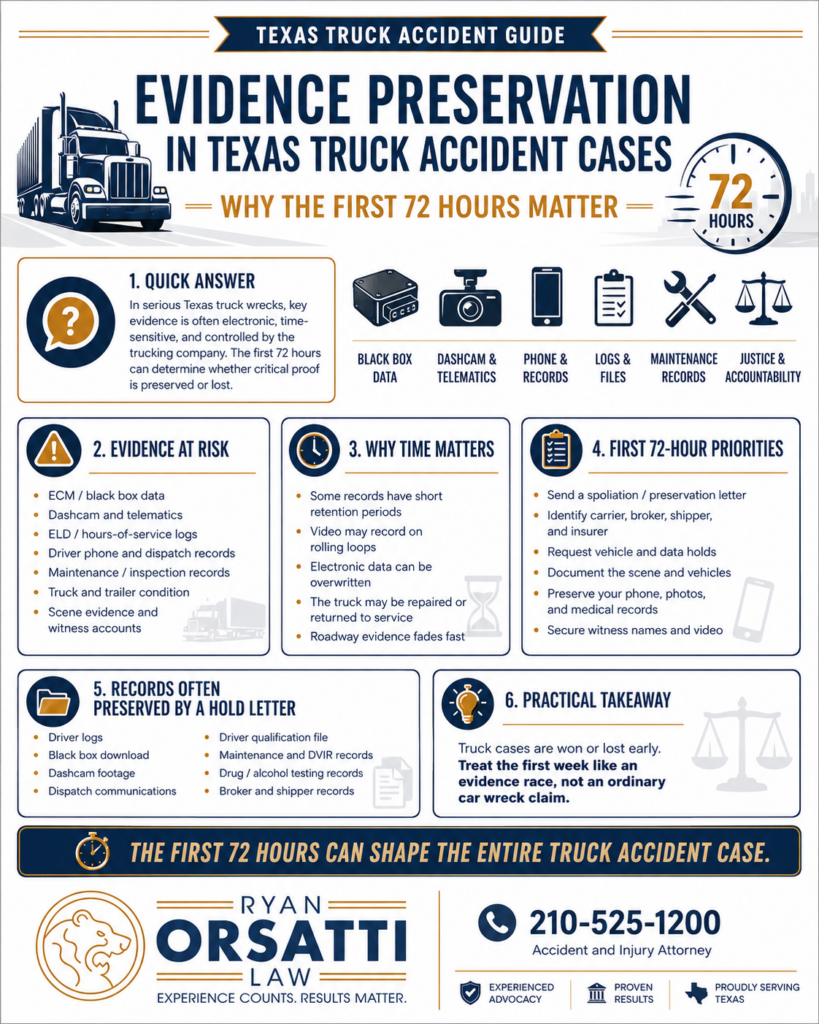
What Evidence Is At Risk in a Texas Truck Wreck
Below are the categories of evidence most commonly at risk in the first days after a commercial vehicle collision.
1. The Truck and Trailer Themselves
- Engine Control Module (ECM) / Event Data Recorder (EDR) data — speed, throttle, brake application, RPM, hard-braking events, and other parameters in the seconds surrounding the crash.
- Mechanical condition — brake adjustment, tire wear, lighting, coupling devices, load securement.
- Post-crash damage patterns that help reconstruction experts model impact angles and forces.
Once the truck is repaired, returned to service, sold, or scrapped, much of this is gone or compromised.
2. Hours-of-Service (HOS) and Electronic Logging Device (ELD) Records
Federal rules generally require commercial drivers to log their duty status using an ELD. Under 49 C.F.R. § 395.8(k), motor carriers must retain records of duty status (RODS) and supporting documents for six months. Supporting documents include things like fuel receipts, toll records, dispatch records, and bills of lading that corroborate (or contradict) what the driver logged.
If a fatigue or HOS-violation theory might apply, six months passes faster than most clients realize.
3. Driver Qualification File and Personnel Records
Under 49 C.F.R. Part 391, motor carriers must maintain a Driver Qualification (DQ) file containing items such as the application for employment, prior employer safety performance history, motor vehicle records, road test certifications, and medical examiner’s certificates. These records can reveal whether the carrier knew or should have known about prior crashes, citations, or disqualifying conditions before placing the driver behind the wheel — a foundation for negligent hiring, training, supervision, and retention claims.
4. Dashcam and Telematics
Many fleets run forward-facing and driver-facing cameras, plus telematics platforms (for example, Samsara, Lytx, Omnitracs, SmartDrive, and similar systems). These can capture:
- The seconds before and after impact;
- “Hard event” triggers (hard braking, harsh cornering, lane departures);
- GPS breadcrumb trails showing route, stops, and speed.
Footage and event data are often overwritten on a rolling cycle unless an event is flagged or downloaded. Without a prompt preservation demand, the most useful clip may be erased before anyone watches it.
5. Maintenance and Inspection Records
Under 49 C.F.R. § 396.3 and § 396.11, motor carriers must keep maintenance records and Driver Vehicle Inspection Reports (DVIRs). Among other things:
- DVIRs documenting defects must generally be retained for three months;
- Vehicle maintenance records must be retained for one year while the vehicle is in service, and six months after the vehicle leaves the carrier’s control.
These records are central to brake-failure, tire-failure, and lighting cases.
6. Bills of Lading, Trip Sheets, Dispatch Records, and Broker Communications
Shipping paperwork and dispatch communications can establish:
- Whether the driver was pressured to meet an unrealistic schedule;
- Who loaded the trailer and how it was secured;
- Whether the broker selected an unsafe carrier;
- Whether the shipper, carrier, or broker had control over the manner of transport.
7. The Driver’s Cell Phone
Texting, hands-free use, navigation, music apps, and calls all generate data on the device and the carrier’s account. Under federal rules, commercial drivers face strict limits on hand-held mobile use (see 49 C.F.R. § 392.82). Cellphone records and on-device data can confirm or refute distraction theories — but only if preserved before they are deleted, recycled, or factory-reset.
8. Scene Evidence
Skid marks, gouges, debris fields, fluid trails, and vehicle rest positions degrade quickly with weather, traffic, and cleanup crews. Photographs from the scene, drone imagery, and laser scans taken early can be far more valuable than reconstruction done weeks later.
9. Drug and Alcohol Testing Records
Under 49 C.F.R. Part 382, commercial drivers are subject to post-accident testing in defined circumstances, and carriers must maintain testing records. Records, chain-of-custody, and lab results all matter, and retention periods vary by record type.
10. The Carrier’s Accident Register and Prior Incidents
Under 49 C.F.R. § 390.15, motor carriers must maintain an accident register for three years. This can show patterns of similar wrecks — important context for negligent supervision and punitive damages theories under Texas law.
Federal Retention Rules Create Real Spoliation Risk
The chart below summarizes minimum retention periods commonly relevant in Texas truck cases. These are floors, not ceilings — but a carrier without a litigation hold is generally not required to keep records longer.
| Record | Authority | Minimum Retention |
|---|---|---|
| Records of Duty Status (RODS) and ELD supporting documents | 49 C.F.R. § 395.8(k) | 6 months |
| Driver Vehicle Inspection Reports (DVIRs) noting defects | 49 C.F.R. § 396.11 | 3 months |
| Vehicle maintenance records (in-service) | 49 C.F.R. § 396.3 | 1 year |
| Vehicle maintenance records after vehicle leaves control | 49 C.F.R. § 396.3 | 6 months |
| Driver Qualification File (during employment) | 49 C.F.R. § 391.51 | Throughout employment |
| Driver Qualification File (after termination) | 49 C.F.R. § 391.51 | 3 years |
| Accident register | 49 C.F.R. § 390.15 | 3 years |
| Drug/alcohol testing records | 49 C.F.R. Part 382 | Varies by record type (often 1–5 years) |
If your case involves theories tied to driver fatigue, mechanical failure, hiring decisions, or carrier history, these retention periods should drive your timeline — not the other way around.
The Spoliation Letter (Litigation Hold) — Your Most Important First Move
A spoliation letter (also called a litigation hold or evidence preservation letter) is a written demand placing the carrier and other parties on notice to preserve specific categories of evidence. In a serious commercial vehicle wreck, this letter is often the single most consequential step taken in the first week.
A well-drafted preservation letter typically does several things:
- Identifies the wreck (date, time, location, units involved, police report or CR-3 number);
- Lists specific categories of evidence to preserve (ECM/EDR data, ELD/HOS, dashcam, telematics, dispatch logs, maintenance and DVIR records, DQ file, drug/alcohol testing, cellphone data, the vehicles themselves in their post-crash condition, and more);
- Demands a download protocol — that no one start, drive, repair, or modify the truck or trailer without notice and an opportunity for an inspection;
- Triggers preservation duties for ESI (electronically stored information) consistent with Texas Rule of Civil Procedure 196.4 when litigation is reasonably anticipated.
The letter should go to the motor carrier, the carrier’s liability insurer, the broker (if any), the shipper (if relevant), the driver, any leasing company on the tractor or trailer, and any maintenance contractor. Sending it broadly avoids fingerpointing later about who “owned” the duty.
The preservation letter is not magic. It does not by itself create new duties or guarantee preservation. What it does is (a) shorten the carrier’s runway to argue it had no notice and (b) put the issue in writing if records later go missing.
Texas Law on Spoliation: What Brookshire Brothers Means for Trucking Cases
Texas courts treat spoliation as a serious issue, but the bar for sanctions — particularly a spoliation jury instruction — is high. The Texas Supreme Court’s leading decision is Brookshire Brothers, Ltd. v. Aldridge, 438 S.W.3d 9 (Tex. 2014).
In broad strokes, Brookshire Brothers held that a trial court may submit a spoliation instruction only after finding that (1) the party had a duty to preserve evidence and (2) intentionally concealed or destroyed it; negligent loss generally is not enough for an adverse-inference instruction, although lesser remedies may be available in narrower circumstances. The opinion explicitly limits how often juries hear about spoliation and shifts much of the analysis to the judge outside the jury’s presence.
Two practical takeaways for plaintiffs in Texas truck cases:
- Do not count on a “missing evidence” instruction to save the case. The path to a Brookshire Brothersinstruction is narrow. Building the case around what should be in the file is far better than chasing sanctions over what is not.
- Document the duty to preserve early and clearly. A timely, specific preservation letter — followed by written confirmation of receipt and follow-up — helps establish both the duty and notice elements that the court will weigh.
For non-Texas readers (or cases involving federal claims), spoliation doctrine differs across jurisdictions and in federal court under Rule 37(e). Confirm the governing standard for any specific case.
The First 72-Hour Checklist
Use this as a working checklist for a serious commercial vehicle wreck. Not every item applies in every case, and some require legal action; this is a practical framework, not a substitute for individualized advice.
Hour 0–24
- Get appropriate medical care and follow ER discharge instructions; gaps in care can become arguments later.
- Photograph injuries, vehicles, and the scene if conditions allow.
- Get the Texas Peace Officer’s Crash Report number (the CR-3) and the investigating agency. Order the CR-3 once available through the Texas Department of Transportation Crash Records Information System.
- Identify witnesses and capture names, phone numbers, and any video they may have.
- Save your phone (do not “trade it in” or wipe it); driver and passenger device data may be relevant.
- Avoid recorded statements to the trucking company’s adjuster.
- Lock down social media; do not post about the wreck, your injuries, or activities.
Hour 24–48
- Identify the motor carrier, USDOT and MC numbers, and check basic public-facing data through the FMCSA’s SAFER system and the Company Snapshot tool.
- Determine whether a broker or shipper is involved (this often takes investigation beyond the police report).
- Identify the carrier’s liability insurer and any excess carriers.
- Begin drafting and sending the spoliation/preservation letter to all known parties.
- Request vehicle holds — that the tractor and trailer not be moved, repaired, or returned to service without notice and inspection.
- Begin gathering the client’s prior medical records and a full list of treaters; this is the foundation for damages and for handling preexisting-condition arguments.
Hour 48–72
- Confirm receipt of the preservation letter and follow up in writing where it has not been acknowledged.
- Engage an accident reconstruction professional if warranted; arrange site documentation before scene evidence degrades.
- Arrange a joint vehicle inspection / ECM download protocol — typically with experts present, written agreed protocols, and chain-of-custody procedures.
- Subpoena or request preservation of 911 audio, CAD logs, body camera, and dashcam from responding agencies before retention windows close.
- Begin identifying video sources along the route: nearby businesses, traffic cameras, residential doorbell cameras, toll authority cameras, and weigh stations.
- For cellphone data, take steps to preserve both the device and the account-level records with the carrier (Verizon, AT&T, T-Mobile); these have different retention periods and capture different things.
- If preservation cannot be obtained voluntarily, evaluate whether a pre-suit petition for deposition or to investigate a claim under Texas Rule of Civil Procedure 202 is appropriate, or whether to file suit and seek a temporary order.
Common Mistakes That Quietly Damage Trucking Cases Early
- Talking to the carrier’s adjuster before you understand what is at stake. Friendly, fast offers in the first week are rarely a measure of full case value.
- Letting the truck be repaired or returned to service without an inspection. Once it rolls, the evidence on it is degraded or gone.
- Wiping or trading in your phone. Both sides will want device-level data; preserve yours, and demand preservation of the driver’s.
- Posting on social media. Even innocuous posts get used to argue you are not as hurt as you say.
- Skipping or delaying medical care. Gaps create arguments. So do “self-discharge” notes from the ER.
- Failing to identify brokers and shippers. Negligent selection theories and contract liability often live with parties who are not named in the police report.
- Relying on the police report as gospel. CR-3s are useful but not the last word; many include errors that should be challenged with independent investigation.
Attorney Insight: Why Trucking Cases Are Won and Lost in the First Week
In an ordinary two-car wreck, the file you build with photos, a police report, and medical records is often enough to evaluate liability. In a commercial vehicle case, that same file is barely a starting point. The story of why the wreck happened is almost always inside data and documents the trucking company controls — ECM downloads, ELD records, telematics events, dispatch logs, driver qualification files, and maintenance records.
The longer those records sit unsecured, the more chances there are for them to be lost, overwritten, or “purged in the ordinary course of business” — which is exactly what federal retention rules permit. By the time a client comes in three months later, key categories of records may already be legally disposed of. Once the truck has been repaired and returned to a Texas highway, opportunities for a meaningful inspection are usually finished.
That is why the first 72 hours matter so much, and why a properly scoped preservation letter — backed by follow-through — is one of the most consequential documents in the case.
San Antonio and Bexar County Context
San Antonio sits at the intersection of I-10, I-35, I-37, Loop 410, and Loop 1604, plus the busy connector corridors that move freight between Mexico, the Texas Triangle, and the Gulf. That geography drives a heavy mix of long-haul tractor-trailer traffic, regional delivery box trucks, and oilfield-related commercial vehicles moving through Bexar County daily.
A few practical implications for evidence preservation locally:
- Multiple agencies investigate — San Antonio Police Department, Bexar County Sheriff’s Office, Texas Department of Public Safety, and individual suburban departments along Loop 1604. Each has different procedures for preserving body camera, dashcam, and 911 audio. Identify the right agency early.
- Hospital systems in San Antonio handle a large volume of trauma cases, and records requests can take time. Start them early.
- Mexico-based carriers and cross-border brokers complicate insurance, jurisdiction, and service. These cases reward early identification of all parties in the transportation chain.
Frequently Asked Questions
How long do I have to file a truck accident lawsuit in Texas? Most personal injury claims arising from a Texas truck wreck are subject to a two-year statute of limitations under Texas Civil Practice & Remedies Code § 16.003. Wrongful death claims are governed by § 16.003(b). Other deadlines (notice provisions, governmental claims, products claims, and others) can be much shorter or operate differently. The filing deadline is separate from — and typically much later than — the windows for preserving evidence.
Will the trucking company really destroy evidence? Most carriers do not actively destroy evidence in a way that would expose them to sanctions. The bigger risk is that records are lawfully purged in the ordinary course because federal regulations only require short retention periods. A timely preservation letter is what shifts that calculus.
Do I need to send a preservation letter myself, or can I wait to hire a lawyer? You can send one yourself, but the letter’s effectiveness depends on its specificity and breadth. In serious cases, working with an attorney who handles commercial vehicle litigation is usually the safer path — both for the letter and for the inspection and download protocols that follow.
The trucking company’s adjuster called me and seems helpful. Should I give a recorded statement? You are typically not required to give a recorded statement to the other side’s insurer in Texas. Until you have a clear picture of injuries, liability, and the evidence on file, recorded statements rarely help and frequently lock you into a version of facts you do not fully remember.
What if the truck has already been repaired by the time I call? The case is not over, but the strategy changes. Reconstruction has to lean more on photos, scene evidence, and electronic records. Earlier inspection of other evidence — telematics, dispatch logs, ELD data, the driver’s phone — becomes even more important.
What is the difference between an ECM download and ELD records? The ECM (“black box”) is part of the truck’s engine control system and captures operational data over short windows around defined events. The ELD records the driver’s duty status (driving, on-duty not driving, off-duty, sleeper berth) and trip data over longer periods. They answer different questions and both may matter.
Does Texas have a “black box” preservation statute for commercial vehicles? There is no Texas statute that automatically preserves a truck’s ECM data after a crash. Preservation is driven by the parties’ duties when litigation is reasonably anticipated and by court orders, not by an automatic statutory hold.
Next Steps If You or a Loved One Was Hurt in a Texas Truck Wreck
- Get medical care and follow through on it.
- Avoid recorded statements to the other side’s insurer.
- Save your phone and photos.
- Lock down social media.
- Talk to a Texas attorney experienced with commercial vehicle cases as soon as possible — ideally before the first week is over — so a preservation letter and inspection protocol can go out promptly.
Contact
Ryan Orsatti Law 4634 De Zavala Rd, San Antonio, TX 78249 Phone: 210-525-1200
This blog is for informational purposes only, not legal advice. Reading it does not create an attorney-client relationship. Past results do not guarantee future results.
Injured in a truck crash? See our San Antonio 18-wheeler accident lawyer page, or call (210) 525-1200 – calls answered 24/7.
Hurt in an accident in San Antonio? Learn how a San Antonio truck accident lawyer can help with your claim. Call 210-525-1200 or request a free consultation.
The firm works on a contingency fee. You pay nothing unless the firm recovers money for you, and that covers case expenses as well as the fee: if there is no recovery, you owe no attorney's fee and no case expenses. Ask for the fee agreement and read the fee and expense section before you sign anything.
Related San Antonio legal resources
Primary legal and public-data sources
Ryan Orsatti Law
4634 De Zavala Road, San Antonio, TX 78249
General reference links. Consult each source for its current text.