
Quick Answer: Most Texas car accident police reports, officially called Texas Peace Officer’s Crash Reports or CR-3s, become available online in about 5 to 14 days. Texas law requires an investigating officer to file a qualifying crash report with TxDOT no later than the 10th day after a crash involving injury, death, or at least $1,000 in apparent property damage. (TxDOT) San Antonio Police Department tells requestors that crash reports can take up to 14 days to appear in the TxDOT system. (San Antonio) Ryan Orsatti Law helps injured people in San Antonio and across Texas obtain, review, and address crash-report issues when the report affects fault or insurance.
Key Takeaways
- In San Antonio, plan for up to 14 days before a crash report appears in TxDOT’s system, although some routine reports appear sooner. (San Antonio)
- Texas law gives the investigating officer 10 days to electronically file a qualifying CR-3 crash report with TxDOT. (TxDOT)
- A regular Texas crash report costs $6, and a certified copy costs $8 through TxDOT. (TxDOT)
- The police report matters, but it does not decide the entire injury claim. Photos, video, witnesses, medical records, and vehicle damage can be just as important.
- If the report is delayed, missing, or wrong, do not wait to preserve evidence or get legal advice.
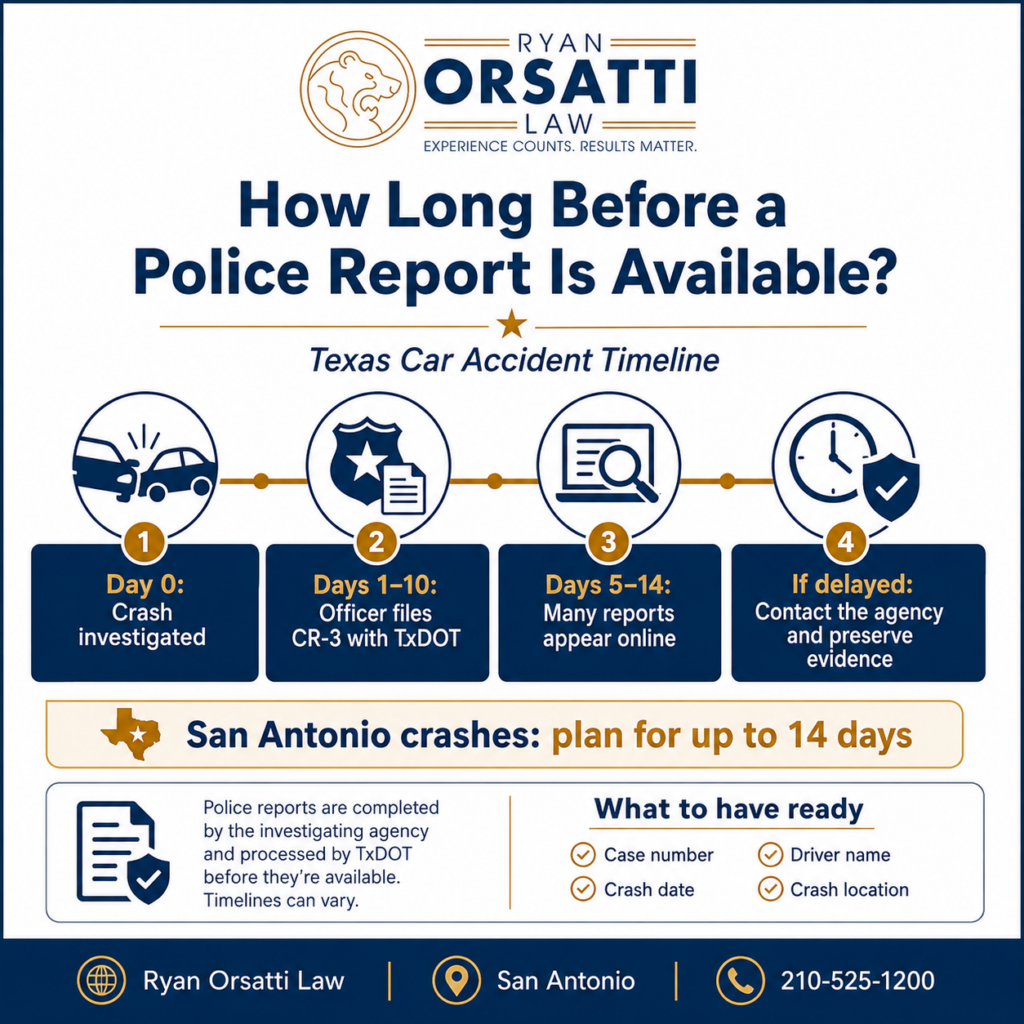
How long before the police report becomes available in San Antonio or Texas?
Most Texas crash reports become available after the officer completes the CR-3 and the report clears agency and TxDOT processing. For San Antonio crashes, SAPD states that reports can take up to 14 days to appear in TxDOT’s system, while Texas law requires qualifying officer reports to be filed with TxDOT by the 10th day after the crash. (San Antonio)
A simple two-car crash on Loop 410, I-10, I-35, US-281, or Loop 1604 may appear faster than a serious injury crash, fatal crash, DWI investigation, hit-and-run, commercial vehicle crash, or multi-vehicle collision. Those cases may require supplements, reconstruction work, toxicology, additional witness review, or approval by a supervisor.
TxDOT reported 14,905 serious injury crashes in Texas in 2024, with 18,218 people sustaining serious injuries. That volume is one reason crash documentation matters: the CR-3 is often the first structured document insurers use to evaluate fault, injuries, vehicle damage, and coverage. (TxDOT)
| Time after crash | What may be happening | What you should do |
|---|---|---|
| Day 0 | Officer investigates, gathers driver information, notes location, and may issue a case or incident number | Get the officer’s name, agency, case number, crash location, and all insurance information |
| Days 1 to 10 | The officer prepares and electronically files the CR-3 if the crash meets Texas reporting requirements | Keep checking the agency or TxDOT system, but do not wait to get medical care or preserve evidence |
| Days 5 to 14 | Many routine reports begin appearing in TxDOT’s Crash Report Online Purchase System | Search by date, county, driver name, and location; check spelling carefully |
| After 14 days | The report may still be pending, misindexed, awaiting approval, or tied to a more complex investigation | Contact the investigating agency, such as SAPD, Bexar County Sheriff’s Office, or DPS |
| Later supplements | Additional pages or corrections may be added after the original report | Recheck if new fault information, witness information, or corrected crash codes matter to your claim |
Key takeaway: A 10-day filing rule does not always mean the report is visible to you on day 10, so use the first two weeks to gather evidence instead of waiting passively.
What is the police report called in Texas?
The police report for a Texas car crash is usually the Texas Peace Officer’s Crash Report, also known as Form CR-3. TxDOT explains that CRASH is the secure electronic system used by law enforcement to process CR-3 reports, and CRASH is part of the Crash Records Information System, known as CRIS. (TxDOT)
The CR-3 is different from 911 audio, CAD notes, bodycam footage, dashcam video, officer field notes, photos, and towing records. TxDOT states that it is the custodian of the crash report only, and requests for dashcam videos, field notes, photographs, or other scene information should go to the investigating agency. (TxDOT)
For a deeper explanation of report codes, see Ryan Orsatti Law’s guide on what “Code 20: Driver Inattention” means on a Texas crash report.
What Texas law controls the crash report filing deadline?
Texas Transportation Code § 550.062 controls when an officer must prepare and file a written crash report. The statute requires a report when an officer investigates a motor vehicle collision that resulted in injury, death, or property damage to any one person to the apparent extent of $1,000 or more, and the report must be filed electronically with TxDOT not later than the 10th day after the crash. (Texas Legislature Online)
This officer filing deadline is separate from your duty to report certain crashes immediately. Texas Transportation Code § 550.026 requires a driver involved in a crash causing injury, death, or damage that leaves a vehicle unable to be normally and safely driven to give immediate notice by the quickest means of communication to the proper law enforcement agency. (Texas Legislature Online)
Does every Texas crash create a CR-3?
Not every Texas crash creates a CR-3. A CR-3 is generally created when law enforcement investigates a crash that meets the injury, death, or $1,000 apparent property damage threshold under Texas Transportation Code § 550.062. (Texas Legislature Online)
If no officer investigated the crash, a TxDOT CR-3 may not exist. TxDOT also states that the old Driver’s Crash Report, Form CR-2, is no longer retained by TxDOT, and drivers who received a CR-2 or similar local form should keep it for their own records. (TxDOT)
Does the police report decide who is legally at fault?
No. A Texas crash report can affect an insurance claim, but it does not automatically decide civil fault. Comparative responsibility means Texas can reduce or bar a recovery based on assigned fault, and Texas Civil Practice and Remedies Code § 33.001 states that a claimant may not recover damages if the claimant’s percentage of responsibility is greater than 50 percent. (Texas Statutes)
The CR-3 may list contributing factors, citations, crash narratives, and diagrams, but insurance companies and lawyers still look at photographs, video, vehicle damage, medical records, witness statements, roadway conditions, and testimony. For evidence planning, see Ryan Orsatti Law’s guide on what evidence can help a car accident case in Texas.
How do I request a Texas crash report from TxDOT or SAPD?
You can usually request a Texas crash report through TxDOT’s Crash Report Online Purchase System, and San Antonio drivers can also submit police records requests through SAPD for crash reports and other records. SAPD confirms that crash and vehicle accident reports are also available through TxDOT, and that requestors should gather the SAPD case number if known or provide details such as the date, location, names involved, and a basic description. (San Antonio)
For crashes inside San Antonio city limits, SAPD may be the investigating agency. For crashes outside city limits or on certain highways, the investigating agency may be Bexar County Sheriff’s Office, a nearby county sheriff’s office, or Texas Department of Public Safety.
What information should I have before I search?
You should have the crash date, county, location, driver names, and agency case number before searching for a Texas crash report. SAPD specifically recommends providing the case number if known, or two or more details such as the date of incident, location, names of persons involved, and a basic description. (San Antonio)
Use this checklist before you request the report:
- Identify the investigating agency: SAPD, Bexar County Sheriff’s Office, DPS, or another local department.
- Save the case number or incident number given at the scene.
- Write down the exact crash location, including highway, exit, cross street, direction of travel, and city or county.
- Gather names of drivers, passengers, and vehicle owners.
- Search TxDOT CRIS using the crash date, county, and at least one driver name.
- Decide whether you need a regular or certified copy.
- Save the PDF, receipt, and any “no report found” messages.
- If the report is still missing after two weeks, contact the investigating agency and ask whether the report is pending, rejected, incomplete, or filed under different information.
Do I need a certified copy of the crash report?
You usually do not need a certified copy just to read the crash report or send it to an insurance adjuster, but a certified copy may be useful for a legal proceeding. TxDOT lists the cost as $6 for a regular copy and $8 for a certified copy, with possible processing fees for credit card transactions. (TxDOT)
A certified copy is not a magic document. It only confirms the copy is official. The accuracy of the report still depends on what the officer observed, what witnesses said, what evidence was available, and whether later supplements or corrections were made.
Who can get an unredacted Texas police report?
Texas crash reports are confidential, but Texas Transportation Code § 550.065 allows release to certain people and entities after written request and payment of the required fee. Those include people involved in the crash, authorized representatives, drivers, vehicle or property owners, certain insurers, and people who may sue because of a death resulting from the collision. (Texas Legislature Online)
An unredacted report contains protected details that a public redacted report may remove. Redacted means private information has been blacked out or withheld. TxDOT states that persons or entities who do not meet the statutory criteria receive a redacted copy. (TxDOT)
If you were injured in the crash, your lawyer may request the report as your authorized representative. That can matter when an insurance company is disputing the crash facts, denying coverage, or arguing that the report does not support your injuries.
Why is the police report not available yet?
A Texas crash report may not be available yet because it has not been filed, has not cleared agency approval, was entered with different information, or involves a more complex investigation. SAPD tells requestors that reports can take up to 14 days to appear in TxDOT’s system, so a missing report during the first two weeks does not always mean no report exists. (San Antonio)
Common reasons a report is delayed include:
- Wrong crash date or county used in the search
- Driver name misspelled or entered differently
- Crash investigated by a different agency than expected
- Serious injury or fatality investigation
- DWI or hit-and-run investigation
- Commercial vehicle or 18-wheeler crash
- Multi-vehicle crash with conflicting witness accounts
- Supervisor review or report rejection inside the agency system
- Later supplement still pending
A delayed report should not stop you from documenting your injuries, property damage, missed work, medical appointments, and insurance communications.
What if the police report is wrong when it finally appears?
If the police report is wrong, act quickly and separate factual errors from opinion-based fault findings. Texas Transportation Code § 550.068 says a change to a material fact in an officer’s written collision report may generally be made only by the officer who prepared it, although a written supplement by another person may be used if it clearly identifies who originated the change. (Texas Legislature Online)
Examples of factual errors include the wrong insurance company, vehicle, location, driver name, or direction of travel. Examples of disputed opinions include contributing factors, narrative language, and fault descriptions. Ryan Orsatti Law has a separate guide on how to amend a police report in Texas after a car accident.
What should I do while waiting for the police report?
While waiting for the police report, you should preserve your own evidence, continue medical care, and avoid treating the CR-3 as the only proof of the crash. The report is useful, but it may arrive after camera footage is overwritten, skid marks disappear, vehicles are repaired, and witnesses become harder to reach.
In Texas, most personal injury lawsuits must be filed within two years after the claim accrues under Texas Civil Practice and Remedies Code § 16.003, but practical evidence deadlines are often much shorter. (Texas Statutes) A nearby business may overwrite video within days, and a vehicle’s repair or salvage process can destroy damage evidence.
Do this while the report is pending:
- Photograph all vehicles before repairs or towing-yard release.
- Save crash-scene photos, road conditions, traffic signals, debris, skid marks, and weather.
- Write down the exact location, lane, direction of travel, and nearby landmarks.
- Get medical care and tell providers how the crash happened.
- Save discharge papers, imaging orders, referrals, prescriptions, and work restrictions.
- Screenshot insurance claim numbers and adjuster contact information.
- Keep dashcam, doorbell, business, or surveillance leads before footage disappears.
- Avoid giving a detailed recorded statement to the other driver’s insurer before you understand the injuries, coverage, and report issues.
- Track missed work, out-of-pocket costs, rental car charges, towing, and storage.
- Recheck for the report and any supplements after the first version appears.
Attorney Insight: Adjusters often treat the first CR-3 as the starting map, not the whole case. If the report is late or has an incorrect contributing factor, we look for independent proof first: photos, dashcam video, 911 records, scene measurements, witness names, vehicle damage, and medical timing. The report matters, but early evidence often decides whether a fault dispute becomes manageable.
When should I call a lawyer about a delayed or missing police report?
You should consider calling a Texas personal injury lawyer if the police report is delayed, missing, inaccurate, or likely to affect fault, insurance coverage, medical bills, or a serious injury claim. Legal help is especially useful after crashes involving commercial vehicles, disputed liability, hit-and-run drivers, uninsured drivers, serious injuries, fatalities, or conflicting witness accounts.
Ryan Orsatti Law helps injured people in San Antonio, Bexar County, and across Texas evaluate crash reports, fault disputes, insurance coverage, medical documentation, and evidence preservation. If your crash involved a driver with no insurance or too little coverage, review Ryan Orsatti Law’s guide to Texas UM/UIM coverage after a wreck.
For San Antonio crash cases, you can also review Ryan Orsatti Law’s San Antonio car accident lawyer resource or contact Ryan Orsatti Law to discuss the next step.
What should I bring to Ryan Orsatti Law if the report is not ready?
Bring the crash date, location, agency name, case number, photos, insurance cards, medical paperwork, towing information, and any messages from adjusters. A lawyer can often start evaluating liability, coverage, injuries, and evidence before the official CR-3 is available.
Useful items include:
- Crash date, time, and exact location
- Police agency and officer name, if known
- Case number, incident number, or call slip
- Photos and videos from the scene
- Names and phone numbers of witnesses
- Driver’s license and insurance information
- Vehicle damage photos and repair estimate
- ER, urgent care, orthopedic, chiropractic, physical therapy, or imaging records
- Any letters, emails, texts, or voicemails from insurers
- Tow-yard, storage, rental, and repair documents
- Employer notes showing missed work
The goal is to build a claim file that does not depend entirely on one report. A complete file lets the lawyer compare the CR-3 against the physical evidence, medical timeline, witness accounts, and insurance positions.
FAQ
How many days does it take to get a police report after a car accident in San Antonio?
Most San Antonio crash reports should be checked through TxDOT after several days, but SAPD states that reports can take up to 14 days to appear in the system. (San Antonio) If your report is not available after two weeks, contact the investigating agency and verify the case number, crash date, county, and driver-name spelling.
Can I get a Texas crash report before 10 days?
Sometimes a routine crash report may appear before 10 days, but Texas law gives the investigating officer until the 10th day after a qualifying crash to file the CR-3 electronically with TxDOT. (Texas Legislature Online) Availability also depends on agency approval and TxDOT processing, so early searches may show “no report found” even when a report is being prepared.
Why can’t I find my report in TxDOT CRIS?
You may not find the report because it is not approved yet, the wrong county or date was entered, a name is misspelled, or another agency investigated the crash. Serious injury, fatality, DWI, hit-and-run, and commercial vehicle crashes can also take longer. Keep proof of your search and call the investigating agency if the report remains missing.
Is a Texas crash report the same as a police incident report?
No. A Texas crash report is usually the CR-3 completed for a motor vehicle collision and submitted through TxDOT’s crash system. A police incident report may involve a broader police call or criminal incident. SAPD separately lists police reports, incident reports, crash reports, 911 calls, towing records, and body or dash cam footage as different records. (San Antonio)
Can the insurance company get my crash report before I do?
An insurer may be allowed to obtain an unredacted Texas crash report if it issued a policy covering a vehicle or person involved in the collision. Texas Transportation Code § 550.065 includes certain insurance companies among the people and entities entitled to release after written request and payment. (Texas Legislature Online) That does not mean the insurer’s fault decision is final.
What if the police report says I was at fault?
A fault statement or contributing factor in a CR-3 can affect an insurance claim, but it does not end the analysis. Compare the report against photos, vehicle damage, witness statements, traffic signal timing, dashcam footage, and medical records. If the report has a factual error, ask about correction or a supplement as soon as possible.
Should I wait for the police report before getting medical treatment?
No. Do not delay medical treatment while waiting for a Texas crash report. The CR-3 may take days or weeks to appear, and treatment delays can create medical and insurance problems. Tell your provider how the crash happened, describe all symptoms, follow referral instructions, and keep copies of records, bills, prescriptions, and work restrictions.
Does a missing police report mean I do not have a case?
No. A missing police report does not automatically defeat a Texas injury claim, but it can make proof harder. Other evidence may still show what happened, including photos, video, witnesses, repair records, medical documentation, 911 records, and insurance communications. A lawyer can help determine whether a report exists and what evidence should be preserved.
Ryan Orsatti Law
4634 De Zavala Rd, San Antonio, TX 78249
Phone: 210-525-1200
ryanorsattilaw.com
This blog is for informational purposes only, not legal advice. Reading it does not create an attorney-client relationship. Past results do not guarantee future results.
Hurt in an accident in San Antonio? Learn how a San Antonio car accident lawyer can help with your claim. Call 210-525-1200 or request a free consultation.
The firm works on a contingency fee. You pay nothing unless the firm recovers money for you, and that covers case expenses as well as the fee: if there is no recovery, you owe no attorney's fee and no case expenses. Ask for the fee agreement and read the fee and expense section before you sign anything.
Related San Antonio legal resources
Primary legal and public-data sources
- TxDOT: Texas crash reports, data, and statistics
- Texas Civil Practice and Remedies Code Chapter 33: proportionate responsibility
Ryan Orsatti Law
4634 De Zavala Road, San Antonio, TX 78249
General reference links. Consult each source for its current text.