
Quick Answer
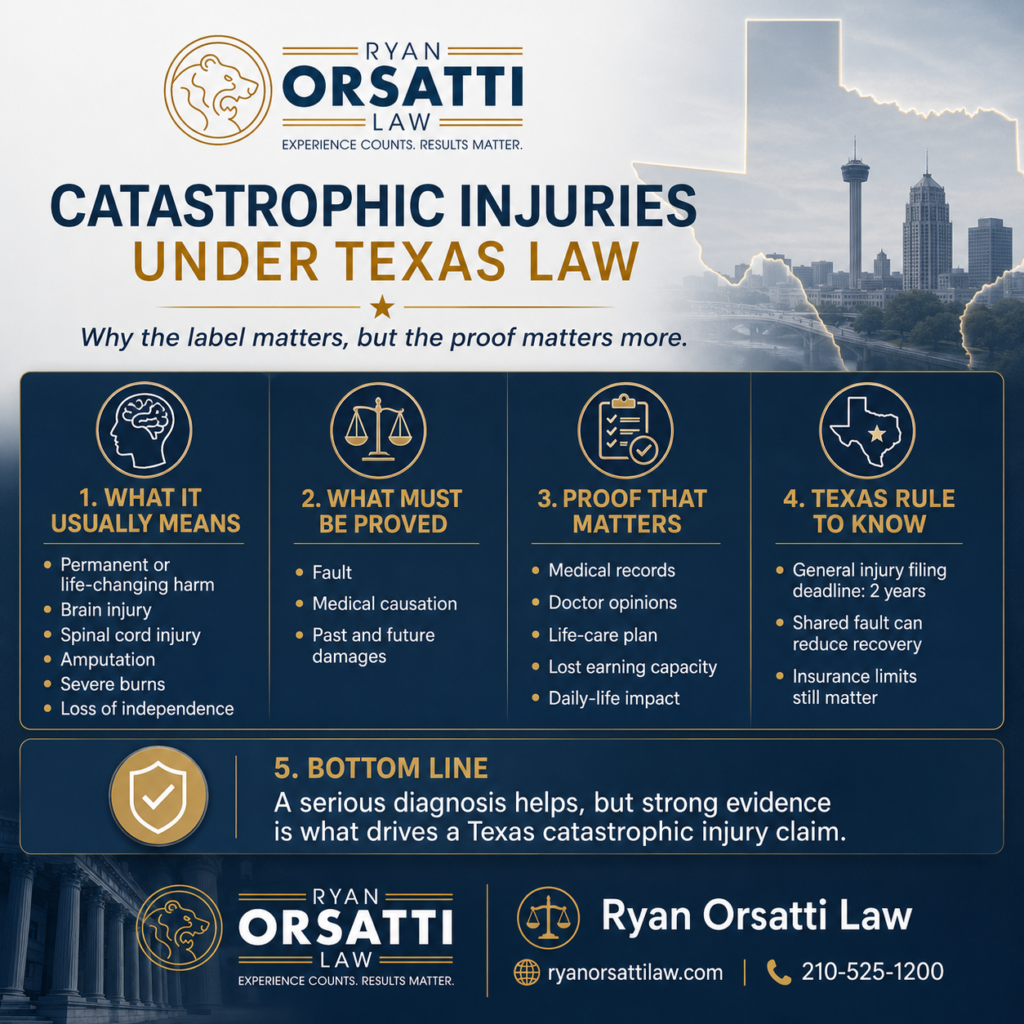
Texas law does not give most negligence plaintiffs a separate damages category merely because an injury is called catastrophic. The term generally describes an injury that permanently changes a person’s ability to work, move, communicate, live independently, or care for themselves, but recovery still depends on proving fault, medical causation, and each past and future loss. Ryan Orsatti Law helps injured Texans investigate those issues and document lifetime needs.
Key Takeaways
- “Catastrophic injury” is usually a practical description, not a separate damages category under Texas negligence law.
- The diagnosis matters, but prognosis, functional limitations, future care, and work capacity usually provide the more important proof.
- Future medical expenses must be supported by evidence showing that the care will probably be needed and what it will reasonably cost.
- Texas proportionate responsibility rules, filing deadlines, insurance limits, and claim-specific damage limits still apply.
- A life-care plan is useful only when its recommendations are supported by qualified medical opinions and reliable cost information.
- Evidence should document how the injury changed the person’s life, not merely repeat the name of the diagnosis.
Is “Catastrophic Injury” a Separate Legal Category Under Texas Law?
For most Texas negligence claims, “catastrophic injury” is not a separate category that automatically creates additional damages. Texas Civil Practice and Remedies Code Chapter 41 defines economic damages, noneconomic damages, compensatory damages, and future damages, but it does not establish a general catastrophic-injury multiplier or automatic recovery.
The phrase still has practical importance. It communicates that an injury may involve permanent impairment, substantial future care, lost earning capacity, attendant care, home modifications, or profound changes in daily life.
The legal analysis, however, remains claim-specific. A negligence plaintiff generally must prove that the defendant owed a duty, breached that duty, and proximately caused compensable damages. Proximate cause includes cause in fact and foreseeability. The defendant’s conduct must be a substantial factor in producing the injury, not merely part of the surrounding circumstances.
According to TxDOT’s 2024 Motor Vehicle Traffic Crash Facts, Texas recorded 14,905 serious-injury crashes and 18,218 people seriously injured in motor-vehicle crashes during 2024. TxDOT’s reporting category is not the same as a legal catastrophic-injury classification, but the numbers show how frequently severe harm occurs on Texas roads.
Why Does the Catastrophic Injury Label Still Matter?
The label matters because it changes the scope of the investigation and the evidence needed to evaluate the claim. A permanent injury may require proof extending decades into the future, including medical care, diminished earning capacity, personal assistance, equipment replacement, transportation, and changes to the home.
| Case issue | Injury with a defined recovery period | Catastrophic injury pattern |
|---|---|---|
| Medical outlook | Treatment followed by expected improvement | Permanent condition or uncertain long-term prognosis |
| Medical proof | Records from treating providers | Prognosis, physician opinions, rehabilitation evidence, and life-care planning |
| Employment loss | Missed work during treatment | Reduced lifetime earning capacity or inability to return to prior work |
| Daily activities | Temporary restrictions | Long-term assistance, mobility limitations, or loss of independence |
| Future expenses | Limited follow-up care | Recurring treatment, equipment, medications, therapy, or attendant care |
| Case investigation | Focused liability and medical review | Multiple defendants, insurance policies, technical evidence, and long-term damages |
| Timing | Evaluation after treatment concludes | Evaluation after a reliable prognosis is established, subject to filing deadlines |
Key takeaway: The catastrophic label matters because it identifies a claim that may require lifetime planning and broader proof, not because the label itself determines the amount of damages.
Calling an injury catastrophic too early can also create problems. Before the long-term effects are known, the medical records may not support permanent limitations, future surgery, lifetime care, or inability to work. A careful claim presentation separates what has already happened from what qualified professionals believe will probably happen.
Which Injuries Are Commonly Treated as Catastrophic?
An injury is commonly treated as catastrophic when it causes permanent or profound changes in physical function, cognition, communication, employment, or independent living. The condition’s real-world consequences usually matter more than the diagnostic label alone.
Examples may include:
- Severe traumatic brain injuries involving memory, judgment, behavior, communication, or executive-function deficits
- Spinal cord injuries involving paralysis, weakness, chronic neurological symptoms, or loss of bowel and bladder control
- Amputations or loss of use of a limb
- Severe burns, scarring, or disfigurement
- Blindness, substantial hearing loss, or other major sensory impairment
- Significant organ damage
- Multiple-system trauma requiring prolonged rehabilitation
- Injuries that prevent a person from returning to prior employment or living independently
A person with a serious brain injury may benefit from information about Texas traumatic brain injury claims. Someone with paralysis or continuing neurological impairment may face different medical and accessibility issues addressed in spinal cord injury claims.
Even an injury initially described as “mild” can have severe consequences. A concussion may produce persistent headaches, sensory sensitivity, cognitive fatigue, sleep disturbance, or reduced work capacity. The proper question is not whether a medical record uses the word catastrophic. It is whether reliable evidence shows lasting functional harm. More information is available in the firm’s discussion of a concussion as a traumatic brain injury.
What Must Be Proved in a Texas Catastrophic Injury Case?
A claimant must prove legal responsibility, medical causation, and the amount of each compensable loss. A severe diagnosis may establish that the person is badly injured, but it does not independently prove who caused the injury or what future losses are reasonably supported.
Can You Prove the Defendant Was Legally Responsible?
You must prove that the defendant owed a legal duty, breached that duty, and proximately caused compensable harm. Liability evidence may include crash-scene photographs, vehicle data, surveillance video, inspection records, driver logs, employment records, witness testimony, safety policies, or physical evidence.
In a commercial-vehicle case, the evidence may involve the driver, motor carrier, vehicle owner, maintenance contractor, or another entity. In a premises case, the analysis may depend on control of the property, knowledge of the condition, and the injured person’s legal status. Each potential defendant must be evaluated under the rules applicable to that claim.
Can You Connect the Incident to the Injury?
The claimant must connect the occurrence to the diagnosed condition through reliable medical evidence. Treatment timing, reported symptoms, prior medical history, imaging, examinations, mechanism of injury, and provider opinions may all affect the causation analysis.
A prior condition does not automatically defeat a claim. It may, however, require the evidence to distinguish between the person’s pre-incident baseline, an aggravation caused by the occurrence, and unrelated progression. Gaps in treatment, incomplete histories, and inconsistent symptom reporting can give an insurer or defense lawyer grounds to dispute causation.
Can You Prove the Full Loss Over Time?
The claimant must prove each past and future loss rather than relying on the seriousness of the diagnosis. That proof may include medical records, bills, payroll records, tax returns, employment evaluations, photographs, care logs, witness testimony, and qualified opinions about future needs.
Lost earning capacity means the reduced ability to earn income over time. It is different from simply adding up missed paychecks. A young person who can no longer perform a physical trade may have a substantial earning-capacity issue even if the person later obtains lower-paying employment.
Is There a Practical Source of Financial Recovery?
A catastrophic injury can produce losses exceeding the limits of a single insurance policy, so identifying every potentially responsible person, company, and coverage source is important. Depending on the facts, the investigation may involve commercial liability coverage, an employer’s policy, umbrella coverage, property coverage, uninsured or underinsured motorist coverage, or assets belonging to a responsible party.
Insurance limits do not determine the amount of the person’s actual damages. They do affect the practical options for collecting a judgment or negotiating a resolution. Policy language, exclusions, reservations of rights, and the legal relationship between the parties should be reviewed before assuming that coverage exists.
How Are Catastrophic Injury Damages Proven in Texas?
Texas catastrophic injury damages are proven category by category through evidence of actual past losses and reasonably probable future losses. Chapter 41 separates economic losses, such as medical expenses and earning losses, from noneconomic losses, such as physical pain, mental anguish, impairment, and disfigurement.
| Damage category | What it may cover | Common forms of proof |
| Past medical expenses | Care already received | Medical records, bills, payment information, and testimony regarding necessity |
| Future medical expenses | Probable future treatment and care | Physician prognosis, treatment recommendations, life-care planning, and cost evidence |
| Past lost income | Earnings already missed | Payroll records, employer verification, tax documents, and work restrictions |
| Lost earning capacity | Reduced future ability to earn | Work history, education, vocational evidence, medical restrictions, and economic analysis |
| Attendant and household services | Assistance with personal care or daily tasks | Care logs, invoices, family testimony, and functional assessments |
| Physical impairment | Loss of normal activities or independence | Medical evidence, testimony, photographs, video, and before-and-after witnesses |
| Pain and mental anguish | Physical suffering and emotional consequences | Testimony, treatment records, medication history, counseling records, and daily-life evidence |
| Disfigurement | Scarring or permanent changes in appearance | Photographs, medical records, surgical evidence, and testimony |
Key takeaway: A persuasive catastrophic injury claim connects every requested damage category to specific evidence instead of asking the diagnosis to carry the entire case.
For past medical expenses, Texas Civil Practice and Remedies Code § 41.0105 generally limits recovery to the amounts actually paid or incurred by or on behalf of the claimant.
Future medical expenses require different proof. In Gunn v. McCoy, the Supreme Court of Texas explained that a claimant must present evidence showing that future care will, in reasonable probability, be required and establishing its reasonable cost. A possible procedure or unsupported estimate is not the same as a medically probable future expense.
Noneconomic damages also require evidentiary support. In Gregory v. Chohan, the Supreme Court of Texas emphasized that an award should have a rational connection to the evidence concerning the injury and the amount awarded. Detailed testimony about function, relationships, independence, symptoms, and daily life is more useful than broad descriptions of suffering.
Attorney Insight: In a catastrophic injury case, the primary defense dispute is often not whether the person was badly hurt. It is whether each future item is connected to a physician-supported need, a realistic frequency, a defensible cost, and the expected duration. A life-care plan that goes beyond the underlying medical opinions can give the defense an opening to challenge the entire projection.
Why Does a Life-Care Plan Matter?
A life-care plan matters because it organizes probable future medical and support needs into a usable, itemized forecast. It may address physician visits, therapy, medications, diagnostic testing, equipment, transportation, home modifications, attendant care, and the frequency with which equipment must be replaced.
A life-care plan is not automatically correct merely because a credentialed planner prepared it. Under Texas Rules of Evidence 702 and 705, opinion testimony must assist the factfinder and rest on an adequate factual basis. Recommendations should be traceable to medical records, treating-provider opinions, accepted clinical practice, and reliable cost information.
The planner also should avoid making medical recommendations outside the planner’s role. A sound process usually begins with the treating physicians’ prognosis and restrictions, then converts those documented needs into frequencies and costs.
Ryan Orsatti Law provides additional information about life-care planning for catastrophic injuries and disputes involving future medical needs in Texas injury claims.
How Do Texas Deadlines, Fault Rules, and Damage Limits Affect the Claim?
Texas deadlines, proportionate responsibility rules, and claim-specific damage limits continue to apply even when an injury is permanent or life-changing. The seriousness of an injury does not suspend ordinary procedural requirements or eliminate defenses concerning fault, causation, or damages.
How Long Do You Have to File a Catastrophic Injury Lawsuit in Texas?
The general Texas limitations period for a personal-injury lawsuit is two years after the claim accrues. Texas Civil Practice and Remedies Code § 16.003 contains that general rule, but the correct deadline can depend on the claimant, defendant, and legal theory.
Do not assume every claim receives a full two years. Different statutes, notice provisions, tolling rules, and accrual disputes may change the analysis. Evidence can also disappear long before the filing deadline, particularly vehicle data, surveillance footage, electronic communications, maintenance records, and physical evidence.
What Happens if the Injured Person Shares Some Fault?
Texas proportionate responsibility law can reduce or completely bar a recovery based on the claimant’s percentage of responsibility. Under Texas Civil Practice and Remedies Code § 33.001, a claimant may not recover if the claimant’s percentage of responsibility is greater than 50 percent.
If the claimant is assigned 50 percent or less, the damages are generally reduced by the assigned percentage. Proportionate responsibility means Texas compares the fault of the claimant and other responsible parties before determining the recoverable amount.
Are Catastrophic Injury Damages Capped in Texas?
There is no universal Texas cap that applies merely because an injury is described as catastrophic. Whether a statutory limit applies depends on the type of damages, legal theory, and defendant involved.
For example, Texas statutes separately address health-care liability claims, claims against governmental units, and exemplary damages. Those limits arise from the nature of the claim or defendant, not from the severity label placed on the injury. A case-specific legal review is necessary before stating whether any cap applies.
What Should You Do After a Catastrophic Injury in San Antonio or Texas?
The immediate priorities are medical stabilization, evidence preservation, and careful documentation of the injured person’s baseline and changing needs. Legal and insurance decisions should not interfere with appropriate medical care, but delaying the investigation can allow critical evidence to be lost.
- Obtain and follow appropriate medical care. Keep discharge instructions, referrals, restrictions, medication information, and appointment records.
- Preserve physical and electronic evidence. Save photographs, videos, vehicles, defective products, clothing, phones, dash-camera files, messages, and other relevant items.
- Request time-sensitive records. Surveillance footage, commercial vehicle data, inspection records, and electronic logs may be overwritten or destroyed under routine retention practices.
- Document the pre-injury baseline. Preserve employment records, photographs, activity history, household responsibilities, and witness information showing what the person could do before the incident.
- Maintain a care and symptom log. Record appointments, medications, assistance provided by family members, missed work, mobility problems, cognitive symptoms, and significant changes.
- Track financial losses. Keep medical statements, receipts, travel expenses, payroll records, tax documents, benefit information, and invoices for replacement services.
- Avoid signing a final release before the prognosis is understood. A release commonly ends the claim permanently, including claims for later-discovered or underestimated future needs.
- Determine the correct filing and notice deadlines. The general two-year rule should not be treated as permission to wait, especially when evidence from an I-10, I-35, Loop 410, Loop 1604, workplace, or commercial-vehicle incident may be time-sensitive.
How Can Ryan Orsatti Law Help With a Catastrophic Injury Claim?
Ryan Orsatti Law helps injured people in San Antonio and across Texas evaluate liability, medical causation, insurance coverage, evidence preservation, future care, and the documentation needed to present a serious-injury claim. The firm’s role may include coordinating records, identifying potential defendants and coverage, reviewing medical opinions, preserving technical evidence, and preparing the claim for negotiation or litigation.
Catastrophic injury cases should be built around the individual person rather than a generic label. That includes understanding the person’s work, family responsibilities, treatment history, pre-injury abilities, future medical recommendations, and practical barriers to recovery.
Learn more about the firm’s approach to catastrophic injury claims in San Antonio or contact Ryan Orsatti Law to discuss the specific facts and deadlines involved.
What Questions Do People Ask About Catastrophic Injury Claims in Texas?
Is a Catastrophic Injury Defined by a Dollar Amount in Texas?
No. Texas law does not define a catastrophic injury in an ordinary negligence claim by requiring a particular settlement value, medical-bill amount, or insurance limit. The claim must instead be evaluated through the injury’s permanence, functional consequences, probable future care, earning impact, and legally recoverable damages supported by evidence.
Does a Catastrophic Injury Have to Be Permanent?
Permanence is a common feature of catastrophic injuries, but the legal analysis focuses on the actual evidence. A prolonged injury involving repeated surgeries, major rehabilitation, or years of incapacity may require catastrophic-level planning even before doctors can give a final permanent-impairment opinion. Any future claim should distinguish probable medical needs from possibilities or speculation.
Can a Concussion or “Mild” Traumatic Brain Injury Be Catastrophic?
Yes, a condition called mild can produce severe long-term consequences for a particular person. Persistent cognitive fatigue, memory problems, headaches, sensory sensitivity, emotional changes, and reduced work capacity may substantially impair daily life. The claim should be supported by consistent medical documentation, functional evidence, credible witnesses, appropriate testing, and a clear comparison to the person’s pre-injury baseline.
How Long Does a Texas Catastrophic Injury Case Take?
There is no fixed timeline. The case may require enough time to establish a reliable prognosis, identify future medical needs, analyze earning capacity, investigate liability, and resolve insurance or lien issues. At the same time, the general Texas personal-injury limitations period is two years, so medical development and legal deadlines must be managed together.
Are Future Medical Expenses Recoverable in Texas?
Future medical expenses may be recoverable when evidence shows that the care will probably be required and establishes its reasonable cost. Treating-provider recommendations, prognosis evidence, a supported life-care plan, and reliable pricing information may be used. A possible surgery or unsupported estimate is generally weaker than a physician-supported probability tied to a defensible cost.
What if I Was Partly Responsible for the Accident?
Partial responsibility does not necessarily eliminate a Texas injury claim. A claimant who is 50 percent or less responsible may generally recover reduced damages, while a claimant found more than 50 percent responsible is barred from recovery under Texas Civil Practice and Remedies Code § 33.001. The fault allocation must be supported by the evidence.
What Is Included in a Catastrophic Injury Life-Care Plan?
A life-care plan may include probable future physician care, therapy, medications, testing, medical equipment, attendant care, transportation, home modifications, and replacement schedules. Each item should be connected to the person’s documented condition and medical recommendations. The plan should quantify supported needs rather than introduce treatment that no qualified medical provider has recommended.
Ryan Orsatti Law
4634 De Zavala Rd, San Antonio, TX 78249
Phone: 210-525-1200
ryanorsattilaw.com
This blog is for informational purposes only, not legal advice. Reading it does not create an attorney-client relationship. Past results do not guarantee future results.
Hurt in an accident in San Antonio? Learn how a San Antonio car accident lawyer can help with your claim. Call 210-525-1200 or request a free consultation.
The firm works on a contingency fee. You pay nothing unless the firm recovers money for you, and that covers case expenses as well as the fee: if there is no recovery, you owe no attorney's fee and no case expenses. Ask for the fee agreement and read the fee and expense section before you sign anything.
Related San Antonio legal resources
Primary legal and public-data sources
- Texas Civil Practice and Remedies Code Chapter 71: wrongful death
- Texas Civil Practice and Remedies Code Chapter 16: limitations
Ryan Orsatti Law
4634 De Zavala Road, San Antonio, TX 78249
General reference links. Consult each source for its current text.