
Quick Answer
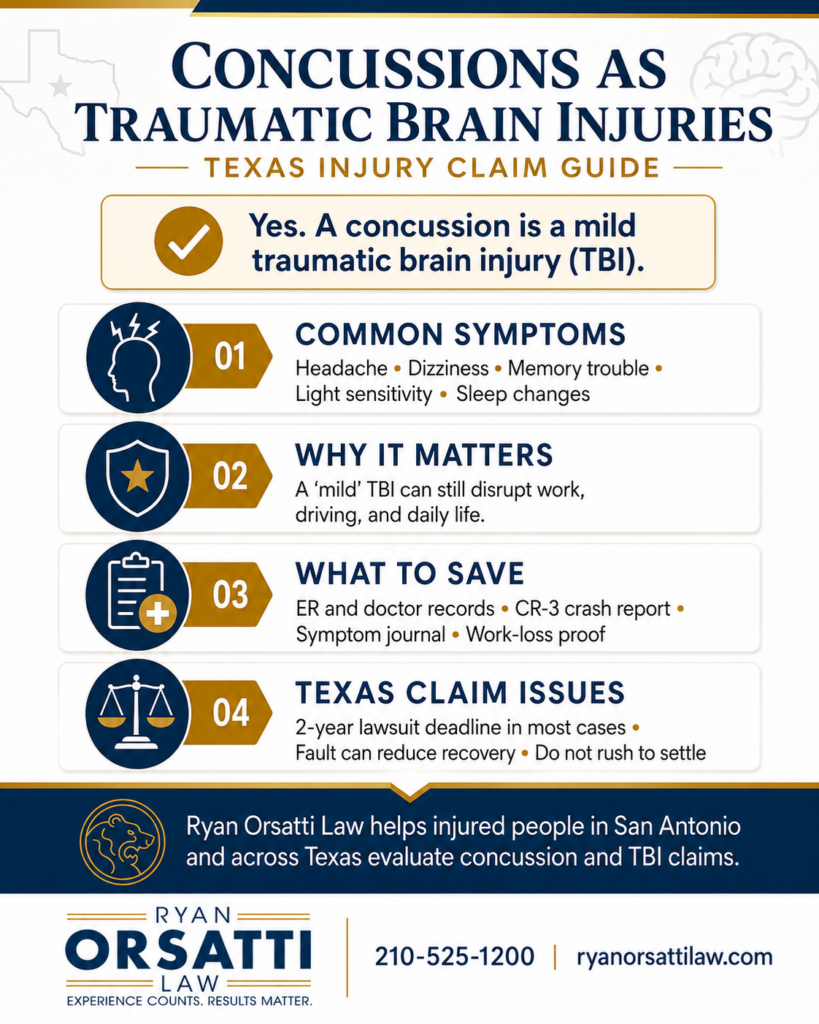
Yes. A concussion is a traumatic brain injury, or TBI, because the CDC classifies a concussion as a mild TBI caused by a bump, blow, jolt, or hit to the body that makes the head and brain move rapidly back and forth. (CDC) In a Texas injury claim, the issue is not just the label. The issue is whether medical records, symptoms, treatment history, and life-impact evidence show the concussion was caused by the accident. Texas generally gives an injured person two years to file a personal injury lawsuit, so documentation should start early. (Texas Statutes) Ryan Orsatti Law helps injured people in San Antonio and across Texas evaluate concussion evidence, insurance issues, and claim deadlines.
Key Takeaways
- A concussion is a mild traumatic brain injury, but “mild” does not mean harmless.
- A normal CT scan or MRI does not automatically defeat a concussion claim.
- Delayed treatment, inconsistent symptoms, and poor documentation are common insurance defense points.
- Texas fault rules can reduce or bar recovery if responsibility is disputed.
- Save medical records, the TxDOT crash report, symptom notes, work-impact proof, and witness information.
- Serious or lasting concussion symptoms should be evaluated before any settlement decision.
Is a Concussion a Traumatic Brain Injury in Texas?
A concussion is a traumatic brain injury in Texas injury claims because it is medically recognized as a mild TBI. The CDC states that there are three main types of TBI: mild TBI or concussion, moderate TBI, and severe TBI. (CDC)
That matters because insurance companies sometimes treat “concussion” like a minor complaint. The medical classification says otherwise. A concussion affects how the brain works, even when the person looks normal, walks normally, and has no visible wound.
The CDC also reports that more than 69,000 TBI-related deaths occurred in the United States in 2021, about 190 per day. (CDC) Most concussion claims do not involve death, but that statistic shows why brain injuries should not be dismissed casually.
Why Does the Word “Mild” Cause Problems in Concussion Claims?
The word “mild” describes the initial medical classification, not the full real-world effect of the injury. A mild TBI can still cause headaches, dizziness, light sensitivity, memory issues, mood changes, sleep problems, and work disruption. The CDC warns that mild TBIs and concussions can be serious even when they are not usually life-threatening. (CDC)
In a Texas personal injury claim, that distinction is important. The insurance adjuster may argue that “mild” means the injury resolved quickly. The injured person needs records showing what symptoms continued, how they affected daily life, and what treatment was recommended.
This is where a concussion claim often becomes different from a broken-bone claim. A fracture usually has an image. A concussion often has symptoms, clinical exams, follow-up visits, therapy notes, and testimony from people who saw the changes.
What Symptoms Help Document a Concussion After an Accident?
Concussion symptoms that help document a claim include physical, cognitive, emotional, and sleep-related changes after the accident. The CDC lists symptoms such as headaches, dizziness, balance problems, fatigue, nausea, vision problems, concentration problems, memory problems, irritability, anxiety, sadness, and sleep changes. (CDC)
For a Texas injury claim, the timing and consistency of symptoms matter. A symptom that appears in the ER record, primary-care record, neurology note, physical therapy note, and personal symptom log is harder to dismiss than a symptom mentioned for the first time months later.
Common concussion symptoms include:
- Headaches or pressure in the head
- Dizziness or balance problems
- Blurry vision or light sensitivity
- Ringing in the ears
- Nausea
- Brain fog
- Trouble concentrating
- Memory gaps
- Irritability or mood changes
- Fatigue
- Sleep disruption
When Should You Get Emergency Care for a Possible Concussion?
You should seek emergency care right away after head trauma if symptoms suggest a more dangerous brain injury. The CDC says adults should get immediate emergency care for danger signs such as a worsening headache, weakness, numbness, seizures, repeated vomiting, slurred speech, unusual behavior, unequal pupils, confusion, loss of consciousness, or inability to wake up. (CDC)
This is a medical safety issue first. It is also a claim documentation issue. If someone has serious symptoms after a crash on I-35, Loop 410, Loop 1604, US-281, or another Texas roadway, the medical record should show when symptoms began and what was done to evaluate them.
Do not rely on how you feel in the first few minutes after a crash. Adrenaline can mask symptoms. Some concussion symptoms become more obvious hours later or the next day.
Does a Normal CT Scan or MRI Hurt a Texas Concussion Claim?
A normal CT scan or MRI does not automatically defeat a Texas concussion claim. Mayo Clinic explains that imaging may be used to check for complications, but images cannot see persistent post-concussive symptoms. (Mayo Clinic)
CT scans are often used in emergency rooms to look for bleeding, swelling, skull fractures, or other urgent findings. Mayo Clinic also notes that CT scans are commonly used after head injury or suspected concussion to check for bleeding or swelling, while MRI may later find injuries CT scans miss. (Mayo Clinic)
The practical point is simple: a concussion is often a clinical diagnosis. That means the doctor looks at the mechanism of injury, reported symptoms, neurologic exam, cognitive issues, balance problems, and follow-up course.
How Do Texas Insurance Adjusters Evaluate Concussion Claims?
Texas insurance adjusters usually evaluate concussion claims by looking for proof of mechanism, diagnosis, treatment consistency, symptom duration, and functional impact. They often challenge concussion claims when there is delayed care, a normal scan, no follow-up treatment, inconsistent symptom reporting, or social media that appears to conflict with the injury.
The strongest concussion claims usually have a clear medical timeline. That timeline connects the accident to the first symptoms, the first diagnosis, follow-up care, missed work, activity limits, and any ongoing cognitive or emotional changes.
| Claim factor | Why it matters | Helpful documentation |
|---|---|---|
| Mechanism of injury | Shows how the brain could have been injured | Crash photos, vehicle damage, fall details, witness statements |
| Early symptoms | Connects the concussion to the accident | ER notes, urgent care notes, primary-care records |
| Follow-up care | Shows the symptoms did not disappear immediately | Neurology referrals, vestibular therapy, vision therapy, medication records |
| Functional impact | Shows how the injury changed daily life | Missed work records, school issues, family observations, symptom journal |
| Consistency | Reduces adjuster arguments that symptoms are unrelated | Similar complaints across multiple records |
| Prior history | Helps separate new symptoms from old problems | Prior medical records, baseline work history, prior concussion history |
Key takeaway: A concussion claim is usually won or lost in the documentation, not in the label “mild TBI.”
Attorney Insight: Insurance companies often look for gaps. A person may say, “I tried to tough it out,” but an adjuster may write, “No treatment for three weeks.” If concussion symptoms are real, the file should show them in medical records, work notes, family observations, and daily symptom tracking before the defense has a chance to rewrite the story.
What Evidence Should You Save After a Suspected Concussion in San Antonio or Bexar County?
You should save evidence that proves both the accident and the brain-injury symptoms. In a San Antonio crash case, that often includes the TxDOT CR-3 crash report, scene photos, vehicle damage photos, medical records, pharmacy records, missed work proof, and names of witnesses.
TxDOT is responsible for collecting and analyzing crash data submitted by Texas law enforcement on the Texas Peace Officer’s Crash Report, and its CRIS database is built from reportable crash data. (Texas Department of Transportation) Texas Transportation Code § 550.062 also requires an investigating officer to submit a written crash report to TxDOT within 10 days for certain injury, death, or property-damage crashes. (Texas Department of Transportation)
Use this checklist after a suspected concussion:
- Get medical care and follow the discharge instructions.
- Tell each provider about head impact, confusion, dizziness, memory problems, headaches, light sensitivity, nausea, or sleep changes.
- Request and save the TxDOT CR-3 crash report when available.
- Take photos of vehicle damage, airbags, broken glass, blood, bruising, and damaged personal items.
- Save all ER, urgent care, primary care, neurology, therapy, and imaging records.
- Keep a daily symptom log for headaches, sleep, memory, mood, balance, and screen tolerance.
- Save missed work notes, reduced-hours documentation, and employer communications.
- Ask family members to write down behavior or memory changes they notice.
- Avoid recorded statements until you understand the injury and the insurance issues.
- Do not settle until you know whether symptoms are resolving or continuing.
How Do Texas Deadlines and Fault Rules Affect a Concussion Claim?
Texas deadlines and fault rules can decide whether a concussion claim survives even when the injury is real. A concussion claim still must satisfy legal rules on negligence, causation, damages, limitations, and comparative responsibility.
Comparative responsibility means Texas can reduce a recovery by the injured person’s percentage of fault. Texas Civil Practice and Remedies Code § 33.001 bars recovery if the claimant’s percentage of responsibility is greater than 50 percent. (Texas Statutes)
How Long Do You Have to File a Concussion Injury Lawsuit in Texas?
Texas generally gives an injured person two years to file a personal injury lawsuit. Texas Civil Practice and Remedies Code § 16.003 is the key limitations statute for personal injury claims, although exceptions and special notice rules can apply in some cases. (Texas Statutes)
Do not treat two years as a reason to wait. Brain injury evidence can disappear quickly. Surveillance video may be overwritten, witnesses may become harder to locate, and medical gaps can become harder to explain.
What If the Insurance Company Says You Were Partly at Fault?
If the insurance company says you were partly at fault, the concussion claim becomes both a medical case and a liability case. Texas proportionate responsibility can reduce damages by the injured person’s fault percentage and can bar recovery if that percentage is greater than 50 percent. (Texas Statutes)
This comes up in rear-end crashes, lane-change crashes, intersection crashes, slip-and-fall cases, motorcycle crashes, and pedestrian collisions. The defense may argue the injured person stopped suddenly, failed to see a hazard, ignored symptoms, or made the injury worse by delaying care.
What Insurance Coverage Can Matter After a Concussion?
The insurance coverage that can matter after a concussion includes liability coverage, PIP, MedPay, UM/UIM, health insurance, and sometimes umbrella coverage. PIP means personal injury protection, which may help with medical bills and lost income regardless of fault, depending on the policy. UM/UIM means uninsured or underinsured motorist coverage, which may apply when the at-fault driver has no insurance or not enough insurance.
The Texas Department of Insurance says UM/UIM coverage may pay for medical bills, pain and suffering, property damage, and hit-and-run losses, and TDI notes that insurers must offer UM/UIM when you buy auto insurance unless it is rejected in writing. (Texas Department of Insurance) TDI also states that personal injury protection must be provided unless the named insured rejects it in writing. (Texas Department of Insurance)
How Can Medical Bills and Liens Affect a Texas Concussion Claim?
Medical bills and liens can affect the final result of a concussion claim because settlement money may have to address providers, health insurers, or lienholders. Subrogation means a health insurer may claim a right to be paid back from a settlement. A hospital lien is a legal claim a hospital may assert against part of a personal injury recovery.
Texas Property Code Chapter 55 allows certain hospital liens in accident cases. For a hospital lien to attach, the injured person generally must be admitted to a hospital not later than 72 hours after the accident. (Texas Statutes)
This matters in concussion cases because early ER care, ambulance bills, imaging, follow-up care, therapy, neurology visits, and medication costs can create a complicated repayment picture. A settlement number does not tell the whole story until medical balances, liens, subrogation claims, and policy benefits are reviewed.
What Damages Can Be Part of a Texas Concussion Claim?
Damages in a Texas concussion claim can include medical expenses, lost income, loss of earning capacity, physical pain, mental anguish, impairment, and loss of enjoyment of life when supported by the facts. “Damages” means the legally recognized losses caused by the injury.
For concussion claims, the most important damages evidence often involves function. Can the person work a full day? Can they tolerate screens? Can they drive safely? Are they forgetting appointments? Are headaches changing sleep, mood, parenting, or household tasks?
Examples of useful damages proof include:
- Medical bills and itemized statements
- Work restrictions
- Missed time from work
- Reduced productivity records
- Therapy notes
- Prescription records
- Symptom journals
- Family observations
- Before-and-after activity evidence
- School or job performance changes
When Should You Talk to a Texas Personal Injury Lawyer About a Concussion?
You should talk to a Texas personal injury lawyer about a concussion when symptoms are significant, treatment continues beyond the first visit, fault is disputed, the adjuster wants a recorded statement, or the insurer is pushing an early settlement. This is especially true when the injury affects work, memory, sleep, driving, mood, or daily responsibilities.
Ryan Orsatti Law helps injured people in San Antonio and across Texas evaluate concussion and TBI claims. The firm reviews medical documentation, insurance coverage, fault evidence, lien issues, and the timing of any settlement decision.
For related information, see the firm’s pages on San Antonio traumatic brain injury claims, how long a brain injury claim may take, San Antonio car accident cases, and catastrophic injury claims in San Antonio.
How Does Ryan Orsatti Law Approach Concussion and TBI Claims?
Ryan Orsatti Law approaches concussion and TBI claims by building the file around medical proof, real-life impact, insurance coverage, and early evidence preservation. In San Antonio and Bexar County cases, that may include reviewing crash location, vehicle damage, CR-3 details, medical timelines, prior records, and how symptoms changed the client’s daily life.
Concussion claims require careful pacing. A quick settlement may happen before the injured person knows whether headaches, dizziness, memory issues, or screen intolerance will resolve. The better approach is to understand the diagnosis, treatment plan, lien status, and functional impact before making major claim decisions.
FAQ
Is a concussion legally considered a TBI in Texas?
Yes. A concussion is medically classified as a mild traumatic brain injury, and Texas injury claims can treat it as a brain injury when evidence shows the accident caused it. The legal claim still depends on proof of negligence, causation, damages, and timely filing. The label matters, but the documentation matters more.
Can I have a concussion claim if I never lost consciousness?
Yes. You can have a concussion without losing consciousness. Many concussion symptoms involve headaches, dizziness, memory issues, light sensitivity, nausea, sleep problems, mood changes, or concentration problems. In a Texas injury claim, the key question is whether medical records and other evidence connect those symptoms to the crash, fall, or incident.
What if my CT scan was normal after a car accident?
A normal CT scan does not automatically mean you did not have a concussion. CT scans are often used to look for urgent problems like bleeding or swelling, while concussion symptoms may be diagnosed clinically. If symptoms continue, follow-up care and consistent medical documentation are important before making settlement decisions.
How long do I have to file a concussion lawsuit in Texas?
Texas generally gives an injured person two years to file a personal injury lawsuit, but exceptions and special rules can change the analysis. Claims involving minors, government entities, workplace injuries, or death may require additional review. Do not wait until the deadline is close, because concussion evidence can become harder to preserve.
What if my concussion symptoms started the day after the accident?
Symptoms that appear the next day can still matter. Concussion symptoms may become clearer after adrenaline wears off or after the person returns to screens, work, driving, or normal activity. Report delayed symptoms to a health care provider as soon as possible and be specific about when they began.
Should I give a recorded statement after a concussion?
Be careful with recorded statements after a concussion. Memory problems, confusion, medication, pain, or fatigue can affect how you describe the crash and your symptoms. Before giving a statement, make sure you understand which insurance company is asking, what coverage is involved, and whether your answers could be used against you later.
Can PIP or UM/UIM help after a concussion in Texas?
Yes, PIP and UM/UIM can matter after a concussion depending on the policy. PIP may help with medical bills or lost income regardless of fault. UM/UIM may apply if the at-fault driver had no insurance, not enough insurance, or left the scene. Always request and review the actual policy, not just the declarations page.
Ryan Orsatti Law
4634 De Zavala Rd, San Antonio, TX 78249
Phone: 210-525-1200
ryanorsattilaw.com
This blog is for informational purposes only, not legal advice. Reading it does not create an attorney-client relationship. Past results do not guarantee future results.
Hurt in an accident in San Antonio? Learn how a San Antonio traumatic brain injury lawyer can help with your claim. Call 210-525-1200 or request a free consultation.
The firm works on a contingency fee. You pay nothing unless the firm recovers money for you, and that covers case expenses as well as the fee: if there is no recovery, you owe no attorney's fee and no case expenses. Ask for the fee agreement and read the fee and expense section before you sign anything.
Related San Antonio legal resources
- San Antonio traumatic-brain-injury representation
- Texas personal-injury services
- Contact Ryan Orsatti Law
Primary legal and public-data sources
- Texas Civil Practice and Remedies Code Chapter 16: limitations
- Texas Civil Practice and Remedies Code Chapter 33: proportionate responsibility
Ryan Orsatti Law
4634 De Zavala Road, San Antonio, TX 78249
General reference links. Consult each source for its current text.