
Quick Answer
A full and final release after an oilfield accident is a settlement contract that usually ends your right to bring covered injury claims in exchange for payment. In Texas, this can affect claims for medical bills, lost wages, future care, pain, impairment, unknown injuries, and sometimes claims against companies you have not fully investigated yet.
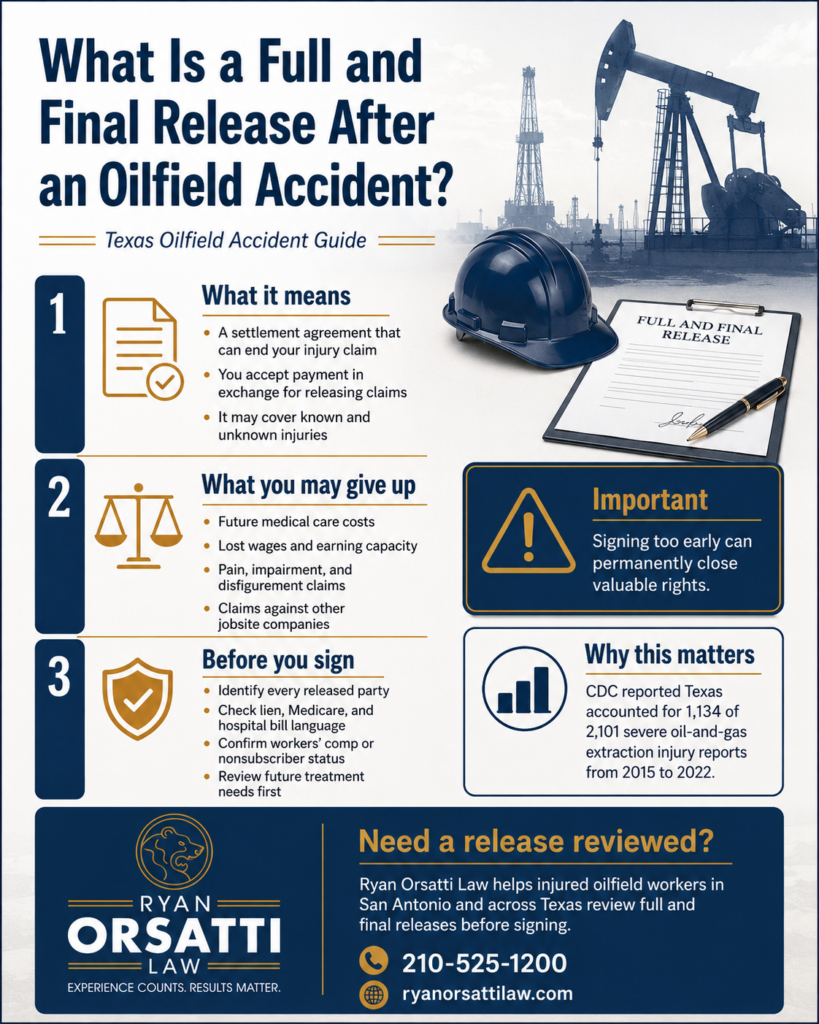
Do not sign one until you know who is being released, what claims are included, whether Texas workers’ compensation or a nonsubscriber plan is involved, and whether medical liens or Medicare reimbursement must be resolved. The CDC reported that Texas accounted for 1,134 of 2,101 severe oil-and-gas extraction injury reports in federal OSHA jurisdictions from January 2015 through July 2022, which shows why these cases often require careful medical, safety, and liability review before settlement. (CDC)
Key Takeaways
- A full and final release usually means the settlement is intended to be the last payment for the released claims.
- In a Texas oilfield injury case, the release may cover more than the company that hands you the check.
- A release can shift responsibility for medical bills, liens, reimbursement claims, or future care back onto the injured worker if the language is not reviewed.
- Texas injury claims generally have a two-year filing deadline, but workers’ compensation notice and claim deadlines can be much shorter. (Texas Statutes)
- Oilfield cases often involve multiple entities, including employers, lease operators, drilling contractors, service companies, trucking companies, equipment owners, and insurers.
- Ryan Orsatti Law helps injured workers and families in San Antonio, South Texas, and across Texas evaluate settlement-release language before important rights are signed away.
What does a full and final release mean after an oilfield accident?
A full and final release after an oilfield accident means the injured person accepts settlement money and gives up the claims described in the release. In Texas, a release is treated as a contract, and Texas courts generally construe releases under contract rules, which means the exact wording matters.
In practical terms, “full and final” usually means the insurance carrier or company wants closure. They do not want to pay now and then face another claim later for surgery, lost earning capacity, permanent impairment, pain, or future complications from the same incident.
A release may apply to claims involving:
- Medical expenses already incurred
- Future medical care
- Lost wages
- Loss of earning capacity
- Physical pain
- Mental anguish
- Physical impairment
- Disfigurement
- Wrongful death or survival claims, if the release is drafted broadly
- Claims against related companies, contractors, employees, insurers, and affiliates
That is why a full and final release is different from an ordinary form or routine claim document. Once it is signed and funded, it may become the document the defense uses to argue that the claim is over.
Why is a full and final release risky in a Texas oilfield accident case?
A full and final release is risky in a Texas oilfield accident case because the full injury picture and the full list of responsible parties may not be clear early. Oilfield jobsites often involve several companies working at the same location, and a release may name broad categories of “released parties” beyond the person or company you think you are settling with.
Texas oilfield accidents may involve:
- A subscribing employer with workers’ compensation coverage
- A nonsubscriber employer without Texas workers’ compensation coverage
- A lease operator or mineral lessee
- A drilling contractor
- A well-servicing company
- A trucking company
- A pressure-control, wireline, casing, crane, or equipment vendor
- A product manufacturer
- A premises owner
- Multiple insurance carriers
Texas private employers can choose whether to carry workers’ compensation insurance in most cases, according to the Texas Department of Insurance. That subscriber or nonsubscriber status can change the legal analysis, available claims, and settlement structure. (Texas Department of Insurance)
Ryan Orsatti Law’s Texas oilfield accident response guide explains why early investigation matters in these cases. The key issue is not just “who paid the settlement.” The issue is whether the release language accidentally gives up claims against another company that may have caused or contributed to the injury.
What claims can a full and final release give up?
A full and final release can give up any claim identified by the language of the agreement, including known and unknown injury claims. In a Texas oilfield accident, that may include negligence claims, gross-negligence allegations, third-party claims, nonsubscriber claims, equipment claims, and claims for future damages if the wording is broad enough.
Here is a practical way to read the issue:
| Release language to check | Why it matters in an oilfield accident |
|---|---|
| “All claims, known and unknown” | May include symptoms, diagnoses, surgeries, or future complications not fully understood yet. |
| “All persons, firms, corporations, affiliates, employees, agents, insurers, and assigns” | May release companies other than the one paying the settlement. |
| “Any and all injuries arising out of the incident” | May cover future medical care and permanent impairment from the same event. |
| “Indemnify and hold harmless” | May require you to protect the released party from lien, reimbursement, or later claims. |
| “Confidentiality” | May restrict what you can say about the settlement or accident. |
| “No admission of liability” | Usually means the company is paying without admitting legal fault. |
| “Medicare, Medicaid, workers’ compensation, or health-plan liens” | May put reimbursement obligations on the injured worker. |
| “Employment claims” or “resignation” | May affect job-related rights beyond the injury claim. |
Key takeaway: A release is not safe just because the settlement amount looks fair. The dangerous language is often in the definitions, released-party list, lien paragraph, and indemnity paragraph.
How is a release different from a workers’ compensation claim?
A release is different from a workers’ compensation claim because a release usually settles civil claims, while workers’ compensation is a statutory benefit system. In Texas, an injured employee with a covered workers’ compensation claim must report the injury to the employer within 30 days and file DWC Form-041 with the Division of Workers’ Compensation within one year to protect benefits. (Texas Department of Insurance)
This distinction matters because an oilfield worker may have more than one track:
- A workers’ compensation claim against a subscribing employer’s carrier
- A nonsubscriber claim against an employer without Texas workers’ compensation coverage
- A third-party injury claim against another company on the jobsite
- A product-liability claim involving defective equipment
- A trucking or commercial-vehicle claim from a lease-road or highway crash
- A lien or reimbursement issue involving workers’ compensation, Medicare, Medicaid, a health insurer, or a hospital
A release that is drafted too broadly can create problems across these tracks. For example, settling a third-party claim without addressing workers’ compensation subrogation may leave unresolved reimbursement issues. Subrogation means an insurer or benefit provider may claim a right to be paid back from a settlement.
Can a full and final release affect future medical treatment?
Yes, a full and final release can affect future medical treatment because the settlement may include payment for future care and then bar you from asking the released party for more money later. The release does not heal the injury, cancel medical bills, or guarantee that future treatment will be affordable.
This is especially important after:
- Burns
- Crush injuries
- Amputations
- Back or neck injuries
- Traumatic brain injuries
- Toxic exposure
- Hearing loss
- Eye injuries
- Psychological trauma after explosions or serious events
- Surgical recommendations that are still pending
If Medicare paid accident-related bills, CMS explains that conditional payments must be repaid when a settlement, judgment, award, or other payment is made. That means a release should not be evaluated only by the gross settlement number. The net result after liens, reimbursement claims, fees, costs, and future medical needs matters. (Centers for Medicare & Medicaid Services)
A hospital lien is another issue. Under Texas Property Code Chapter 55, hospitals and emergency medical services providers may assert certain liens tied to accident-related care, including 72-hour timing rules for lien attachment. (Texas Statutes)
What deadlines matter before signing an oilfield accident release?
The main Texas civil deadline is usually two years for personal-injury claims, but that is not the only deadline that matters. Texas Civil Practice and Remedies Code § 16.003 generally requires personal-injury lawsuits to be filed within two years, and TDI states that workers’ compensation injury notice and DWC claim deadlines can be much shorter. (Texas Statutes)
Important deadlines and timing issues may include:
| Issue | Common deadline or timing concern | Why it matters before signing |
|---|---|---|
| Texas personal-injury lawsuit | Generally two years | If the claim is released, the filing deadline may become irrelevant because the claim may already be settled. |
| Texas wrongful-death lawsuit | Generally two years from death | Families should be careful before signing documents after a fatal oilfield accident. |
| Employer notice for workers’ compensation | 30 days | Late notice may affect benefits. |
| DWC Form-041 | One year | This protects workers’ compensation rights. |
| OSHA fatality report | 8 hours for a reportable work-related death | OSHA records can become important evidence. |
| OSHA severe-injury report | 24 hours for reportable inpatient hospitalization, amputation, or eye loss | These reports may help identify what happened and who controlled the work. |
| Video, telematics, and jobsite records | Often days or weeks before overwrite risk | Preservation letters should be sent quickly. |
Key takeaway: A release should not be signed just because “the deadline is coming.” The safer question is whether the injury, parties, liens, insurance, and evidence have been evaluated before the settlement becomes final.
What should you check before signing a full and final release?
You should check the released parties, claims released, future medical language, lien language, indemnity language, and whether the settlement matches the actual medical and legal risk. In a Texas oilfield accident, you should also confirm whether the employer was a workers’ compensation subscriber, a nonsubscriber, or operating under an occupational injury benefit plan.
Use this checklist before signing:
- Identify every released party. Look for broad language covering parent companies, subsidiaries, affiliates, employees, contractors, insurers, and unknown parties.
- Confirm the settlement type. Is this a bodily-injury settlement, workers’ compensation document, employment release, property-damage settlement, or all of the above?
- Review the injury description. Make sure the release does not treat the injury as minor if diagnoses, surgery, work restrictions, or future treatment are still developing.
- Check future medical language. Confirm whether future care is included in the settlement.
- Check lien and reimbursement language. Look for Medicare, Medicaid, workers’ compensation, hospital, health-insurance, ERISA, VA, or occupational-benefit plan language.
- Look for indemnity obligations. Be careful if the release says you must defend, indemnify, or hold harmless the released parties.
- Confirm who pays outstanding bills. A settlement check does not automatically resolve medical balances.
- Confirm wage-loss documentation. Oilfield workers may have overtime, per diem, rotation pay, bonus pay, or rig-specific earnings that need careful review.
- Preserve evidence before settling. Request JSAs, permits, incident reports, photos, videos, maintenance records, training records, and witness names when available.
- Get legal review before signing. A Texas personal injury lawyer can identify whether the release is broader than the intended settlement.
What if the company says the release is just standard paperwork?
If a company says the release is just standard paperwork, you should still treat it as legally important. Standard release language is often written to protect the company, insurer, and related entities, not to explain every right the injured worker may be giving up.
This matters in San Antonio and South Texas oilfield cases because many workers rotate through Eagle Ford Shale sites, yards, lease roads, and contractor-controlled worksites. A worker may know the supervisor and direct employer but not know the lease operator, equipment owner, service company, or insurance layers involved.
Attorney Insight: In serious oilfield cases, the first settlement offer often arrives before the claim is fully built. The defense may already have incident reports, witness statements, photos, and safety documents. The injured worker may only have a discharge summary and a settlement form. That imbalance is why release review should happen before signature, not after the check clears.
What if you already signed a full and final release?
If you already signed a full and final release, gather the signed agreement, settlement check information, emails, text messages, medical bills, lien notices, and all claim communications. A lawyer can review whether the release applies to the claim at issue, whether any parties were not released, and whether contract defenses may exist.
Do not assume the release can be undone. Under Texas law, releases are contracts, and courts may enforce clear settlement language. Limited issues such as fraud, mutual mistake, lack of capacity, duress, ambiguity, minor settlement concerns, or failure to include a required party may require close legal analysis.
The practical next steps are:
- Save the signed release and all drafts.
- Save proof of when and how it was signed.
- Save all settlement communications.
- Do not ignore medical liens or reimbursement letters.
- Identify whether the release was for injury claims, employment claims, workers’ compensation issues, or only one part of the dispute.
- Ask a Texas personal injury lawyer to review the exact language.
How can Ryan Orsatti Law help with an oilfield accident release?
Ryan Orsatti Law helps injured workers and families evaluate Texas oilfield accident releases before important rights are signed away. The review usually focuses on the settlement amount, released parties, lien language, future medical exposure, workers’ compensation status, third-party liability, and whether the claim has been investigated enough to settle responsibly.
The firm’s work may include:
- Reviewing the proposed full and final release
- Identifying overly broad released-party language
- Checking whether the employer was a subscriber or nonsubscriber
- Evaluating potential third-party claims
- Reviewing medical records and future-care issues
- Checking for hospital liens, Medicare issues, and reimbursement claims
- Preserving jobsite evidence before it disappears
- Communicating with insurers and claim representatives
- Explaining whether the settlement appears premature based on the available information
Ryan Orsatti Law is based in San Antonio and represents injured people in Texas personal injury matters, including oil field accident cases in San Antonio. You can also learn more about the firm at Ryan Orsatti Law or reach out through the contact page.
FAQ
Is a full and final release the same as a settlement agreement?
A full and final release is usually part of a settlement agreement. It is the document that states what money is being paid and what claims are being released. In a Texas oilfield accident, the release language matters because it may include future medical claims, unknown injuries, related companies, insurers, employees, contractors, and lien obligations.
Should I sign a release if the oilfield company offers money right away?
You should not sign a full and final release just because money is offered quickly. Early offers may arrive before you know the diagnosis, future medical needs, lost income, responsible parties, or lien exposure. A Texas oilfield accident release should be reviewed before signature, especially if surgery, work restrictions, or multiple companies are involved.
Can I still sue another company after signing a release?
You may or may not be able to sue another company after signing a release. The answer depends on the exact release language. Some releases only protect the paying party. Others release affiliates, contractors, insurers, employees, agents, and unknown entities. In oilfield cases with multiple companies on site, this wording can decide whether another claim survives.
Does a release cover future surgery after an oilfield injury?
A full and final release can cover future surgery if the language includes future medical damages or all claims arising from the accident. This is dangerous when treatment is still developing. Before signing, an injured worker should understand the diagnosis, likely future care, work restrictions, impairment issues, and whether the settlement accounts for those medical risks.
What if workers’ compensation is paying my medical bills?
If workers’ compensation is paying your medical bills, a third-party settlement release may still create reimbursement and subrogation issues. Texas workers’ compensation, occupational benefit plans, Medicare, Medicaid, and health insurers may claim repayment rights depending on the facts. A release should be reviewed with those reimbursement issues in mind before settlement funds are distributed.
Can my employer make me sign a release after an oilfield accident?
An employer may ask you to sign documents, but you should be careful before signing any release, waiver, resignation, or benefit-plan settlement after an oilfield accident. The document may affect injury claims, employment rights, medical benefits, or future claims. Ask for a copy and get legal review before signing language you do not fully understand.
How long do I have to file an oilfield accident lawsuit in Texas?
Most Texas personal-injury lawsuits must be filed within two years under Texas Civil Practice and Remedies Code § 16.003, but workers’ compensation deadlines can be shorter. TDI states injured employees must report a work injury within 30 days and file DWC Form-041 within one year to protect workers’ compensation rights. (Texas Statutes)
What documents should I save before signing a full and final release?
Before signing a release, save medical records, work restrictions, bills, wage records, incident reports, photos, videos, text messages, witness names, supervisor communications, benefit-plan paperwork, workers’ compensation documents, lien notices, and the proposed release. In oilfield cases, also ask about JSAs, permits, training records, equipment maintenance records, and contractor safety documents.
Ryan Orsatti Law
4634 De Zavala Rd, San Antonio, TX 78249
Phone: 210-525-1200
ryanorsattilaw.com
This blog is for informational purposes only, not legal advice. Reading it does not create an attorney-client relationship. Past results do not guarantee future results.
Hurt in an accident in San Antonio? Learn how a San Antonio personal injury lawyer can help with your claim. Call 210-525-1200 or request a free consultation.
The firm works on a contingency fee. You pay nothing unless the firm recovers money for you, and that covers case expenses as well as the fee: if there is no recovery, you owe no attorney's fee and no case expenses. Ask for the fee agreement and read the fee and expense section before you sign anything.
Related San Antonio legal resources
- San Antonio construction-accident representation
- Texas personal-injury services
- Contact Ryan Orsatti Law
Primary legal and public-data sources
- Texas Civil Practice and Remedies Code Chapter 16: limitations
- Texas Civil Practice and Remedies Code Chapter 33: proportionate responsibility
Ryan Orsatti Law
4634 De Zavala Road, San Antonio, TX 78249
General reference links. Consult each source for its current text.