
Quick Answer
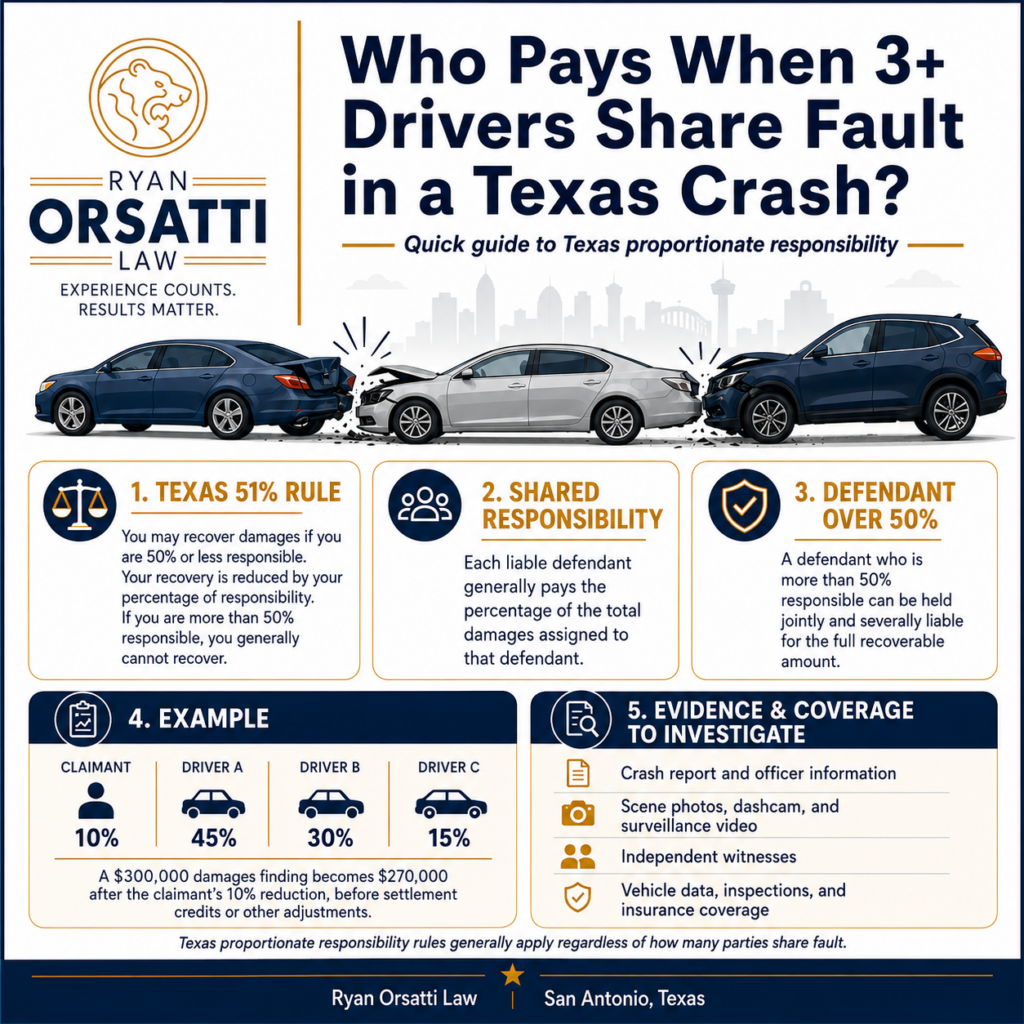
When three or more drivers share fault for a Texas crash, each liable driver generally pays the percentage of damages equal to that driver’s responsibility. Your recovery is first reduced by your own percentage of fault, and you recover nothing if you are more than 50% responsible. A defendant found more than 50% responsible may be required to pay the entire recoverable amount under Texas joint and several liability rules.
Ryan Orsatti Law helps injured people in San Antonio and across Texas investigate multi-vehicle crashes, identify every available insurance policy, and respond when several insurers blame one another or shift responsibility to the injured person.
Key Takeaways
- Texas assigns a percentage of responsibility to each person who caused or contributed to the crash.
- An injured person who is 50% responsible may still recover, but the award is reduced by 50%.
- An injured person who is 51% or more responsible generally cannot recover from the other drivers.
- A defendant who is 50% or less responsible usually pays only that defendant’s percentage of the damages.
- A defendant who is more than 50% responsible may be liable for the full recoverable amount.
- Uninsured drivers, limited policies, settlements, and responsible-third-party designations can create collection problems even when fault appears clear.
How Does Texas Divide Fault Among Three or More Drivers?
Texas uses a system called proportionate responsibility, which means responsibility for the same crash can be divided among multiple people. Under Texas Civil Practice and Remedies Code § 33.003, the factfinder assigns whole-number percentages based on how each person caused or contributed to the harm.
The allocation may include:
- The injured claimant
- Each defendant
- A person who previously settled
- A designated responsible third party
The percentages submitted for a particular claim must account for all responsibility attributed to the people included in the allocation. An insurance adjuster may propose percentages during negotiations, but the adjuster’s opinion is not legally binding. If the case goes to trial, the judge or jury resolves the disputed allocation.
Proportionate responsibility is especially important in chain-reaction crashes. One driver may create the initial danger, another may be following too closely, and a third may worsen the collision by speeding or failing to brake.
Who Actually Pays When Several Drivers Share Fault?
Each liable driver usually pays the portion of the total damages that matches that driver’s percentage of responsibility. The injured claimant’s own percentage is deducted first under Texas Civil Practice and Remedies Code § 33.012.
Consider a crash in which total damages are found to be $300,000:
| Person | Percentage of responsibility | Effect on the $300,000 damages |
|---|---|---|
| Injured claimant | 10% | Recovery reduced by $30,000 |
| Driver A | 45% | Responsible for $135,000 |
| Driver B | 30% | Responsible for $90,000 |
| Driver C | 15% | Responsible for $45,000 |
| Recoverable amount | 90% | $270,000 |
Key takeaway: Because no defendant is more than 50% responsible in this example, each defendant generally owes only that defendant’s allocated share, and one defendant ordinarily does not have to cover another defendant’s unpaid portion.
This calculation assumes all three defendants can be held legally liable and the money can actually be collected. Insurance limits, exclusions, insolvency, and missing parties can affect what is ultimately paid.
What Changes if One Driver Is More Than 50% at Fault?
A defendant found more than 50% responsible may be jointly and severally liable, meaning the injured claimant may collect the entire recoverable judgment from that defendant. This rule appears in Texas Civil Practice and Remedies Code § 33.013.
Assume the same $300,000 in total damages, but fault is allocated as follows:
- Injured claimant: 10%
- Driver A: 55%
- Driver B: 25%
- Driver C: 10%
The claimant’s recoverable damages are $270,000 after the 10% reduction. Driver A’s proportional share is $165,000, but because Driver A is more than 50% responsible, Driver A may be required to pay the full $270,000 recoverable amount.
If Driver A pays more than its allocated share, Driver A may seek contribution from the other liable defendants. Contribution means one defendant seeks reimbursement from another defendant for an overpayment. That dispute is generally between the defendants and does not require the injured claimant to absorb the unpaid shares.
Can You Recover if You Were Also Partially at Fault?
You may recover in Texas if your responsibility is 50% or less, but your damages are reduced by your percentage. Under Texas Civil Practice and Remedies Code § 33.001, recovery is barred only when the claimant’s percentage is greater than 50%.
For example:
- At 0% fault, you may recover 100% of the legally proven damages.
- At 20% fault, you may recover 80%.
- At exactly 50% fault, you may recover 50%.
- At 51% fault, you generally recover nothing from the other responsible parties.
This is why even a small shift in fault can have a substantial effect. Moving a claimant from 40% to 50% cuts the potential recovery by another 10%. Moving the claimant from 50% to 51% can eliminate the claim against the other drivers.
Insurance companies may argue that an injured driver was speeding, distracted, following too closely, or reacting unreasonably. Evidence matters more than the percentage an adjuster writes in a claim file. Learn more about responding to comparative-fault allegations in a Texas injury claim.
What if One of the At-Fault Drivers Has Little or No Insurance?
An uninsured or underinsured driver may leave part of the damages unpaid unless another defendant is jointly liable, the driver has collectible assets, or applicable first-party insurance is available. Liability and collectability are separate questions: proving that someone owes money does not guarantee that the person or insurer can pay it.
Texas minimum auto liability coverage is commonly described as 30/60/25:
- $30,000 for bodily injury to one person
- $60,000 total bodily injury coverage per accident
- $25,000 for property damage per accident
The $60,000 bodily injury limit is a per-accident cap. If several people are injured, they may be competing for the same limited pool of liability coverage. The Texas Department of Insurance auto insurance guide warns that minimum limits may be inadequate in a multi-vehicle accident.
Depending on the policies involved, additional sources may include:
- Uninsured or underinsured motorist coverage
- Personal injury protection
- Medical payments coverage
- Collision coverage for vehicle damage
- A commercial or employer policy
- An umbrella or excess-liability policy
The Texas Department of Insurance also advises notifying your insurer and obtaining the police report after a crash. Your insurer may pursue reimbursement from responsible drivers after paying benefits under your policy.
Can Someone Who Was Not Sued Still Receive a Percentage of Fault?
A person who is not a defendant may sometimes be designated as a responsible third party, allowing the jury to consider that person’s fault. A responsible-third-party designation can reduce the percentages allocated to the named defendants, but the designation alone does not create a judgment or a source of payment against that person.
Under Texas Civil Practice and Remedies Code § 33.004, a defendant may request permission to designate another person who allegedly contributed to the harm.
This can create a serious collection problem. For example, an insurer may claim that an unidentified hit-and-run driver, a nonparty motorist, or another person caused part of the collision. If that person receives a percentage of responsibility but is not a liable defendant with available insurance or assets, the injured claimant may have no direct way to collect that share.
The legal team must identify potential parties early, determine whether they should be joined in the lawsuit, and address procedural deadlines before important claims are lost.
Can You Settle With One Driver and Continue Against the Others?
You can often settle with one driver while continuing claims against other responsible parties, but the settlement may reduce the amount recoverable from the nonsettling defendants. In an ordinary Texas automobile case, § 33.012 generally requires the court to subtract settlement amounts from the remaining recoverable damages.
The release must also be reviewed carefully. A poorly drafted release could:
- Release more parties than intended
- Waive claims against an employer or additional insured
- Affect contribution rights
- Trigger a settlement credit
- Complicate an uninsured or underinsured motorist claim
Before accepting one insurer’s payment, confirm who is being released, which claims remain, how the settlement will be credited, and whether all available policies have been identified.
How Is Fault Proven in a Multi-Vehicle Crash?
Fault is proven by reconstructing the sequence of impacts and connecting each driver’s conduct to the injuries and property damage. A police report is useful, but it may not capture every collision, the timing between impacts, or what each driver was doing immediately beforehand.
Evidence may include:
- Photograph every vehicle, including all impact points and interior damage.
- Record the final resting positions of the vehicles before they are moved, when it is safe to do so.
- Obtain names, telephone numbers, and short accounts from independent witnesses.
- Preserve dashcam, rideshare, delivery, and commercial-vehicle video.
- Request nearby business or residential surveillance footage promptly.
- Obtain the CR-3 crash report, 911 recordings, body-camera footage, and available dash-camera footage.
- Preserve event data recorder information, telematics, GPS records, and electronic logs when relevant.
- Document whether you felt one impact or several and which direction each impact moved your body or vehicle.
A recorded statement given before the sequence is understood can create damaging inconsistencies. Review what to know before giving an insurance company a recorded statement.
Attorney Insight
In a multi-vehicle claim, each insurance carrier has an incentive to describe its insured’s collision as secondary, unavoidable, or too minor to cause injury. The critical question is not only who started the chain reaction. It is also whether a later driver had time to react, created an additional impact, or increased the force and harm.
Why Are Multi-Driver Fault Disputes Important in San Antonio?
Multi-driver disputes are common concerns in a county with a high volume of traffic crashes. According to TxDOT’s 2024 county report, Bexar County recorded 48,522 reportable crashes, including 773 suspected-serious-injury crashes and 205 fatal crashes.
Crashes on I-10, I-35, Loop 410, Loop 1604, and US-281 may involve several lanes, commercial vehicles, merging traffic, construction patterns, and multiple impacts. The more vehicles involved, the more likely insurers are to dispute the order of impacts, stopping distances, visibility, reaction time, and injury causation.
Ryan Orsatti Law’s guide to multi-vehicle accidents in Texas explains additional issues that arise in chain-reaction collisions.
When Should You Contact a Texas Car Accident Lawyer?
Legal help becomes particularly important when several drivers, several insurers, serious injuries, or limited policy proceeds are involved. A lawyer can investigate fault, preserve disappearing evidence, identify insurance coverage, coordinate claims, and challenge unsupported efforts to place excessive responsibility on the injured person.
Ryan Orsatti Law helps clients evaluate:
- Which driver caused each impact
- Whether a company or employer may be liable
- Which liability, UM/UIM, PIP, collision, or excess policies apply
- Whether one defendant may be jointly and severally liable
- How settlements with one party could affect remaining claims
- Whether medical expenses, lost income, and future losses are adequately documented
- Whether suit must be filed to preserve claims against every responsible party
Learn more about working with a San Antonio car accident lawyer or use the firm’s online contact form to request an evaluation.
Frequently Asked Questions
Can two or three drivers’ insurance companies pay the same injury claim?
Yes. Multiple liability insurers may contribute to one injury claim when several drivers caused the same crash. Each insurer generally evaluates its driver’s percentage of responsibility, applicable policy limits, and the claimant’s damages. The combined payments cannot exceed the legally recoverable damages, and a settlement with one insurer may reduce what is recoverable from the others.
What happens if none of the at-fault drivers is more than 50% responsible?
If no defendant is more than 50% responsible, each defendant ordinarily pays only the percentage of damages corresponding to that defendant’s fault. If one driver is uninsured or unable to pay, the other defendants generally do not automatically absorb that unpaid share. UM/UIM coverage or another available policy may become important.
Can I recover if I am exactly 50% at fault for a Texas crash?
Yes. Texas law bars recovery only when the claimant’s responsibility is greater than 50%. A claimant found exactly 50% responsible may recover 50% of the proven damages. One additional percentage point matters: a claimant found 51% responsible is generally barred from recovering against the other responsible parties.
Does the police report decide who is legally at fault?
No. A police report may contain useful observations, witness information, diagrams, contributing factors, and citations, but it does not conclusively determine civil liability. Insurance companies can reach different conclusions, and the ultimate allocation may be decided through settlement negotiations or by the judge or jury after reviewing all admissible evidence.
Can I accept one driver’s policy limits and still sue another driver?
Possibly, but the release and settlement terms must be examined before acceptance. A settlement can create a credit against remaining damages, and broad release language may unintentionally release an employer, vehicle owner, additional insured, or other party. The effect also depends on the parties, claims, available coverage, and wording of the settlement documents.
What if one of the responsible drivers fled the scene?
A hit-and-run driver may still receive a percentage of responsibility if the evidence supports it, but collecting directly from an unidentified person is usually impossible. Uninsured motorist coverage may apply, subject to the policy and proof requirements. Preserve witness information, video, debris, vehicle descriptions, and any partial license-plate information as quickly as possible.
How long do I have to file a multi-vehicle accident lawsuit in Texas?
Most Texas personal injury lawsuits must be filed within two years of the injury under Texas Civil Practice and Remedies Code § 16.003. Exceptions and shorter notice requirements may apply, especially when a governmental entity is involved. Waiting can also result in lost video, unavailable witnesses, and deleted electronic data.
Ryan Orsatti Law
4634 De Zavala Rd, San Antonio, TX 78249
Phone: 210-525-1200
ryanorsattilaw.com
This blog is for informational purposes only, not legal advice. Reading it does not create an attorney-client relationship. Past results do not guarantee future results.
Hurt in an accident in San Antonio? Learn how a San Antonio car accident lawyer can help with your claim. Call 210-525-1200 or request a free consultation.
The firm works on a contingency fee. You pay nothing unless the firm recovers money for you, and that covers case expenses as well as the fee: if there is no recovery, you owe no attorney's fee and no case expenses. Ask for the fee agreement and read the fee and expense section before you sign anything.
Related San Antonio legal resources
Primary legal and public-data sources
Ryan Orsatti Law
4634 De Zavala Road, San Antonio, TX 78249
General reference links. Consult each source for its current text.