
Quick Answer
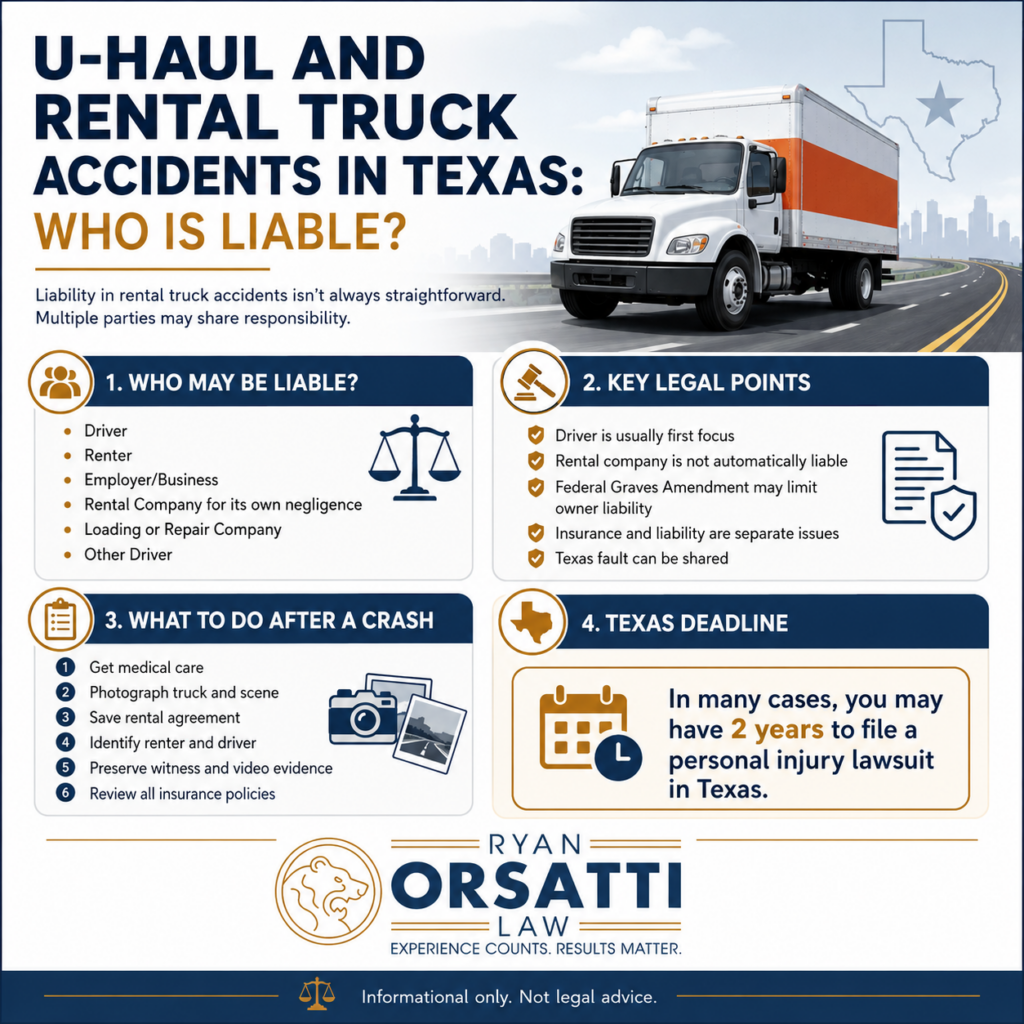
The negligent driver is usually the first person liable after a U-Haul or rental truck accident in Texas. Depending on the facts, responsibility may also reach the renter, an employer, another motorist, a loading or repair company, or the rental company for its own negligence. The federal Graves Amendment generally blocks liability based only on vehicle ownership, so fault and every available insurance layer must be investigated. Ryan Orsatti Law helps injured Texans evaluate these issues.
Key Takeaways
- The driver and renter may be different people, and either may face liability depending on the evidence.
- U-Haul is not automatically liable merely because its name is on the truck.
- Liability and insurance are separate. A negligent driver may remain legally responsible even when an insurer denies coverage.
- U-Haul currently describes Safemove Plus as adding $1,000,000 in supplemental liability coverage for moving trucks, subject to the governing terms.
- Texas generally allows two years to file a personal injury lawsuit, but rental records, video, and vehicle evidence may disappear much sooner.
Why Are Rental Truck Accident Claims Different From Ordinary Car Crashes?
Rental truck claims often involve more parties and coverage disputes than an ordinary two-car collision. The driver may not own or have rented the truck, a business may have paid for the trip, and protection purchased at the counter may cover the rental vehicle without fully covering injuries caused to others.
A rental box truck may also be unfamiliar to the driver and requires attention to its posted clearance, gross vehicle weight, load limits, and weight distribution. Those differences can become important when investigating an overhead collision, rollover, braking problem, or loss of control.
TxDOT reported 251,977 injuries in Texas motor vehicle crashes in 2024, including 18,218 serious injuries. TxDOT’s statewide summary does not isolate U-Haul crashes, but it shows the scale of the injury risk on Texas roads.
In San Antonio, the trip’s purpose matters whether a crash occurs during an apartment move, a business delivery, or travel on I-10, I-35, Loop 410, Loop 1604, or US-281.
Who Can Be Liable for a U-Haul or Rental Truck Accident in Texas?
The operator is usually the starting point, but Texas law does not limit every rental truck claim to the person behind the wheel. The investigation should determine who rented and permitted use of the truck, whether the trip served an employer, who loaded and maintained the vehicle, and whether another road user contributed.
| Potentially responsible party | When liability may apply | Important evidence |
|---|---|---|
| Truck driver | Unsafe speed, lane change, following distance, distraction, fatigue, impairment, or failure to account for the truck’s size | Report, photos, witnesses, video, phone records, and available vehicle data |
| Renter or person supplying the truck | Knowingly allowing an incompetent or reckless driver to use it. License status may be relevant but is not automatically enough | Agreement, messages, license status, driving history, and prior knowledge |
| Employer or business | The employee was acting within the course and scope of work, or the business’s own conduct contributed | Work orders, payroll, route instructions, texts, and trip purpose |
| Rental, dealer, or repair entity | Its negligent inspection, repair, maintenance, or entrustment contributed | Repair history, inspections, complaints, and counter records |
| Loader, mover, or manufacturer | An unsafe load shifted, the truck was overloaded, or a defective component contributed | Cargo photos, weight records, contracts, and component evidence |
| Another driver or entity | Another motorist or entity created or contributed to the danger | Video, roadway evidence, witnesses, and incident records |
Key takeaway: The logo does not answer the liability question. Evidence must connect each person or company’s conduct to the crash and injuries.
Texas recognizes employer vicarious liability when an employee’s negligence occurs within the course and scope of employment. A business may also face direct, fact-dependent claims based on its own conduct, such as unsafe driving instructions or improper loading.
Can U-Haul Itself Be Liable for a Texas Rental Truck Crash?
U-Haul or another rental owner is generally not liable solely because it owns the vehicle. Under the federal Graves Amendment, 49 U.S.C. § 30106, a rental owner engaged in the rental business is protected from ownership-only liability when there is no negligence or criminal wrongdoing by the owner.
The protection is not absolute. A rental company, local dealer, maintenance provider, or related entity may still face liability if its own conduct contributed, such as:
- Ignoring a known brake, tire, steering, or lighting problem
- Performing a negligent inspection or repair
- Failing to address a documented safety complaint
- Renting a truck with a known dangerous condition
- Knowingly entrusting the vehicle to an incompetent or reckless driver
The exact entity matters. The company on the contract, titled owner, pickup location, and business that repaired the truck may not be identical.
What Insurance May Pay After a U-Haul Accident?
Insurance may come from several sources, and coverage should not be assumed from the truck’s branding. The claim may involve the driver’s personal policy, protection purchased with the rental, an employer’s commercial policy, and the injured person’s PIP, health insurance, or uninsured/underinsured motorist coverage.
| Possible coverage | What must be checked |
|---|---|
| Driver’s personal auto policy | Coverage for a non-owned moving truck and vehicle-type, weight, regular-use, or business-use exclusions |
| U-Haul Safemove | U-Haul describes it as equipment, cargo, and medical/life protection, without the added liability feature of Safemove Plus |
| U-Haul Safemove Plus | U-Haul advertises $1,000,000 in supplemental liability coverage for moving trucks, subject to the certificate, exclusions, and driver terms |
| Employer or commercial policy | Whether the trip furthered a business and the driver and vehicle qualify |
| Injured person’s PIP, MedPay, or health plan | Whether benefits can address treatment or lost income while liability is disputed |
| Injured person’s UM/UIM | Whether responsible parties lack enough applicable liability coverage |
Key takeaway: The rental agreement and every potentially applicable policy must be read together. A coverage denial does not erase a negligent person’s potential liability.
The Texas Department of Insurance auto insurance guide states that Texas auto policies include personal injury protection unless rejected in writing. Insurers must also offer uninsured/underinsured motorist coverage, which may be rejected in writing. TDI cautions that rental coverage depends on the actual policy and exclusions.
U-Haul states that many personal auto policies do not cover moving trucks because of vehicle-weight restrictions. Its current materials describe Safemove Plus as adding $1,000,000 in supplemental liability coverage for moving trucks. The contract, insurance certificate, endorsements, exclusions, authorized-driver terms, and crash facts control.
See our guides to rental car insurance coverage gaps in Texas and who pays medical bills after a Texas car accident.
Do Federal Trucking Regulations Apply to a U-Haul Accident?
Federal trucking regulations do not automatically apply merely because the vehicle is a box truck. Under 49 C.F.R. § 390.3, occasional transportation of personal property by an individual, without compensation and outside a commercial enterprise, is generally excluded from the Federal Motor Carrier Safety Regulations.
The analysis can change if the rented truck furthered a business. The following facts may affect whether federal or Texas commercial vehicle rules apply:
- The truck’s gross vehicle weight rating
- Whether the trip crossed state lines
- Whether the driver was being paid
- Whether the cargo was being transported for a business
- The relationship between the driver and the business
- The duration and terms of the rental
A family moving its own furniture is not treated the same as a company using a rented box truck for deliveries.
How Does Texas Divide Fault in a Rental Truck Crash?
Texas uses proportionate responsibility, allowing fault to be divided among the claimant, truck driver, renter, business, and other responsible parties. Under Texas Civil Practice and Remedies Code § 33.001, a claimant cannot recover if assigned more than 50% of the responsibility.
If the claimant is 50% or less responsible, § 33.012 generally reduces damages by that percentage. A claimant assigned 20% responsibility would ordinarily have the factfinder’s damages reduced by 20%.
This rule becomes especially important when the rental truck insurer argues that the injured driver was speeding, following too closely, occupying the truck’s blind spot, or could have avoided the collision.
What Evidence Should Be Preserved After a Rental Truck Accident?
Evidence should be preserved immediately because the truck may be repaired, transferred, or returned to service, while video and electronic records may be overwritten. Early materials should identify the vehicle, renter and driver, trip purpose, purchased protection, mechanical condition, load, and every possible policy.
- Call 911 when appropriate and obtain medical care.
- Photograph the truck thoroughly. Include all sides, damage, plate, unit number, VIN, tires, cargo area, load, and clearance markings.
- Save the rental documents. Preserve the agreement, receipt, protection election, emails, messages, and app screenshots.
- Identify the renter and actual driver. Determine whether the driver was listed or otherwise authorized.
- Document the trip’s purpose. Record whether it was personal, work-related, or paid for by a business.
- Locate outside evidence. Obtain witness information and promptly request dashcam, business, apartment, or traffic video.
- Preserve truck records. Request inspection, repair, complaint, dispatch, telematics, and available onboard data.
- Document the losses. Keep medical records, bills, wage documents, injury photos, and notes describing activity limitations.
See our guide to evidence that can help a Texas car accident claim.
Attorney Insight: Adjusters often focus first on whether the driver was listed on the contract and whether added liability protection was purchased. Those are coverage questions, not the full liability analysis. A sound investigation also identifies who rented and loaded the truck, why the trip occurred, and whether a documented mechanical issue contributed.
What Damages and Deadlines Apply in Texas?
An injured person may seek damages supported by the evidence, including medical expenses, lost income, reduced earning capacity, physical impairment, disfigurement, pain, property damage, and loss of use. A fatal collision may support wrongful death and survival claims for qualifying parties, depending on the facts.
Texas Civil Practice and Remedies Code § 16.003 generally requires personal injury and wrongful death lawsuits to be filed within two years of accrual. Exceptions can change the calculation, and evidence deadlines arise much earlier.
A two-year limitations period does not mean a person should wait two years to investigate. A preservation request sent after the truck has been repaired, a surveillance recording has been deleted, or witnesses can no longer be located cannot recreate that evidence.
When Should You Contact a Lawyer After a Rental Truck Accident?
Early legal review is especially useful when injuries are serious, the driver was not listed, the truck was used for work, an insurer denies coverage, multiple people dispute fault, or a mechanical or loading problem may have contributed. These facts can create several defendants, policies, contracts, and evidence targets.
Ryan Orsatti Law helps injured people in San Antonio, Bexar County, and across Texas evaluate fault, identify coverage, review rental documents, preserve evidence, and address medical bill and lien issues. Our San Antonio commercial vehicle accident resource explains how business use can add parties and records beyond the driver.
Frequently Asked Questions
Is U-Haul automatically liable when one of its trucks causes an accident?
No. The Graves Amendment generally prevents a rental owner from being held liable merely because it owns the truck, provided the owner is in the rental business and committed no negligence or criminal wrongdoing. U-Haul or a related entity may still be liable for its own proven negligence, such as a maintenance failure that contributed to the crash.
Does standard U-Haul Safemove cover injuries to people in another vehicle?
U-Haul currently describes Safemove as damage waiver, cargo, and medical/life protection. It describes Safemove Plus as adding $1,000,000 in supplemental liability coverage for moving trucks. The certificate, exclusions, driver provisions, and collision facts determine whether a particular claim is covered.
What happens if an unlisted driver was operating the truck?
An unlisted driver can still be personally liable for negligent driving, but the person’s status may create a coverage dispute. The insurer or protection provider may rely on authorized-driver or contract exclusions. The renter may also face a negligent-entrustment claim if the renter knew or should have known the driver was incompetent or reckless.
Is the renter liable if someone else was driving?
Not automatically. A non-driving renter may be liable when separate evidence supports a theory such as negligent entrustment, agency, employment, improper loading, or the renter’s own negligent conduct. Signing the rental agreement alone does not establish responsibility for every later crash.
Can my own UM/UIM coverage apply after a rental truck crash?
Possibly. Texas uninsured/underinsured motorist coverage may apply when the responsible parties have no applicable liability insurance or not enough to cover the loss, subject to the policy and facts. Because rental truck claims can produce exclusions and denials, promptly notify every potentially applicable insurer.
How long do I have to sue after a U-Haul accident in Texas?
Texas generally provides a two-year limitations period for personal injury and wrongful death claims under Civil Practice and Remedies Code § 16.003. The accrual date and any exception require case-specific review. Do not treat two years as a safe waiting period because rental, maintenance, video, witness, and electronic evidence may be lost much earlier.
Ryan Orsatti Law
4634 De Zavala Rd, San Antonio, TX 78249
Phone: 210-525-1200
ryanorsattilaw.com
This blog is for informational purposes only, not legal advice. Reading it does not create an attorney-client relationship. Past results do not guarantee future results.
Hurt in an accident in San Antonio? Learn how a San Antonio car accident lawyer can help with your claim. Call 210-525-1200 or request a free consultation.
The firm works on a contingency fee. You pay nothing unless the firm recovers money for you, and that covers case expenses as well as the fee: if there is no recovery, you owe no attorney's fee and no case expenses. Ask for the fee agreement and read the fee and expense section before you sign anything.
Related San Antonio legal resources
Primary legal and public-data sources
Ryan Orsatti Law
4634 De Zavala Road, San Antonio, TX 78249
General reference links. Consult each source for its current text.