
Quick Answer
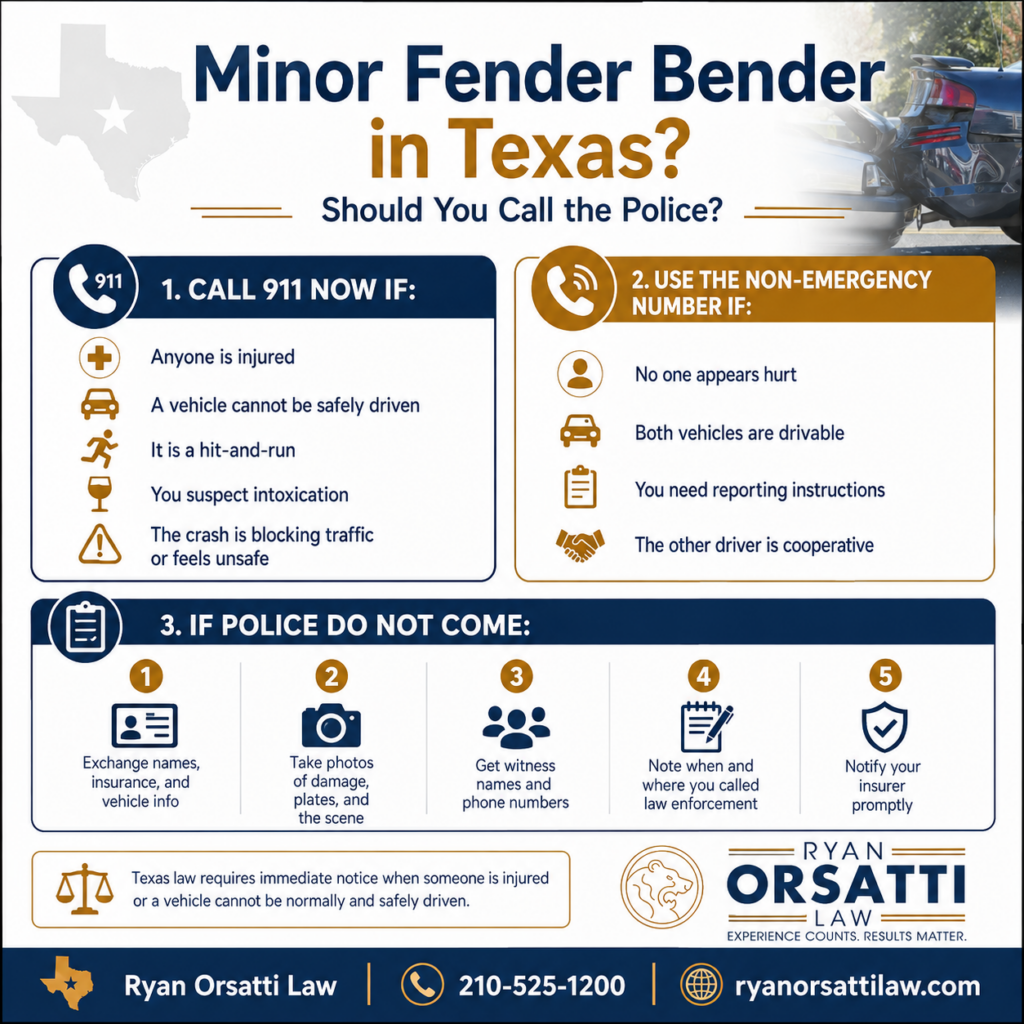
Usually, yes. You should at least contact law enforcement after a minor fender bender, although Texas law does not require a 911 call for every collision. Under Texas Transportation Code § 550.026, immediate police notice is required when someone is injured or killed, or when a vehicle cannot be normally and safely driven. For a no-injury crash involving drivable vehicles, use the local non-emergency number, exchange information, and document the scene.
Ryan Orsatti Law helps injured people in San Antonio and across Texas evaluate police reports, disputed fault, insurance coverage, and evidence after motor vehicle crashes.
Key Takeaways
- Call 911 for injuries, dangerous road conditions, a hit-and-run, suspected intoxication, threats, or a vehicle that cannot be safely driven.
- Texas law does not require an immediate police call solely because damage may exceed $1,000.
- Drivers must stop, exchange required information, and render reasonable assistance when someone may be injured.
- A police report can help document the collision, but it does not conclusively decide legal responsibility.
- If an officer does not respond, photographs, witness information, insurance details, and prompt medical documentation become especially important.
When Does Texas Law Require You to Call the Police After a Fender Bender?
Texas law requires immediate notice to law enforcement when a crash causes an injury or death, or when a damaged vehicle cannot be normally and safely driven. Notice must be given to the local police department, sheriff’s office, or the nearest Texas Department of Public Safety office, depending on where the collision occurred.
A vehicle is not normally and safely drivable when it needs to be towed or cannot operate in its usual manner without causing additional damage or creating a road hazard. A hanging bumper, leaking fluid, damaged wheel, broken steering system, or deployed airbag may indicate that the vehicle should not be driven.
Texas drivers involved in a collision must also:
- Stop at or return to the scene.
- Remain until required duties are completed.
- Provide their name, address, vehicle registration number, and liability insurer information.
- Show a driver’s license when requested and available.
- Provide reasonable assistance to an injured person, including arranging transportation for medical treatment when needed.
These duties appear in Texas Transportation Code §§ 550.022 and 550.023. On a freeway in a metropolitan area, drivers of safely operable vehicles generally must move them from the main lanes, ramps, shoulders, medians, or adjacent areas to a suitable location where information can be exchanged.
Does the $1,000 Damage Rule Mean You Must Call Police?
No. The $1,000 figure does not create a statewide requirement for a driver to immediately call the police after every property-damage collision. It governs when an officer who investigates a crash must prepare a written Texas Peace Officer’s Crash Report, commonly called a CR-3.
Under Texas Transportation Code § 550.062, an investigating officer must submit a CR-3 when the collision results in:
- Injury or death; or
- Apparent property damage of at least $1,000 to the property of any one person.
This is different from the driver’s immediate-notice duty under § 550.026, which is triggered by an injury, death, or a vehicle that cannot be normally and safely driven.
A city may also adopt a local ordinance requiring drivers to file a written collision report under circumstances permitted by Texas Transportation Code § 550.067. Because local requirements can differ, contacting the appropriate law enforcement agency is a practical step when there is uncertainty about damage, injury, or reporting obligations.
Why Should You Still Call for a Minor Fender Bender?
You should still consider calling because damage, injuries, and fault disputes are often less obvious at the scene than they appear. A police response may create a contemporaneous record identifying the drivers, vehicles, location, statements, witnesses, visible damage, and any citations, although an officer may decline to respond to a low-risk collision.
Vehicle damage can be hidden behind bumpers, sensors, cameras, and structural components. Neck pain, back pain, headaches, dizziness, and other symptoms may also develop after the initial stress of the crash wears off.
Documentation matters because collisions are common and insurers regularly investigate competing accounts. According to TxDOT’s 2024 Texas Motor Vehicle Traffic Crash Facts, one reportable crash occurred in Texas every 57 seconds during 2024.
A police report does not conclusively establish liability, meaning legal responsibility for the collision. Insurers may compare the report with vehicle damage, photographs, witness statements, traffic-camera footage, dashcam recordings, medical records, and each driver’s account.
Should You Call 911 or the Non-Emergency Number?
Call 911 when the collision presents an active emergency. For a minor crash with no reported injuries, no immediate danger, and drivable vehicles, the local non-emergency number is generally more appropriate.
Within San Antonio, the SAPD non-emergency number is 210-207-7273. For a non-emergency in unincorporated Bexar County, the Bexar County Sheriff’s Office number is 210-335-6000. Emergencies should be reported through 911.
| Situation | Who to contact | Why |
|---|---|---|
| Someone is injured, unconscious, bleeding, disoriented, or requesting medical help | 911 | Emergency medical care and immediate traffic control may be necessary |
| A vehicle is blocking traffic, leaking fuel, on fire, or cannot be safely driven | 911 | The crash presents an immediate road or safety hazard |
| The other driver leaves the scene | 911 | A hit-and-run may require an immediate search and investigation |
| The other driver appears intoxicated, threatens someone, or acts aggressively | 911 | The situation may involve criminal conduct or personal danger |
| No one reports an injury, both vehicles are drivable, and everyone is cooperative | Local non-emergency line | An officer may respond or provide reporting instructions |
| Minor parking-lot contact with no injury and cooperative drivers | Exchange information and document the scene; call non-emergency if facts are disputed | Texas duties still apply even when police do not investigate |
Key takeaway: Use 911 for injuries, danger, suspected criminal conduct, or an unsafe vehicle; use the non-emergency number for a routine, no-injury crash involving cooperative drivers and drivable vehicles.
What Should You Do If Police Do Not Come?
If police do not respond, create your own accurate record before leaving the scene. The absence of an officer does not eliminate the drivers’ duties to stop, exchange information, assist an injured person, and notify their insurers.
Follow this checklist:
- Check every occupant for injuries. Call 911 if anyone reports pain, dizziness, confusion, numbness, breathing difficulty, or another concerning symptom.
- Move to a safe location when appropriate. If the vehicles can be safely driven, move out of active traffic after capturing essential photographs when doing so is safe.
- Record your call to law enforcement. Note the agency contacted, time of the call, instructions received, and any incident or call number.
- Photograph the entire scene. Capture all vehicles, license plates, damage, debris, lane markings, traffic controls, nearby businesses, road conditions, and the wider intersection or parking area.
- Exchange the required information. Obtain the other driver’s name, address, registration information, liability insurer, policy information, telephone number, and driver’s license details. Photograph the insurance card and license with permission.
- Identify witnesses. Ask for names, telephone numbers, email addresses, and a short description of what each person observed.
- Preserve electronic evidence. Save dashcam video, photographs, text messages, vehicle alerts, and any communication with the other driver.
- Notify your insurer promptly. Provide accurate facts without guessing about speed, injuries, repair costs, or fault.
- Seek appropriate medical care. Do not ignore symptoms merely because the collision looked minor or an ambulance was not requested.
For a more detailed sequence, review the firm’s guide to the first 24 hours after a San Antonio car accident and its explanation of evidence that can help a Texas car accident claim.
Attorney Insight: The biggest problem in a minor crash is usually not the absence of a police report by itself. It is the absence of any reliable, time-stamped record. If no officer responds, insurers often compare impact photographs, witness accounts, initial medical records, claim timing, and the consistency of each driver’s statements. A complete set of scene photographs can be more useful than a vague recollection written several days later.
Do You Have to File a CR-2 Blue Form After a Texas Crash?
No. Texas drivers no longer submit the former CR-2 Driver’s Crash Report, commonly called the Blue Form, to TxDOT. TxDOT stopped retaining CR-2 reports on September 1, 2017, and no longer provides or accepts the form.
You should still keep a personal written record containing:
- The date, time, and exact location.
- Driver, vehicle, and insurance information.
- A diagram or description of the collision.
- Photographs and videos.
- Witness information.
- The law enforcement agency contacted.
- Medical symptoms and treatment.
- Insurance claim numbers and communications.
If an officer investigates a qualifying crash, the officer may prepare a CR-3 report. TxDOT is the custodian of those reports and provides instructions for purchasing regular or certified copies through its crash reports and records system.
Can You File an Insurance Claim Without a Police Report?
Yes. You can file an insurance claim without a police report, but you may need other evidence to establish what happened, who was responsible, and what damage or injuries resulted. Texas Department of Insurance guidance recommends collecting insurance information, photographing the scene and vehicles, obtaining witness information, and notifying your own insurer.
Without a report, an insurer may rely more heavily on:
- Statements from both drivers.
- Damage location and severity.
- Scene photographs.
- Witness accounts.
- Dashcam or surveillance footage.
- Repair estimates and inspections.
- Medical records.
- Telephone, vehicle, or electronic data when relevant.
Even when a report exists, an insurer can dispute the officer’s description or argue that both drivers share responsibility. Texas follows proportionate responsibility rules, which can reduce a claimant’s recovery according to the percentage of fault assigned and can bar recovery when the claimant is more than 50 percent responsible.
Police reports should therefore be reviewed for accuracy and compared with the underlying evidence. The firm’s article on how insurers may use or misinterpret police reports explains why the report should not be treated as the only evidence.
What If the Other Driver Wants to Handle the Damage Privately?
Do not rely solely on a handshake or promise to pay. You should still exchange complete information, photograph the scene, preserve communications, and notify your insurer as required by your policy.
A driver may underestimate repair costs, stop responding, provide invalid insurance information, or later give a different account of the crash. Modern vehicles may also have hidden damage involving bumper supports, sensors, cameras, suspension parts, or structural components.
Avoid signing a release, accepting cash as a full settlement, or agreeing that no insurance claim will be made before you know:
- The complete repair cost.
- Whether the vehicle has hidden damage.
- Whether anyone has developed symptoms.
- Whether a rental vehicle will be needed.
- Whether the other driver’s insurance is valid.
- Whether another person or business may be responsible.
Keep any text messages or written statements from the other driver. Do not argue, threaten, or pressure the person into admitting fault.
When Does a Minor Fender Bender Need a Lawyer?
Not every minor fender bender requires a lawyer. Legal review becomes more useful when someone is injured, fault is disputed, insurance coverage is uncertain, the police report is inaccurate, or an insurer delays, undervalues, or denies the claim.
You should consider speaking with a Texas personal injury attorney when:
- Pain or other symptoms develop after the crash.
- The other driver denies responsibility.
- The other driver is uninsured or underinsured.
- A commercial, delivery, rideshare, or government vehicle is involved.
- Multiple vehicles or injured people are involved.
- Surveillance footage or other evidence may be erased.
- The insurer requests a recorded statement or broad medical authorization.
- Medical bills, lost income, or lasting physical limitations are involved.
- The police report contains an important factual error.
Ryan Orsatti Law helps injured people in San Antonio and across Texas evaluate liability, available insurance, medical documentation, and evidence-preservation needs. Learn more about working with a San Antonio car accident lawyer or contact Ryan Orsatti Law to discuss the specific facts.
Frequently Asked Questions
Do I have to call 911 after every car accident in Texas?
No. Texas does not require a 911 call after every collision. Immediate law enforcement notice is required when someone is injured or killed, or when a vehicle cannot be normally and safely driven. For a no-injury crash involving drivable vehicles, contact the local non-emergency line, exchange required information, and document the scene.
What if police refuse to come to a minor accident?
If police do not respond, exchange driver and insurance information, take wide and close photographs, identify witnesses, save video, and notify your insurer. Write down the agency contacted, call time, and any incident number. Call 911 again if an injury becomes apparent, traffic conditions become dangerous, or another emergency develops.
Can I file an insurance claim without a police report in Texas?
Yes. A police report is not required to open an insurance claim. However, you will need evidence showing how the collision occurred and what losses resulted. Photographs, vehicle damage, witness statements, dashcam video, repair records, medical records, and consistent driver statements may become particularly important when no officer investigated.
Is $1,000 in property damage the rule for calling police in Texas?
No. The $1,000 threshold applies to an investigating officer’s duty to prepare a CR-3 report when the apparent damage to any one person’s property reaches that amount. A driver’s statewide immediate-notice duty is instead triggered by injury, death, or a vehicle that cannot be normally and safely driven.
Do I need to file a CR-2 Blue Form after a Texas crash?
No. TxDOT stopped retaining CR-2 Driver’s Crash Reports in 2017 and no longer accepts or provides the Blue Form. Keep your own detailed collision record and follow any instructions given by the local police or sheriff’s office. An investigating officer may prepare a CR-3 report when statutory reporting conditions are met.
What information must drivers exchange after a minor crash?
Texas drivers must provide their names, addresses, vehicle registration numbers, and liability insurer information. A driver must also show a driver’s license when requested and available. When someone is injured, drivers must provide reasonable assistance, which may include arranging transportation for medical treatment when it is necessary or requested.
Ryan Orsatti Law
4634 De Zavala Rd, San Antonio, TX 78249
Phone: 210-525-1200
ryanorsattilaw.com
This blog is for informational purposes only, not legal advice. Reading it does not create an attorney-client relationship. Past results do not guarantee future results.
Hurt in an accident in San Antonio? Learn how a San Antonio car accident lawyer can help with your claim. Call 210-525-1200 or request a free consultation.
The firm works on a contingency fee. You pay nothing unless the firm recovers money for you, and that covers case expenses as well as the fee: if there is no recovery, you owe no attorney's fee and no case expenses. Ask for the fee agreement and read the fee and expense section before you sign anything.
Related San Antonio legal resources
Primary legal and public-data sources
Ryan Orsatti Law
4634 De Zavala Road, San Antonio, TX 78249
General reference links. Consult each source for its current text.