
Quick Answer
Yes. After a Texas truck accident, you should refuse to discuss fault with the truck driver in any back-and-forth way, even if the driver admits it was his fault. Exchange required information, call 911 when needed, document the admission, identify witnesses, and get medical care. A truck driver’s admission can help later, but your own rushed words can also be used to argue partial fault.
Key Takeaways
- You can be polite without debating fault: “Let’s exchange information and wait for the officer.”
- Texas law requires certain information exchange and reasonable aid after a crash, not a roadside argument over liability. (Texas Legislature Online)
- If the truck driver admits fault, write down the exact words, time, location, and names of anyone who heard it.
- Avoid guesses, apologies, speed estimates, injury minimization, or statements like “I’m fine.”
- Texas proportionate responsibility rules matter because a claimant may be barred from recovery if found more than 50 percent responsible. (Texas Statutes)
- In commercial truck cases, evidence such as ELD logs, dispatch data, maintenance records, and camera footage should be preserved quickly.
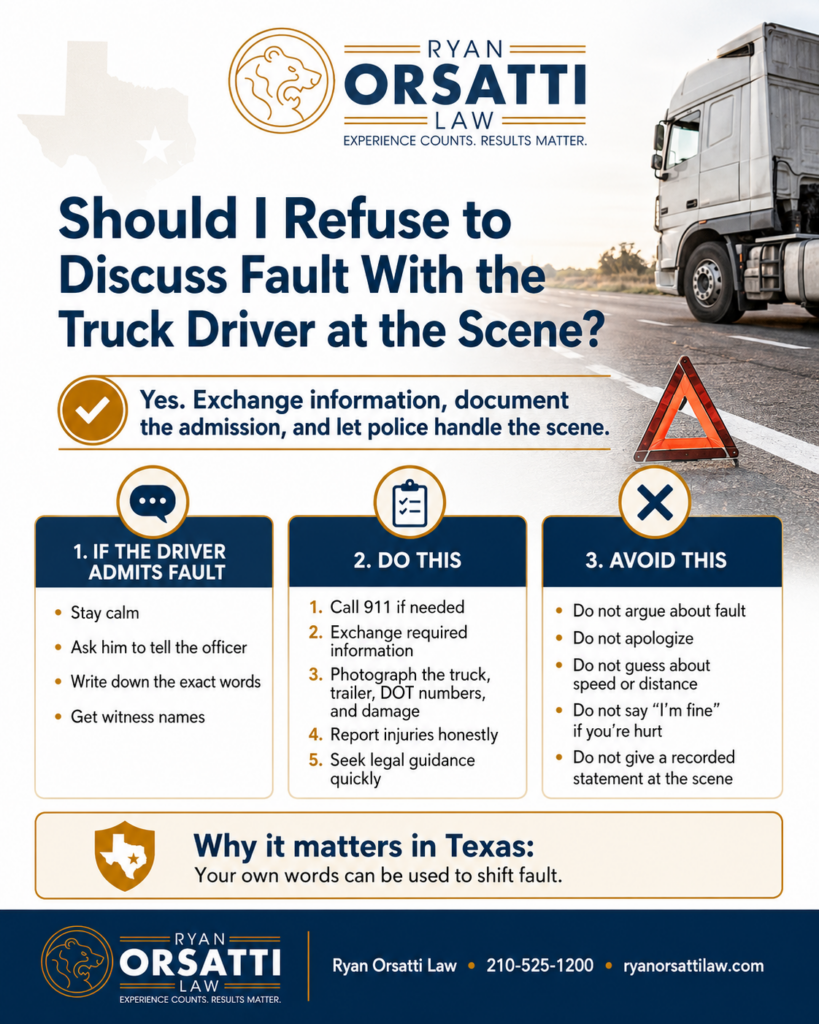
Should I refuse to discuss fault with the truck driver at the scene?
Yes, you should refuse to discuss fault with the truck driver at the scene, while still exchanging required information and cooperating with law enforcement. The safest approach is calm, short, and factual.
A good response is:
“Let’s exchange information and wait for the officer. I’m not going to discuss fault right now.”
Another safe response is:
“I heard what you said. Please tell the officer. I’m going to document the scene and get checked out.”
Texas Transportation Code § 550.023 requires drivers involved in covered crashes to provide identifying information, vehicle registration information, liability insurance information, a driver’s license if requested and available, and reasonable assistance to anyone injured. It does not require an injured driver to debate fault with the truck driver, the trucking company, or an insurance representative at the roadside. (Texas Legislature Online)
That distinction matters. You can follow the law, treat people respectfully, and protect your claim at the same time. You do not need to convince the truck driver, argue with the truck driver, or get the truck driver to repeat an admission over and over.
What should I say if the truck driver admits fault?
If the truck driver admits fault, respond calmly, document the statement, and avoid turning it into a conversation. The admission may matter later, but the way you react can also matter.
For example, if the truck driver says, “I’m sorry, I didn’t see you,” you can say:
“Please tell the officer exactly that.”
Then write down:
- The exact words used
- The driver’s name, if you know it
- The time and location
- The truck number, trailer number, and company name
- The names and phone numbers of witnesses who heard it
- Whether police, EMS, firefighters, or bystanders were present
A truck driver’s roadside statement, such as “I caused this,” can be useful only if it is tied to the right person, time, vehicle, carrier, and witnesses. In a Bexar County truck crash, the safer move is to document the statement and let law enforcement, records, and later investigation test it.
Do not pressure the driver to sign anything. Do not ask leading questions designed to trap the driver. Do not tell the driver what to say. Preserve what happened naturally.
Why can talking about fault hurt my Texas truck accident claim?
Talking about fault can hurt your Texas truck accident claim because insurers may quote your exact words to shift responsibility onto you. Even a casual comment can become part of the liability dispute.
“Proportionate responsibility” is the Texas term for assigning percentages of fault to the people or entities involved in a claim. Under Texas Civil Practice & Remedies Code § 33.001, a claimant may not recover damages if the claimant’s percentage of responsibility is greater than 50 percent. Texas law also requires the factfinder to assign responsibility in whole-number percentages when the issue is submitted. (Texas Statutes)
That is why these comments can create problems:
- “I may have been going too fast.”
- “I looked down for a second.”
- “I’m sorry.”
- “I didn’t see you either.”
- “I’m okay.”
- “I should have stopped sooner.”
- “Maybe I was in your blind spot.”
You may be shaken, injured, embarrassed, scared, or trying to be polite. The trucking company’s insurer may still treat those words as admissions.
Under Texas Civil Practice & Remedies Code § 33.001, a claimant may not recover damages if the claimant’s percentage of responsibility is greater than 50 percent. That is why a casual roadside comment after an I-35, I-10, Loop 410, Loop 1604, or US-281 truck crash can become a real insurance issue. (Texas Statutes)
Is the truck driver’s admission enough to prove liability?
No, a truck driver’s admission can help, but it is usually not enough by itself to prove liability in a serious commercial truck case. Liability means legal responsibility for the crash and resulting harm.
A truck driver may later deny the statement, say it was taken out of context, claim he was only being polite, or argue he did not know all the facts. The trucking company may also separate itself from the driver’s roadside comments, especially if the case involves training, dispatch, maintenance, cargo loading, or hours-of-service issues.
Texas Rule of Evidence 801 defines hearsay and recognizes that certain statements offered against an opposing party are not treated as hearsay when they meet the rule’s requirements. That can include a party’s own statement or, in some circumstances, a statement by an agent or employee on a matter within the scope of that relationship. The exact use of a truck driver’s statement depends on the facts and the rule.
In plain English: the admission may matter, but it still needs support.
Useful evidence may include:
- The Texas Peace Officer’s Crash Report, often called the CR-3
- Bodycam or dashcam footage
- Witness statements
- Photos of vehicle damage and final resting positions
- Electronic logging device data, often called ELD data
- Engine control module data, sometimes called “black box” data
- Dispatch records
- GPS data
- Driver qualification materials
- Maintenance and inspection records
- Bills of lading or cargo documents
- Trucking company safety policies
Negligence means the failure to use reasonable care. In a truck crash, negligence may involve the driver, the motor carrier, a maintenance contractor, a cargo loader, or another company tied to the trip.
What information should I get instead of discussing fault?
Instead of discussing fault, focus on getting the information that identifies the driver, truck, company, insurance, witnesses, and evidence. That information is more useful than a roadside argument.
| Information to get | Why it matters | Practical tip |
|---|---|---|
| Truck driver’s name and license information | Identifies the person operating the truck | Ask to photograph the driver’s license if safe and allowed |
| Motor carrier or trucking company name | Identifies the company connected to the truck | Photograph the door markings and company logo |
| USDOT or MC number | Helps identify the motor carrier | Look on the cab door or side panel |
| Tractor plate, trailer plate, unit number, and trailer number | The tractor and trailer may involve different owners | Photograph the front, sides, and rear of the truck and trailer |
| Insurance card or policy information | Helps open the correct claim | Photograph the card and verify the company name |
| Exact crash location | Helps with reports, cameras, and reconstruction | Note highway, lane, exit, cross street, mile marker, or frontage road |
| Witness names and phone numbers | Witnesses may confirm the admission and crash sequence | Ask, “Did you hear what he said?” |
| Photos and video | Preserves conditions before vehicles move | Take wide shots, close shots, skid marks, debris, signs, signals, and damage |
| Police agency and report number | Helps later obtain the CR-3 report | Ask the officer how to identify the report |
The Texas Department of Insurance advises drivers after a crash to collect insurance and driver information, take photos, file a claim with the other driver’s insurer when appropriate, notify their own insurer, and obtain the police report if police responded. (Texas Department of Insurance)
If you were hit by a commercial vehicle in San Antonio or Bexar County, Ryan Orsatti Law has a resource page on working with a San Antonio commercial vehicle accident lawyer. For disputes where the trucking insurer later changes the story, this guide on truck crash insurance denials in Texas explains common coverage and liability tactics.
After a truck driver admits fault at the scene, do these 8 things
After a truck driver admits fault, use the moment to preserve evidence and protect your health, not to negotiate blame. A short checklist can prevent avoidable mistakes.
- Move to safety if you can. Do not stand in active lanes on I-35, I-10, Loop 410, Loop 1604, US-281, or any frontage road.
- Call 911 when required or needed. Texas law requires immediate notice to the appropriate law enforcement agency when a crash involves injury, death, or vehicle damage that prevents safe driving. (Texas Legislature Online)
- Exchange required information. Get the driver’s name, address, vehicle registration information, liability insurance information, and driver’s license information if available and requested. (Texas Legislature Online)
- Write down the exact admission. Use the driver’s actual words, not your summary. “He said, ‘I was looking at my GPS and hit you,’” is better than “He admitted fault.”
- Identify everyone who heard it. Get witness names, phone numbers, and a short note about where each person was standing.
- Photograph the truck and scene. Include the cab, trailer, USDOT number, company markings, license plates, trailer number, cargo markings, roadway, lane markings, debris, and damage.
- Report injuries honestly. Do not say “I’m fine” just to calm the situation. If you are hurt, dizzy, disoriented, sore, or unsure, say so.
- Do not give a recorded statement to the trucking insurer at the scene. A recorded statement can lock you into early guesses before you know your diagnosis, medical plan, witness evidence, or the trucking company’s records. This related article explains why clear fault may still require legal help.
What should I tell the police officer?
Tell the police officer facts you personally observed, report injuries honestly, and mention the truck driver’s exact admission without adding opinions. The goal is accuracy, not argument.
A helpful statement sounds like this:
“The truck driver said, ‘I didn’t see you and came into your lane.’ The witness in the blue shirt heard it too. My neck and back hurt, and I want to be checked.”
Avoid statements like:
- “He is 100 percent liable.”
- “I know I can sue him.”
- “He admitted everything, so this is over.”
- “I’m probably okay.”
- “I might have been speeding too.”
If an officer investigates a crash, Texas Transportation Code § 550.062 requires a written report when the crash results in injury, death, or apparent property damage of $1,000 or more. The officer’s report is important, but it is not the only evidence in the case. (Texas Legislature Online)
What changes because this is a commercial truck, not a normal car crash?
Commercial truck crashes involve company records and federal trucking evidence that usually do not exist in an ordinary two-car crash. That is why a truck driver’s roadside admission should trigger evidence preservation, not just confidence that the claim will be easy.
A commercial truck crash may involve:
- The truck driver
- The motor carrier
- A trailer owner
- A broker
- A shipper
- A maintenance contractor
- A cargo-loading company
- A parts manufacturer
- Another driver
Commercial truck evidence can include driver logs, ELD data, dispatch records, trip sheets, onboard camera footage, GPS, driver qualification files, maintenance records, inspection records, and post-crash company communications.
FMCSA guidance states that a motor carrier must retain ELD records of duty status data and supporting documents for six months. After a San Antonio truck crash, waiting to preserve logs, dispatch data, truck-camera footage, maintenance records, and driver qualification materials can make the fault investigation harder. (FMCSA)
That six-month retention period does not mean every useful item will automatically be available for six months. Some camera systems overwrite much faster. Some vehicle data can be lost if the truck is repaired, sold, moved, or placed back into service. A preservation letter, sometimes called a spoliation letter, is a written request demanding that relevant evidence be protected from loss or destruction.
Attorney Insight: In truck-crash matters, the driver’s admission is often only the first thread. The more important question is what the company records show: hours on duty, dispatch pressure, maintenance history, driver training, camera footage, and whether the truck should have been on the road in the first place.
For related evidence and communication concerns after a commercial truck crash, see Ryan Orsatti Law’s article on what not to post after a commercial truck crash.
How common are commercial truck crashes in Bexar County?
Commercial truck crashes are common enough in Bexar County that an admission at the scene should be treated seriously and documented carefully. According to TxDOT’s 2024 Commercial Motor Vehicle Involved Crashes and Injuries by County report, Bexar County had 2,684 CMV-involved crashes, including 18 fatal crashes and 34 suspected-serious-injury crashes, based on reportable CR-3 data processed by TxDOT as of April 9, 2025. (TxDOT)
That statistic matters because San Antonio sits at the intersection of major truck corridors. I-35, I-10, Loop 410, Loop 1604, US-281, and nearby routes connect local delivery trucks, interstate carriers, construction vehicles, oilfield traffic, warehouse traffic, and commercial fleets.
The larger the truck and the more companies involved, the more careful you should be about roadside fault discussions. A driver’s statement may be helpful, but the claim may later turn on records that were never visible at the scene.
When should I call a San Antonio truck accident lawyer?
Call a San Antonio truck accident lawyer quickly if you are hurt, the truck driver admitted fault, the trucking company contacts you, or evidence needs to be preserved. Early legal involvement is often about protecting facts before they disappear.
A lawyer can help:
- Send preservation letters for truck, camera, ELD, GPS, maintenance, and dispatch evidence
- Identify the correct motor carrier and insurance policies
- Review the police report for missing or disputed facts
- Communicate with insurers
- Track medical records, bills, liens, and subrogation claims
- Evaluate liability under Texas proportionate responsibility rules
- Avoid broad releases or recorded statements before the claim is understood
Subrogation means a health insurer, ERISA plan, Medicare, Medicaid, or another benefit provider may claim a right to be paid back from a settlement. A hospital lien is a legal claim a hospital may assert against a personal injury recovery for certain treatment. MedPay is optional auto coverage that may help pay medical bills regardless of fault, depending on the policy. UM/UIM means uninsured or underinsured motorist coverage, which may apply when the at-fault driver has no insurance or not enough insurance.
These issues are separate from what the truck driver said at the scene. They affect the real value, timing, and net result of the claim.
For help after a San Antonio truck crash, you can contact Ryan Orsatti Law for a case review.
FAQ
Can I tell the truck driver, “You admitted it was your fault”?
You should avoid arguing with the truck driver about the admission. A better response is, “Please tell the officer exactly what you just said.” Then document the exact words, witnesses, time, location, truck number, and company information. The goal is to preserve the statement, not create a confrontation.
Can the truck driver take back an admission of fault later?
Yes. A truck driver, trucking company, or insurer may later dispute what was said, what it meant, or whether the statement was accurate. A roadside admission can still matter, especially if documented and supported by witnesses, photos, records, or Texas Rule of Evidence 801 issues. It should not be treated as the entire case.
Should I apologize after a truck accident if I did nothing wrong?
Do not apologize in a way that sounds like you accept blame. You can be humane without admitting fault. Say, “Are you hurt?” or “I’m calling 911.” Avoid “I’m sorry,” “I didn’t see you,” or “I should have stopped.” In Texas, fault percentages can affect the claim.
Do I have to give the trucking company’s insurance adjuster a recorded statement?
You generally should not give an immediate recorded statement to the trucking company’s insurer before understanding your rights, injuries, and evidence. Your own insurance policy may require cooperation, but the trucking company’s insurer is not on your side. Be truthful, but do not guess about speed, distance, injuries, or fault.
What if the police report does not mention the truck driver’s admission?
A missing admission in the police report does not automatically end the issue. Reports can be incomplete. Preserve your notes, photos, witness names, dashcam footage, and any messages from the driver or company. A lawyer can evaluate whether a supplemental report, witness statement, preservation letter, or later testimony may address the missing information.
How long do I have to file a Texas truck accident lawsuit?
Texas Civil Practice & Remedies Code § 16.003 generally gives two years to file a personal injury lawsuit, and a wrongful death claim generally must be filed within two years from the date of death. Some claims, including claims involving government entities, can involve shorter notice issues, so early review matters. (Texas Legislature Online)
What if the truck driver says, “My company will take care of it”?
Do not rely on a verbal promise that the company will “take care of it.” Get the driver’s information, motor carrier name, USDOT number, insurance information, witness contacts, and police report details. Do not sign a release or give a broad recorded statement until you understand the injury, liability, insurance, and evidence issues.
Ryan Orsatti Law
4634 De Zavala Rd, San Antonio, TX 78249
Phone: 210-525-1200
ryanorsattilaw.com
If a commercial truck or 18-wheeler was involved, our San Antonio truck accident lawyer page explains how these claims work and who may be responsible.
This blog is for informational purposes only, not legal advice. Reading it does not create an attorney-client relationship. Past results do not guarantee future results.
Hurt in an accident in San Antonio? Learn how a San Antonio personal injury lawyer can help with your claim. Call 210-525-1200 or request a free consultation.
The firm works on a contingency fee. You pay nothing unless the firm recovers money for you, and that covers case expenses as well as the fee: if there is no recovery, you owe no attorney's fee and no case expenses. Ask for the fee agreement and read the fee and expense section before you sign anything.
Related San Antonio legal resources
Primary legal and public-data sources
- Texas Civil Practice and Remedies Code Chapter 16: limitations
- Texas Civil Practice and Remedies Code Chapter 33: proportionate responsibility
Ryan Orsatti Law
4634 De Zavala Road, San Antonio, TX 78249
General reference links. Consult each source for its current text.