
Quick Answer
If you see a brake-fluid trail, air-line spray pattern, or coolant stain at a crash scene, photograph it before vehicles move, traffic resumes, rain falls, or cleanup begins. Take wide shots, medium shots, close-ups, and a short video that shows where the stain starts, where it ends, and how it lines up with the vehicles, debris, gouge marks, skid marks, and point of impact.
Key Takeaways
- Do not touch, wipe, smell closely, taste, or collect unknown fluid unless trained responders say it is safe.
- Photograph from far away first so the location makes sense later.
- Use a ruler, coin, key, shoe, or lane stripe for scale, but do not place yourself in traffic.
- Capture the start point, direction, width, color, texture, and whether the pattern looks like drops, mist, spray, pooling, or a continuous trail.
- In a truck or commercial-vehicle crash, fluid and air-line evidence may connect the scene to brake defects, hose damage, maintenance failures, inspection records, or driver reports.
- Evidence can disappear within minutes from traffic, rain, absorbent cleanup, tow-truck movement, fire response, or ordinary road drying.
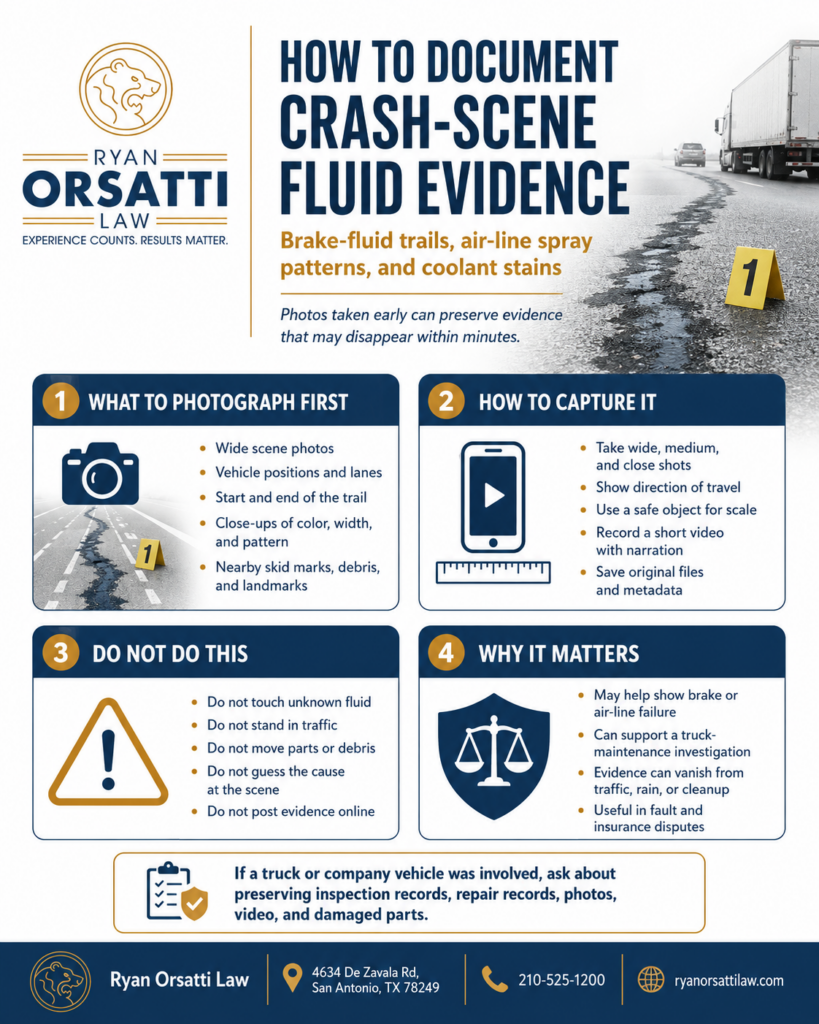
Why does documenting a brake-fluid trail, air-line spray pattern, or coolant stain matter?
Documenting a brake-fluid trail, air-line spray pattern, or coolant stain matters because those marks can help show whether a vehicle had a mechanical problem before, during, or after impact. In a serious crash, that can affect fault, maintenance issues, and which insurance policies may apply.
Brake fluid, air-line discharge, and coolant stains are not just “mess” on the road. They can help answer real claim questions:
- Did the truck or car lose braking ability before impact?
- Did an air line rupture during the crash or before the crash?
- Did a leaking cooling system show where the vehicle traveled after impact?
- Did the stain begin before the collision point or only after the impact?
- Did the vehicle leave a trail that contradicts what the driver told police or the insurance adjuster?
According to TxDOT’s 2024 Commercial Motor Vehicle crash table, Bexar County had 2,684 CMV involved crashes, including 18 fatal crashes and 34 suspected-serious-injury crashes. That volume matters because truck and commercial-vehicle crash scenes in San Antonio can be cleaned up quickly, especially on I-10, I-35, Loop 410, Loop 1604, US-281, and busy service roads. (Texas Department of Transportation)
For broader truck-crash claim issues, Ryan Orsatti Law has a verified resource on San Antonio truck accident cases and another on commercial vehicle accident claims in San Antonio.
What should I photograph first if I see fluid, spray, or staining?
Photograph the whole crash scene first, then move closer only if it is safe. The mistake is starting with a tight close-up that shows a stain but not where the stain was located.
Use this sequence:
- Wide scene photo: Capture all vehicles, lanes, shoulders, debris, traffic lights, signs, ramps, medians, and landmarks.
- Approach photo: Step closer and show the stain in relation to the vehicles.
- Direction photo: Capture the trail from the suspected start point to the end point.
- Close-up photo: Photograph the color, texture, drops, bubbles, streaks, mist, or pooling.
- Scale photo: Place a safe object near the stain for size, without stepping into traffic or contaminating evidence.
- Vehicle underside photo: If safe, photograph visible leaks near the wheels, engine area, radiator, brake lines, trailer connections, glad hands, or damaged hoses.
- Video: Slowly narrate where you are, what direction traffic was moving, and what you are seeing.
A useful photo answers three questions: where was it, how big was it, and what did it connect to? A close-up of a stain may look dramatic, but it has less value if no one can tell whether it came from the striking vehicle, the injured person’s vehicle, or a different car that passed through later.
How do I photograph the trail or spray pattern so it can be understood later?
Photograph the pattern in a line, from beginning to end, and include fixed reference points in every few photos. Fixed reference points include lane stripes, curbs, signs, bridge columns, guardrails, drainage grates, traffic signals, mile markers, driveways, and roadway seams.
A brake-fluid trail may appear as drops, a wet line, or a series of spots near a wheel path. A coolant stain may look like pooling, splatter, colored fluid, or a wet area spreading from the radiator or hose area. An air-line spray pattern in a truck crash may look like misted residue, wet streaking, dust disturbance, or a directional fan near a damaged hose or connection.
Do not assume the fluid type from color alone. Crash fluids can mix with dirt, water, oil, fuel, fire suppressant, or other vehicle fluids. Your job at the scene is to document what you observed, not to diagnose the vehicle.
Photo angles that help later reconstruction
| What to capture | Why it matters | Practical tip |
|---|---|---|
| Start of trail | Helps show whether the leak began before impact or after impact | Take a wide shot first, then a close-up |
| End of trail | Helps show final vehicle movement or where cleanup began | Include the nearest vehicle or landmark |
| Width and direction | May show speed, movement, rupture location, or spray direction | Photograph parallel and perpendicular to the trail |
| Drops versus continuous fluid | May help distinguish slow leak, sudden rupture, or post-impact pooling | Use scale, but do not step into the fluid |
| Pattern near tires or brake components | May connect the mark to a wheel, axle, brake line, or air line | Photograph each wheel area if safe |
| Road grade and drainage | Fluid can run downhill after the crash | Capture slope, gutters, and water flow |
| Cleanup or absorbent material | Shows evidence was altered after the crash | Photograph sand, absorbent, cones, responders, and tow activity from a safe distance |
What should I write down before the stain dries or gets washed away?
Write down the time, weather, lighting, traffic conditions, smell from a safe distance, color, pattern, and location of the stain. Notes made close in time to the crash can help you explain the photos later.
Use plain words. Do not overstate. For example:
- “Clear to light amber drops started behind the truck’s rear axle and continued about two car lengths.”
- “Greenish fluid pooled under the front passenger side after the vehicles stopped.”
- “Wet spray pattern appeared on the roadway near the trailer air-line area.”
- “Fire crew placed absorbent over the fluid before the tow truck moved the vehicle.”
- “Rain started about 10 minutes after the crash.”
- “The stain crossed the lane stripe toward the shoulder.”
The Texas Peace Officer’s Crash Report, Form CR-3, is the statewide crash-report document used by law enforcement, and TxDOT’s instructions describe the CR-3 as a vital document for crash data collection. Your photos and notes can preserve scene details that may not be fully described in the report. (Texas Department of Transportation)
What should I avoid doing at the crash scene?
Avoid touching unknown fluid, standing in traffic, moving parts, crawling under vehicles, or arguing with the other driver about what the stain means. Your safety matters more than any photograph.
Do not do these things:
- Do not taste, smell closely, or handle unknown fluid.
- Do not stand between vehicles or in an active lane.
- Do not move broken hoses, caps, lines, debris, or vehicle parts.
- Do not wipe stains to “see better.”
- Do not step through fluid or drag it with your shoes.
- Do not tell the other driver, police, or an adjuster that you “know” the brake line failed unless a qualified person has confirmed it.
- Do not post the photos online.
- Do not delete blurry photos. Sometimes a blurry photo still preserves sequence, timing, or location.
If you are injured, dizzy, bleeding, confused, or in pain, stop documenting and get medical help. Photos are useful, but medical care comes first.
How can fluid evidence point to brake failure, air-line problems, or poor maintenance?
Fluid evidence can point to a maintenance or mechanical issue when it lines up with vehicle movement, damage location, component failure, inspection records, or driver complaints. Standing alone, a stain is usually not enough. Connected to the right records, it can become important.
Federal motor-carrier rules require commercial motor vehicles to have brakes adequate to stop and hold the vehicle under 49 C.F.R. § 393.40. (eCFR) Brake tubing and hoses must also be installed to avoid damage, kinking, high heat, leaks, constrictions, and other conditions that harm brake performance under 49 C.F.R. § 393.45. (eCFR)
That is why a brake-fluid trail or air-line spray pattern in an 18-wheeler crash can raise maintenance questions, not just driver-error questions. A lawyer may need to request:
- Driver vehicle inspection reports
- Maintenance and repair records
- Brake work invoices
- Annual inspection records
- Roadside inspection reports
- Tow-yard photographs
- Electronic control module data
- Dash-camera or fleet-camera footage
- Dispatch, route, and load records
- Post-crash inspection reports
- Any removed or replaced brake lines, hoses, fittings, reservoirs, or coolant components
Motor carriers must systematically inspect, repair, and maintain vehicles under 49 C.F.R. § 396.3, and certain maintenance records must be retained for one year and for six months after the vehicle leaves the carrier’s control. (eCFR) Drivers also have pre-driving inspection duties under 49 C.F.R. § 396.13. (eCFR)
How fast can this evidence disappear in San Antonio or Bexar County?
This evidence can disappear within minutes, especially on high-traffic San Antonio roads. Heat, wind, rain, moving traffic, tow trucks, fire response, absorbent cleanup, and ordinary road slope can change the appearance of fluid evidence before an investigator ever sees it.
On Loop 410, I-35, I-10, US-281, and Loop 1604, responders may need to clear lanes quickly to reduce secondary crashes. That is understandable, but it means scene evidence can be altered fast. A coolant stain can run downhill. Brake fluid can blend with oil, water, and dirt. Air-line residue can be disturbed by tires or cleanup.
Your safest opportunity may be a few wide photos from the shoulder, sidewalk, parking lot, or inside your vehicle after you are out of danger.
How does this evidence affect fault under Texas law?
Fluid evidence can affect fault if it helps prove a driver, trucking company, maintenance provider, vehicle owner, or parts-related defendant failed to act reasonably. In plain English, negligence means someone did not use ordinary care under the circumstances.
Texas also uses proportionate responsibility, which means a claimant’s recovery can be reduced by their percentage of responsibility. Under Texas Civil Practice and Remedies Code § 33.001, a claimant may not recover damages if their percentage of responsibility is greater than 50 percent. (Texas Constitution and Statutes)
That is why documenting the scene matters. If an insurance adjuster later says, “You stopped too suddenly,” “You cut off the truck,” or “This was unavoidable,” physical evidence may help test those claims. The key question is not just whether a fluid mark existed. The key question is whether the mark fits the timeline of the crash.
Texas generally gives injured people two years to file many personal-injury and property-damage lawsuits under Texas Civil Practice and Remedies Code § 16.003, but evidence should be preserved immediately, not at the end of the limitations period. (Texas Constitution and Statutes)
Does scene evidence affect insurance, medical bills, and claim value?
Scene evidence can affect insurance and claim evaluation because it may change who is potentially responsible and what policies may be available. A mechanical-failure case may involve the driver, motor carrier, owner, maintenance company, leasing company, or another responsible party, depending on the facts.
This can matter when medical bills are high. If the at-fault driver has low bodily-injury limits, a strong liability investigation may help identify other coverage. If coverage is still limited, your own uninsured or underinsured motorist coverage, called UM/UIM, may become important. Medical payments coverage, called MedPay, may also help with early bills if it exists on the policy.
Other financial issues can also arise. Subrogation means a health insurer may seek repayment from a settlement. A hospital lien is a statutory claim a hospital may assert against certain injury recoveries. A letter of protection is an agreement where a provider treats now and waits for payment from the case. These issues are separate from scene documentation, but better evidence can affect the liability side of the claim.
For a broader explanation of what a lawyer does after a crash, see Ryan Orsatti Law’s guide on what a car accident lawyer actually does behind the scenes.
After a crash, do these 7 things if you see fluid, spray, or stains
If you see fluid, spray, or stains after a crash, follow this checklist only if you can do it safely.
- Get to safety first. Move away from traffic, fire risk, leaking fuel, and unstable vehicles.
- Call 911. Tell dispatch if you see leaking fluid, smoke, fire risk, or a commercial vehicle.
- Take wide photos. Start with the full scene, vehicle positions, lane layout, and landmarks.
- Document the pattern. Photograph the start, middle, end, direction, width, and pooling.
- Capture context. Include debris, skid marks, gouges, tire marks, traffic signals, signs, and road slope.
- Save originals. Keep the original photos and videos with date, time, location data, and file metadata.
- Ask about preservation. If a truck, company vehicle, rideshare, delivery van, or work vehicle is involved, ask a lawyer about a preservation letter quickly.
A preservation letter is a written notice asking a person or company to keep relevant evidence. In truck cases, it may ask for vehicle inspection records, brake repair records, electronic data, dash footage, driver reports, and the damaged vehicle or component parts.
When should I call a lawyer about brake-fluid, air-line, or coolant evidence?
Call a lawyer quickly if the crash involved serious injury, a commercial vehicle, suspected brake failure, disputed fault, missing video, a quick settlement offer, or an adjuster asking for a recorded statement. The issue is time-sensitive because vehicles get repaired, parts get replaced, and digital records can be overwritten.
Attorney Insight: In truck-crash files, a stain photo rarely wins the issue by itself. The value comes from matching the photo to vehicle position, repair history, driver inspection reports, tow-yard condition, and post-crash component changes. The earlier those items are preserved, the easier it is to test whether “sudden mechanical failure” is real or just an insurance defense.
If you were injured in a crash involving a truck or company vehicle, Ryan Orsatti Law has additional guidance on when the trucking company may be liable after a Texas truck accident and on San Antonio car accident claims.
FAQ
What is the best way to photograph a brake-fluid trail after a crash?
The best way to photograph a brake-fluid trail is to start with wide photos showing the whole scene, then take closer photos showing the trail’s start, direction, width, and endpoint. Include lane stripes, vehicles, debris, and fixed landmarks so the photo can be located later. Do not step into traffic or touch the fluid.
Should I collect a sample of brake fluid or coolant from the roadway?
You generally should not collect fluid from the roadway unless trained responders or qualified investigators say it is safe and proper. Unknown crash fluids can be hazardous, contaminated, or mixed with other substances. For most injured people, photos, videos, notes, and prompt preservation requests are safer and more useful than trying to collect a sample.
Can an air-line spray pattern help prove truck brake failure?
An air-line spray pattern may help prove a truck brake issue if it lines up with damaged air lines, trailer connections, inspection records, driver complaints, repair history, or post-crash mechanical findings. The pattern alone usually does not prove failure. It becomes more useful when connected to the vehicle, location, timeline, and maintenance evidence.
What if police did not mention the fluid stain in the crash report?
If police did not mention the stain in the crash report, your photos and videos may still matter. The Texas Peace Officer’s Crash Report is important, but it may not include every scene detail. Save the original files, write down what you saw, and tell your attorney where the stain was located in relation to the vehicles.
What if the truck company repairs the brake line before anyone inspects it?
If the truck company repairs the brake line before inspection, the case may become more difficult, but not necessarily impossible. Repair invoices, parts records, driver inspection reports, tow-yard photos, electronic data, and witness photos may still show what happened. A lawyer can evaluate whether preservation duties, discovery requests, or sanctions issues may apply.
Does coolant on the road prove the other driver caused the crash?
Coolant on the road does not, by itself, prove the other driver caused the crash. Coolant may leak because of impact damage, pre-existing mechanical failure, or post-crash movement. Its value depends on where it began, how it spread, which vehicle it came from, and whether it fits the crash sequence.
Should I send my fluid-stain photos to the insurance adjuster?
Do not rush to send fluid-stain photos to the insurance adjuster without understanding the claim strategy. Photos can help your case, but they can also be misread if sent without context. In a serious injury case, a lawyer can help organize the photos, preserve metadata, and explain what the images do and do not show.
How soon should a lawyer send a preservation letter after a truck crash?
A preservation letter should usually be sent as soon as possible after a serious truck or commercial-vehicle crash. Important evidence can include the vehicle, brake components, inspection reports, maintenance records, driver vehicle inspection reports, dash video, electronic data, and repair records. Waiting can make it easier for evidence to be lost, repaired, overwritten, or disputed.
Ryan Orsatti Law
4634 De Zavala Rd, San Antonio, TX 78249
Phone: 210-525-1200
ryanorsattilaw.com
This blog is for informational purposes only, not legal advice. Reading it does not create an attorney-client relationship. Past results do not guarantee future results.
Hurt in an accident in San Antonio? Learn how a San Antonio personal injury lawyer can help with your claim. Call 210-525-1200 or request a free consultation.
The firm works on a contingency fee. You pay nothing unless the firm recovers money for you, and that covers case expenses as well as the fee: if there is no recovery, you owe no attorney's fee and no case expenses. Ask for the fee agreement and read the fee and expense section before you sign anything.
Related San Antonio legal resources
Primary legal and public-data sources
- Texas Civil Practice and Remedies Code Chapter 16: limitations
- Texas Civil Practice and Remedies Code Chapter 33: proportionate responsibility
Ryan Orsatti Law
4634 De Zavala Road, San Antonio, TX 78249
General reference links. Consult each source for its current text.