
Quick Answer
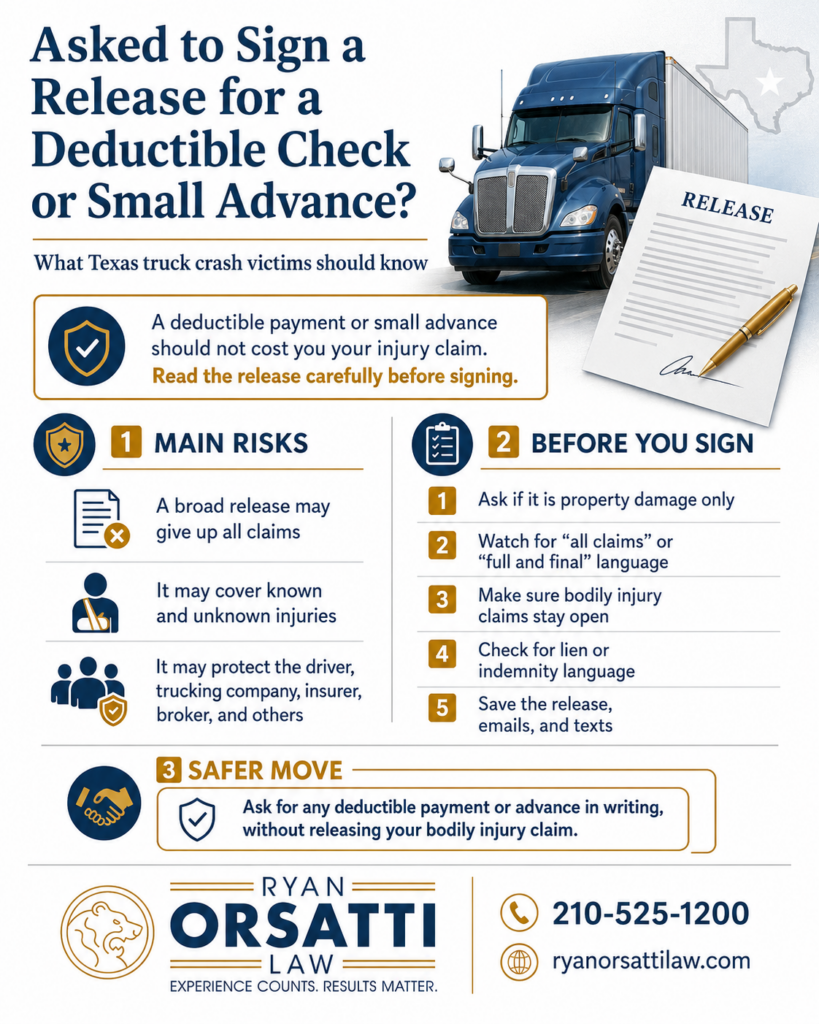
Do not sign a release after a truck crash just because the trucking company offers to pay your deductible or give you a small advance. A broad release can end your injury claim, even if the payment only covers property damage, a rental issue, or short-term bills.
A safer approach is to ask whether the payment can be made as a property damage only payment or a written advance that does not release your bodily injury claim, medical bills, lost wages, future treatment, liens, or claims against other responsible parties.
Key Takeaways
- A “release” is a legal document that can give up claims from the truck crash.
- A deductible reimbursement should not require you to release your personal injury claim.
- A small advance may later be credited against a settlement, but it should not settle the whole case unless that is clearly intended.
- Property damage and bodily injury claims should usually be handled separately.
- Truck crash releases can accidentally protect the driver, carrier, broker, owner, insurer, and related companies.
- Before signing, read for words like “all claims,” “bodily injury,” “known and unknown injuries,” “full and final,” and “indemnify.”
What does it mean if the truck company asks me to sign a release?
A release means you are giving up legal claims in exchange for money, repairs, or another benefit. In a truck crash case, that language may be much broader than the adjuster’s explanation.
The adjuster may say, “We just need this signed to pay your deductible,” or “This is only a small advance.” The document may say something different. In Texas, a signed release can be treated as a binding agreement, and the exact words matter.
A release after an 18-wheeler crash on I-35, I-10, Loop 410, Loop 1604, or US-281 may cover more than the truck driver. It may also name the trucking company, the truck owner, the trailer owner, the freight broker, the shipper, the insurer, parent companies, employees, agents, and “all other persons or entities.”
That is why the first question is not, “How much are they offering?” The first question is, “What claims am I giving up?”
Should I sign a release for the truck company to pay my deductible?
You generally should not sign a broad release for deductible reimbursement after a truck accident. If the payment is truly only for your deductible, the release should be limited to property damage only and should clearly preserve your injury claim.
The Texas Department of Insurance explains that you pay a deductible for collision, comprehensive, and uninsured or underinsured motorist claims, but you do not pay a deductible for claims against another driver’s insurance company. That matters because a truck company’s liability insurer should not need a full bodily injury release just to address vehicle damage or a deductible reimbursement. Texas Department of Insurance auto insurance guide (Texas Department of Insurance)
A property damage only release should be narrow. It should say the payment resolves only vehicle repair, total loss, towing, storage, rental, or deductible reimbursement, if that is the actual agreement. It should not mention personal injuries, medical bills, lost wages, pain and suffering, physical impairment, future care, or “all claims arising from the accident.”
A deductible reimbursement after a Texas truck crash should not require a broad bodily injury release. If the document releases “all claims” from the collision, the injured person may be trading future medical care, lost income, and liability claims for a payment that only solves a short-term property damage problem.
What if the truck company offers a small advance after the crash?
A small advance can be risky if it is tied to a release. The danger is not the word “advance.” The danger is whether the paperwork turns the advance into a final settlement.
An advance is supposed to be money paid before final settlement. In many claims, an advance is credited against the final recovery later. But if the document says “full and final settlement,” “complete release,” or “no further claims,” then it may not be an advance at all.
The Texas Department of Insurance tells consumers that when an accident was caused by another driver, the other driver’s insurance company may offer a medical settlement and ask for a release promising no more claims for that accident. TDI also advises considering future medical treatment before signing. Texas Department of Insurance auto insurance guide (Texas Department of Insurance)
In truck cases, a small advance often comes before the full injury picture is known. Neck injuries, back injuries, concussions, shoulder tears, radiculopathy, and surgical recommendations may not be clear in the first few days or weeks. Signing too early can create a mismatch: a small payment today, in exchange for a major claim tomorrow.
What language should I watch for in a truck accident release?
The most dangerous language is broad language that releases all claims, all injuries, all damages, and all related parties. These words can matter more than the adjuster’s phone explanation.
Watch for these phrases:
- “Full and final settlement”
- “All claims arising out of the accident”
- “Known and unknown injuries”
- “Bodily injury”
- “Medical expenses”
- “Lost wages” or “loss of earning capacity”
- “Pain and suffering”
- “Any and all persons, firms, corporations, insurers, agents, employees, and assigns”
- “Indemnify and hold harmless”
- “No further payment”
- “Confidentiality,” if you do not understand what it restricts
“Indemnify” means you may be promising to pay someone back if another claim, lien, medical bill, or insurer later seeks money from the released party. That can create a problem if Medicare, a health insurer, an ERISA plan, a hospital lien, or another reimbursement claim is still unresolved.
What is the difference between a property damage release and an injury release?
A property damage release resolves vehicle-related losses, while an injury release resolves bodily injury damages. Those are different categories, and they should not be mixed unless you knowingly intend to settle everything.
| Document type | What it may cover | Main risk | Safer question to ask |
|---|---|---|---|
| Deductible reimbursement | Your collision deductible after your insurer paid repairs or total loss | Broad wording may release injury claims | “Does this release bodily injury claims, or property damage only?” |
| Property damage only release | Vehicle repairs, total loss, towing, storage, rental, deductible | May accidentally include “all claims” language | “Will you revise it to preserve all injury claims?” |
| Medical advance | Short-term medical bill help before final settlement | May be treated as final injury settlement if wording is broad | “Is this an advance credited later, not a release?” |
| General release | All claims from the crash | Can end the entire case | “Why is a general release required for a small payment?” |
| Release with indemnity | Claims plus promise to protect the payer from liens or later demands | You may take on lien or reimbursement risk | “Which liens and repayment claims does this language cover?” |
A property damage only release after a Texas truck crash should identify the vehicle-related payment and preserve all bodily injury claims in clear words. If the release does not separate property damage from injury damages, the safer assumption is that it may be broader than the adjuster described.
Why are truck crash releases more dangerous than ordinary car accident paperwork?
Truck crash releases are more dangerous because there may be multiple responsible parties and multiple insurance layers. A broad release may protect companies you have not identified yet.
In a commercial vehicle case, liability may involve:
- The truck driver
- The motor carrier
- The truck owner
- The trailer owner
- A freight broker
- A shipper or loader
- A maintenance company
- A leasing company
- A safety contractor
- A parent or affiliated company
- A separate excess insurer
According to TxDOT’s 2024 Commercial Motor Vehicle Involved Crashes and Injuries by County report, Texas had 39,393 CMV-involved crashes, including 546 fatal crashes, 608 fatalities, and 1,601 suspected serious injuries. Bexar County alone had 2,684 CMV-involved crashes in that report.
Those numbers matter because commercial vehicle cases often require early investigation. Driver qualification files, electronic logging device data, dash camera footage, ECM or “black box” data, dispatch messages, maintenance records, and broker-carrier documents may not be obvious from the police report alone.
For more on timing and investigation, see Ryan Orsatti Law’s guide on when to hire a truck accident lawyer in San Antonio.
Can the truck company delay my property damage claim to pressure me into signing?
The truck company’s insurer may be allowed to investigate, but you should be cautious if payment for a clear property damage issue is being used to pressure a broad injury release. The law treats first-party and third-party insurance claims differently, so the exact payer and policy matter.
The Texas Department of Insurance says prompt payment deadlines apply to your own insurer after you file a claim, but not when another driver’s insurer is paying. TDI also states that the other driver’s insurer must act in good faith and try to settle quickly and fairly. Texas Department of Insurance auto insurance guide (Texas Department of Insurance)
The Texas Department of Insurance has also reminded insurers that Texas Insurance Code Chapter 542 and 28 Texas Administrative Code § 21.203 prohibit unfair claim settlement practices, including undertaking to enforce a full and final release from a policyholder when only a partial payment has been made. Texas Department of Insurance Bulletin B-0006-22 (Texas Department of Insurance)
The practical point is simple: do not let the urgency of your car repair, rental, or deductible force you into signing away a serious injury claim.
How can signing too early affect my Texas injury claim?
Signing too early can cut off claims before you know the medical diagnosis, the available insurance, or the responsible parties. Truck accident injuries often develop over time.
Texas personal injury and property damage claims usually have a two-year filing deadline under Texas Civil Practice and Remedies Code § 16.003. That deadline is not a recommendation to wait. It simply means that evidence and medical proof must be developed before the claim is resolved or suit is filed. Texas Civil Practice and Remedies Code § 16.003 (Texas Statutes)
Texas also uses proportionate responsibility. Under Texas Civil Practice and Remedies Code § 33.001, a claimant may not recover damages if the claimant’s percentage of responsibility is greater than 50 percent. Texas Civil Practice and Remedies Code § 33.001 (Texas Statutes)
That means evidence matters. If you sign a release before investigating truck speed, following distance, braking, lane change, driver fatigue, maintenance, cargo securement, or company safety practices, you may lose leverage before the key facts are known.
For related claim value issues, see Ryan Orsatti Law’s guide on how personal injury case value is evaluated.
What should I do before signing a truck accident release?
Before signing a truck accident release, slow the process down and separate the payment categories. You need to know whether the document resolves property damage only, an advance only, or the entire injury claim.
- Ask for the release in writing. Do not rely only on what the adjuster says by phone.
- Identify who is being released. Look for the truck driver, motor carrier, insurer, broker, shipper, parent companies, employees, and “all other persons.”
- Circle every claim being released. Watch for bodily injury, medical expenses, lost wages, pain, impairment, future treatment, property damage, and unknown injuries.
- Ask whether it is property damage only. If yes, the document should clearly preserve all injury claims.
- Ask whether the payment is an advance. If yes, the document should say it is not a final settlement and does not release your injury claim.
- Check for lien and indemnity language. Do not take on hospital, Medicare, health insurance, ERISA, MedPay, or subrogation obligations you do not understand.
- Preserve evidence immediately. Save photos, the crash report, repair estimates, tow bills, rental bills, medical records, adjuster texts, emails, and any release drafts.
- Talk to a lawyer before signing if you were hurt. This is especially important in any 18-wheeler crash, commercial vehicle crash, surgery case, concussion case, missed-work claim, or crash with disputed facts.
The official Texas Peace Officer’s Crash Report may also matter. Texas Transportation Code § 550.065 allows release of a crash report to certain people with a proper interest, including people directly concerned in the accident and their authorized representatives. TxDOT crash reports and records (Texas Department of Transportation)
What should a safer property damage only release say?
A safer property damage only release should clearly state that it does not release bodily injury claims. The wording should match the deal.
A safer release concept usually includes language like this:
“This payment resolves property damage only, including vehicle repair or total loss, towing, storage, rental, and deductible reimbursement. This agreement does not release any bodily injury claim, medical expense claim, lost wage claim, impairment claim, pain and suffering claim, future medical claim, lien issue, UM/UIM claim, or claim against any other person or entity arising from the collision.”
Do not use sample wording without legal review. The facts, parties, insurer, and policy language can change what should be included. But the concept is important: if the payment is only for property damage, the release should say that clearly.
What if I already signed the release?
If you already signed a release, do not assume the situation is hopeless, but do not assume it can be undone either. The next step is to gather the document and all communications around it.
Save:
- The signed release
- The check, deposit record, or payment confirmation
- Emails and text messages with the adjuster
- Voicemails
- The envelope or electronic signature record
- Any draft versions
- The repair estimate, deductible statement, and rental records
- Medical records showing what was known at the time
A lawyer will want to know whether the release was property damage only, whether the wording was broad, whether the payment was partial or final, whether there was misrepresentation, whether you were injured, whether you had counsel, and whether other parties or insurers may still be available.
Attorney Insight
In truck crash matters we review, the problem is often not the deductible payment itself. The problem is timing and scope. A $500 or $1,500 deductible reimbursement can look harmless, but the release may name every company connected to the tractor, trailer, load, and insurer. Property damage can usually be separated from injury claims, but only if the paperwork actually separates them.
How Ryan Orsatti Law approaches these release questions
Ryan Orsatti Law reviews release language with the claim structure in mind: property damage, injury damages, insurance coverage, liens, subrogation, and evidence preservation. The goal is to avoid accidentally giving up a serious claim while trying to solve an immediate financial problem.
In San Antonio and Bexar County truck crash cases, this often means reviewing the release, identifying the payer, checking whether the payment is property damage only, sending preservation requests, evaluating medical status, and making sure communications with the carrier or insurer do not create avoidable risk.
For more on what legal work happens behind the scenes in an injury claim, see what a car accident lawyer actually does in a Texas PI case. For general crash information, see Ryan Orsatti Law’s page on San Antonio car accident cases. If insurance coverage is part of the issue, review the firm’s guide to UM/UIM coverage in Texas.
FAQ
Can I accept deductible reimbursement without settling my injury claim?
Yes, it may be possible to accept deductible reimbursement without settling your injury claim, but the paperwork must be limited. The release should clearly say property damage only and preserve bodily injury, medical bills, lost wages, future care, liens, UM/UIM issues, and claims against other responsible parties.
Is a small advance from the trucking insurer a settlement?
A small advance is not necessarily a settlement, but it can become one if the document says it is full and final. Before accepting money, confirm in writing whether it is an advance credited against a later settlement or a final release of claims from the truck crash.
What if the adjuster says the release is just standard paperwork?
“Standard paperwork” can still waive major rights. Ask the adjuster to identify the exact paragraph that preserves your bodily injury claim. If the document says “all claims,” “known and unknown injuries,” or “full and final settlement,” do not treat it as routine property damage paperwork.
Can the trucking company pay my rental or repairs without an injury release?
Often, yes. Property damage, rental, towing, storage, repair, total loss, and deductible issues can usually be documented separately from an injury claim. The safer document is a property damage only release, not a general release of all claims from the crash.
What if I need the money right now?
Needing money does not make a broad release safe. Ask whether the payment can be made as a limited property damage payment or written advance without releasing injury claims. Also consider whether MedPay, PIP, health insurance, rental coverage, or collision coverage can address the immediate issue while the truck claim is evaluated.
Can signing a release affect my UM/UIM claim?
It can, depending on your policy language, notice requirements, consent provisions, and the facts. UM/UIM means uninsured or underinsured motorist coverage. Before releasing a truck driver or carrier, review your own auto policy and notify your insurer as required so you do not create an avoidable coverage dispute.
Do I need a lawyer before signing a truck accident release?
If you were injured, missed work, had emergency care, need follow-up treatment, or were hit by a commercial truck, it is wise to have the release reviewed before signing. A lawyer can check whether the document is property damage only or whether it gives up claims that are still being investigated.
Ryan Orsatti Law
4634 De Zavala Rd, San Antonio, TX 78249
Phone: 210-525-1200
ryanorsattilaw.com
This blog is for informational purposes only, not legal advice. Reading it does not create an attorney-client relationship. Past results do not guarantee future results.
Hurt in an accident in San Antonio? Learn how a San Antonio personal injury lawyer can help with your claim. Call 210-525-1200 or request a free consultation.
The firm works on a contingency fee. You pay nothing unless the firm recovers money for you, and that covers case expenses as well as the fee: if there is no recovery, you owe no attorney's fee and no case expenses. Ask for the fee agreement and read the fee and expense section before you sign anything.
Related San Antonio legal resources
Primary legal and public-data sources
- Texas Civil Practice and Remedies Code Chapter 16: limitations
- Texas Civil Practice and Remedies Code Chapter 33: proportionate responsibility
Ryan Orsatti Law
4634 De Zavala Road, San Antonio, TX 78249
General reference links. Consult each source for its current text.