
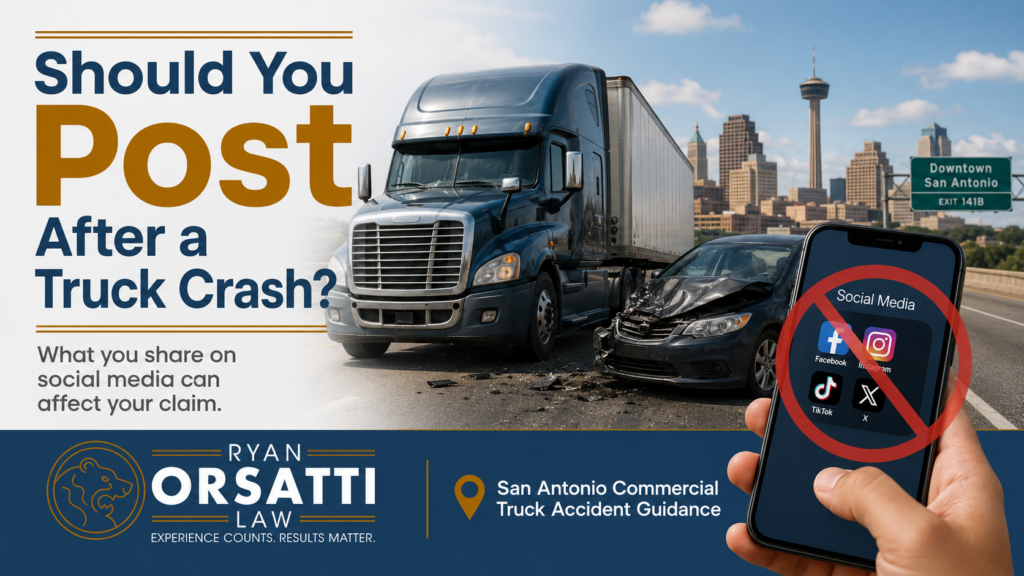
Quick Answer
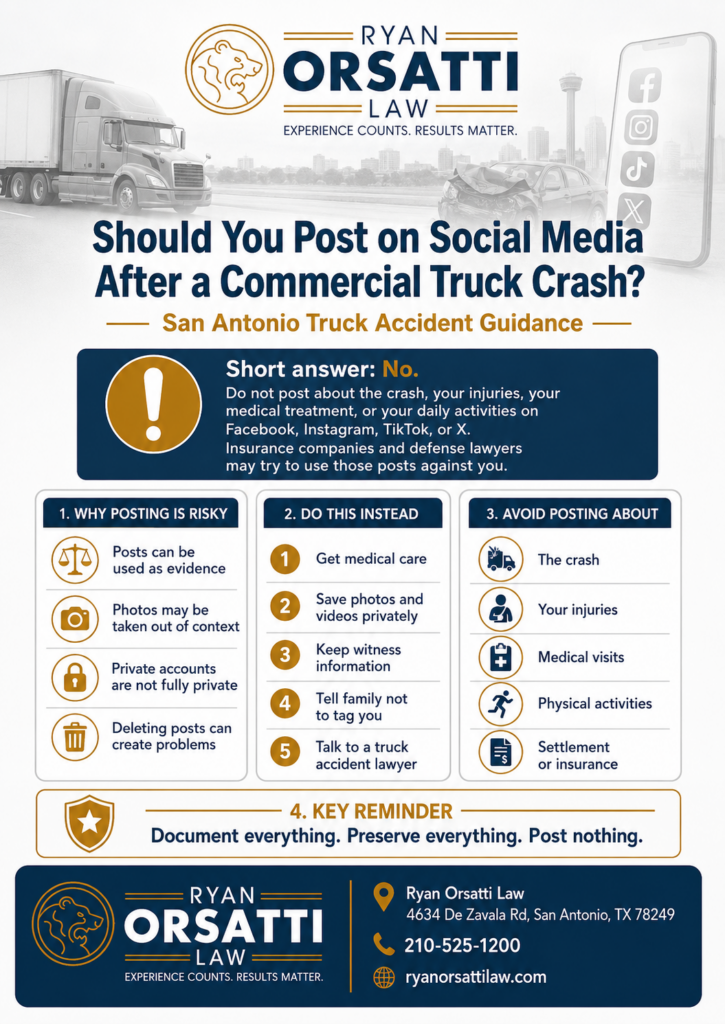
No. If you were hit by a commercial truck in San Antonio, do not post about the crash, your injuries, the truck driver, the trucking company, your medical care, or your daily activities on Facebook, Instagram, TikTok, X, or any other public platform. Even a harmless photo, comment, repost, check-in, or “I’m okay” update can be taken out of context by an insurance company or defense lawyer.
Use private calls or texts to update close family. Save photos, videos, dashcam clips, screenshots, and witness information, but do not publish them online.
Key Takeaways
- Social media posts can become evidence if they are relevant to fault, injuries, damages, or credibility.
- Privacy settings do not make posts invisible in litigation.
- Deleting posts after a claim begins can create avoidable evidence-preservation problems.
- Truck crash cases often involve corporate defendants, commercial insurers, investigators, and rapid evidence collection.
- The safer rule is simple: document everything, preserve everything, post nothing.
- Before making any public statement, talk with a San Antonio truck accident lawyer who handles commercial vehicle cases.
Why is posting after a commercial truck crash in San Antonio risky?
Posting after a commercial truck crash is risky because your words, photos, videos, location tags, comments, emojis, and activity history may be used to challenge your injury claim. Texas discovery rules allow parties to request nonprivileged information relevant to the case, and social media content can fall within that category when it relates to fault, injury severity, daily activities, lost wages, or credibility. Texas Rule of Civil Procedure 192.3 allows discovery of nonprivileged matter relevant to the subject matter of the pending action.
A commercial truck crash is not treated like a small property-damage claim. The trucking company may notify its insurer quickly. The insurer may assign adjusters, defense counsel, investigators, and data vendors. They may look for anything that helps them argue you were not badly hurt, were distracted, caused the crash, delayed treatment, exaggerated symptoms, or returned to normal activity sooner than your medical records suggest.
Quotable passage: In a San Antonio commercial truck crash claim, Facebook, Instagram, TikTok, and X posts can become claim evidence if they relate to fault, injury severity, medical treatment, work limits, daily activities, or credibility. Under Texas Rule of Civil Procedure 192.3, relevant nonprivileged information may be discoverable in civil litigation.
This matters in Bexar County because commercial vehicle crashes are common enough that insurers handle them as repeat business. According to TxDOT’s 2024 Commercial Motor Vehicle Involved Crashes and Injuries by County report, Bexar County had 2,684 CMV-involved crashes, including 18 fatal crashes and 34 suspected serious-injury crashes. TxDOT states the report is based on Texas Peace Officer’s Crash Reports (CR-3) received and processed by the Department. (txdot.gov)
For more on how truck crash claims are built, see Ryan Orsatti Law’s guide to working with a San Antonio truck accident lawyer and its page on commercial vehicle accident claims in San Antonio.
Can insurance companies use my Facebook, Instagram, TikTok, or X posts against me?
Yes. Insurance companies and defense lawyers may try to use social media posts if they believe the content helps them dispute liability, injury severity, damages, or credibility. “Liability” means legal responsibility for causing the crash. “Damages” means the losses caused by the crash, such as medical bills, lost income, pain, impairment, and future care needs.
Texas Rule of Evidence 401 defines relevant evidence as evidence that tends to make a consequential fact more or less probable. Texas Rule of Evidence 403 allows a court to exclude relevant evidence if its probative value is substantially outweighed by unfair prejudice, confusion, or other listed concerns, but that does not mean social media is automatically excluded.
Defense lawyers often look for posts that seem inconsistent with the injury claim. Examples include:
- A smiling photo at a birthday party after a crash.
- A TikTok showing movement that looks easier than what was reported to a doctor.
- A Facebook comment saying “I’m fine” before symptoms worsened.
- An Instagram story from a concert, gym, lake trip, wedding, or vacation.
- A post blaming the truck driver before the investigation is complete.
- A repost joking about suing, getting paid, or “truck money.”
- A check-in that contradicts missed-work or mobility claims.
A post does not need to be fair to be damaging. It only needs to give the defense a way to argue doubt.
What types of posts should I avoid after being hit by a commercial truck?
Avoid any post that mentions the crash, your injuries, your medical treatment, the trucking company, the driver, witnesses, police, insurance, settlement value, or what you think happened. Also avoid posts that show physical activity, travel, parties, alcohol, workouts, home projects, dancing, lifting, sports, or anything that could be framed as inconsistent with your symptoms.
| Post type | Why it can hurt the claim | Safer alternative |
|---|---|---|
| “I’m okay” update | Can be used to argue injuries were minor or unrelated | Call or text close family privately |
| Crash-scene photos | May reveal angles, statements, plates, bystanders, or evidence strategy | Save the originals and send them to your lawyer |
| Video of the truck driver | May create confrontation, defamation, or context problems | Preserve the video without posting it |
| Medical updates | Can conflict with later diagnoses or treatment records | Keep notes for your medical team and lawyer |
| Gym, travel, party, or activity photos | Can be used to minimize pain, impairment, or work restrictions | Pause posting until the claim is resolved |
| Comments blaming the driver | May be used to challenge credibility if facts later change | Let the CR-3, witnesses, data, and investigation develop |
| Settlement jokes or money posts | Can make a valid injury claim look opportunistic | Do not discuss the claim online |
| Deleting old posts | Can create preservation issues if done after a claim begins | Ask your lawyer before changing or removing content |
Quotable passage: After an 18-wheeler or commercial vehicle crash on I-35, I-10, Loop 410, Loop 1604, or US-281 in San Antonio, the safest social media rule is: preserve evidence, do not publish evidence. Save crash photos, videos, and witness messages, but do not post them on Facebook, Instagram, TikTok, or X.
Is it okay to post if my account is private?
No. A private account is not a shield. Privacy settings may reduce public visibility, but they do not prevent screenshots, shares, subpoenas, discovery requests, or questions under oath. “Discovery” is the formal process where parties exchange information in a lawsuit.
Private posts can still reach the defense through mutual contacts, saved screenshots, tagged photos, public comments, stories, archived content, or platform data. A friend may comment on your post. A family member may tag you. A public account may repost something you shared. The defense may also ask whether you used social media after the crash, whether you changed settings, and whether you deleted or hid posts.
Do not rely on privacy settings as a case strategy. Privacy settings are a personal-security tool, not a litigation wall.
Should I delete old posts after the truck crash?
Do not delete, hide, edit, or scrub posts after a truck crash claim begins without legal guidance. Evidence preservation matters. “Spoliation” means the loss, destruction, or material alteration of evidence that should have been preserved. Deleting posts can create a new argument even when the original post was not especially harmful.
The better approach is:
- Stop posting new content.
- Preserve existing posts.
- Take screenshots for your lawyer if something relates to the crash.
- Change passwords if needed for account security, not to hide evidence.
- Ask your lawyer before deleting, archiving, deactivating, or editing anything.
Quotable passage: Deleting social media after a Texas truck accident can create a separate evidence problem. If Facebook, Instagram, TikTok, or X content may relate to the crash, injuries, treatment, work limits, or daily activities, preserve it and ask counsel before removing, editing, archiving, or deactivating the account.
What if I already posted about the commercial truck crash?
If you already posted, do not panic and do not start deleting. Take screenshots, preserve the post, record the date and time, and tell your lawyer exactly what was posted. Include comments, replies, stories, captions, edits, deleted drafts, tags, and direct messages that relate to the crash.
A lawyer can evaluate whether the post is actually important. Sometimes a post looks bad emotionally but is manageable legally. Sometimes a short phrase, such as “I’m okay,” becomes a repeated defense theme because the person later developed neck pain, concussion symptoms, back pain, or radicular symptoms. “Radicular” means pain, numbness, tingling, or weakness that travels from the spine into an arm or leg.
What matters is context. A quick reassurance to family is not the same as a medical diagnosis. But once it exists online, expect the insurance company to look for ways to use it.
How can social media affect fault in a Texas truck accident case?
Social media can affect fault if it gives the defense a way to argue you were distracted, speeding, inattentive, impaired, angry, or inconsistent about how the crash happened. Texas follows proportionate responsibility, which means fault can be divided by percentage among people or entities involved in the case.
Under Texas Civil Practice and Remedies Code § 33.001, a claimant may not recover damages if the claimant’s percentage of responsibility is greater than 50 percent. (Texas Statutes)
That rule makes social media especially important in truck crash cases. A commercial carrier may argue that the injured driver changed lanes suddenly, braked too hard, failed to keep a lookout, used a phone, or ignored traffic conditions. A public post, video, comment, or prior driving-related content may become part of that argument.
This does not mean every social media post decides the case. It means you should not give the defense extra material.
How can social media affect injury damages?
Social media can affect injury damages because defense lawyers often compare your online activity to your medical records, work restrictions, pain complaints, and daily limitations. If you claim severe neck pain but appear in a short video lifting a cooler, the defense may use that image even if the video does not show what happened afterward.
In serious truck crash cases, damages can include medical bills, future care, lost wages, loss of earning capacity, pain, physical impairment, disfigurement, and mental anguish. “Loss of earning capacity” means reduced ability to earn income in the future, even if you are still trying to work.
The problem is not only what you post. It is what others post about you. Ask close friends and family not to tag you, discuss the crash, post hospital photos, share updates, or comment publicly about the claim.
What should I do instead of posting after a commercial truck crash?
After a commercial truck crash, document privately and preserve evidence carefully. Do not use public platforms as your crash diary.
- Call 911 and report the crash if you are still at the scene.
- Get medical care quickly, even if symptoms seem delayed.
- Save photos and videos of the vehicles, roadway, skid marks, debris, truck markings, company logos, license plates, USDOT numbers, trailers, traffic signals, and visible injuries.
- Get names and contact information for witnesses.
- Save dashcam footage, phone photos, repair estimates, tow documents, and the CR-3 crash report number.
- Do not give a recorded statement to the trucking company’s insurer before understanding your rights.
- Do not post about the crash, your injuries, settlement, or daily activities.
- Tell family and friends not to tag you or discuss the crash online.
- Preserve your existing social media content.
- Contact a lawyer familiar with commercial truck crash evidence, including electronic logging device data, truck camera footage, dispatch records, driver qualification files, maintenance records, and insurance issues.
Ryan Orsatti Law has additional guidance on when to hire a truck accident lawyer in San Antonio and what not to do after a Texas car accident.
What evidence should I save privately instead of posting?
Save anything that helps show what happened, who was involved, what was damaged, what hurt, and how your life changed. Do not post it. Keep the original files when possible because metadata, which is hidden data such as date, time, device, and location, can matter.
Useful evidence may include:
- Crash-scene photos and videos.
- Dashcam or security-camera clips.
- Screenshots of witness messages.
- Photos of the truck, trailer, USDOT number, company name, license plate, and cargo markings.
- Medical discharge papers and appointment summaries.
- Photos of bruising, cuts, swelling, casts, braces, and mobility devices.
- A private symptom journal.
- Missed-work records.
- Texts with your employer about work restrictions.
- Repair and total-loss documents.
- Insurance letters and claim numbers.
Texas Rule of Evidence 901 requires a party offering evidence to produce enough proof that the item is what the party claims it is. Keeping originals, timestamps, and context can help avoid authentication problems later.
How long should I stay off social media after a truck accident?
Stay off public posting until your claim is fully resolved, and continue to avoid claim-related posts even afterward if there is a confidentiality term or any remaining legal issue. Truck crash cases can take months or longer depending on medical treatment, disputed fault, commercial insurance coverage, company records, and whether litigation is necessary.
Texas generally gives two years to file a personal injury lawsuit under Texas Civil Practice and Remedies Code § 16.003, although specific deadlines can change depending on the facts, including claims involving governmental entities or other special circumstances. (Texas Statutes)
Quotable passage: In Texas, many personal injury claims have a two-year filing deadline under Texas Civil Practice and Remedies Code § 16.003, but social media risk starts immediately. A single public post made hours after a San Antonio truck crash may be compared against medical records, deposition testimony, and later damages evidence.
Attorney Insight
In truck crash cases, the defense rarely needs a perfect social media post to create damage. They need a screenshot that lets them ask uncomfortable questions. A five-second TikTok, a smiling photo at a family event, or a casual “I’m okay” comment can become the anchor for an argument that ignores the full medical story. The safest practice is not to explain online. Preserve the evidence, treat consistently, and let the claim be built through records, witnesses, data, and testimony.
When should I call a San Antonio truck accident lawyer?
You should call a San Antonio truck accident lawyer quickly if you were hit by an 18-wheeler, delivery truck, company pickup, box truck, dump truck, work truck, rideshare vehicle, or any commercial vehicle. Early action matters because trucking evidence can disappear, vehicles can be repaired, driver logs can roll over, and witnesses can become harder to locate.
Commercial truck claims often involve several possible defendants: the driver, motor carrier, broker, maintenance vendor, shipper, loading company, owner of the trailer, or employer. They may also involve liability coverage, excess insurance, uninsured or underinsured motorist coverage, medical payments coverage, health insurance liens, hospital liens, subrogation claims, and letters of protection. “Subrogation” means a health insurer or benefit plan may claim repayment from a settlement for medical bills it paid. A “letter of protection” is an agreement that a medical provider may wait for payment from a future settlement or recovery.
To discuss a truck crash in San Antonio or Bexar County, you can contact Ryan Orsatti Law for a case review.
FAQ
Can I post a simple “thank you for the prayers” after a truck accident?
It is safer not to post publicly. Even a kind, non-legal update can invite comments about the crash, your condition, or what happened. If you want to thank people, use private calls or texts. Ask friends and family not to tag you, share hospital photos, or discuss your injuries online.
Can I post crash-scene photos if the truck driver was clearly at fault?
Do not post crash-scene photos. Save the originals and send them to your lawyer. A public photo may reveal evidence strategy, invite arguments about angles or context, expose witness identities, or trigger comments that complicate the claim. Fault should be proven through the CR-3, witnesses, vehicle damage, data, photos, and investigation.
Can the trucking company see my private Instagram or Facebook?
A private account is not fully protected. Posts can be captured by screenshots, tags, shared comments, mutual contacts, subpoenas, or discovery requests. If the content is relevant to the crash, injuries, activity level, work restrictions, or credibility, the defense may try to obtain it. Privacy settings help security, not litigation control.
Should I delete TikToks or Instagram posts that make me look active?
Do not delete posts without legal guidance. Deleting content after a crash can create preservation issues and may make the defense argue that evidence was destroyed. Preserve the posts, stop posting new content, and ask your lawyer how to handle existing material. The solution is context and preservation, not panic deletion.
What if my friend posts about my San Antonio truck crash?
Ask the friend to stop posting and not to tag you, but do not secretly coordinate a cover-up or destroy evidence. Save screenshots and tell your lawyer. Posts by friends can still create problems, especially if they discuss fault, injuries, medical condition, settlement, or what you can and cannot do physically.
Can I post about needing witnesses to the crash?
Be careful. Public witness posts can sometimes help locate people, but they can also create bad comments, speculation, and defense exhibits. A safer approach is to let your lawyer or investigator handle witness outreach. If witness help is needed, the wording should be controlled, factual, and free of blame or injury claims.
Is it okay to post after my case settles?
Do not post about settlement unless your lawyer confirms it is allowed. Some settlements include confidentiality terms. Even without confidentiality, public comments about money, fault, or the trucking company can create unnecessary issues. A settlement ends the claim, but it does not make every detail safe to publish.
Ryan Orsatti Law
Ryan Orsatti Law
4634 De Zavala Rd, San Antonio, TX 78249
Phone: 210-525-1200
ryanorsattilaw.com
This blog is for informational purposes only, not legal advice. Reading it does not create an attorney-client relationship. Past results do not guarantee future results.
Hurt in an accident in San Antonio? Learn how a San Antonio truck accident lawyer can help with your claim. Call 210-525-1200 or request a free consultation.
The firm works on a contingency fee. You pay nothing unless the firm recovers money for you, and that covers case expenses as well as the fee: if there is no recovery, you owe no attorney's fee and no case expenses. Ask for the fee agreement and read the fee and expense section before you sign anything.
Related San Antonio legal resources
Primary legal and public-data sources
Ryan Orsatti Law
4634 De Zavala Road, San Antonio, TX 78249
General reference links. Consult each source for its current text.