
By Ryan Orsatti, Texas personal injury attorney, Ryan Orsatti Law, San Antonio.
Quick Answer
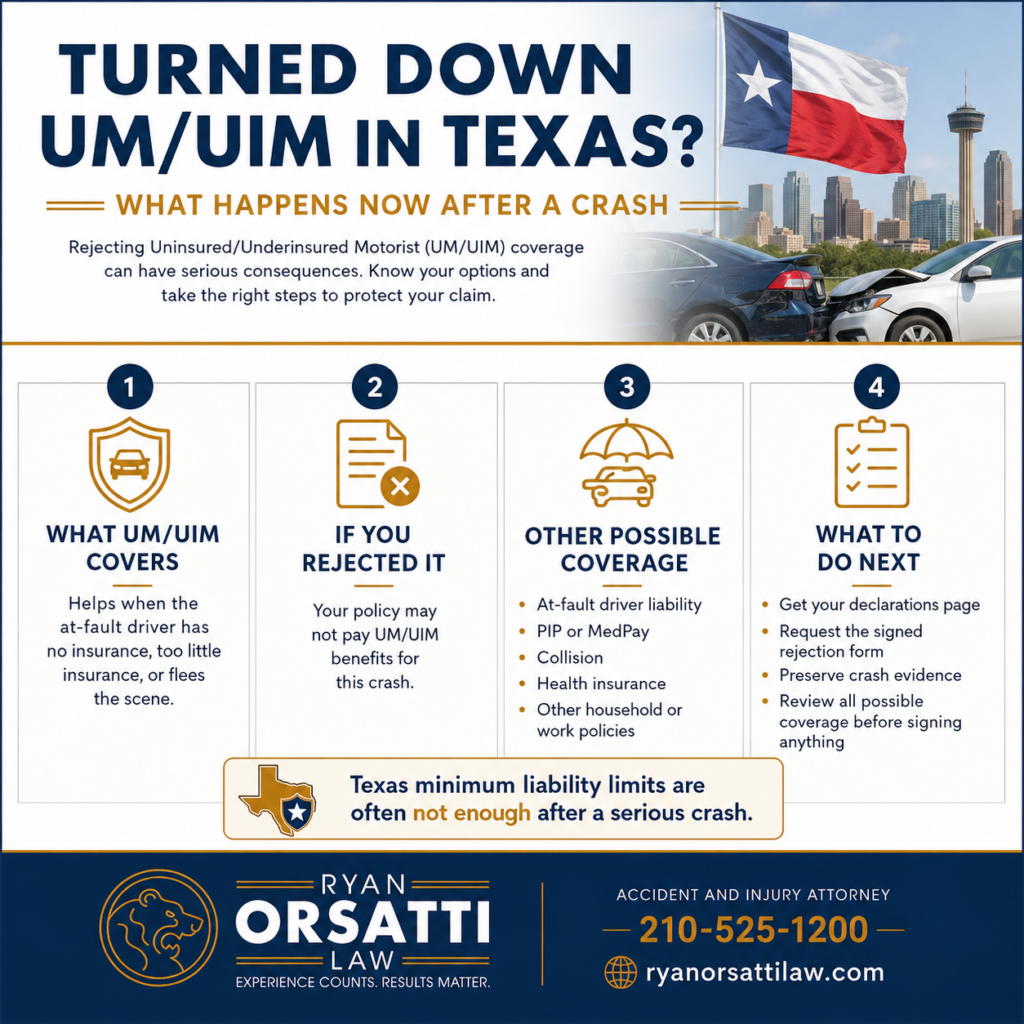
If you turned down UM/UIM coverage in Texas, your own auto policy may not pay uninsured or underinsured motorist benefits for a crash involving a driver with no insurance, too little insurance, or a hit-and-run driver. Texas insurers must offer UM/UIM coverage, but the coverage is not required when the named insured rejects it in writing. (Texas Department of Insurance)
That does not automatically mean you have no claim. You may still be able to pursue the at-fault driver, use PIP, MedPay, collision coverage, health insurance, or another available policy, but you should get your declarations page, full policy, and signed UM/UIM rejection form before assuming the answer.
Key Takeaways
- A valid written UM/UIM rejection can leave you without your own UM/UIM benefits for that policy after a Texas crash.
- Texas Department of Insurance reported in 2025 that more than 2.4 million state-registered vehicles were not matched to an insurance policy, about 12% of registered vehicles. (Texas Department of Insurance)
- Texas minimum liability coverage is only $30,000 per injured person, $60,000 per accident, and $25,000 for property damage, known as 30/60/25 coverage. (Texas Department of Insurance)
- Do not sign a release until you know all available coverage, medical bills, hospital liens, and health insurance reimbursement claims.
- Texas personal injury lawsuits are generally subject to a two-year filing deadline under Texas Civil Practice & Remedies Code § 16.003, although shorter notice rules can apply in some cases. (Texas Constitution and Statutes)
- Ryan Orsatti Law helps injured people in San Antonio and across Texas review coverage, fault, medical bill issues, and claim options after serious crashes.
What does UM/UIM coverage do in Texas?
UM/UIM coverage protects you when the driver who caused the crash has no insurance, not enough insurance, or cannot be identified after a hit-and-run. The Texas Department of Insurance explains that uninsured/underinsured motorist coverage can pay for car repairs, property in the car, rental car needs, medical bills, pain and suffering, and diminished value, depending on the policy and facts. (Texas Department of Insurance)
UM means uninsured motorist coverage. UIM means underinsured motorist coverage. In plain English, UM helps when the at-fault driver has no valid liability policy, while UIM helps when the driver has insurance but the available limits are not enough to cover the harm caused.
| Coverage issue | What it usually means | Why it matters after a Texas crash |
|---|---|---|
| UM coverage | The at-fault driver has no insurance | Your own policy may be the main source of injury and property-damage recovery if you kept UM coverage |
| UIM coverage | The at-fault driver has insurance, but not enough | Texas minimum 30/60/25 limits may be far below serious injury losses |
| Hit-and-run UM | The other driver leaves and cannot be identified | TDI notes UM/UIM may apply to hit-and-run crashes if the coverage exists |
| Rejected UM/UIM | You turned down UM/UIM in writing | Your own policy may not fill the gap unless another policy or coverage applies |
Key takeaway: UM/UIM is the coverage designed to protect you from another driver’s missing or inadequate insurance, so rejecting it can make every other source of recovery more important.
If I rejected UM/UIM, can I still make a claim?
Yes, you may still have claim options, but usually not a UM/UIM claim under the policy where the rejection is valid and applies to the crash. Texas law requires insurers to provide UM/UIM coverage unless the named insured rejects it in writing, and TDI’s personal auto checklist confirms that UM/UIM selection and rejection forms are part of the compliance review for Texas auto policies. (Texas Department of Insurance)
The first issue is coverage. The second issue is collectability, which means whether there is a realistic source of payment. A driver who caused a crash on I-10, Loop 1604, Loop 410, US-281, or I-35 may be legally responsible, but if that driver has no insurance and few assets, the practical recovery may be limited unless another policy or responsible party exists.
What documents should I request first?
You should request your declarations page, full policy, and the actual written UM/UIM rejection form. A declarations page is the policy summary that lists your coverages, limits, and deductibles, and TDI tells consumers that the first page of the policy summarizes these items. (Texas Department of Insurance)
Ask for the document, not just a verbal answer from the adjuster. You want to know who signed the rejection, when it was signed, what policy period it applied to, whether the policy was renewed or changed, and whether any later endorsement added coverage back.
Could a UM/UIM rejection be invalid or not apply?
A UM/UIM rejection may be disputed if there is no written rejection, the wrong person signed, the policy period does not match the crash date, or another policy covers you as an insured. Texas insurers must be able to show that UM/UIM coverage was handled consistently with Insurance Code Chapter 1952, and TDI states that UM/UIM coverage must be provided unless rejected in writing. (Texas Department of Insurance)
This issue often comes up when a driver says, “I think I declined it,” but no one has actually reviewed the underwriting file. It can also come up when the injured person was driving a family member’s car, riding as a passenger, using a company vehicle, driving a rental car, or living in a household with another auto policy.
What other insurance can help if I turned down UM/UIM?
Other insurance may still help if you rejected UM/UIM, including the at-fault driver’s liability coverage, your PIP, your MedPay, collision coverage, health insurance, or a commercial, employer, household, rideshare, rental, or umbrella policy. TDI explains that PIP pays medical bills and can also pay lost wages and other nonmedical costs, while MedPay pays medical bills. (Texas Department of Insurance)
The hard part is identifying every possible policy before a release is signed. Once you sign a broad release for the at-fault driver or insurer, you may give up claims that should have been evaluated more carefully.
| Possible source | What it may cover | Practical issue to check |
|---|---|---|
| At-fault driver liability coverage | Your injury and property damage losses, up to policy limits | Texas minimum coverage may be only 30/60/25 |
| PIP | Medical bills, lost wages, and some nonmedical costs | PIP is included in Texas auto policies unless rejected in writing |
| MedPay | Medical bills for you or passengers | It depends on whether you purchased it and the policy limit |
| Collision coverage | Vehicle repair or total loss | Deductible applies, and it does not pay injury damages |
| Health insurance | Medical treatment | Subrogation means the health plan may later claim reimbursement from a settlement |
| Commercial or employer policy | Crashes involving work vehicles, delivery vehicles, or company drivers | Requires investigation of ownership, employment, and route purpose |
| Household or resident-relative policy | Possible coverage if you qualify as an insured | Policy definitions and exclusions control |
| Other liable parties | Negligent entrustment, employer liability, vehicle defects, premises issues, or alcohol-service issues | These depend on facts and evidence |
Key takeaway: When UM/UIM is gone, the case often turns on finding every other policy, every responsible party, and every medical-bill issue before the claim is resolved.
Can I add UM/UIM after the crash?
You can ask your agent to add UM/UIM coverage going forward, but adding it after a crash generally will not cover a crash that already happened. Insurance coverage depends on the policy terms, effective dates, covered vehicle, insured person, and loss date, so a post-crash coverage change should be treated as future protection, not a fix for the current claim.
That does not mean the step is pointless. TDI warns that drivers do not know when the person who hits them will have enough insurance, and the agency reported that more than 2.4 million Texas-registered vehicles were not matched to an insurance policy in 2025. (Texas Department of Insurance)
What should I do in the first seven days after learning I rejected UM/UIM?
You should protect the injury claim, gather insurance documents, and avoid signing anything final before all coverage is reviewed. TDI recommends getting the other driver’s name, insurer, policy number, license plate, witness information, photos, police information, and medical documentation after a wreck. (Texas Department of Insurance)
Use this checklist:
- Get your declarations page and full policy. Request every page, not just the app screen or ID card.
- Request the signed UM/UIM rejection form. Ask for the actual document showing when and how UM/UIM was rejected.
- Identify every possible policy. Check your household vehicles, resident relatives, employer policies, rental coverage, rideshare coverage, and any umbrella policy.
- Get the crash report information. TxDOT says officers must submit qualifying crash reports involving injury, death, or at least $1,000 apparent property damage not later than the 10th day after the crash. (Texas Department of Transportation)
- Save photos, video, witness names, and scene details. Do not rely only on the police report to prove fault.
- Get medical care and keep the paperwork. Delayed treatment can create a causation dispute, meaning the insurer may argue your injuries came from something other than the crash.
- Track bills, liens, and health insurance payments. A hospital lien is a legal claim a hospital may assert against part of a personal injury recovery. Subrogation means a health insurer may claim a right to be paid back from a settlement.
- Do not sign a broad release too early. A property damage check, injury settlement, or policy-limits offer may include language that ends claims you still need.
For related coverage issues, see Ryan Orsatti Law’s guides on Texas car insurance requirements, how UM/UIM coverage works after a Texas wreck, and what happens if the at-fault driver is uninsured in Texas.
How do Texas fault rules affect the claim if I rejected UM/UIM?
Texas fault rules still matter because the at-fault driver, insurer, or defense lawyer may argue that you caused or partly caused the crash. Under Texas Civil Practice & Remedies Code § 33.001, a claimant may not recover damages if the claimant’s percentage of responsibility is greater than 50%. (Texas Constitution and Statutes)
Comparative responsibility means Texas can reduce your recovery by your percentage of fault. For example, if a jury found you 20% responsible, your damages could be reduced by 20%. If you are found more than 50% responsible, the Texas proportionate responsibility rule can bar recovery.
This matters even more when UM/UIM is unavailable. Without your own UM/UIM coverage as a fallback, proving the other driver’s responsibility and defeating blame-shifting can be the difference between a meaningful claim and a denied claim.
How long do I have to file a Texas injury claim after rejecting UM/UIM?
For most Texas car-crash injury claims against the at-fault driver, the lawsuit deadline is two years from the date the claim accrues under Texas Civil Practice & Remedies Code § 16.003. That deadline does not disappear because you are waiting on insurance, medical treatment, a repair estimate, or a policy-limits decision. (Texas Constitution and Statutes)
Your insurance policy may also have notice duties, cooperation duties, and proof requirements. If a government vehicle, public employee, or public road condition is involved, separate notice rules may apply. Do not wait until the two-year mark to investigate coverage, because video, vehicle data, witness memory, and business records can disappear much sooner.
What mistakes hurt a Texas claim after UM/UIM was rejected?
The biggest mistakes are assuming there is no claim, assuming there is plenty of insurance, delaying treatment, giving unnecessary recorded statements, and signing a release before the full net recovery is known. The net recovery is what remains after attorney fees, case expenses, medical balances, liens, and reimbursement claims are accounted for.
A rejected UM/UIM policy changes the strategy. The case becomes more dependent on proving fault, finding insurance, documenting damages, and resolving medical-bill claims correctly.
Attorney Insight: In rejected UM/UIM cases, adjusters often focus on three pressure points: disputed fault, treatment gaps, and limited collectable insurance. Before sending a demand, a lawyer should know the liability limits, injury timeline, diagnosis, treatment plan, lien status, health insurance reimbursement position, and whether another defendant or policy changes the claim.
How can Ryan Orsatti Law help if I turned down UM/UIM coverage in Texas?
Ryan Orsatti Law helps injured people in San Antonio, Bexar County, and across Texas evaluate what coverage remains after a UM/UIM rejection. That can include reviewing the rejection form, declarations pages, full policies, crash evidence, medical bills, hospital liens, health insurance reimbursement claims, and possible claims against the at-fault driver or another responsible party.
This review is especially important after serious crashes on Loop 1604, I-10, I-35, Loop 410, US-281, Bandera Road, Culebra Road, Potranco Road, and other San Antonio corridors where fault, coverage, and medical documentation may be disputed. For help with related issues, see the firm’s pages on San Antonio uninsured motorist accident claims, Texas crash report timing, and Texas injury health insurance subrogation.
FAQ
Is UM/UIM coverage required in Texas?
Texas insurers must offer UM/UIM coverage, but a Texas driver can reject it in writing. If the coverage was validly rejected, that policy may not provide UM/UIM benefits for a later crash. The practical first step is to request the declarations page, full policy, and written rejection form before assuming coverage is unavailable. (Texas Department of Insurance)
Can I undo my UM/UIM rejection after an accident in Texas?
You usually cannot add UM/UIM after a crash and make it apply retroactively to that crash. You can ask your agent to add UM/UIM for future policy periods, but the current claim depends on the coverage in force on the crash date. Still, the rejection form should be reviewed before accepting a denial.
What if I never signed a UM/UIM rejection form?
If there is no written UM/UIM rejection, coverage may still be an issue worth challenging. Texas rules require UM/UIM coverage unless rejected in writing, so ask the insurer for the actual rejection document. Do not rely only on an adjuster’s statement that the computer shows UM/UIM was declined.
Does PIP help if I rejected UM/UIM in Texas?
PIP may still help if you kept it, even if you rejected UM/UIM. TDI explains that PIP pays medical bills and can also pay lost wages and some nonmedical costs, and Texas auto policies include PIP unless it is rejected in writing. Check your declarations page for PIP limits. (Texas Department of Insurance)
Can I sue an uninsured driver personally in Texas?
You may be able to sue an uninsured driver personally if that driver caused the crash, but collectability can be difficult. A judgment is only useful if there is a realistic way to collect it. A lawyer should evaluate assets, employment, other liable parties, and any insurance before recommending a lawsuit strategy.
What happens if I rejected UM/UIM and the other driver only has minimum coverage?
If the other driver only has Texas minimum coverage, the available liability limits may be $30,000 per injured person, $60,000 per accident, and $25,000 for property damage. Serious injuries can exceed those limits quickly, so PIP, MedPay, health insurance, other policies, and additional responsible parties should be reviewed before settlement. (Texas Department of Insurance)
Should I give a recorded statement if I rejected UM/UIM?
Be careful with recorded statements, especially when fault, injuries, or coverage are disputed. Your own insurer may have policy cooperation requirements, but the other driver’s insurer is not on your side. Before giving a detailed recorded statement, understand who is asking, what coverage is at issue, and how the statement may be used.
What if the crash was a hit-and-run and I rejected UM coverage?
If the crash was a hit-and-run and you rejected UM coverage, your own policy may not provide hit-and-run UM benefits. You should still report the crash, preserve evidence, look for camera footage, identify witnesses, check collision coverage, and review every household or vehicle policy. TDI notes UM/UIM can cover hit-and-run crashes when the coverage exists. (Texas Department of Insurance)
Ryan Orsatti Law
4634 De Zavala Rd, San Antonio, TX 78249
Phone: 210-525-1200
ryanorsattilaw.com
This blog is for informational purposes only, not legal advice. Reading it does not create an attorney-client relationship. Past results do not guarantee future results.
Hurt in an accident in San Antonio? Learn how a San Antonio personal injury lawyer can help with your claim. Call 210-525-1200 or request a free consultation.
The firm works on a contingency fee. You pay nothing unless the firm recovers money for you, and that covers case expenses as well as the fee: if there is no recovery, you owe no attorney's fee and no case expenses. Ask for the fee agreement and read the fee and expense section before you sign anything.
Related San Antonio legal resources
Primary legal and public-data sources
- Texas Civil Practice and Remedies Code Chapter 16: limitations
- Texas Civil Practice and Remedies Code Chapter 33: proportionate responsibility
Ryan Orsatti Law
4634 De Zavala Road, San Antonio, TX 78249
General reference links. Consult each source for its current text.