
Quick Answer
Texas car insurance requirements are commonly called 30/60/25 liability coverage: at least $30,000 for injuries to one person, $60,000 total for injuries in one crash, and $25,000 for property damage. Texas drivers must be able to show financial responsibility for crashes they cause, and most drivers satisfy that rule by buying liability insurance. (Texas Department of Insurance)
Minimum coverage keeps you legal, but it may not be enough after a serious San Antonio or Texas crash. Ryan Orsatti Law helps injured people evaluate liability coverage, UM/UIM coverage, PIP, medical bills, and claim deadlines after motor vehicle accidents.
Watch Ryan Orsatti Explain Texas Auto Insurance on KENS 5
Ryan Orsatti joined KENS 5’s Great Day SA to explain liability, collision, comprehensive coverage, UM/UIM, PIP, and rental reimbursement in plain English.
Key Takeaways
- Texas minimum liability insurance is 30/60/25, but that is only the legal floor.
- Liability coverage pays others when you cause a crash. It does not repair your own car unless you have other coverage.
- Collision, comprehensive, PIP, MedPay, rental, and UM/UIM coverage can matter after a wreck.
- Texas insurers must include PIP and must offer UM/UIM unless rejected in writing. (Texas Department of Insurance)
- Texas crash claims are time-sensitive. Most personal injury lawsuits must be filed within two years under Texas Civil Practice & Remedies Code § 16.003.
- After a serious wreck, review the declarations page, policy limits, exclusions, medical bills, liens, and all claim communications before signing a release.
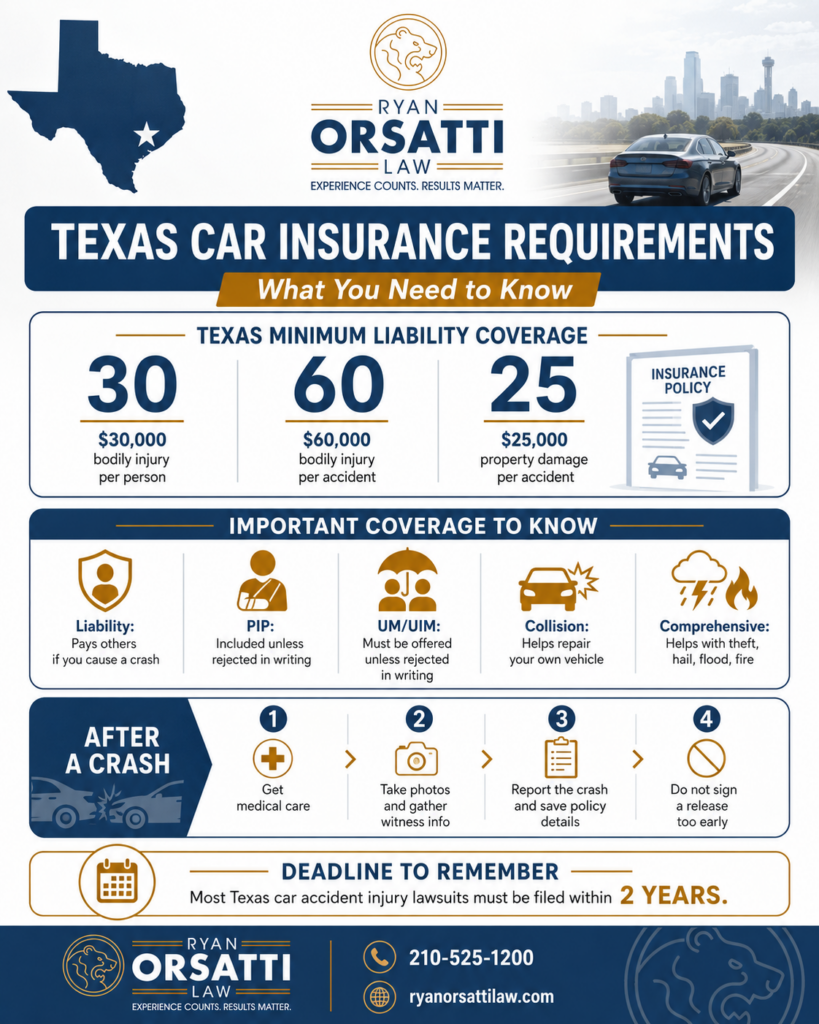
What are the minimum Texas car insurance requirements?
Texas requires most drivers to carry at least $30,000 in bodily injury coverage per person, $60,000 in bodily injury coverage per accident, and $25,000 in property damage coverage per accident. The Texas Department of Insurance calls this 30/60/25 coverage, and it is the minimum liability coverage most Texas drivers buy to prove financial responsibility. (Texas Department of Insurance)
Liability coverage means insurance that pays for harm you cause to someone else. If you cause a crash on I-10, Loop 410, Loop 1604, I-35, US-281, or another Texas roadway, your liability coverage may pay for the other person’s medical bills, vehicle damage, lost income, and related losses, up to your policy limits.
Texas minimum coverage is not a promise that every crash loss will be covered. TDI warns that minimum liability limits might be too low if you cause a multi-vehicle accident or total another driver’s car. (Texas Department of Insurance)
| Required Texas liability coverage | Minimum amount | What it pays for |
|---|---|---|
| Bodily injury per person | $30,000 | One injured person’s covered injury damages |
| Bodily injury per accident | $60,000 | Total covered injury damages for all injured people in one crash |
| Property damage per accident | $25,000 | Damage to another person’s vehicle or other property |
Key takeaway: Texas 30/60/25 coverage may satisfy the legal minimum, but one emergency room visit, totaled vehicle, or multi-person crash can quickly exceed those limits.
Is minimum liability insurance enough in Texas?
Minimum liability insurance is often not enough after a serious Texas car accident. A single crash can involve ambulance bills, ER care, imaging, follow-up treatment, lost wages, totaled vehicles, rental needs, and long-term symptoms that exceed $30,000 per injured person.
This matters in San Antonio because major corridors like I-35, I-10, Loop 410, Loop 1604, and US-281 routinely involve high-speed traffic, commercial vehicles, and multi-car collisions. TxDOT reported that in 2024 Texas had 14,905 serious injury crashes, 18,218 people with serious injuries, and 251,977 total people injured in motor vehicle crashes. (TxDOT)
If the at-fault driver only carries minimum limits, an injured person may need to look at other sources of recovery. Those sources can include UM/UIM coverage, PIP, MedPay, health insurance, collision coverage for property damage, a commercial policy, an employer policy, or a claim against another responsible party.
What does liability insurance cover after a Texas car accident?
Liability insurance covers other people’s losses when you are legally responsible for causing a crash. In Texas, liability coverage may pay for the other driver’s car repairs, medical bills, lost wages, and related damages, but only up to the policy’s dollar limits. (Texas Department of Insurance)
Liability coverage does not automatically pay for your own injuries or your own vehicle damage. For your own losses, you may need first-party coverage, which means coverage under your own policy, such as collision, comprehensive, PIP, MedPay, rental reimbursement, or UM/UIM.
Texas is a fault-based insurance state in practical claim handling. That means the insurance company usually asks who caused the crash, what evidence proves fault, what injuries were caused by the crash, and how the claimed damages connect to the collision.
What optional car insurance coverages should Texas drivers understand?
Texas drivers should understand optional coverages because the minimum required policy does not protect against every real-world loss. TDI identifies several common auto coverages, including liability, collision, comprehensive, MedPay, PIP, UM/UIM, towing, and rental reimbursement. (Texas Department of Insurance)
Here is how the most common coverages work:
| Coverage type | Required by Texas law? | Why it matters after a crash |
|---|---|---|
| Liability | Yes, in minimum amounts for most drivers | Pays others when you cause a covered crash |
| Collision | No, but lenders usually require it | Helps repair or replace your vehicle after a crash |
| Comprehensive | No, but lenders usually require it | Helps with theft, hail, fire, flood, vandalism, and non-collision losses |
| PIP | Included unless rejected in writing | Helps with medical bills, lost wages, and some nonmedical costs |
| MedPay | Optional | Helps pay medical bills, but usually does not cover lost wages |
| UM/UIM | Must be offered unless rejected in writing | Helps when the at-fault driver has no insurance or not enough insurance |
| Rental reimbursement | Optional | Helps with rental car costs while your car is repaired or replaced |
Key takeaway: The required Texas minimum is only liability coverage, so drivers should review optional coverages before a crash, not after they are already dealing with bills and transportation problems.
What is PIP in Texas car insurance?
Personal Injury Protection, or PIP, is first-party coverage that can pay your medical bills, lost wages, and some nonmedical costs after a crash regardless of fault. TDI states that all Texas auto policies include PIP unless the policyholder rejects it in writing. (Texas Department of Insurance)
PIP can be important because the at-fault driver’s insurance company may not pay immediately. The adjuster may investigate fault, request medical records, dispute treatment, or wait until you are ready to settle the whole injury claim.
PIP is often useful in the first weeks after a crash. It may help with ER bills, follow-up treatment, missed work, and early financial pressure while the liability claim develops.
What is UM/UIM coverage in Texas?
Uninsured/underinsured motorist coverage, usually called UM/UIM, can help when the driver who caused the crash has no insurance, not enough insurance, or cannot be identified after a hit-and-run. TDI says insurance companies must offer UM/UIM coverage in Texas, and drivers who do not want it must reject it in writing. (Texas Department of Insurance)
UM means uninsured motorist coverage. UIM means underinsured motorist coverage. Underinsured coverage matters when the at-fault driver has insurance, but the available liability limits are too low to cover the full damages.
Ryan Orsatti Law has a separate guide on Texas UM/UIM coverage for injured drivers who need to understand how their own policy may apply after a wreck.
What should I do after a crash if insurance may be an issue?
After a crash, protect your health, document the scene, identify all insurance policies, and avoid signing a release before you understand your damages. TDI recommends getting the other driver’s name, insurance company, policy number, license plate, witness information, photos, police information, and medical documentation after a wreck. (Texas Department of Insurance)
Use this checklist after a Texas crash:
- Call 911 if anyone is injured or if the other driver leaves the scene.
- Photograph vehicle damage, license plates, road conditions, traffic signals, skid marks, debris, and visible injuries.
- Get the other driver’s insurance card, policy number, phone number, and license plate.
- Get witness names and phone numbers before they leave.
- Seek medical care as soon as symptoms appear.
- Report the crash to your insurance company promptly.
- Request or save the Texas Peace Officer’s Crash Report, often called a CR-3.
- Save the declarations page for every possible insurance policy.
- Do not give a recorded statement to the other driver’s insurer without understanding the purpose and risk.
- Do not sign a full release until you know your diagnosis, treatment plan, liens, wage loss, and future care needs.
TDI also notes that if the other driver’s limits are not high enough to pay your car repair or medical bills, your own collision, UM/UIM, PIP, MedPay, or health insurance may become important. (Texas Department of Insurance)
How do Texas insurance claims work after you file?
After you file a claim with your own insurance company, Texas law sets deadlines for the company to act. TDI states that an insurer must acknowledge a claim within 15 days, accept or reject the claim within 15 business days after receiving all needed information, and send payment within five business days after agreeing to pay. (Texas Department of Insurance)
Those prompt-payment rules do not work the same way when you are dealing with the other driver’s insurance company. TDI explains that the prompt payment law does not apply if another driver’s insurer is paying the claim, although that company must act in good faith and try to settle quickly and fairly. (Texas Department of Insurance)
That distinction matters. Your own insurer owes you contractual duties under your policy. The other driver’s insurer usually views you as a third-party claimant and may investigate liability, damages, causation, and coverage before making an offer.
What happens if the at-fault driver has no insurance or not enough insurance?
If the at-fault driver has no insurance or not enough insurance, your own UM/UIM, PIP, MedPay, collision, or health insurance may become the practical path to early help. TDI specifically says UM/UIM can pay when you are hit by a driver who has no insurance, not enough insurance, or leaves the scene in a hit-and-run. (Texas Department of Insurance)
A hit-and-run creates extra proof problems. TDI warns that uninsured motorist coverage will not pay for a hit-and-run accident if you did not report it to police. (Texas Department of Insurance)
In uninsured or underinsured cases, Ryan Orsatti Law helps injured Texans evaluate the crash report, available insurance policies, rejection forms, policy limits, medical bills, wage loss, liens, and whether a lawsuit or UM/UIM claim is needed.
Attorney Insight: Adjusters do not value an injury claim by looking only at the crash photos or the police report. They look at proof: who was at fault, what coverage exists, how quickly symptoms were documented, whether treatment was consistent, what bills are related, and whether the injured person signed anything that limits the claim. In minimum-limits cases, the coverage investigation often matters as much as the liability investigation.
How does fault affect a Texas car insurance claim?
Fault affects whether an insurance company pays and how much may be paid. Under Texas proportionate responsibility law, a claimant may not recover damages if the claimant’s percentage of responsibility is greater than 50 percent. (Texas Statutes)
Comparative responsibility means Texas can reduce a person’s recovery by that person’s percentage of fault. For example, if a jury found an injured person 20 percent responsible, the damages could be reduced by 20 percent. If the injured person is found more than 50 percent responsible, recovery is barred.
This is why evidence matters. Photos, witness statements, dashcam video, vehicle damage, event data, crash reconstruction, 911 records, and medical documentation can all affect how fault is evaluated.
How long do I have to file a Texas car accident lawsuit?
Most Texas personal injury and property damage lawsuits must be filed within two years from the date the claim accrues. Texas Civil Practice & Remedies Code § 16.003 applies a two-year limitations period to personal injury and property-damage claims, and wrongful death claims generally run two years from the date of death. (Texas Statutes)
This lawsuit deadline is not the same thing as an insurance reporting deadline. Many policies require prompt notice, cooperation, proof of loss, medical documentation, or other claim steps well before the two-year mark.
If a crash involves a government vehicle, road defect, public employee, minor, out-of-state defendant, commercial vehicle, rideshare driver, or wrongful death issue, the deadline analysis may change. Do not assume the standard deadline is the only deadline.
What should I review on my Texas auto policy before a crash happens?
You should review your declarations page, liability limits, UM/UIM limits, PIP, MedPay, collision, comprehensive, rental, exclusions, deductibles, and listed drivers. TDI explains that the declarations page summarizes your coverages, dollar limits, and deductibles. (Texas Department of Insurance)
Pay special attention to these items:
- Liability limits: Are they only 30/60/25, or higher?
- UM/UIM: Did you keep it, or reject it in writing?
- PIP: Did you keep it, increase it, or reject it in writing?
- Collision: Will your policy help repair your own car?
- Comprehensive: Are theft, hail, flood, and non-collision losses covered?
- Rental reimbursement: Will you have a rental car if your vehicle is not drivable?
- Deductibles: Can you afford the out-of-pocket amount after a wreck?
- Excluded drivers: Is anyone in your household excluded from coverage?
- Business or rideshare use: Does the policy exclude delivery, rideshare, or business driving?
This review is especially important for families with teen drivers, borrowed cars, rental cars, vehicles used for work, or multiple household members.
When should I call a Texas personal injury lawyer about insurance coverage?
You should consider calling a Texas personal injury lawyer when injuries, disputed fault, low policy limits, UM/UIM coverage, PIP issues, medical bills, liens, recorded statements, or a release are involved. A lawyer can review the available insurance, preserve evidence, calculate deadlines, and evaluate whether the offer accounts for the full claim.
Ryan Orsatti Law helps injured people in San Antonio, Bexar County, and across Texas evaluate insurance coverage after car, truck, motorcycle, rideshare, and commercial vehicle crashes. The firm also provides information on the personal injury lawsuit process and representation for people looking for a San Antonio car accident lawyer.
Before accepting an injury settlement, make sure you understand medical bills, health insurance liens, hospital liens, PIP, MedPay, UM/UIM, wage loss, future care, and what rights you are releasing.
FAQs
What is the minimum car insurance required in Texas?
Texas minimum car insurance is 30/60/25 liability coverage: $30,000 for bodily injury to one person, $60,000 total for bodily injury in one accident, and $25,000 for property damage. This is the legal minimum for most drivers, but it may be too low for a serious crash. (Texas Department of Insurance)
Does Texas require full coverage car insurance?
Texas does not require “full coverage” by law. Full coverage usually refers to liability plus collision and comprehensive coverage. Texas requires minimum liability coverage for most drivers, but lenders commonly require collision and comprehensive coverage if you still owe money on the vehicle. (Texas Department of Insurance)
Is PIP required in Texas?
PIP is included in Texas auto policies unless the named insured rejects it in writing. PIP can help pay medical bills, lost wages, and some nonmedical costs after a crash regardless of fault. Before assuming you do not have PIP, review your declarations page and any signed rejection form. (Texas Department of Insurance)
Is UM/UIM coverage required in Texas?
Texas insurance companies must offer uninsured/underinsured motorist coverage, but drivers can reject it in writing. UM/UIM may help when the at-fault driver has no insurance, too little insurance, or leaves the scene in a hit-and-run. This coverage can be critical after a serious crash. (Texas Department of Insurance)
What happens if the other driver only has minimum insurance?
If the other driver only has minimum insurance, there may be only $30,000 available for one injured person’s bodily injury claim and $25,000 for property damage. If damages exceed those limits, you may need to review UM/UIM, PIP, MedPay, health insurance, collision coverage, or other potentially responsible parties.
How long does an insurance company have to respond to my claim in Texas?
For a claim with your own insurer, TDI says the company generally must acknowledge the claim within 15 days, accept or reject the claim within 15 business days after receiving all necessary information, and pay within five business days after agreeing to pay. Different rules may apply to third-party claims. (Texas Department of Insurance)
Should I talk to the other driver’s insurance adjuster?
You can report basic facts, but be careful with recorded statements, broad medical authorizations, and questions about injuries before you know your diagnosis. The other driver’s insurer does not represent you. In serious injury, disputed fault, low-limits, or UM/UIM cases, legal review before a detailed statement is often prudent.
Can Ryan Orsatti Law review my Texas insurance coverage after a crash?
Yes. Ryan Orsatti Law can review Texas crash claims involving liability coverage, UM/UIM, PIP, MedPay, collision, property damage, medical bills, liens, and settlement releases. To discuss an accident in San Antonio or elsewhere in Texas, use the firm’s contact page or call the number below.
Ryan Orsatti Law
4634 De Zavala Rd, San Antonio, TX 78249
Phone: 210-525-1200
ryanorsattilaw.com
The firm works on a contingency fee. You pay nothing unless the firm recovers money for you, and that covers case expenses as well as the fee: if there is no recovery, you owe no attorney’s fee and no case expenses. Ask for the fee agreement and read the fee and expense section before you sign anything.
This blog is for informational purposes only, not legal advice. Reading it does not create an attorney-client relationship. Past results do not guarantee future results.
Hurt in an accident in San Antonio? Learn how a San Antonio car accident lawyer can help with your claim. Call 210-525-1200 or request a free consultation.
The firm works on a contingency fee. You pay nothing unless the firm recovers money for you, and that covers case expenses as well as the fee: if there is no recovery, you owe no attorney's fee and no case expenses. Ask for the fee agreement and read the fee and expense section before you sign anything.
Related San Antonio legal resources
Primary legal and public-data sources
- TxDOT: Texas crash reports, data, and statistics
- Texas Civil Practice and Remedies Code Chapter 33: proportionate responsibility
Ryan Orsatti Law
4634 De Zavala Road, San Antonio, TX 78249
General reference links. Consult each source for its current text.