
By Ryan Orsatti, Texas personal injury attorney, Ryan Orsatti Law, San Antonio.
Quick Answer: No, you should not post about your accident on social media after a Texas crash. A photo, comment, check-in, tag, or “I’m okay” update can be used by an insurance adjuster or defense lawyer to question your injuries, fault, timeline, or credibility. TxDOT reported 251,977 people injured in Texas motor vehicle crashes in 2024, and injury claims often turn on careful documentation, not casual online updates. (TxDOT) Ryan Orsatti Law helps injured people in San Antonio and across Texas evaluate what to preserve, what not to say, and how to protect their claim.
Key Takeaways
The safest social media rule after a Texas accident is simple: do not post, do not comment, do not delete old posts without legal advice, and do not let friends tag you in accident-related content.
- Social media posts can be used to challenge your injury claim, even when the post seems harmless.
- Privacy settings help, but they do not make relevant social media content automatically protected in litigation.
- Do not discuss fault, injuries, pain level, treatment, insurance, settlement, or legal strategy online.
- Do not delete or edit posts without first speaking with your lawyer because that can create evidence-preservation problems.
- Save screenshots, adjust tagging settings, and tell close friends not to post about your accident or recovery.
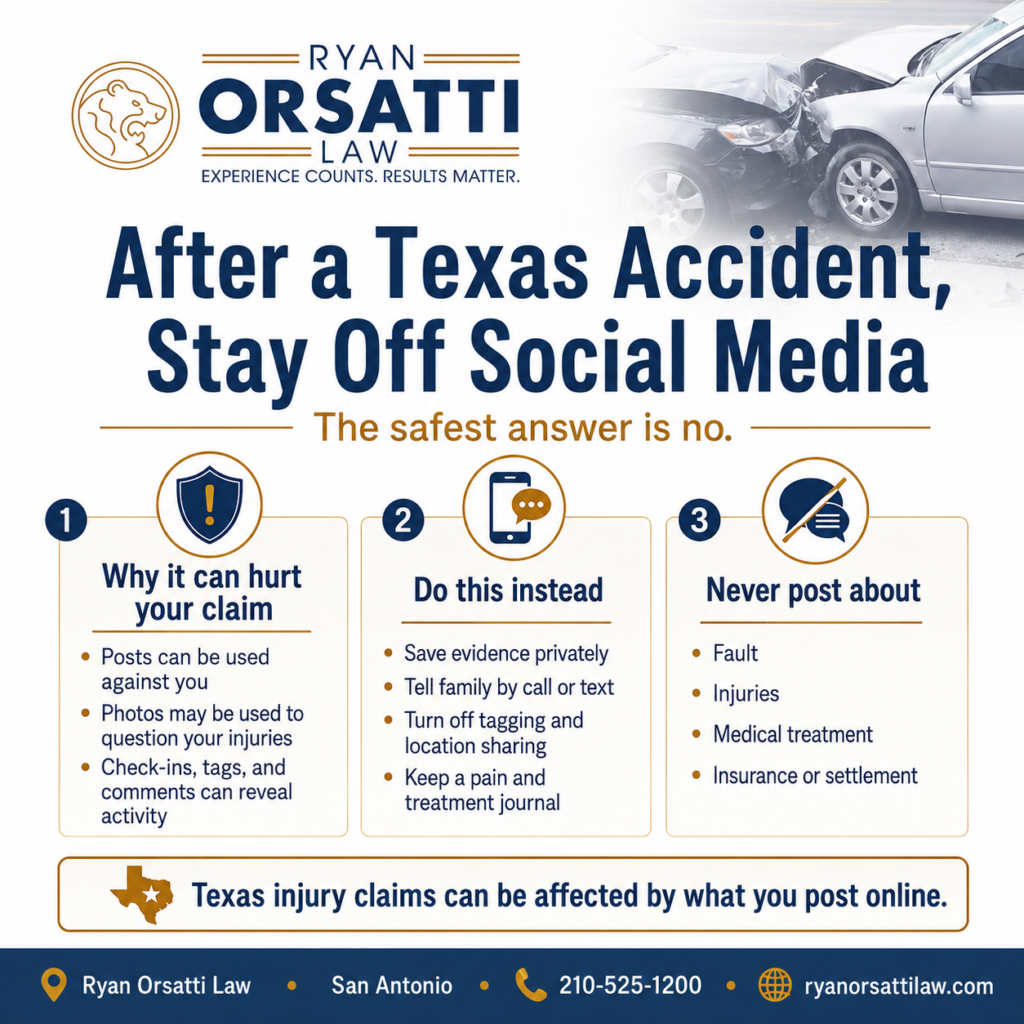
Should I post about my accident on social media after a Texas crash?
No, you should not post about your accident on social media after a Texas crash. Insurance companies look for posts that can be used to argue you are less injured than claimed, more at fault than reported, or inconsistent with your medical records.
This applies to Facebook, Instagram, TikTok, X, Snapchat, LinkedIn, YouTube, Reddit, neighborhood apps, fitness apps, public comments, private groups, and direct messages. The problem is not only what you mean. The problem is how a post can be interpreted later by someone trying to reduce the value of your claim.
A simple post like “I’m okay” may only mean “I survived and I’m trying not to worry my family.” An adjuster may treat it as a statement that you were not hurt. A smiling photo at dinner may only mean you had one decent hour. A defense lawyer may argue it contradicts months of pain complaints.
If you were injured in a crash in San Antonio, Bexar County, Comal County, Guadalupe County, or anywhere in Texas, treat your social media accounts like potential evidence from the day of the accident forward.
Can insurance companies use social media against me in a Texas injury claim?
Yes, insurance companies and defense lawyers can use social media content against you if it is relevant to the issues in your claim. Texas Rule of Civil Procedure 192.3 allows discovery of nonprivileged information relevant to the subject matter of the case, including documents, photographs, electronic recordings, data, and data compilations.
“Discovery” means the formal process where parties request information in a lawsuit. It does not mean the other side automatically gets unlimited access to every private message, unrelated photo, or personal detail. But it does mean relevant posts, photos, videos, comments, messages, and account data can become part of the dispute.
For example, social media may matter if the case involves:
- How the crash happened
- Whether you admitted fault
- Whether your pain complaints are consistent
- Whether you missed work because of the injury
- Whether you are following medical restrictions
- Whether your activity level matches your claimed limitations
- Whether there are witnesses, videos, or statements online
Texas Rule of Evidence 901 also matters because a party offering social media evidence must show enough evidence that the item is what the party claims it is. That can include testimony, account details, contents, appearance, internal patterns, or other distinctive characteristics.
What social media posts are most dangerous after an accident?
The most dangerous posts are the ones that discuss the crash, your injuries, your activities, or your legal claim. Even posts that seem unrelated can cause problems if they create the wrong impression about pain, mobility, emotional distress, work restrictions, or fault.
| Social media activity | Why it can hurt your claim | Safer move |
|---|---|---|
| Posting “I’m fine” or “I’m okay” | Can be used to argue you were not injured | Call or text close family privately |
| Posting crash scene photos | May reveal details before the investigation is complete | Save photos for your lawyer and insurer |
| Blaming the other driver | Can create inconsistent statements about fault | Let the crash report, witnesses, and evidence speak |
| Posting gym, travel, party, or outdoor photos | May be used to dispute pain and physical limits | Avoid activity updates while the claim is pending |
| Checking in at places | Can be used to track your movement and activity | Turn off check-ins and location sharing |
| Commenting about settlement or insurance | Can reveal strategy or create misunderstandings | Keep claim discussions offline and private |
| Letting friends tag you | Other people’s posts may still create problems | Review tag settings and ask friends not to post |
Key takeaway: The safest approach is not to explain your life online while an injury claim is pending because context is often lost when a post is shown to an adjuster, lawyer, judge, or jury.
What should I do with my accounts after the accident?
You should pause posting and lock down avoidable exposure, but you should not destroy or alter potential evidence without legal advice. The goal is to reduce new risk while preserving what already exists.
- Stop posting about the crash, your injuries, treatment, insurance, work status, or legal claim.
- Turn off public tagging, public comments, check-ins, and automatic location sharing.
- Ask friends and family not to post about your accident, recovery, medical appointments, vehicle damage, or legal claim.
- Save screenshots of accident-related posts, messages, tags, or comments that already exist.
- Do not delete, edit, or hide old accident-related posts until you talk to your lawyer.
- Do not accept new friend requests from people you do not know.
- Do not discuss your case in direct messages or group chats.
- Tell your lawyer immediately if you already posted something about the accident.
This checklist applies whether your crash happened on Loop 1604, I-10, I-35, Loop 410, US-281, a San Antonio neighborhood road, or a South Texas highway. Ryan Orsatti Law reviews social media issues as part of a broader evidence plan in serious San Antonio car accident claims and 18-wheeler accident claims.
Attorney Insight: Adjusters rarely treat social media with full context. A client may post one smiling photo after a painful week because they are trying to feel normal for an hour. The adjuster may frame that same photo as proof the injury is exaggerated. The safer strategy is to document pain, treatment, missed work, and limitations privately, then let the claim file tell the story.
Is it enough to make my social media private?
No, making your account private is helpful but not enough. Privacy settings may reduce public viewing, but they do not guarantee that relevant social media content will stay out of a Texas lawsuit.
A private account can still create problems through screenshots, tagged posts, mutual connections, shared messages, discovery requests, subpoenas, or testimony. The issue is not just public visibility. The issue is whether the content is relevant to fault, injuries, damages, credibility, or other disputed facts.
Privacy settings are a shield against casual viewing, not a legal privilege. “Privilege” means a legal protection that allows certain communications or information to be withheld. Your private Instagram photo is not automatically privileged just because your account is closed to the public.
Use privacy settings, but do not rely on them. The better rule is to avoid creating new posts that need explaining later.
What if I already posted about the accident?
If you already posted about the accident, do not panic and do not start deleting everything. Take screenshots, preserve the content, stop posting going forward, and speak with a Texas personal injury lawyer before changing anything.
Deleting a post may feel like the natural fix, but it can create a separate problem if the post is relevant to a claim or lawsuit. Instead, preserve what exists and let your lawyer decide how to address it.
Useful information to save includes:
- The date and time of the post
- The platform
- The full text, not just part of it
- Comments and replies
- Photos or videos attached
- Tags, shares, or reposts
- Direct messages about the accident
- Any posts by the other driver or witnesses
If someone else posted crash footage, comments about fault, or photos from the scene, save that too. It may help your claim. TxDOT explains that Texas crash data comes from Texas Peace Officer’s Crash Reports, also called CR-3 reports, but social media evidence can sometimes capture details that never make it into the report. (TxDOT)
How can social media affect fault in Texas?
Social media can affect fault if a post suggests you admitted blame, minimized the other driver’s conduct, contradicted the crash report, or described events differently than you later testify. This matters because Texas proportionate responsibility can reduce or bar recovery depending on your percentage of fault.
Comparative responsibility means Texas can reduce your recovery by your percentage of fault. Under Texas Civil Practice and Remedies Code § 33.001, a claimant may not recover damages if the claimant’s percentage of responsibility is greater than 50 percent. (Texas Statutes)
That is why posts about fault are especially risky. Avoid statements like:
- “I should have been paying more attention.”
- “I never saw them.”
- “Maybe I was going too fast.”
- “It was partly my fault.”
- “The other driver probably couldn’t avoid me.”
- “I’m not sure what happened, but I feel bad.”
Those statements may be incomplete, emotional, or inaccurate. But once posted, they can be used to create a fault dispute.
How can social media affect my injury damages?
Social media can affect injury damages if it appears inconsistent with your medical records, pain reports, work restrictions, or daily limitations. Damages are the losses claimed in a personal injury case, such as medical bills, lost income, pain, impairment, and loss of normal daily activities.
The danger is selective framing. A ten-second video of you walking normally may not show the pain that came later that night. A vacation photo may not show that the trip was planned before the crash, required medication, or involved long periods of rest. A birthday photo may not show that you left early because your back pain flared.
Insurance companies often compare social media against:
- ER records
- Imaging reports
- Physical therapy notes
- Work status notes
- Pain management records
- Deposition testimony
- Prior recorded statements
- Surveillance footage
- Photos and videos from before and after the crash
If your case involves serious injuries, disputed fault, commercial insurance, a hit-and-run driver, or UM/UIM coverage, the social media issue becomes more important. Ryan Orsatti Law helps injured Texans evaluate evidence and insurance issues in cases involving hit and run crashes and uninsured or underinsured motorist claims.
How long should I stay off social media after an accident?
You should avoid accident-related posting until the claim is fully resolved, and in serious cases you should stay very limited with all activity posts until your lawyer says otherwise. Many Texas injury claims last months, and some disputed cases last longer.
Texas Civil Practice and Remedies Code § 16.003 generally gives two years to bring a personal injury lawsuit, although special rules or shorter notice deadlines may apply in some cases, especially claims involving government entities. (Texas Statutes) That does not mean you should wait two years to get advice. It means the claim may remain active long enough for old and new posts to matter.
A practical rule is this: post nothing you would not want shown on a screen in mediation, deposition, or trial.
What should I do instead of posting about my accident?
Instead of posting online, document privately and preserve evidence carefully. The best record is usually not a public update. It is a clear private file showing what happened, what hurt, what treatment you received, what work you missed, and how the injury affected daily life.
Keep a private folder with:
- Crash scene photos
- Vehicle damage photos
- Medical discharge papers
- Prescriptions
- Work restriction notes
- Lost wage records
- Insurance letters
- Repair estimates
- Pain and limitation notes
- Names and phone numbers of witnesses
- Screenshots of relevant posts by others
Do not exaggerate. Do not diagnose yourself online. Do not argue with the other driver. Do not respond to comments asking who was at fault. A clean, consistent record is better than a public explanation.
When should I talk to a lawyer about social media after an accident?
You should talk to a lawyer before posting, deleting, editing, messaging, or responding about the accident if you were injured or may have a claim. A short review can help you avoid mistakes that are hard to fix later.
Legal help matters most when:
- You went to the ER or urgent care
- You have ongoing pain
- Liability is disputed
- The other driver’s insurer is calling
- A commercial vehicle was involved
- You missed work
- You have prior injuries
- Someone is blaming you
- You already posted about the crash
- Friends or witnesses posted about the crash
Ryan Orsatti Law helps injured people in San Antonio, Bexar County, and across Texas evaluate accident evidence, fault issues, insurance coverage, medical documentation, and social media risks. To discuss a claim, use the firm’s contact page or call the number below.
FAQ: Social Media After a Texas Accident
Can I post that I was in a car accident if I do not discuss fault?
No, it is safer not to post that you were in a car accident while a Texas injury claim is open. Even a neutral post can invite comments, questions, tags, or replies that create problems. Tell close family directly, preserve your photos privately, and let your lawyer decide what should be shared.
Can the insurance company see my private Instagram after a crash?
A private Instagram account is harder for the public to view, but it is not automatically protected from discovery if the content is relevant to a lawsuit. Texas discovery rules allow relevant, nonprivileged information to be requested. Do not assume privacy settings alone will keep posts, messages, photos, or tags out of the claim.
Should I delete old posts after my accident?
No, do not delete old posts after your accident without legal advice. Deleting or editing potentially relevant content can create evidence-preservation issues. The safer step is to stop posting, take screenshots, preserve what exists, and tell your lawyer what was posted before making any changes.
Can my friends’ posts hurt my personal injury claim?
Yes, your friends’ posts can hurt your claim if they tag you, discuss the accident, show your activities, or make comments about your injuries or fault. Ask friends and family not to post about the crash, your recovery, medical visits, insurance, settlement talks, or anything related to the claim.
Is it okay to post medical updates after a Texas accident?
No, avoid posting medical updates after a Texas accident. Medical posts can be incomplete, misunderstood, or compared against your records later. Keep treatment details between you, your medical providers, your lawyer, and the insurance process. If family needs updates, use direct communication rather than public posts.
Can social media affect my settlement?
Yes, social media can affect settlement negotiations if an adjuster believes your posts weaken fault, injury severity, credibility, or damages. A single post usually does not decide a claim by itself, but it can give the insurance company arguments to reduce an offer, delay negotiations, or request more information.
What if the other driver posts about the crash?
If the other driver posts about the crash, preserve it immediately with screenshots or screen recordings. Save the profile name, date, comments, photos, videos, and any admissions. Do not argue online. Posts by the other driver or witnesses may become useful evidence if they relate to fault, distraction, speed, impairment, or the crash timeline.
Ryan Orsatti Law
4634 De Zavala Rd, San Antonio, TX 78249
Phone: 210-525-1200
ryanorsattilaw.com
This blog is for informational purposes only, not legal advice. Reading it does not create an attorney-client relationship. Past results do not guarantee future results.
Hurt in an accident in San Antonio? Learn how a San Antonio personal injury lawyer can help with your claim. Call 210-525-1200 or request a free consultation.
The firm works on a contingency fee. You pay nothing unless the firm recovers money for you, and that covers case expenses as well as the fee: if there is no recovery, you owe no attorney's fee and no case expenses. Ask for the fee agreement and read the fee and expense section before you sign anything.
Related San Antonio legal resources
Primary legal and public-data sources
- Texas Civil Practice and Remedies Code Chapter 16: limitations
- Texas Civil Practice and Remedies Code Chapter 33: proportionate responsibility
Ryan Orsatti Law
4634 De Zavala Road, San Antonio, TX 78249
General reference links. Consult each source for its current text.