
By Ryan Orsatti, Texas personal injury attorney, Ryan Orsatti Law, San Antonio.
Quick Answer
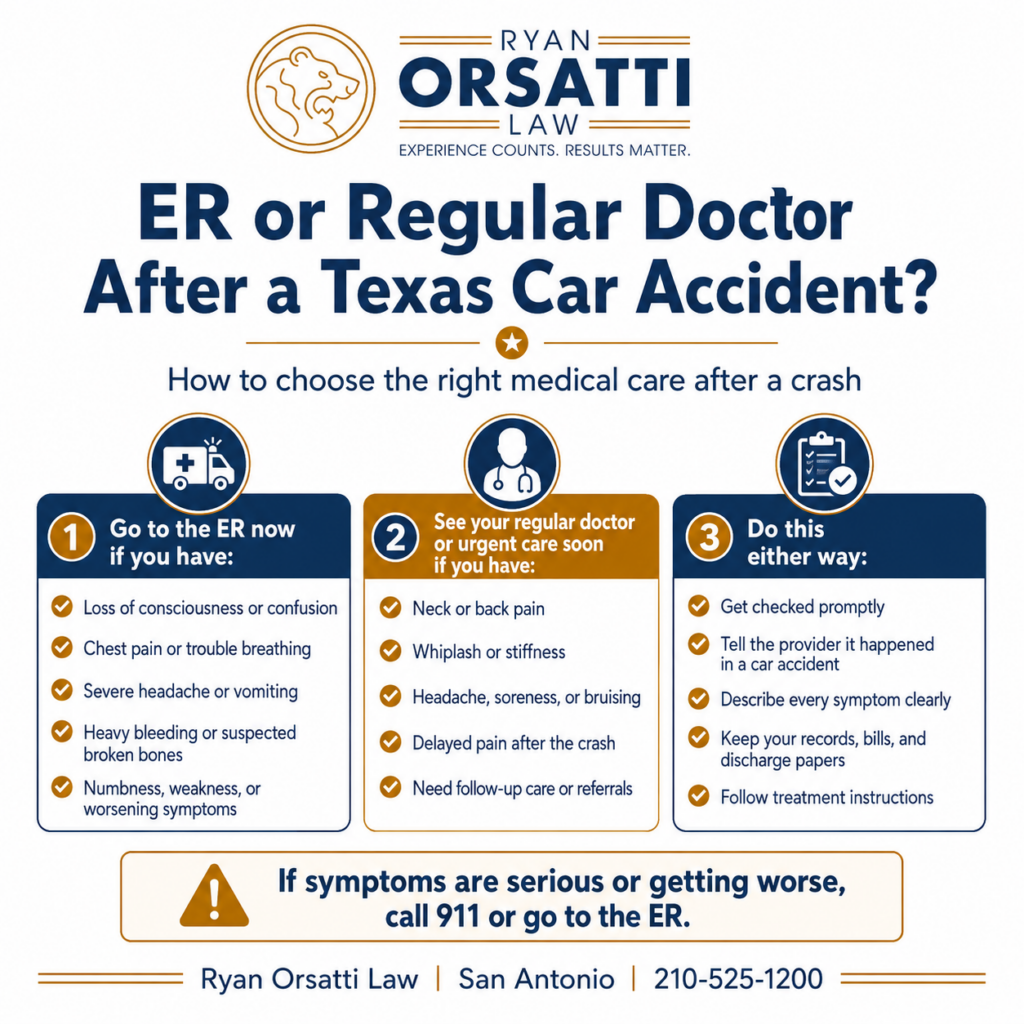
After a car accident in Texas, go to the ER or call 911 if you have serious symptoms such as loss of consciousness, confusion, worsening headache, repeated vomiting, chest pain, severe neck or back pain, weakness, numbness, or trouble breathing. If your symptoms are not an emergency, see your regular doctor or urgent care as soon as practical so your injuries are evaluated and documented. TxDOT reported 251,977 people injured in Texas motor vehicle crashes in 2024, so prompt medical evaluation is not just a legal issue, it is a health issue. (Texas Department of Transportation)
Ryan Orsatti Law helps injured people in San Antonio and across Texas evaluate medical documentation, insurance coverage, PIP, MedPay, hospital bills, and next steps after car accidents.
Key Takeaways
- Go to the ER or call 911 for emergency symptoms after a crash, especially head, neck, spine, chest, abdominal, or neurological symptoms.
- A regular doctor or urgent care may be appropriate for non-emergency pain, soreness, stiffness, headaches, or symptoms that develop later.
- Do not wait just because you felt “okay” at the scene. Whiplash and concussion symptoms can appear hours or days later.
- Tell every medical provider that your symptoms started after a motor vehicle crash, and describe all pain areas clearly.
- Keep medical bills, records, discharge papers, imaging reports, work notes, and referrals.
- In Texas, most personal injury lawsuits must be filed within two years, but medical evidence and insurance issues start much earlier. (Texas Statutes)
Should I go to the ER or my regular doctor after a car accident in Texas?
You should choose the ER when your symptoms could involve a serious or time-sensitive injury, and you should choose your regular doctor or urgent care when your symptoms are not life-threatening but still need prompt evaluation. In Texas injury claims, the most important point is that you get medically evaluated at the right level of care for your symptoms and that the records clearly connect the complaints to the crash.
This question comes up often after wrecks on Loop 1604, I-10, I-35, Loop 410, and neighborhood roads across San Antonio and Bexar County. The answer depends on symptoms, crash severity, age, medical history, and whether pain is getting worse.
A police report, vehicle photos, and insurance claim are not substitutes for medical care. Medical records are what document diagnosis, treatment plan, restrictions, referrals, and whether symptoms were reported close in time to the crash.
When should I go to the ER after a Texas car accident?
Go to the ER or call 911 after a Texas car accident if you have signs of a possible head injury, spinal injury, internal injury, fracture, chest injury, or another serious condition. The CDC lists concussion danger signs that call for immediate emergency care, including worsening headache, repeated vomiting, seizures, slurred speech, weakness, numbness, confusion, unusual behavior, unequal pupils, loss of consciousness, or inability to wake up. (CDC)
ER care is usually the safer option when symptoms are severe, sudden, neurological, or getting worse. That includes chest pain, trouble breathing, abdominal pain, severe headache, severe neck or back pain, loss of bladder or bowel control, weakness, numbness, visible deformity, heavy bleeding, or pain after a high-speed crash.
You should be especially cautious if the injured person is pregnant, elderly, a child, taking blood thinners, recovering from a prior head injury, or medically fragile. These facts can change how urgent the evaluation needs to be.
When is a regular doctor or urgent care appropriate after a crash?
A regular doctor or urgent care may be appropriate when you do not have emergency symptoms but still have pain, stiffness, soreness, headaches, dizziness, bruising, limited range of motion, or symptoms that appear later. Mayo Clinic advises people with neck pain or other whiplash symptoms after a car accident to see a healthcare professional so broken bones or other damage can be ruled out. (Mayo Clinic)
Your regular doctor can evaluate symptoms, order imaging when needed, prescribe medication, document work restrictions, and refer you to physical therapy, an orthopedic doctor, a neurologist, or another provider. Urgent care can help when your regular doctor cannot see you quickly, but urgent care may refer you to an ER if symptoms look more serious.
Do not choose a lower level of care just to save money if your symptoms suggest an emergency. From both a health and claim standpoint, the safer rule is: serious symptoms first, cost concerns second.
What if I felt fine at the scene but hurt the next day?
You should still get checked if symptoms begin hours or days after the crash, because delayed pain is common with soft-tissue, whiplash, and concussion-type injuries. Mayo Clinic notes that whiplash symptoms may not appear right away after a crash, and prompt evaluation can help rule out more serious injury. (Mayo Clinic)
Delayed symptoms should be documented clearly. Tell the provider the crash date, where you were sitting, whether airbags deployed, whether your head or body moved suddenly, and when each symptom began.
Insurance adjusters often focus on gaps in treatment. A delay does not automatically ruin a Texas injury claim, but it gives the insurance company an argument that the injury was minor, unrelated, or caused by something else.
ER vs. urgent care vs. regular doctor after a Texas car accident
The right medical choice after a Texas car accident depends on symptom severity, not on what looks better for an insurance claim. The ER is for emergencies, urgent care is for prompt non-emergency evaluation, and your regular doctor is often best for ongoing care, referrals, work notes, and follow-up.
| Medical option | Better fit when | What it usually helps document | Claim-related concern |
|---|---|---|---|
| ER or ambulance | Loss of consciousness, confusion, severe pain, chest pain, abdominal pain, weakness, numbness, breathing trouble, suspected fracture, major crash | Emergency symptoms, imaging, trauma evaluation, discharge instructions | Expensive, but often necessary for serious symptoms |
| Urgent care | Pain, stiffness, minor cuts, soreness, headache, mild dizziness, no emergency red flags | Initial evaluation, medications, basic imaging, referral instructions | May not handle serious trauma or advanced imaging |
| Regular doctor | Non-emergency symptoms, delayed symptoms, follow-up care, medication management, work restrictions | Consistent treatment history, referrals, restrictions, symptom progression | Appointment delays can create documentation gaps |
| Orthopedic doctor, neurologist, or physical therapy | Persistent neck, back, shoulder, knee, head, nerve, or mobility problems after initial evaluation | Diagnosis, objective findings, treatment plan, impairment issues | Usually works best after referral or documented initial visit |
| Telehealth | Medication questions, limited follow-up, referral discussion, records review | Limited documentation of subjective complaints | Usually not enough for serious crash injuries by itself |
Key takeaway: Choose care based on symptoms first, then make sure every provider documents that the symptoms followed the crash and records all body parts that hurt.
How does medical treatment affect a Texas car accident claim?
Medical treatment affects a Texas car accident claim because it helps prove injury, causation, medical necessity, and damages. Causation means the connection between the crash and the injury. Texas law also limits recovery of medical or health care expenses to amounts actually paid or incurred by or on behalf of the claimant, so bills, insurance adjustments, and payment sources matter. (Texas Statutes)
An ER visit alone may not be enough if the discharge instructions tell you to follow up and you never do. A regular doctor visit alone may not be enough if the symptoms were serious enough to require emergency care.
A clean treatment timeline usually helps. That means the first visit documents the crash, later visits document whether symptoms improved or worsened, and referrals show why additional care was needed.
Attorney Insight: Insurance adjusters rarely evaluate medical treatment in isolation. They look for patterns: how soon you reported pain, whether the complaints match the crash mechanics, whether every provider documented the same injury areas, whether you followed discharge instructions, and whether there are unexplained gaps. A modest ER visit followed by consistent, appropriate care can be stronger than a dramatic first visit with no follow-up.
Who pays for ER or doctor bills after a Texas car accident?
After a Texas car accident, medical bills may be paid through health insurance, PIP, MedPay, the at-fault driver’s liability insurance, UM/UIM coverage, or sometimes a letter of protection. The Texas Department of Insurance tells crash victims to keep medical records and bills for the insurance company, and TDI also explains that the other driver’s insurer should pay medical bills if that driver was at fault. (Texas Department of Insurance)
PIP means Personal Injury Protection. TDI explains that PIP is similar to medical payments coverage because it pays medical bills, but PIP can also pay for lost wages and some nonmedical costs. Texas auto policies include PIP unless the insured rejects it in writing. (Texas Department of Insurance)
MedPay means medical payments coverage. The Office of Public Insurance Counsel explains that PIP and MedPay both pay regardless of fault, but they are different coverages. (Office of Public Insurance Counsel)
UM/UIM means uninsured or underinsured motorist coverage. It may matter if the at-fault driver has no insurance, too little insurance, or leaves the scene. Ryan Orsatti Law has additional information about San Antonio uninsured and underinsured motorist claims.
What is a hospital lien after a Texas car accident?
A hospital lien is a legal claim a hospital may assert against part of a personal injury recovery for certain accident-related hospital care. Under Texas Property Code Chapter 55, a hospital lien can attach when an injured person receives hospital services for injuries caused by an accident attributed to another person’s negligence, and the person is admitted to a hospital not later than 72 hours after the accident. (Texas Statutes)
A lien is different from an ordinary bill. It can affect settlement distribution, health insurance coordination, and the amount that must be resolved before funds are released.
If hospital liens, health insurance, PIP, MedPay, and liability coverage are all involved, the billing order matters. Ryan Orsatti Law helps injured people review these issues in Texas crash claims, including who pays medical bills after a car accident in Texas and PIP and MedPay coverage in Texas.
What should I tell the doctor after a car accident?
Tell the doctor the truth, be specific, and explain that your symptoms started after a motor vehicle crash. Medical records are only useful if they accurately reflect what happened, what hurts, when symptoms began, and how the injuries affect work, sleep, driving, lifting, childcare, and daily activities.
Use this checklist at the ER, urgent care, or your regular doctor:
- State the crash date, time, and location.
- Explain how the crash happened in simple terms.
- Identify every body part that hurts, even if one area hurts more.
- Describe symptoms such as headache, dizziness, nausea, numbness, tingling, weakness, stiffness, sleep problems, or memory issues.
- Tell the provider if symptoms appeared later or got worse.
- Mention prior injuries honestly, but explain what changed after this crash.
- Ask what symptoms should make you return to the ER.
- Follow discharge instructions and schedule recommended follow-up.
- Save discharge papers, prescriptions, imaging reports, work notes, and referrals.
- Keep a simple symptom journal for the first few weeks.
Do not exaggerate and do not minimize. Both can hurt your medical care and your claim. Accurate, consistent reporting is the goal.
How soon should I see a doctor if I did not go to the ER?
You should see a doctor as soon as possible if you have pain or symptoms after a crash, even if you did not go to the ER from the scene. Texas does not have a rule that says every crash victim must see a doctor within a specific number of hours, but waiting too long can create medical risk and make the insurance claim harder to prove.
This is especially true in rear-end crashes, T-bone collisions, highway wrecks, and crashes involving airbags. Pain can increase after adrenaline wears off.
A delay is not always fatal to a claim. But the longer the gap, the more important it becomes to explain it honestly, such as lack of transportation, inability to get an appointment, childcare issues, financial concerns, or symptoms that did not appear until later.
Can the insurance company use my medical choice against me?
Yes, an insurance company may use your medical choice, delay, gaps in treatment, or inconsistent records to question your injury claim. Texas uses proportionate responsibility, which means fault and evidence matter, and a claimant may not recover damages if the claimant’s percentage of responsibility is greater than 50 percent. (Texas Statutes)
Adjusters may argue that no ER visit means the injury was not serious. They may also argue that a long treatment gap means the crash did not cause the symptoms.
Those arguments are not always fair, but they are common. The practical response is to get appropriate medical care, follow instructions, document symptoms clearly, and avoid giving recorded statements before you understand the medical and coverage issues.
Should I wait for the crash report before seeing a doctor?
No, you should not wait for the crash report before seeing a doctor after a Texas car accident. A Texas Peace Officer’s Crash Report, also called a CR-3, can help with insurance and fault issues, but it does not diagnose injuries or create a treatment plan.
Texas law requires an officer who investigates a qualifying crash to make a written report if the crash involved injury, death, or apparent property damage of $1,000 or more, and the report must be filed electronically with TxDOT not later than the 10th day after the collision. (Justia Law)
For more detail on timing, Ryan Orsatti Law explains how long it takes for a Texas crash report to become available.
When should I call a Texas car accident lawyer about medical treatment?
You should call a Texas car accident lawyer when injuries, bills, fault, insurance coverage, recorded statements, liens, missed work, or treatment referrals become unclear. A lawyer should not make medical decisions for you, but a Texas personal injury lawyer can help protect the claim while you and your providers focus on medical care.
Legal help is especially useful when the other driver denies fault, the insurer requests a recorded statement, the ER bill is large, the hospital files a lien, you missed work, you need PIP or MedPay reviewed, or the other driver has minimum limits or no insurance.
Ryan Orsatti Law helps injured people in San Antonio, Bexar County, and across Texas evaluate car accident claims, medical-bill issues, insurance coverage, and evidence preservation. You can learn more about the firm’s San Antonio car accident representation and its guide on prompt medical treatment after a car wreck in Texas.
FAQs
Should I go to the ER after a minor car accident in Texas?
You do not always need the ER after a minor crash, but you should go immediately if you have emergency symptoms such as confusion, loss of consciousness, worsening headache, vomiting, severe pain, chest pain, numbness, weakness, or trouble breathing. If symptoms are milder, see your regular doctor or urgent care promptly and follow their instructions. (CDC)
Is urgent care good enough after a Texas car accident?
Urgent care can be enough for non-emergency symptoms such as soreness, stiffness, minor cuts, mild pain, or delayed discomfort, but it is not a substitute for the ER when symptoms suggest serious trauma. If urgent care sees signs of head, spine, chest, abdominal, or neurological injury, they may send you to the ER.
Will insurance deny my claim if I see my regular doctor instead of the ER?
Insurance should not deny a valid claim simply because you saw your regular doctor instead of the ER, but adjusters may question whether the care matched the injury. The stronger issue is whether you sought timely, reasonable treatment and whether the records connect your symptoms to the crash. Consistent follow-up matters.
How soon should I see a doctor after a car accident in Texas?
You should see a doctor as soon as practical if you have pain or symptoms after a Texas car accident. There is no universal Texas rule requiring treatment within a set number of hours for every injury claim, but delays can create health risks and give the insurance company arguments about causation, severity, and treatment gaps.
Who pays my ER bill after a Texas car accident?
Payment may come from health insurance, PIP, MedPay, the at-fault driver’s liability insurance, UM/UIM coverage, or another source depending on the facts and policies. TDI explains that PIP can pay medical bills and lost wages, while MedPay pays medical bills. Keep all bills and records before resolving the claim. (Texas Department of Insurance)
Can I still have a claim if I waited a few days to see a doctor?
Yes, you may still have a claim if you waited a few days, especially if symptoms appeared later or you had a reasonable explanation. But waiting can make the claim harder. The insurance company may argue the injuries were unrelated or minor, so it helps to document when symptoms began and why care was delayed.
Does going to the ER make my car accident case worth more?
Not automatically. An ER visit may support the seriousness and timing of symptoms, but claim value depends on the full evidence: diagnosis, treatment, imaging, recovery time, impairment, missed work, fault, insurance limits, medical bills, and consistency. The goal is appropriate medical care, not choosing a provider for claim optics.
Should I talk to the insurance adjuster before I see a doctor?
Be careful. You can report the crash, but avoid giving a detailed recorded statement about injuries before you know your medical condition. Symptoms can change after the first day. If you have significant pain, ER care, missed work, disputed fault, or coverage questions, talk to a Texas personal injury lawyer before making detailed injury statements.
Ryan Orsatti Law
4634 De Zavala Rd, San Antonio, TX 78249
Phone: 210-525-1200
ryanorsattilaw.com
This blog is for informational purposes only, not legal advice. Reading it does not create an attorney-client relationship. Past results do not guarantee future results.
Hurt in an accident in San Antonio? Learn how a San Antonio personal injury lawyer can help with your claim. Call 210-525-1200 or request a free consultation.
The firm works on a contingency fee. You pay nothing unless the firm recovers money for you, and that covers case expenses as well as the fee: if there is no recovery, you owe no attorney's fee and no case expenses. Ask for the fee agreement and read the fee and expense section before you sign anything.
Related San Antonio legal resources
Primary legal and public-data sources
- TxDOT: Texas crash reports, data, and statistics
- Texas Civil Practice and Remedies Code Chapter 33: proportionate responsibility
Ryan Orsatti Law
4634 De Zavala Road, San Antonio, TX 78249
General reference links. Consult each source for its current text.