
By Ryan Orsatti, Texas personal injury attorney, Ryan Orsatti Law, San Antonio.
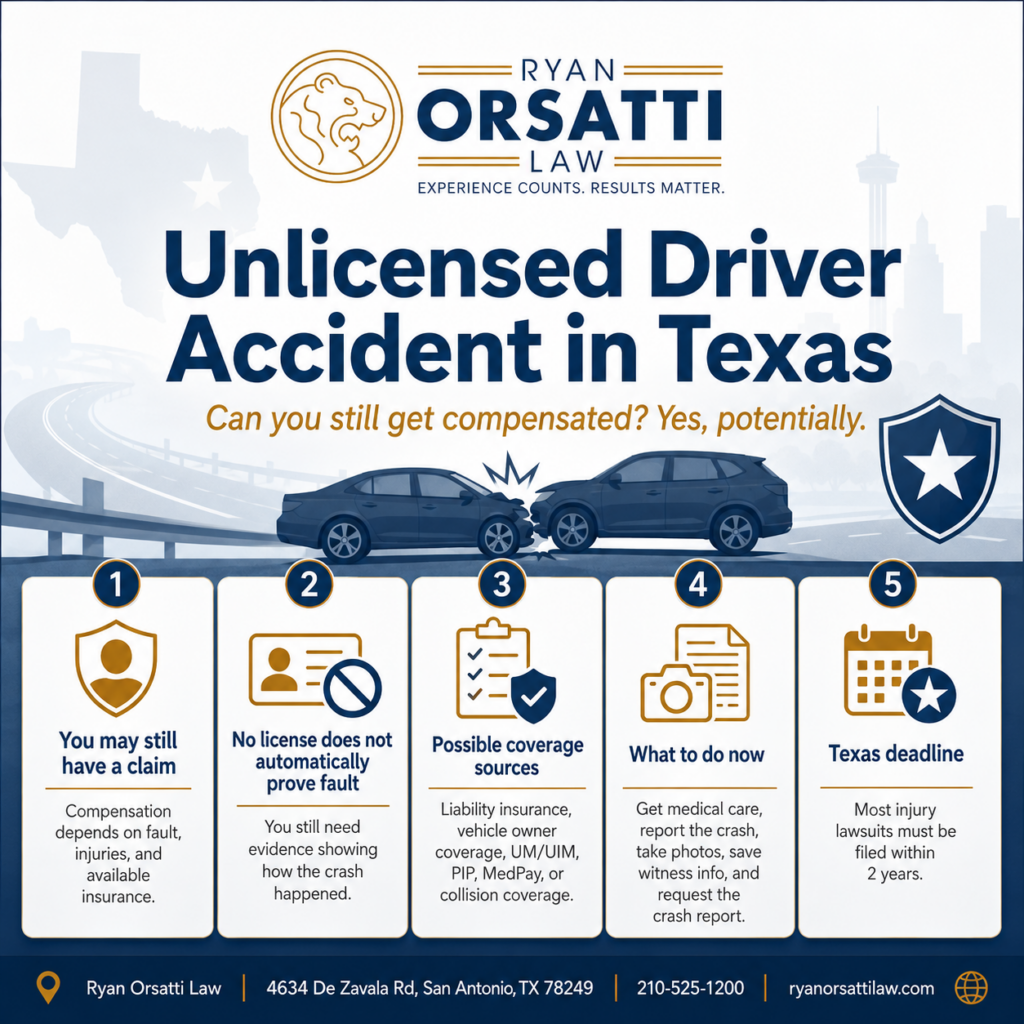
Quick Answer: Yes. If an unlicensed driver caused your accident in Texas, you can still seek compensation, but the lack of a license does not automatically prove the whole injury claim. You still need evidence that the driver’s negligence caused the crash, proof of your injuries and damages, and an available source of recovery, such as liability insurance, UM/UIM coverage, PIP, MedPay, collision coverage, or the driver’s personal assets. NHTSA reported that 19% of U.S. motor vehicle fatalities in 2012 involved drivers with invalid licenses, while cautioning that license status alone does not prove crash causation. (CrashStats)
Key Takeaways
- An unlicensed driver can still be legally responsible for a Texas crash if careless driving caused your injuries.
- “Unlicensed” does not always mean “uninsured.” The driver, vehicle owner, or your own policy may provide coverage.
- Texas generally gives injured people two years to file a personal injury lawsuit, but shorter notice issues can apply in some cases. (Texas Constitution and Statutes)
- Texas uses proportionate responsibility, meaning your recovery can be reduced by your percentage of fault, and you generally cannot recover if you are more than 50% responsible. (Texas Constitution and Statutes)
- The Texas crash report, photos, witnesses, insurance documents, medical records, and policy declarations can matter more than the traffic ticket itself.
- Ryan Orsatti Law helps injured people in San Antonio and across Texas evaluate fault, coverage, medical bills, and evidence after crashes involving unlicensed or uninsured drivers.
Can I get compensated if an unlicensed driver hit me in Texas?
Yes, you may still be able to get compensated if an unlicensed driver hit you in Texas, but compensation depends on fault, damages, and collectable insurance or assets. Texas law requires a person operating a motor vehicle on a Texas highway to hold a valid driver’s license, but a license violation is only one part of the civil claim. (Texas Constitution and Statutes)
The civil claim usually focuses on negligence. Negligence means the driver failed to use reasonable care, such as running a red light, speeding, failing to yield, following too closely, driving distracted, or making an unsafe lane change.
A driver’s lack of a license can be powerful evidence, especially if it helps show unsafe driving, lack of qualification, or a known risk. Still, the claim must connect the crash to your injuries, medical bills, lost income, pain, physical limitations, and other damages.
Does driving without a license automatically make the other driver at fault?
No. Driving without a license does not automatically prove the unlicensed driver caused the crash, but it can be an important fact in the case. Texas injury claims still require proof that the driver’s conduct was a legal cause of the collision and your injuries.
The Texas Supreme Court has explained that proximate cause requires more than “but for” causation. The negligence must be a substantial factor in bringing about the injury. In plain English, the unsafe conduct must actually matter to how the wreck happened. (Texas Judicial Branch)
For example, if an unlicensed driver rear-ended you while texting on Loop 1604, the lack of a license may support the claim, but the rear-end impact, distraction, speed, braking, and vehicle damage will likely be the core liability evidence. If both drivers entered an intersection at the same time, the case may turn on signal timing, right-of-way, witnesses, dashcam footage, and the crash report.
What compensation may be available after an unlicensed driver accident in Texas?
Compensation after an unlicensed-driver crash may come from several sources, depending on the facts and insurance policies involved. Texas minimum liability coverage is commonly described as 30/60/25, meaning at least $30,000 for injuries to one person, $60,000 total for injuries per accident, and $25,000 for property damage. (Texas Department of Insurance)
| Possible source of recovery | What it may cover | What to verify |
|---|---|---|
| At-fault driver’s liability insurance | Injury damages and property damage caused by the driver | Whether the policy was active and whether the driver was covered or excluded |
| Vehicle owner’s insurance | Claims involving a borrowed vehicle | Whether the driver had permission and whether the policy covers permissive users |
| Your UM/UIM coverage | Injuries caused by an uninsured or underinsured driver | Whether you rejected UM/UIM coverage in writing |
| PIP or MedPay | Medical bills and, for PIP, possible lost income | Whether your policy includes the coverage and the limits |
| Collision coverage | Vehicle repair or total loss | Deductible, total-loss valuation, and reimbursement rights |
| Health insurance | Medical care while the injury claim is pending | Subrogation, which means the insurer may claim repayment from a recovery |
| Personal assets of the driver | Possible direct recovery from the at-fault driver | Whether the driver has collectable assets |
Key takeaway: Do not assume there is no recovery just because the driver had no license. The real coverage question is whether any policy, person, employer, owner, or first-party benefit can be used.
What if the unlicensed driver was also uninsured?
If the unlicensed driver was also uninsured, your own auto policy may become the most important source of recovery. Uninsured/underinsured motorist coverage, often called UM/UIM, can apply when the at-fault driver has no insurance or not enough insurance, but Texas insurers must offer it and the named insured may reject it in writing. (Texas Constitution and Statutes)
PIP, MedPay, collision coverage, and health insurance may also help. PIP means personal injury protection. Texas auto policies generally include PIP unless it is rejected in writing, and it can help with medical bills and certain lost income regardless of who caused the crash. (Texas Department of Insurance)
If there is no usable insurance, a claim against the driver personally may still exist. The practical issue is collection. A judgment against someone with no insurance, no job, and no assets may be difficult to collect, which is why a careful coverage review is critical.
For more on this issue, see Ryan Orsatti Law’s page on uninsured and underinsured motorist accident claims.
What if the unlicensed driver was driving someone else’s car?
If the unlicensed driver was driving someone else’s car, the vehicle owner’s insurance may need to be reviewed immediately. The Texas Department of Insurance explains that when someone causes a wreck while driving a borrowed car, the car owner’s insurance may pay first, and the driver’s insurance may apply if the owner does not have enough coverage. (Texas Department of Insurance)
That does not mean every borrowed-car claim is covered. Insurance companies may raise issues about permission, excluded drivers, household members, named-driver policies, misrepresentations, or business use.
A lawyer should also examine whether the owner, employer, rental company, rideshare company, or commercial entity had any role in allowing the vehicle to be used. These issues are fact-specific and should not be guessed from the crash scene alone.
What evidence should I save after a crash with an unlicensed driver?
You should save evidence that proves fault, injuries, insurance coverage, and damages, not just evidence that the other driver had no license. TxDOT collects crash data from Texas law enforcement through the Texas Peace Officer’s Crash Report, commonly called the CR-3, and that report can be an important starting point. (Texas Department of Transportation)
Use this checklist:
- Call 911 if anyone is hurt, the driver may be uninsured, the driver has no license, or the crash scene is unsafe.
- Photograph the vehicles, license plates, damage, skid marks, debris, traffic signs, signal lights, and nearby cameras.
- Get the driver’s name, address, phone number, insurance card, vehicle owner information, and any ID the driver has.
- Get witness names and phone numbers before they leave.
- Ask nearby businesses or homes whether they have camera footage.
- Seek medical care promptly and follow the treatment plan.
- Save discharge paperwork, prescriptions, imaging, referrals, work restrictions, and bills.
- Notify your own insurance company promptly, but be careful with recorded statements requested by the other driver’s insurer.
- Request the crash report when available and review it for license status, insurance information, contributing factors, and witness information.
- Preserve dashcam, phone, rideshare, GPS, and vehicle data before it is overwritten.
Texas law generally requires an officer’s written crash report when a crash results in injury, death, or apparent property damage of $1,000 or more, and the report is filed electronically within the statutory deadline. (Texas Constitution and Statutes)
For more detail, Ryan Orsatti Law has a guide on how long it takes before a Texas police report becomes available.
How do medical bills and liens work after an unlicensed-driver accident?
Medical bills after an unlicensed-driver crash may be paid through health insurance, PIP, MedPay, UM/UIM, a letter of protection, or a later injury settlement. The best path depends on your insurance, the seriousness of your injuries, the providers involved, and whether any reimbursement claims apply.
Subrogation means a health insurer or benefit plan may claim a right to be repaid from part of a personal injury recovery. A hospital lien is a legal claim that may attach to an injury claim when a hospital treats accident-related injuries under Texas Property Code Chapter 55, including rules tied to hospital admission after the accident. (Texas Constitution and Statutes)
This is where many injured people make costly mistakes. A quick settlement with the wrong release language can leave unresolved medical bills, liens, or reimbursement claims. Before signing a release, TDI advises making sure your doctor believes you have healed or that you understand the likely cost of future treatment. (Texas Department of Insurance)
Attorney Insight: In unlicensed-driver cases, adjusters often try to separate “no license” from “what caused the crash.” The strongest files connect both: the CR-3, photos, witness statements, vehicle damage, traffic-control evidence, treatment history, and policy documents. Do not rely on the citation alone. Build the case around unsafe driving, causation, and documented injury.
How long do I have to file a Texas accident claim against an unlicensed driver?
In most Texas personal injury cases, you generally have two years from the crash date to file a lawsuit. Texas Civil Practice and Remedies Code § 16.003 is the key limitations statute for injury claims, but special facts can change the analysis. (Texas Constitution and Statutes)
Do not wait until the deadline is close. Insurance coverage can disappear, video can be overwritten, witnesses can become hard to find, and medical documentation can become weaker if treatment is delayed.
If a government vehicle, road defect, public employee, minor, death claim, or out-of-state party is involved, additional rules may apply. Those issues should be evaluated promptly because some notice requirements can be much shorter than the two-year filing period.
How does Texas proportionate responsibility affect an unlicensed-driver claim?
Texas proportionate responsibility can reduce or bar recovery even when the other driver was unlicensed. Proportionate responsibility means the factfinder can assign percentages of fault to the people or entities involved, and Texas generally bars recovery if the claimant is more than 50% responsible. (Texas Constitution and Statutes)
This matters because insurance companies often argue the injured person shares fault. They may claim you were speeding, failed to keep a proper lookout, changed lanes unsafely, stopped suddenly, or delayed medical care.
The best response is evidence. Scene photos, vehicle damage, event data, traffic-camera footage, medical records, phone records, and witness statements can help push the case away from blame-shifting and toward what actually happened.
When should I contact a Texas personal injury lawyer after an unlicensed-driver crash?
You should contact a Texas personal injury lawyer early if the other driver was unlicensed, uninsured, driving someone else’s car, disputing fault, or if you needed medical care after the crash. These cases often require a fast coverage investigation and evidence preservation before insurers lock into a denial.
Ryan Orsatti Law helps injured people in San Antonio, Bexar County, and across Texas evaluate unlicensed-driver crashes, insurance coverage, UM/UIM claims, medical documentation, liens, and settlement decisions. The firm’s San Antonio car accident lawyer page explains how Texas crash claims often involve fault, insurance, medical bills, and deadlines. (Ryan Orsatti Law)
This type of case is not just about whether the other driver had a license. It is about proving what happened, finding all available insurance, documenting the injury, and making decisions before signing away rights.
What should I do next after being hit by an unlicensed driver in San Antonio?
After being hit by an unlicensed driver in San Antonio, get medical care, report the crash, preserve evidence, notify your own insurer, and review your policy for UM/UIM, PIP, MedPay, and collision coverage. If you were hurt, speak with a lawyer before giving a broad recorded statement or signing a release.
A San Antonio crash may involve local roads like I-10, I-35, Loop 410, Loop 1604, US-281, Wurzbach Parkway, Bandera Road, Culebra Road, or De Zavala Road. Local details can matter because cameras, witnesses, responding agencies, traffic patterns, and roadway design may affect the investigation.
Ryan Orsatti Law is based in San Antonio and focuses on helping injured people understand their options after serious Texas accidents. You can also learn more about the firm on the About Ryan Orsatti Law page. (Ryan Orsatti Law)
FAQ
Can I sue an unlicensed driver after a Texas car accident?
Yes. You can sue an unlicensed driver after a Texas car accident if you can prove the driver’s negligence caused your injuries and damages. The lack of a license can support the claim, but it does not replace proof of fault, medical causation, insurance coverage, and damages.
Does UM/UIM cover a crash caused by an unlicensed driver in Texas?
UM/UIM may cover a crash caused by an unlicensed driver if the driver was uninsured or did not have enough insurance and your policy includes UM/UIM coverage. Texas insurers must offer UM/UIM, but it can be rejected in writing, so your declarations page and policy documents matter. (Texas Constitution and Statutes)
What if I was partly at fault and the other driver had no license?
You may still have a claim if you were partly at fault, but Texas proportionate responsibility can reduce your recovery by your percentage of responsibility. If you are found more than 50% responsible, Texas law generally bars recovery, even if the other driver was unlicensed. (Texas Constitution and Statutes)
Will the unlicensed driver’s ticket prove my injury claim?
No. A ticket for driving without a license may help, but it does not automatically prove your injury claim. You still need evidence showing how the crash happened, why the driver’s conduct caused it, what injuries you suffered, and what damages you incurred.
What if the unlicensed driver was borrowing someone else’s car?
If the unlicensed driver was borrowing someone else’s car, the owner’s insurance policy should be reviewed. Coverage may depend on permission, policy language, exclusions, and whether the driver had any separate insurance. Do not assume there is no coverage until the policies are checked.
How soon should I get the Texas crash report after an unlicensed-driver accident?
You should request the Texas crash report as soon as it becomes available because it may identify the driver, owner, insurance, license status, contributing factors, and witnesses. TxDOT crash data comes from law enforcement reports submitted through the Texas Peace Officer’s Crash Report system. (Texas Department of Transportation)
Should I give a recorded statement to the unlicensed driver’s insurance company?
Be careful. You should notify your own insurance company promptly, but the other driver’s insurer is not there to advise you. A recorded statement can be used to dispute fault, injuries, timing of treatment, or prior conditions. Consider getting legal guidance before giving a detailed statement.
Ryan Orsatti Law
4634 De Zavala Rd, San Antonio, TX 78249
Phone: 210-525-1200
ryanorsattilaw.com
This blog is for informational purposes only, not legal advice. Reading it does not create an attorney-client relationship. Past results do not guarantee future results.
Hurt in an accident in San Antonio? Learn how a San Antonio personal injury lawyer can help with your claim. Call 210-525-1200 or request a free consultation.
The firm works on a contingency fee. You pay nothing unless the firm recovers money for you, and that covers case expenses as well as the fee: if there is no recovery, you owe no attorney's fee and no case expenses. Ask for the fee agreement and read the fee and expense section before you sign anything.
Related San Antonio legal resources
Primary legal and public-data sources
- Texas Civil Practice and Remedies Code Chapter 16: limitations
- Texas Civil Practice and Remedies Code Chapter 33: proportionate responsibility
Ryan Orsatti Law
4634 De Zavala Road, San Antonio, TX 78249
General reference links. Consult each source for its current text.