
Quick Answer
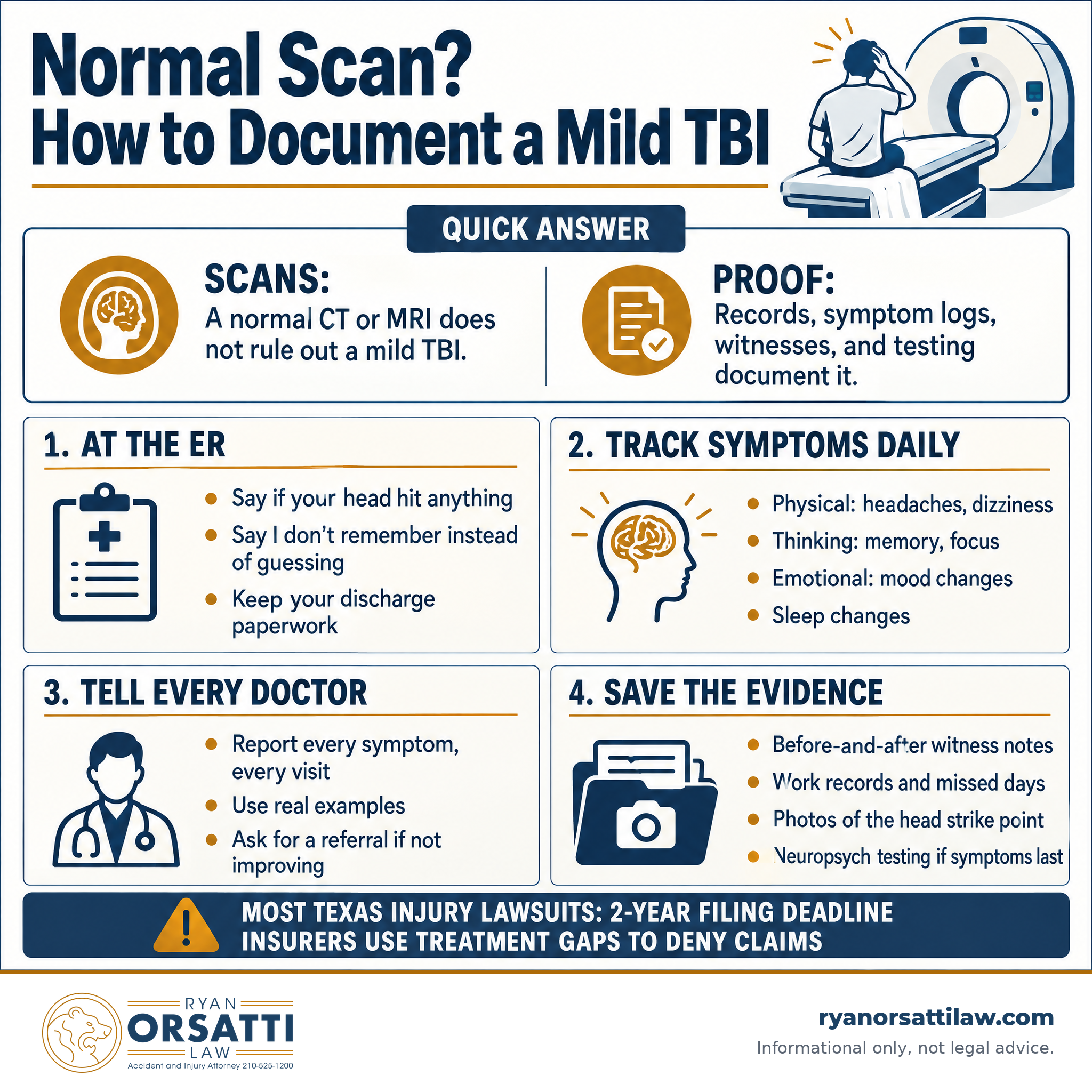
- A normal CT or MRI does not rule out a mild traumatic brain injury (mild TBI). A head CT is built to find bleeding, fractures, and swelling, and the National Institute of Neurological Disorders and Stroke (NINDS) says current clinical tools cannot always detect damage from mild, concussive injuries.
- You document a mild TBI with three kinds of proof: what the medical team recorded right after the crash, what you and people close to you track day to day, and what later testing shows, such as a neuropsychological evaluation.
- Tell every provider about every symptom at every visit, in plain words. Vague or missing symptoms in your records are what insurance adjusters use to deny brain injury claims.
- In Texas, most personal injury lawsuits must be filed within two years under Texas Civil Practice and Remedies Code Sec. 16.003.
Key Takeaways
- In a UCSF-led study published in Annals of Neurology, 27 of 99 mild TBI patients with a normal CT scan had detectable findings on MRI.
- The American Congress of Rehabilitation Medicine’s 2023 diagnostic criteria say “concussion” and “mild TBI” can be used interchangeably when brain imaging is normal or not needed.
- In the TRACK-TBI study (JAMA Neurology, 2019), 53 percent of 1,154 patients with mild TBI reported incomplete functional recovery 12 months after injury.
- The CDC says some mild TBI and concussion symptoms may not appear for hours or days after the injury.
If you were hurt in a Texas crash and your scans came back clean but you still do not feel like yourself, you can talk through how your symptoms are being documented with Ryan Orsatti Law in a free consultation. The firm is a San Antonio personal injury firm that has represented injured Texans for more than a decade and works with people across the state from offices in San Antonio, Austin, Dallas, and Houston.
Why Can a Brain Injury Not Show Up on a CT or MRI?
A mild traumatic brain injury often does not show up on a CT or MRI because the injury can be too subtle for standard scans to see. NINDS explains that CT imaging can show a skull fracture and brain bruising, bleeding, or swelling. MRI is more sensitive and can pick up subtle changes a CT may miss. Even so, NINDS says the clinically validated imaging and blood tests available today cannot always detect damage from mild, concussive injuries.
The ER’s job is to rule out an emergency, such as a brain bleed that needs surgery. A normal head CT answers that question, not whether your brain works the way it did before the wreck.
In the UCSF-led study, 99 of 135 mild TBI patients had a normal CT, and 27 of those 99 had detectable spots on a later MRI that helped predict lasting neurological problems.
Medical definitions agree. The American Congress of Rehabilitation Medicine’s 2023 criteria treat “concussion” and “mild TBI” as the same diagnosis when imaging is normal or not needed. A clean scan and a real brain injury can exist in the same patient.
Your chart may list a Glasgow Coma Scale score (a bedside rating of alertness). The FDA clearance for one concussion blood test describes suspected mild TBI as a score of 13 to 15, so a “GCS 15” means you were awake and talking, not that your brain was uninjured.
What Evidence Documents a Mild TBI When Scans Are Normal?
When scans are normal, a mild TBI is documented by records made close to the crash, symptom tracking over time, outside observers, and specialized testing. No single item carries the claim. Consistency across all of them does.
| Evidence | What it shows | Who creates it | When it matters most |
|---|---|---|---|
| EMS and ER records | Confusion, memory gaps, loss of consciousness, Glasgow Coma Scale score | Paramedics, ER staff | First hours |
| Daily symptom log | Headaches, sleep, focus, mood, light and noise sensitivity | You or a family member | From day one |
| Before-and-after statements | Changes in memory, temper, work, and routines | Spouse, coworkers, friends | First few months |
| Neuropsychological testing | Memory, attention, processing speed, problem solving, effort | Neuropsychologist | When symptoms last past the first few weeks |
| Specialist follow-up | Neurology, balance, vision, and speech-cognitive findings | Treating specialists | Weeks to months |
| MRI or advanced imaging | Subtle changes a CT can miss | Radiologist | When a treating doctor orders it |
| Crash evidence | Head strike point, airbag deployment, force of impact | Photos, CR-3 crash report, vehicle data | Right away, before repairs |
Some ERs also run a blood test for two brain proteins, GFAP and UCH-L1. The FDA cleared Abbott’s i-STAT TBI test for adults with suspected mild TBI within 24 hours of injury, to help decide whether a head CT is needed. A “not elevated” result points to no acute lesion on CT. It does not rule out a concussion.
How to Document Mild TBI Symptoms After a Texas Crash: 10 Steps
The most reliable way to document mild TBI symptoms is to start the same day and keep the record consistent across every doctor and every visit.
- Get checked the same day. If your head hit anything, tell the paramedics and the ER staff.
- Say “I don’t know” instead of guessing. If someone asks whether you blacked out and you are not sure, an honest “I don’t remember” is more accurate than “no,” and the memory gap is itself a symptom.
- Keep your discharge paperwork. It shows the diagnosis and the follow-up the ER told you to get.
- Start a symptom log tonight. Use the CDC’s four symptom groups: physical, thinking and remembering, social or emotional, and sleep. A line or two a day is enough.
- Follow up with your primary doctor on the timeline the ER gave you, and ask for a referral if symptoms are not improving.
- Report every symptom at every visit. Include the ones that feel embarrassing, such as crying easily, losing words mid-sentence, or forgetting a pan on the stove.
- Ask someone who knows you well to write down changes they notice, with dates.
- Save work records. Missed days and emails about new mistakes show real-world impact.
- Preserve crash evidence. Photograph the spot your head hit (a cracked side window, a dented headliner, a cracked helmet) before the vehicle is repaired or totaled.
- Request your records. Under Texas Health and Safety Code Sec. 181.102, a provider with a capable electronic records system must provide your electronic health record within 15 business days of a written request.
Attorney Insight: In normal-scan brain injury cases we handle, the most damaging line is often in the ER triage note: “Denies LOC. Denies head strike. GCS 15.” People in shock answer fast and play things down. A nurse asks if you passed out, you are not sure, and “no” gets typed. Months later, the adjuster reads it back to you. If you do not remember part of the crash, say exactly that.
What Should You Tell Your Doctor About Concussion Symptoms?
Tell your doctor exactly what is different, with real examples, at every visit. Texas Rule of Evidence 803(4) allows statements made for medical diagnosis or treatment, including past or present symptoms and when they started, to come into evidence even though they would otherwise be hearsay (an out-of-court statement offered to prove it is true). Your words in the chart become proof.
Specific examples get charted. General complaints get summarized into nothing.
- Instead of “trouble concentrating,” say “I read the same page three times and still cannot tell you what it said.”
- Instead of “memory problems,” say “I missed my daughter’s school pickup twice this week. That never happened before.”
- Instead of “headaches,” say “headaches four days a week, worse under fluorescent lights and by the afternoon.”
Do not exaggerate, and do not tough it out. A symptom you never mention to a doctor is a symptom the defense will say you never had.
What Is Neuropsychological Testing, and When Does It Help?
Neuropsychological testing is a set of timed, standardized tasks that measure how your brain is working, and in a normal-scan case it is often the most objective evidence available. NINDS describes these tests as assessing memory, concentration, information processing, executive functioning, reaction time, and problem solving, and notes they are often used along with imaging in people with mild TBI.
The CDC says most people with a mild TBI or concussion feel better within a couple of weeks. When symptoms last longer, a treating doctor may refer you to a neuropsychologist, whose testing can show deficits a scan cannot.
Test batteries also include effort measures, often called performance validity tests, and defense experts lean on them. Go in rested, tell the examiner what medications you take, and give full effort on every task, even the easy ones. A poor effort score is harder to overcome than a low memory score.
Does an Advanced MRI or DTI Scan Prove a Brain Injury?
An advanced scan can support a mild TBI claim, but it is not required and it does not prove the case alone. NINDS lists diffusion tensor imaging (DTI, an MRI technique that can identify damage in white matter tracts) among the tools researchers may use to detect milder TBI damage. That research label matters in court.
Under Texas Rule of Evidence 702, an expert may testify only if the expert’s specialized knowledge will help the jury, and the defense can ask the judge to keep out expert testimony it argues is unreliable. Defense lawyers routinely challenge advanced brain imaging this way. A well-built case rests on the ER record, consistent treatment notes, testing, and witnesses, with any imaging as one more layer.
How Do Insurance Companies Fight a Brain Injury Claim With Normal Scans?
Insurance companies fight normal-scan brain injury claims by arguing there is no objective proof of injury and that your symptoms come from something else. Expect these arguments.
- “Your CT and MRI were normal.” CT is built to find emergencies, MRI can miss mild injury, and current criteria allow the diagnosis with normal imaging.
- “Most concussions clear up in two weeks.” The CDC does say most people feel better within a couple of weeks. TRACK-TBI also found 53 percent of mild TBI patients reported incomplete recovery at one year. Your records must show which group you are in.
- “You never lost consciousness.” Medical criteria look at more than blacking out, including memory loss around the crash and feeling dazed or confused at the time.
- “You waited too long to get treatment.” See how insurance companies use treatment gaps to deny San Antonio injury claims.
- “It is your old migraines, depression, or neck injury.” Symptoms overlap, so before-and-after witnesses and prior records showing how you functioned before the crash become central.
- “Your test effort was poor” or “your social media shows you are fine.” Full effort on testing and quiet social media are the answer.
Attorney Insight: The defense will ask for years of your prior medical records. Get ahead of it. Tell your lawyer up front about any earlier concussions, sports head injuries, migraines, ADHD, or counseling. A prior condition does not end a Texas injury claim, because the question becomes what the crash added or made worse. A prior condition the defense finds on its own, after you told a doctor you never had one, can end your credibility.
Texas Deadlines and Proof Rules for a Mild TBI Claim
The general deadline to file a personal injury lawsuit in Texas is two years from the date the claim accrues, under Texas Civil Practice and Remedies Code Sec. 16.003. That cutoff is the statute of limitations, and slowly developing symptoms do not pause it on their own. If a government vehicle was involved, much shorter notice deadlines can apply, so get the deadline checked early.
Medical bills are handled differently from the injury itself. Under Texas Civil Practice and Remedies Code Sec. 18.001, a proper affidavit from a provider can be enough evidence that a charge was reasonable and the service was necessary, unless the other side serves a controverting affidavit (a sworn challenge to the bill). The statute says that affidavit is not evidence of causation (proof that the crash caused the injury). In a normal-scan case, causation usually comes from your treating doctors and other qualified experts, so their notes need to be complete.
TxDOT’s 2024 Crash Facts report says 251,977 people were injured in Texas motor vehicle traffic crashes in 2024, one every 2 minutes and 5 seconds. The CDC lists motor vehicle crashes among the common causes of TBI.
For more background, read delayed concussion symptoms after an accident in Texas and whether a concussion counts as a traumatic brain injury in a Texas injury claim.
Why Injured Texans Ask a Brain Injury Lawyer to Review a Normal-Scan Case
A mild TBI with normal scans is a documentation case before it is anything else. A lawyer reviewing one should start with the first EMS and ER notes, find the gaps and minimized answers, then build the record that fills them: the right specialist referrals, neuropsychological testing when it fits, family and coworker statements, work records, and crash evidence that shows the force of impact. Ryan Orsatti Law reviews brain injury claims for people hurt in car accidents, truck accidents, motorcycle crashes, and pedestrian collisions across San Antonio and Texas. Learn more on the firm’s San Antonio traumatic brain injury lawyer page and its San Antonio car accident lawyer page.
If your scans were normal but your life is not, you can talk through your options with Ryan Orsatti Law in a free consultation. Calls are answered 24/7, and consultations are available in English and Spanish. Call 210-525-1200.
Frequently Asked Questions About Mild TBI and Normal Scans
Can you have a brain injury if your CT scan is normal?
Yes. A normal CT scan does not rule out a mild traumatic brain injury. Head CT mainly looks for fractures, bleeding, bruising, and swelling that may need emergency care. NINDS says current clinical imaging and blood tests cannot always detect damage from mild, concussive injuries. In one UCSF-led study, 27 of 99 mild TBI patients with a normal CT had findings on a later MRI.
Does a concussion show up on an MRI?
Often it does not. MRI is more sensitive than CT and can pick up subtle changes a CT misses, but many concussions still produce a normal MRI. The American Congress of Rehabilitation Medicine’s 2023 criteria allow the diagnosis “concussion” or “mild TBI” when imaging is normal. Diagnosis rests on the clinical picture: what happened at the crash, your symptoms, and examination and testing findings.
How long after a car accident can concussion symptoms start?
Some concussion symptoms start right away, and others may not appear for hours or days, according to the CDC. MedlinePlus, from the National Library of Medicine, notes some symptoms may show up a few days or weeks later. If new headaches, confusion, sleep changes, or memory problems appear after a crash, see a doctor and tell them about the crash.
Is a mild TBI claim worth less if my scans were normal?
Not automatically, but it is harder to prove, and insurers use normal scans to argue the injury is minor. Every case is different. What usually matters most is documentation: early medical records, consistent symptom reports, testing results, and witnesses who can describe how your life changed. A claim with strong records and normal scans can be more convincing than one with a scan and no follow-up care.
Should I wait to see if my symptoms go away before calling a lawyer?
No. Waiting can cost you evidence that cannot be rebuilt later. Early ER and doctor notes, crash photos, vehicle damage, and witness memories are strongest in the first weeks. The two-year Texas filing deadline also keeps running while you wait. Talking with a lawyer early does not commit you to a lawsuit. It helps you understand your options and protect your records.
Source Notes
- National Institute of Neurological Disorders and Stroke, Traumatic Brain Injury (TBI) (CT and MRI, limits of current tests, neuropsychological testing, diffusion tensor imaging).
- Centers for Disease Control and Prevention, Signs and Symptoms of TBI and TBI Facts and Stats.
- MedlinePlus, National Library of Medicine, Concussion.
- U.S. Food and Drug Administration, 510(k) K234143, i-STAT TBI Cartridge (GFAP and UCH-L1, adults, within 24 hours, aid in deciding need for head CT).
- Silverberg ND, et al., The American Congress of Rehabilitation Medicine Diagnostic Criteria for Mild Traumatic Brain Injury, Archives of Physical Medicine and Rehabilitation 104(8):1343-1355 (2023).
- University of California, San Francisco, MRIs Reveal Signs of Brain Injuries Not Seen in CT Scans (Yuh et al., Annals of Neurology).
- Nelson LD, et al., Recovery After Mild Traumatic Brain Injury in Patients Presenting to US Level I Trauma Centers (TRACK-TBI), JAMA Neurology 76(9):1049-1059 (2019).
- Texas Department of Transportation, Texas Motor Vehicle Traffic Crash Facts, Calendar Year 2024.
- Texas Civil Practice and Remedies Code Sec. 16.003 (two-year limitations period) and Sec. 18.001 (affidavits on cost and necessity of services).
- Texas Health and Safety Code Sec. 181.102 (consumer access to electronic health records).
- Texas Rules of Evidence, Rules 702 and 803(4) (Supreme Court of Texas and Court of Criminal Appeals).
Ryan Orsatti Law
4634 De Zavala Rd, San Antonio, TX 78249
Phone: 210-525-1200
ryanorsattilaw.com
This blog is for informational purposes only, not legal advice. Reading it does not create an attorney-client relationship. Past results do not guarantee future results.
Hurt in an accident in San Antonio? Learn how a San Antonio personal injury lawyer can help with your claim. Call 210-525-1200 or request a free consultation.
The firm works on a contingency fee. You pay nothing unless the firm recovers money for you, and that covers case expenses as well as the fee: if there is no recovery, you owe no attorney's fee and no case expenses. Ask for the fee agreement and read the fee and expense section before you sign anything.
Related San Antonio legal resources
- San Antonio traumatic-brain-injury representation
- Texas personal-injury services
- Contact Ryan Orsatti Law
Primary legal and public-data sources
- Texas Civil Practice and Remedies Code Chapter 16: limitations
- Texas Civil Practice and Remedies Code Chapter 33: proportionate responsibility
Ryan Orsatti Law
4634 De Zavala Road, San Antonio, TX 78249
General reference links. Consult each source for its current text.