
Quick Answer: Delayed concussion symptoms after an accident in Texas should be taken seriously because the CDC says mild TBI symptoms may appear hours or days after the injury, not always at the scene. Seek medical care promptly, document each symptom, and do not assume a delayed diagnosis gives you extra time to act. Most Texas personal injury lawsuits must be filed within two years, and claims involving the City of San Antonio can require written notice within 90 days. (CDC)
Key Takeaways
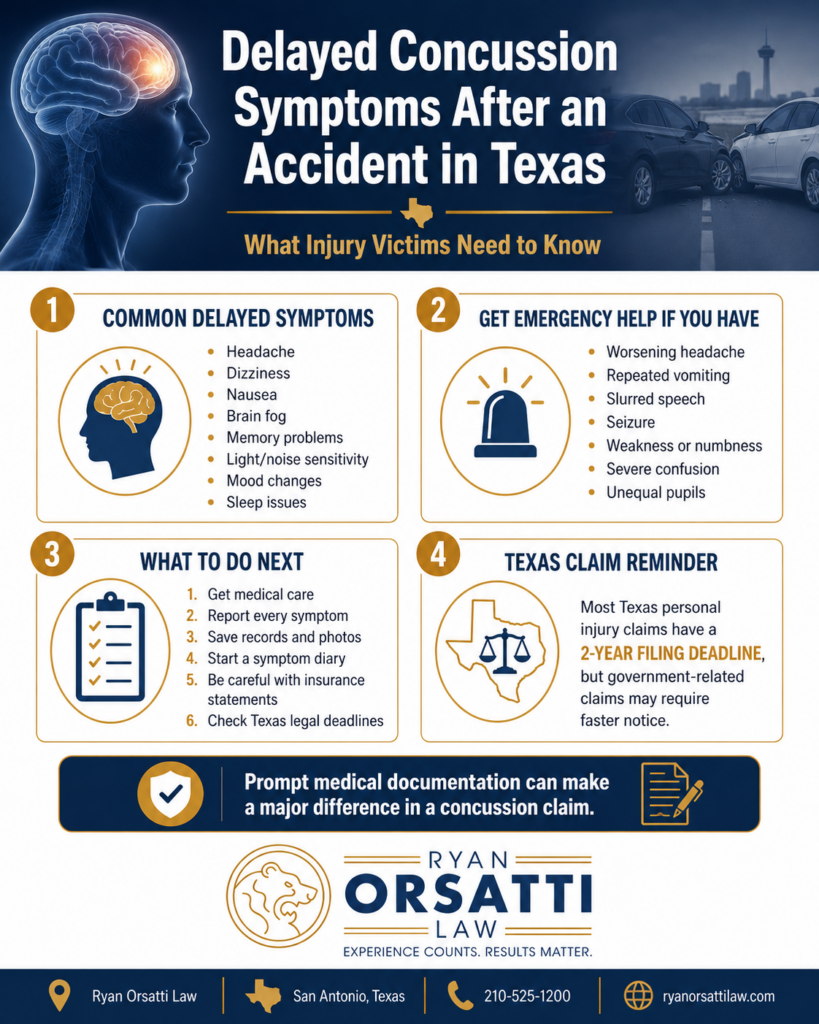
- Delayed concussion symptoms can include headaches, dizziness, nausea, brain fog, memory problems, mood changes, sleep disruption, light sensitivity, and noise sensitivity. (CDC)
- A concussion can occur from a hit to the head or from a body impact that makes the head and brain move quickly back and forth. (CDC)
- A normal CT scan does not always rule out a mild TBI or concussion because CDC guidance says a CT scan is not needed to spot every mild TBI. (CDC)
- Texas personal injury deadlines still matter even when symptoms appear later. Assume the two-year limitations period applies unless a lawyer confirms a different rule. (Texas Statutes)
- Medical documentation is often the difference between “I felt bad later” and a claim that clearly connects concussion symptoms to the crash, fall, or impact.
What are delayed concussion symptoms after an accident in Texas?
Delayed concussion symptoms are brain-injury symptoms that appear after the crash, fall, or impact instead of immediately at the scene. The CDC says mild TBI and concussion symptoms may appear right away, but others may not appear for hours or days, and they can affect how a person feels, thinks, acts, and sleeps. (CDC)
In a Texas personal injury claim, delayed symptoms matter because insurance adjusters often focus on what was reported at the scene, in the EMS record, or during the first doctor visit. If the first record says “no head injury” or “no complaints,” the insurer may later argue that headaches, confusion, or memory problems came from something else.
Common delayed concussion symptoms include:
- Headaches that start or worsen after the accident
- Dizziness or balance problems
- Nausea or vomiting
- Sensitivity to light or noise
- Blurred vision or vision problems
- Trouble concentrating
- Brain fog or feeling slowed down
- Short-term memory problems
- Irritability, anxiety, sadness, or unusual mood changes
- Sleeping more than usual, sleeping less than usual, or trouble falling asleep
The phrase “mild traumatic brain injury” can be misleading. CDC guidance explains that healthcare providers may describe these injuries as mild because they are usually not life-threatening, but the effects can still be serious. (CDC)
Why can concussion symptoms show up hours or days later?
Concussion symptoms can show up later because the injury may affect brain function before the person fully recognizes the problem. The CDC explains that a mild TBI or concussion can be caused by a bump, blow, jolt, or body impact that causes the head and brain to move quickly back and forth, leading to chemical changes and possible stretching or damage to brain cells. (CDC)
After a San Antonio crash on I-10, I-35, Loop 1604, Loop 410, or US-281, adrenaline can also mask symptoms. A person may focus first on vehicle damage, getting home, calling family, arranging a tow, or dealing with police and insurance. Hours later, the headache, nausea, sensitivity to light, or confusion becomes harder to ignore.
Delayed symptoms are also common because concussion symptoms can overlap with stress, neck injury, medication effects, poor sleep, and shock after an accident. That overlap is why medical evaluation and consistent reporting matter. The goal is not to self-diagnose. The goal is to get appropriate care and create an accurate medical timeline.
What symptoms mean I should get emergency care?
You should seek emergency care right away if symptoms suggest a potentially more serious brain injury. The CDC lists danger signs after a head impact, including seizures, repeated nausea or vomiting, unusual behavior, increased confusion, loss of consciousness with increasing drowsiness, slurred speech, weakness, numbness, decreased coordination, worsening headache, one pupil larger than the other, or double vision. (CDC)
Those symptoms should not be handled as an insurance issue first. They are medical red flags. Call 911 or go to the nearest emergency department if they appear after a crash, fall, workplace incident, truck collision, motorcycle wreck, pedestrian impact, assault, or premises incident.
For children, older adults, and people on blood thinners, caution is especially important. The medical decision belongs to a healthcare provider, not an insurance adjuster, employer, property owner, or at-fault driver.
Can a normal CT scan still be consistent with a concussion?
Yes. A normal CT scan can still be consistent with a concussion because a CT scan is not required to identify every mild TBI or concussion. CDC guidance says healthcare providers may use symptom questions and neurocognitive testing, and that a brain scan such as CT is not needed to spot a mild TBI or concussion, although it may be used when bleeding risk is a concern. (CDC)
This point matters in Texas injury claims because adjusters may say, “The CT was normal, so there is no brain injury.” That is not a complete medical analysis. A CT scan is useful for certain urgent problems, such as bleeding or skull fracture, but concussion claims often depend on symptoms, clinical evaluation, follow-up care, neurocognitive findings, and how the injury affects daily life.
The better documentation usually answers these questions:
| Evidence | Why it matters in a delayed concussion claim |
|---|---|
| ER or urgent care record | Shows when head symptoms were first reported and whether red flags were evaluated |
| Primary care or neurology follow-up | Tracks whether symptoms persisted after the first visit |
| Neurocognitive or neuropsychological testing | May document problems with memory, attention, processing speed, or concentration |
| Work restriction notes | Connect symptoms to missed work, reduced hours, or activity limits |
| Symptom diary | Shows day-by-day changes in headache, sleep, mood, dizziness, and concentration |
| Witness statements | Helps prove family, coworkers, or friends noticed changes after the incident |
| Crash photos, video, or incident report | Helps show the mechanism of injury and force involved |
Key takeaway: A delayed concussion claim is usually stronger when medical records, symptom tracking, and witness observations all tell the same timeline.
What should I do if concussion symptoms appear after I already left the scene?
If concussion symptoms appear after you left the scene, get medical care, report the new symptoms accurately, and preserve evidence from the accident. Do not wait for symptoms to become unbearable before getting checked, because the first medical record after the symptoms appear may become a key causation document in a Texas personal injury claim.
Use this checklist:
- Get medical help promptly. Go to an ER, urgent care, primary care doctor, neurologist, or other appropriate provider based on symptom severity.
- Describe the accident mechanism. Tell the provider whether your head hit anything, whether your body was jolted, whether airbags deployed, whether you blacked out, and whether symptoms were delayed.
- List every symptom. Include headache, dizziness, nausea, light sensitivity, noise sensitivity, memory issues, confusion, sleep changes, mood changes, and vision issues.
- Follow discharge instructions. Ask when to return to work, drive, exercise, use screens, or resume normal activity.
- Start a symptom diary. Track symptoms by date, severity, triggers, missed work, sleep, medications, and functional problems.
- Preserve accident evidence. Save photos, dashcam footage, vehicle photos, incident reports, witness names, repair estimates, and insurance communications.
- Avoid casual recorded statements. Do not tell an insurer “I am fine” if symptoms are still developing or you have not been evaluated.
- Get legal deadlines checked. This is especially important if a city vehicle, public property, rideshare, commercial vehicle, or employer-owned vehicle may be involved.
For serious crashes, Ryan Orsatti Law helps injured people in San Antonio and across Texas evaluate medical documentation, fault, insurance coverage, and evidence preservation. The firm’s San Antonio traumatic brain injury lawyer page explains how brain injury cases are different from ordinary soft-tissue injury claims. (Ryan Orsatti Law)
How do delayed symptoms affect a Texas personal injury claim?
Delayed symptoms affect a Texas personal injury claim because they create a causation issue. Causation means the injured person must connect the symptoms and diagnosis to the accident, not merely show that symptoms appeared at some point afterward.
Insurers often look for gaps. They may ask:
- Did you report head pain at the scene?
- Did EMS document confusion, dizziness, nausea, or head impact?
- Did the ER record mention a concussion concern?
- How many days passed before treatment?
- Did you have prior migraines, prior concussions, anxiety, sleep issues, or neck problems?
- Did you return to work, exercise, or normal activity before reporting symptoms?
- Do the medical records consistently mention the same symptoms?
A delay does not automatically defeat a claim. The CDC recognizes that symptoms may appear hours or days later. But in a claim file, delay gives the insurance company room to argue about cause, severity, or credibility. (CDC)
Attorney Insight: In delayed concussion cases, adjusters often discount claims when the first medical record does not mention head symptoms, when the client gives a recorded statement before symptoms fully develop, or when treatment notes use vague phrases like “feels off” without detail. Specific documentation matters. “Headache, dizziness, light sensitivity, and trouble concentrating since the crash” is much stronger than a general complaint that the client “does not feel right.”
How long do I have to bring a delayed concussion claim in Texas?
Most Texas personal injury lawsuits must be filed within two years from when the cause of action accrues. For a crash, fall, or other accident, the safest assumption is that the deadline runs from the date of the incident, even if concussion symptoms became obvious later. (Texas Statutes)
Do not assume delayed symptoms extend the filing deadline. Texas deadline issues can be fact-specific, and some claims have shorter notice requirements before the lawsuit deadline. A delayed diagnosis should trigger faster action, not a wait-and-see approach.
Two deadline problems are especially common:
| Situation | Why it matters |
|---|---|
| Private driver, business, property owner, or company | The general two-year Texas personal injury limitations period often controls, but evidence can disappear much sooner |
| City, county, school district, state agency, or public employee | Texas Tort Claims Act notice issues may apply before suit, and some cities require shorter written notice |
| City of San Antonio claim | The City’s notice page states written notice of death, injury, or property destruction must be given within 90 days after it is sustained |
| Commercial vehicle or 18-wheeler | Data, logs, dashcam footage, maintenance records, and driver records should be preserved quickly |
| Workplace incident involving a third party | Workers’ compensation, third-party liability, employment records, and medical authorization issues may overlap |
Key takeaway: The legal deadline may be two years, but the practical evidence deadline is often much shorter.
What if the accident involved the City of San Antonio or another government entity?
If the accident involved a government vehicle, public employee, public property, or a dangerous roadway condition, written notice may be required long before the two-year lawsuit deadline. Texas Civil Practice & Remedies Code § 101.101 generally gives a governmental unit notice rights within six months, and the City of San Antonio’s notice page states a 90-day written notice requirement for death, personal injury, or property damage claims. (Texas Statutes)
This can matter after crashes involving city vehicles, VIA-related issues, public works vehicles, unsafe public property, or roadway conditions. Government claims can also involve immunity defenses, special notice content, and strict delivery issues.
For a delayed concussion, do not wait until every symptom is fully understood before evaluating notice. A lawyer can help identify the correct entity, preserve proof of delivery, and avoid sending a vague or incomplete notice to the wrong place.
What insurance issues come up in delayed concussion cases?
Insurance issues in delayed concussion cases usually involve fault, medical proof, policy limits, PIP, MedPay, UM/UIM, health insurance, liens, and subrogation. Subrogation means a health insurer may claim a right to be paid back from a settlement, and a hospital lien is a legal claim a hospital may assert against part of a personal injury recovery.
The biggest insurance issue is often the gap between symptoms and documentation. If you told the insurance company you were “okay” before seeing a doctor, the adjuster may use that statement against later concussion complaints. If you delayed treatment because you hoped symptoms would go away, the adjuster may argue the injury was minor.
A Texas personal injury lawyer can help gather the coverage documents that matter, including:
- At-fault driver’s liability coverage
- Your PIP or MedPay information, if available
- UM/UIM coverage if the at-fault driver is uninsured or underinsured
- Health insurance explanation of benefits
- Hospital lien notices
- Letters of protection, if used
- Wage loss records
- Medical bills and itemized charges
- Prior medical records if the insurer raises pre-existing condition arguments
Ryan Orsatti Law also has related resources on how much a head injury claim is worth and how long a brain injury claim can take, both of which explain why brain injury claims often require careful medical and damages documentation. (Ryan Orsatti Law)
What damages can be part of a delayed concussion injury claim?
Damages in a delayed concussion claim may include medical bills, future care, lost wages, reduced earning ability, pain, mental anguish, physical limitations, and loss of enjoyment of life. The exact categories depend on the facts, the medical proof, the insurance coverage, and Texas law.
A concussion claim may look “minor” on paper if the only bill is one ER visit. It may look very different if the injured person later needs neurology follow-up, vestibular therapy, cognitive therapy, medication management, work restrictions, or help with daily activities.
Useful damages evidence can include:
- Medical records describing symptoms over time
- Bills and explanation of benefits
- Doctor work notes
- Employer wage verification
- Missed work calendar
- Before-and-after witness statements
- Headache and sleep logs
- Screen-time limitations
- Driving restrictions
- Notes showing problems with work performance, school, parenting, or daily tasks
CDC data shows why brain injuries deserve careful attention: the CDC reported approximately 214,110 TBI-related hospitalizations in 2020 and 68,663 TBI-related deaths in 2023, and those estimates do not include many TBIs treated only in emergency departments, primary care, urgent care, or not treated at all. (CDC)
When should I talk to a Texas personal injury lawyer about delayed concussion symptoms?
You should talk to a Texas personal injury lawyer when symptoms are significant, treatment is ongoing, fault is disputed, an insurer wants a recorded statement, a government entity may be involved, or medical bills and work loss are starting to build. Delayed concussion cases can turn on early documentation, so waiting can make the proof harder to collect.
Legal help is especially useful when:
- You had a head impact, airbag deployment, rollover, pedestrian impact, motorcycle crash, truck crash, or hard fall
- Symptoms appeared after the first medical visit
- The adjuster says the CT was normal
- The insurer says the delay means the concussion was unrelated
- You missed work or are having trouble concentrating
- You have prior headaches, prior concussion, anxiety, neck injury, or sleep issues the insurer may use against you
- The crash involved a commercial vehicle, rideshare, delivery driver, public entity, or uninsured driver
Ryan Orsatti Law is a San Antonio personal injury firm that helps injured people evaluate delayed concussion claims, preserve evidence, review insurance issues, and understand Texas deadlines. You can also review the firm’s San Antonio car accident lawyer page for crash-specific information and the contact page for office information. (Ryan Orsatti Law)
FAQ: Delayed Concussion Symptoms After an Accident in Texas
Can concussion symptoms appear the next day after a car accident?
Yes. The CDC says mild TBI and concussion symptoms may appear right away, but others may not appear for hours or days after the injury. After a Texas car accident, symptoms like headache, dizziness, nausea, light sensitivity, brain fog, mood changes, or sleep problems should be medically evaluated and documented. (CDC)
Does a normal CT scan mean I do not have a concussion?
No. A normal CT scan does not always rule out a concussion. CDC guidance says a brain scan such as a CT is not needed to spot a mild TBI or concussion, though it may be used when bleeding on the brain is a concern. Symptoms, clinical evaluation, and follow-up records still matter. (CDC)
How long do I have to sue for delayed concussion symptoms in Texas?
Most Texas personal injury lawsuits must be filed within two years from when the cause of action accrues. In an accident case, you should assume the clock started on the accident date unless a lawyer confirms a different rule. Claims involving government entities may have shorter notice deadlines before suit. (Texas Statutes)
What if I told the insurance company I was fine before symptoms appeared?
A statement that you were “fine” can create a problem, but it does not automatically end the claim. Delayed concussion symptoms are medically recognized by the CDC. The key is to get medical care, correct the record with accurate symptom reporting, avoid further casual statements, and preserve proof of when symptoms appeared. (CDC)
Should I drive or return to work with delayed concussion symptoms?
You should ask a healthcare provider before driving, returning to full work duties, exercising, or doing screen-heavy tasks after suspected concussion symptoms. CDC guidance says people with mild TBI or concussion should be seen by a healthcare provider and should follow provider instructions on safely returning to activity. (CDC)
What evidence helps prove delayed concussion symptoms came from the accident?
Helpful evidence includes ER records, follow-up medical records, symptom diaries, witness statements, work restriction notes, photos, video, crash reports, and proof of the force involved. In Texas claims, consistent documentation helps connect the delayed symptoms to the accident and reduces the insurer’s ability to argue that symptoms came from something unrelated.
Can Ryan Orsatti Law review a delayed concussion claim in San Antonio?
Yes. Ryan Orsatti Law reviews delayed concussion and brain injury issues for injured people in San Antonio, Bexar County, and across Texas. The review usually focuses on medical documentation, fault, deadlines, insurance coverage, liens, wage loss, and whether additional evidence should be preserved before it disappears.
Ryan Orsatti Law
4634 De Zavala Rd, San Antonio, TX 78249
Phone: 210-525-1200
ryanorsattilaw.com
This blog is for informational purposes only, not legal advice. Reading it does not create an attorney-client relationship. Past results do not guarantee future results.
Hurt in an accident in San Antonio? Learn how a San Antonio car accident lawyer can help with your claim. Call 210-525-1200 or request a free consultation.
The firm works on a contingency fee. You pay nothing unless the firm recovers money for you, and that covers case expenses as well as the fee: if there is no recovery, you owe no attorney's fee and no case expenses. Ask for the fee agreement and read the fee and expense section before you sign anything.
Related San Antonio legal resources
Primary legal and public-data sources
- TxDOT: Texas crash reports, data, and statistics
- Texas Civil Practice and Remedies Code Chapter 33: proportionate responsibility
Ryan Orsatti Law
4634 De Zavala Road, San Antonio, TX 78249
General reference links. Consult each source for its current text.