
Quick Answer
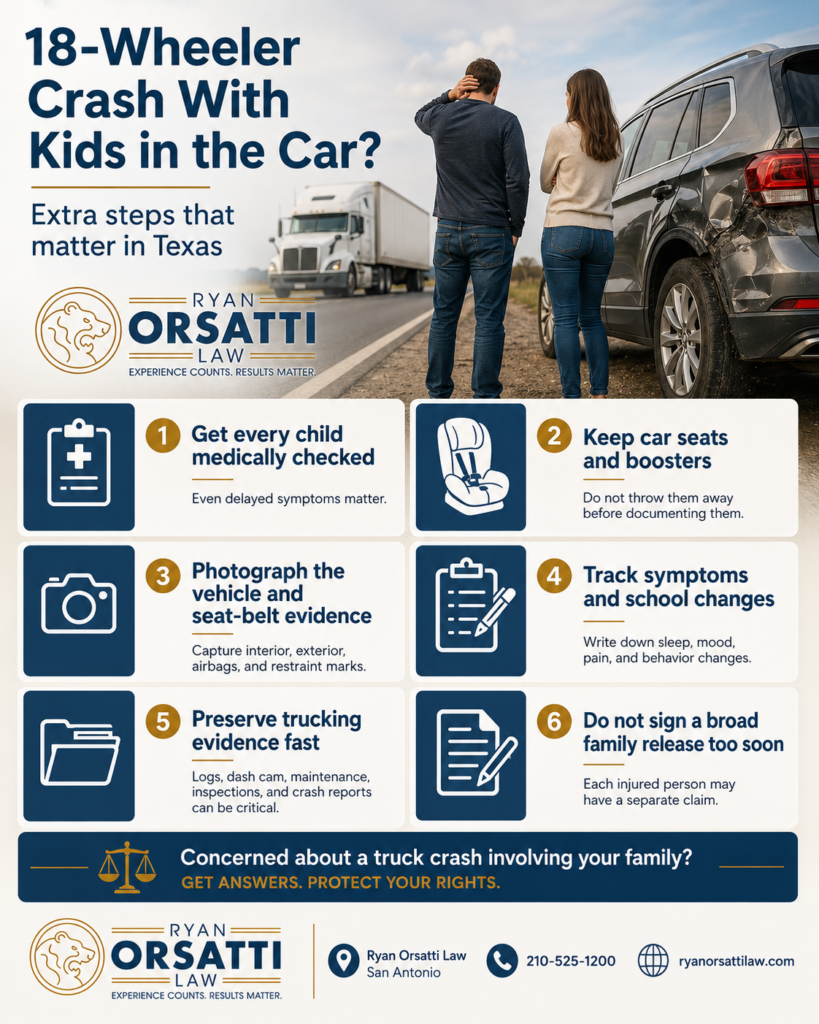
If your children were in the vehicle when an 18-wheeler hit you, the extra steps are to get each child medically evaluated, preserve every car seat and booster, document behavior or school changes, and move quickly to preserve trucking evidence. Do not let the insurance company treat the children as an afterthought inside one “family claim.”
In Texas, a child’s injury claim may involve separate medical proof, separate damages, a parent or guardian acting as “next friend,” possible court approval, and protected settlement funds.
Key Takeaways
- Children should be checked by a doctor even if they seem “fine” at the scene.
- Keep the car seats, booster seats, seat belts, photos, and vehicle damage evidence.
- Trucking evidence can disappear quickly, including driver logs, inspection reports, dash footage, and electronic data.
- Each child may have a separate claim, even when the whole family was in one vehicle.
- Do not sign a broad release until each child’s injuries, bills, liens, and future care needs have been reviewed.
- Texas minor injury settlements can require special handling, especially when a claim is filed in court.
Why do children in an 18-wheeler crash need extra steps?
Children need extra steps after an 18-wheeler crash because they may not explain pain clearly, their symptoms can show up later, and Texas law treats minor injury claims differently from adult claims.
A child may say “I’m okay” because they are scared, confused, or trying not to upset a parent. Younger children may not know how to describe a headache, dizziness, neck pain, abdominal pain, ringing in the ears, or anxiety. Some symptoms show up later at home, school, daycare, or bedtime.
This matters even more in a commercial truck crash. The size difference between an 18-wheeler and a passenger vehicle can make the forces more severe, especially on I-35, I-10, Loop 410, Loop 1604, US-281, and other San Antonio corridors where families share the road with commercial traffic.
According to TxDOT’s 2024 commercial motor vehicle crash data, Texas had 39,393 commercial motor vehicle involved crashes, including 546 fatal crashes and 1,261 suspected serious injury crashes. (Texas Department of Transportation) NHTSA has also reported that children remain at serious risk in passenger vehicle crashes, including deaths and injuries involving children age 14 and younger. (NHTSA)
Quotable passage: An 18-wheeler crash with children in the vehicle should be handled as multiple claims, not one family claim. Each child may need separate pediatric records, school records, symptom tracking, damages analysis, and settlement protection under Texas Rule of Civil Procedure 44 and Texas Property Code Chapter 142.
What should I do for my child’s medical care after an 18-wheeler hit us?
You should get each child medically evaluated as soon as possible, even if the child was quiet, asleep, or walking around after the crash.
A pediatrician, emergency room, or urgent care provider can document the child’s condition and decide whether more testing or monitoring is needed. This is not just about the first day. Children can develop or report symptoms later, especially after the adrenaline and fear wear off.
Watch for symptoms such as:
- Headache
- Vomiting or nausea
- Dizziness
- Confusion
- Sleep changes
- Neck or back pain
- Abdominal pain
- Bruising from a seat belt or car seat harness
- New fear of riding in a car
- Nightmares
- Bed-wetting after being potty trained
- Mood changes
- Trouble paying attention at school
- New complaints after sports, recess, or physical activity
A traumatic brain injury, often called a TBI, means an injury to the brain caused by force, movement, or impact. A child does not need to lose consciousness to have a concussion or brain injury. If a child has headaches, dizziness, vomiting, confusion, memory issues, light sensitivity, or unusual behavior, tell the medical provider exactly what changed after the crash.
For more information on brain injury claims, Ryan Orsatti Law has a page on San Antonio traumatic brain injury cases.
Should I keep the car seat, booster seat, and vehicle?
Yes, you should keep every car seat, booster seat, seat belt photo, and vehicle damage photo until the evidence has been documented and reviewed.
Do not throw away the car seat or booster just because the insurance company says the property damage claim is moving forward. A car seat can show where the child was sitting, the type of restraint used, the child’s position, the direction of force, and whether the crash involved enough impact to require replacement.
Texas child passenger safety law generally requires children younger than 8 to be secured in a child passenger safety seat system unless the child is taller than 4 feet 9 inches, and the seat must be used according to the manufacturer’s instructions. (Texas Health Services) That makes the actual car seat, booster, labels, installation method, and seating position important evidence after a crash.
Take photos of:
- The car seat from all angles
- The booster seat from all angles
- The label, model number, and serial number
- The expiration date
- The child’s seating position
- The seat belt path
- The harness position
- The airbags
- The interior damage near the child
- Any bruising or restraint marks
- The outside vehicle damage before repairs
Keep receipts for replacement seats. If you must replace the seat for safety, document the old seat first and store it if possible.
| Evidence to preserve | Why it matters | Practical step |
|---|---|---|
| Car seat or booster | Shows restraint type, position, and possible impact forces | Photograph labels, store the seat, keep replacement receipts |
| Seat belt and airbag evidence | Helps show restraint use and crash forces | Photograph before repairs or salvage |
| Vehicle damage | Shows direction and severity of impact | Take wide, close, and interior photos |
| Child medical records | Connects symptoms to the crash timeline | Keep ER, pediatric, therapy, and follow-up records |
| School or daycare notes | Helps prove behavior, attention, pain, or emotional changes | Ask teachers to document changes they observe |
| Trucking evidence | Can prove driver fatigue, maintenance issues, route, or violations | Send preservation notices quickly |
| TxDOT CR-3 crash report | Identifies parties, crash facts, injuries, and reporting data | Request the report after law enforcement submits it to TxDOT |
What trucking evidence is time-sensitive when children were passengers?
Trucking evidence is time-sensitive because federal retention rules may allow some records to be kept for only months, not years.
A preservation letter is a written demand telling a trucking company, insurer, broker, or other involved party to preserve relevant evidence. Spoliation means the destruction, loss, or failure to preserve evidence that should have been kept.
In a child passenger truck case, the preservation letter should usually cover more than the police report. It should seek electronic logging device data, driver qualification materials, driver phone data when appropriate, dash camera footage, cab camera footage, maintenance records, inspection records, dispatch records, bills of lading, post-crash drug and alcohol testing records, and the truck’s event data.
Quotable passage: In a Texas 18-wheeler crash, evidence can expire before a family feels ready to talk about a claim. Federal rules require motor carriers to keep driver records of duty status and supporting documents for at least six months, but driver vehicle inspection reports may be retained for only three months. (eCFR)
| Trucking evidence | Why it matters in a child passenger case | Verified rule or source |
|---|---|---|
| Driver logs and supporting documents | May show fatigue, route, stops, or hours of service issues | Motor carriers must keep records of duty status and supporting documents for at least 6 months under 49 C.F.R. § 395.8(k)(1). (eCFR) |
| Driver vehicle inspection reports | May show brake, tire, light, or equipment issues | Driver vehicle inspection reports are addressed under 49 C.F.R. § 396.11, including retention requirements. (eCFR) |
| Accident register | May show required crash documentation kept by the motor carrier | Motor carriers must keep accident register information for 3 years after a qualifying accident under 49 C.F.R. § 390.15. (eCFR) |
| Post-accident drug and alcohol testing | May matter if federal testing rules were triggered | Post-accident testing is addressed in 49 C.F.R. § 382.303. (eCFR) |
| Texas Peace Officer’s Crash Report, CR-3 | Helps identify vehicles, drivers, injuries, and crash factors | Reporting agencies generally have 10 days to submit crash reports to TxDOT. (Texas Department of Transportation) |
For cases involving commercial trucks in San Antonio or elsewhere in Texas, see Ryan Orsatti Law’s page on San Antonio truck accident claims.
Does each child have a separate Texas injury claim?
Yes, each injured child may have a separate Texas injury claim, even if the entire family was in the same vehicle.
This is one of the biggest mistakes families can make after a truck crash. The insurance company may open one claim number for convenience, but that does not mean every family member has the same injuries, the same medical bills, the same damages, or the same legal issues.
Liability means legal responsibility for causing the crash. Damages means the losses caused by the crash, such as medical bills, pain, impairment, emotional distress, and future care needs. A child’s damages may look different from an adult’s damages because children may have growth, school, sleep, sports, developmental, or behavioral issues that need more time to evaluate.
Under Texas Rule of Civil Procedure 44, minors who do not have a legal guardian may sue by “next friend,” usually an adult acting for the child in the lawsuit. The same rule also addresses court-approved compromises in suits involving minors.
A guardian ad litem is a person appointed by the court to help protect a minor’s interests in certain situations. Texas Rule of Civil Procedure 173 addresses when a guardian ad litem may be appointed, including when the minor’s next friend or guardian appears to have an interest adverse to the minor or when the parties agree.
Quotable passage: A child’s 18-wheeler claim should not be treated as a checkbox inside the parent’s claim. Texas Rule of Civil Procedure 44 allows certain minors to sue through a next friend, and court approval can make a compromise binding on the minor when a suit is involved.
Texas Property Code Chapter 142 can also matter when money is recovered for a minor, because courts may order certain handling, investment, or protection of funds that belong to the child. (Texas Constitution and Statutes) Ryan Orsatti Law has a separate resource on child injury settlement issues in San Antonio.
How do Texas deadlines work when the injured passenger is a child?
Texas deadlines are not a reason to wait, even when the injured passenger is a child.
For most Texas personal injury claims, Texas Civil Practice and Remedies Code § 16.003 sets a two-year limitations period. (Texas Constitution and Statutes) Minors can raise additional tolling issues under Texas law, but families should not assume that every claim waits until the child turns 18.
Why? Because the child may not be the only claimant. A parent may have separate claims. Adult family members may have their own injury claims. Medical expense issues, health insurance reimbursement claims, hospital liens, property damage evidence, trucking evidence, and witness memories may move on much shorter practical timelines.
Texas proportionate responsibility means fault can be divided among parties. Under Texas Civil Practice and Remedies Code Chapter 33, a claimant’s recovery can be affected by their percentage of responsibility, and recovery can be barred if the claimant’s percentage of responsibility is greater than 50 percent. (Texas Constitution and Statutes) That is another reason to preserve evidence early, especially if a trucking company tries to blame the parent driver, road conditions, another vehicle, or an unknown driver.
What insurance issues change when children were in the vehicle?
Insurance becomes more complicated because each child may have separate medical bills, liens, reimbursement claims, and future care needs.
A bodily injury liability policy is the at-fault party’s coverage for injury claims. In an 18-wheeler crash, that may include the trucking company’s commercial liability policy, excess policy, umbrella policy, or other available coverage depending on the facts.
Other coverage issues may include:
- MedPay: Medical payments coverage that may help pay crash-related medical bills, depending on the policy.
- PIP: Personal injury protection, a type of first-party auto coverage that may help with medical bills and certain other losses, depending on the policy and whether it was rejected.
- UM/UIM: Uninsured or underinsured motorist coverage, which may apply when the at-fault driver has no insurance or not enough insurance. Texas law requires UM/UIM coverage to be offered unless rejected in writing. (Texas Department of Insurance)
- Subrogation: A health insurer’s claim to be reimbursed from a settlement for bills it paid.
- ERISA plan: An employer health plan governed by federal law that may assert reimbursement rights.
- Hospital lien: A statutory claim by a hospital against certain injury recoveries. Texas Property Code Chapter 55 addresses hospital liens, including timing tied to emergency medical care after an accident. (Texas Constitution and Statutes)
- Letter of protection: An agreement where a medical provider treats now and waits to be paid from a later settlement or recovery.
Do not assume the first settlement offer accounts for all of this. A quick release can create problems if it does not separately address each child’s medical bills, health insurance reimbursement, hospital lien issues, and future care.
Ryan Orsatti Law has additional information about liens on Texas personal injury settlements and UM/UIM coverage in Texas.
After an 18-wheeler crash with children in the car, do these 7 things
After an 18-wheeler crash with children in the car, you should protect safety first, then protect medical proof, child-specific evidence, and trucking evidence.
- Call 911 and get to safety.
Do not move an injured child unless there is an immediate danger, such as fire, traffic, leaking fuel, or another impact risk. - Get each child medically evaluated.
Tell the provider exactly where each child was seated, what restraint was used, whether airbags deployed, and what symptoms appeared after the crash. - Photograph everything before repair or cleanup.
Photograph the vehicle exterior, interior, airbags, child seats, boosters, seat belts, broken glass, cargo intrusion, and visible injuries. - Save every child restraint.
Keep car seats and boosters in a safe place. Photograph the model number, serial number, expiration date, and installation position. - Start a child symptom log.
Track headaches, sleep problems, pain complaints, appetite changes, mood changes, nightmares, school issues, and missed activities. - Ask schools or daycare providers to document changes.
Teachers may notice fatigue, attention problems, fear, behavior changes, or complaints of pain before a child can explain them clearly. - Do not give recorded statements for your children without legal guidance.
An adjuster may ask broad questions that later get used out of context. A parent should not guess about a child’s pain, diagnosis, or future condition.
Attorney Insight: In family truck-crash files, one of the biggest mistakes is treating the children as “uninjured” because they were quiet at the scene. Children may freeze, sleep, cry, or say they are fine because they are scared. We look for objective markers: seating position, restraint marks, pediatric follow-up, school changes, sleep disruption, and whether the insurer is trying to fold the child into a quick family release.
How does Ryan Orsatti Law approach 18-wheeler crashes involving children in San Antonio?
Ryan Orsatti Law reviews child passenger truck cases by separating the crash evidence, the trucking evidence, and each child’s medical proof.
In San Antonio and Bexar County, these crashes often involve busy commercial routes like I-35, I-10, Loop 410, Loop 1604, and US-281. They may also involve regional trucking traffic from Comal, Guadalupe, Kendall, Wilson, Atascosa, Medina, and other surrounding counties.
The work often starts with evidence preservation. That can include the truck, trailer, electronic logging device data, maintenance records, driver qualification materials, dispatch records, dash footage, crash reports, scene photos, and witness information.
Then each child’s claim needs its own review. That includes pediatric records, ER records, follow-up care, school notes, therapy records, medical bills, health insurance claims, liens, and whether a court-approved minor settlement process may be needed.
Families can contact Ryan Orsatti Law in San Antonio to discuss an 18-wheeler crash involving children.
FAQ
Should I take my child to the ER after an 18-wheeler accident if they say they are fine?
A child should be medically evaluated after an 18-wheeler crash if there was a significant impact, airbag deployment, visible injury, pain, vomiting, headache, dizziness, confusion, abdominal pain, or unusual behavior. Children may minimize symptoms or lack the words to describe them. Follow medical advice and keep every record from the ER, pediatrician, urgent care, and follow-up providers.
Can the insurance company make one settlement offer for the whole family?
An insurance company may try to present one settlement number for the family, but each injured person can have separate damages. A child’s claim should be reviewed separately for medical bills, future care, emotional effects, school changes, liens, and settlement protection. Do not sign a broad family release until each child’s claim has been evaluated.
Do I have to replace my child’s car seat after a truck crash in Texas?
You should follow the car seat manufacturer’s instructions and any guidance from your insurer or safety professional, but do not throw away the crashed seat before documenting it. Photograph the seat, label, serial number, expiration date, harness, and seating position. Keep replacement receipts because the car seat may be both safety equipment and evidence.
Who files a Texas personal injury claim for a minor child?
A parent, guardian, or other appropriate adult may act for a minor child, depending on the facts. Texas Rule of Civil Procedure 44 allows certain minors to sue by next friend when they do not have a legal guardian. If a settlement is reached in a filed case, court approval and minor-fund protections may become important.
How long do we have to bring a child’s 18-wheeler injury claim in Texas?
Do not wait to investigate just because a child is involved. Texas personal injury claims generally have a two-year limitations period, but minor claims can involve separate tolling questions. Adult claims, parent claims, trucking records, witness memories, video, vehicle evidence, and insurance issues may move much faster than the child’s ultimate legal deadline.
What if my child has nightmares or changed behavior after the crash?
Document the behavior and tell the child’s pediatrician. Nightmares, fear of riding in a vehicle, sleep problems, regression, irritability, or school issues can matter when they begin after a crash. Ask teachers, counselors, or daycare providers to note what they observe. Emotional symptoms are easier to evaluate when they are documented consistently.
Can my child’s school records matter in an 18-wheeler claim?
Yes, school records can matter when the crash affects attendance, concentration, behavior, grades, physical activity, or emotional health. A teacher may notice changes that a parent does not see during the school day. Keep attendance records, nurse visits, counselor notes, emails, and documentation of missed sports, recess limitations, or academic struggles.
Can Ryan Orsatti Law help if the truck crash happened outside San Antonio?
Ryan Orsatti Law is based in San Antonio and reviews Texas personal injury matters, including crashes outside Bexar County. Truck crashes may involve statewide evidence, trucking companies from other states, federal safety rules, and local medical proof. You can contact the firm to discuss whether the case is one the firm can review.
Ryan Orsatti Law
4634 De Zavala Rd, San Antonio, TX 78249
Phone: 210-525-1200
ryanorsattilaw.com
This blog is for informational purposes only, not legal advice. Reading it does not create an attorney-client relationship. Past results do not guarantee future results.
Hurt in an accident in San Antonio? Learn how a San Antonio personal injury lawyer can help with your claim. Call 210-525-1200 or request a free consultation.
The firm works on a contingency fee. You pay nothing unless the firm recovers money for you, and that covers case expenses as well as the fee: if there is no recovery, you owe no attorney's fee and no case expenses. Ask for the fee agreement and read the fee and expense section before you sign anything.
Related San Antonio legal resources
Primary legal and public-data sources
Ryan Orsatti Law
4634 De Zavala Road, San Antonio, TX 78249
General reference links. Consult each source for its current text.