
If you have been hurt in a car accident or truck wreck in San Antonio, one of the first things you will do is look for a lawyer. Billboards, TV commercials, and online ads make it seem like there are hundreds of options. But not every personal injury law firm operates the same way — and choosing the wrong one can cost you tens of thousands of dollars in compensation you will never recover.
The term you need to know is case mill (also called a settlement mill). Understanding what it means and how to spot one is one of the most important steps you can take to protect your claim.
Quick Answer: What Is a Case Mill?
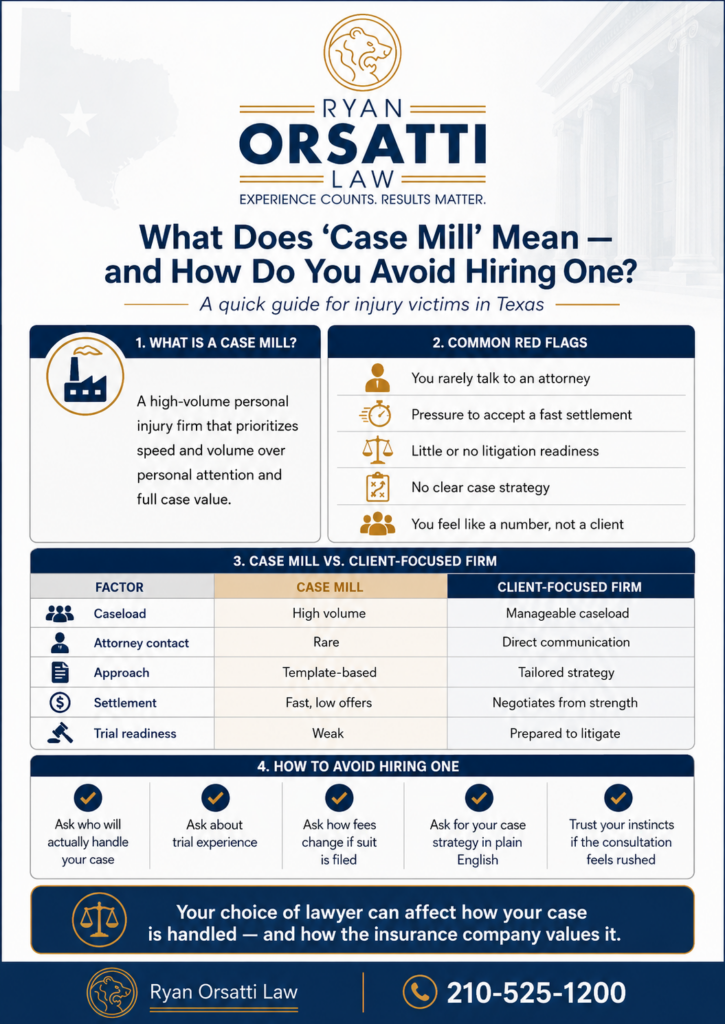
A case mill is a personal injury law firm that prioritizes volume and speed over the quality of each client’s case. These firms sign up as many clients as possible, push for fast settlements — often far below what claims are actually worth — and move on to the next file. Here is the short version:
- High volume of cases handled simultaneously, often hundreds or thousands at a time.
- Minimal attorney involvement. Paralegals or unlicensed “case managers” handle most of the work.
- Quick, low-ball settlements accepted without genuine negotiation or litigation preparation.
- No real trial capability. Insurance companies know which firms never go to court — and adjust their offers downward accordingly.
- Heavy advertising spending to keep the intake pipeline full, because the model depends on constant new sign-ups.
If you feel like a number instead of a person at your law firm, you may be inside a case mill.
Why Case Mills Exist in Personal Injury Law
Personal injury cases operate on contingency fees, meaning the attorney gets paid a percentage of what the client recovers. That structure creates two very different business models:
- Quality model: Take fewer cases, invest real time and resources, build each claim to its maximum value, and be prepared to go to trial. Higher recovery per case, fewer clients.
- Volume model: Sign up as many clients as possible, settle every case quickly for whatever the insurance company offers first, and collect fees on sheer quantity. Lower recovery per case, but hundreds or thousands of clients.
Case mills follow the second model. The math works for the firm — a 33% fee on a $15,000 quick settlement, multiplied across 500 cases a year, generates significant revenue. But it does not work for the individual client who might have recovered $60,000 or more with proper case development.
How Insurance Companies Exploit Case Mills
This is the part most injured people do not realize: insurance adjusters know exactly which firms are case mills.
Carriers track law firm behavior. They know which firms file lawsuits, which ones take depositions, and which ones have actually tried cases to verdict. When a demand letter arrives from a firm with no litigation history, the adjuster has no incentive to offer fair value. They know the firm will accept a low-ball number to close the file and move on.
By contrast, when a demand comes from a firm that regularly files suit and has courtroom experience, the insurance company factors in the real cost of a trial — and offers significantly more at the negotiating table.
Your choice of attorney directly affects how much the insurance company is willing to pay.
Red Flags: How to Spot a Case Mill
Not every firm that advertises is a case mill, and not every small firm is automatically better. The key is knowing what to look for. Here are the warning signs:
1. You Rarely (or Never) Talk to an Attorney
In a case mill, a paralegal or non-lawyer “case manager” handles your file from start to finish. The attorney whose name is on the billboard may never review your case, speak with you directly, or make strategic decisions about your claim.
What to ask: “Will I have direct access to the attorney handling my case? How often will the attorney personally review my file?”
2. Your Case Is Settled Unusually Fast with Pressure to Accept
Getting a quick settlement is not always bad — but being pressured to accept the first offer before you have finished medical treatment is a major red flag. Case mills need files to close quickly so they can collect fees and move to the next one.
What to ask: “Will you wait until I reach maximum medical improvement before settling? What happens if I do not want to accept the first offer?”
3. The Firm Discourages Litigation or Charges More for It
Some firms structure their fee agreements so the contingency percentage jumps significantly if a lawsuit needs to be filed. This discourages clients from pursuing litigation even when it would produce a substantially better outcome.
What to ask: “What is your fee if the case settles before suit? What is your fee if we have to file a lawsuit? How many lawsuits has your firm filed in the past year?”
4. No One Can Explain Your Case Strategy
Every personal injury case — even a straightforward rear-end collision — should have a plan: what evidence needs to be gathered, what medical records are critical, what legal theories support liability, and what the realistic range of value is. If no one at the firm can walk you through this, no one is actually working your case.
5. The Firm Has Massive Advertising but Few Verifiable Trial Results
Heavy advertising is not disqualifying on its own. But if the firm spends millions on billboards and TV spots yet cannot point to specific trial results, courtroom experience, or meaningful case outcomes, the advertising may be the entire business model.
6. You Are Directed to Specific Doctors with No Choice
Some case mills steer clients to preferred medical providers who have financial arrangements with the firm. These providers may charge inflated rates that create large medical liens — reducing your net recovery even further. In Texas, you have the right to choose your own treating physicians.
Case Mill vs. Client-Focused Firm: Side-by-Side Comparison
| Factor | Case Mill | Client-Focused Firm |
|---|---|---|
| Caseload | Hundreds or thousands of open files | Manageable caseload with individual attention |
| Attorney contact | Rare or nonexistent; paralegals run the file | Direct, regular communication with your attorney |
| Case strategy | Minimal investigation; template-based approach | Tailored strategy based on facts, injuries, and liability |
| Settlement approach | Accept first reasonable offer quickly | Negotiate from a position of strength; prepared to litigate |
| Trial capability | No real trial experience; insurance companies know it | Demonstrated willingness and ability to try cases |
| Medical treatment | Steered to specific providers; treatment may be rushed | Supports your choice of doctors; waits for full recovery |
| Fee structure | May penalize you for wanting to litigate | Transparent fee agreement with no hidden disincentives |
| Communication | Long delays; generic updates | Responsive; you know what is happening and why |
How to Protect Yourself: A Checklist Before You Hire
Use this checklist during your free consultation with any personal injury attorney in San Antonio or anywhere in Texas:
- [ ] Ask about caseload. How many active cases does the firm handle at one time?
- [ ] Ask who handles your case. Will you work directly with a licensed attorney, or primarily with paralegals?
- [ ] Ask about trial experience. Has the attorney personally tried cases to verdict? How recently?
- [ ] Ask about case strategy. Can the attorney explain, in plain terms, how they plan to build your specific claim?
- [ ] Ask about the fee agreement. Is the contingency percentage the same whether your case settles or goes to trial?
- [ ] Check online reviews carefully. Look for specifics — do reviewers mention actually working with the attorney? Or do they describe a faceless, assembly-line experience?
- [ ] Verify credentials. Search the attorney’s name on the State Bar of Texas Member Directory to confirm active licensure and check for any disciplinary history.
- [ ] Trust your instincts. If the consultation feels rushed, impersonal, or focused on getting you to sign paperwork rather than understanding your situation, keep looking.
What Happens When You Hire the Right Firm
When you work with an attorney who actually handles personal injury cases with care, the difference shows up in the process and the result:
Thorough investigation from day one. Your attorney reviews the crash report, gathers evidence, identifies all potentially liable parties, and begins building your claim before the insurance company has a chance to control the narrative.
Medical treatment guidance without pressure. A good attorney will help you understand the importance of consistent treatment and following your doctor’s recommendations — but will not rush you to settle before you have recovered.
Real negotiation leverage. Insurance adjusters respond differently when they know the attorney on the other side will file suit, take depositions, and go to trial if necessary. That reputation is earned over years, not bought with advertising.
Transparency throughout. You should always know the status of your case, what the next steps are, and what decisions need to be made. No surprises at the end.
Attorney Insight
One of the patterns I see regularly in Texas personal injury practice is clients who come to our firm after spending months with a case mill and realizing their claim was not being developed. By that point, critical evidence may have been lost, witnesses’ memories have faded, and the statute of limitations clock has been ticking.
In Texas, you generally have two years from the date of injury to file a personal injury lawsuit under Texas Civil Practice & Remedies Code § 16.003. That deadline does not pause because your prior attorney was not doing the work. If you suspect you are at a case mill, you have the right to change attorneys at any time — and you should not wait.
Insurance companies in Bexar County and throughout Texas closely monitor which firms actually litigate. The firms that prepare every case as though it could go to trial — gathering records, consulting with medical professionals, retaining necessary resources — consistently achieve better outcomes for their clients, whether the case ultimately settles or not.
Frequently Asked Questions
What is the difference between a “case mill” and a “settlement mill”? They mean the same thing. Both terms describe a personal injury law firm that handles a high volume of cases and settles them quickly, usually for less than they are worth, without meaningful attorney involvement or litigation preparation.
Can I switch attorneys if I think I hired a case mill? Yes. In Texas, you have the right to change attorneys at any time. Your current firm may have a lien for costs advanced, but that is typically resolved between the attorneys. You do not need your current firm’s permission to make a change.
Do case mills charge lower fees? Some case mills advertise lower contingency fee percentages to attract clients. However, a lower percentage of a significantly lower settlement often means less money in your pocket than a standard fee on a properly developed claim.
How many cases should my attorney be handling at once? There is no magic number, but you should feel confident that your attorney has time to personally review your file, answer your calls, and make strategic decisions about your case. If you cannot reach your attorney for weeks at a time, that is a problem.
Are all heavily advertised law firms case mills? No. Advertising is a legitimate and necessary part of any law practice. The issue is when advertising volume is the primary business strategy and the firm lacks the infrastructure, experience, or willingness to actually litigate cases.
Does it matter if my attorney has trial experience for a case that will probably settle? Absolutely. The insurance company’s willingness to offer fair settlement value is directly influenced by whether they believe your attorney will take the case to trial. Trial readiness drives better settlements.
Next Steps
If you have been injured in a car accident, truck wreck, or any other incident caused by someone else’s negligence in San Antonio or anywhere in Texas, take the time to choose your attorney carefully. Ask hard questions. Look for substance over flash.
A free consultation should feel like a conversation — not a sales pitch.
Ryan Orsatti Law 4634 De Zavala Rd, San Antonio, TX 78249 Phone: 210-525-1200
This blog is for informational purposes only, not legal advice. Reading it does not create an attorney-client relationship. Past results do not guarantee future results.
Hurt in an accident in San Antonio? Learn how a San Antonio personal injury lawyer can help with your claim. Call 210-525-1200 or request a free consultation.
The firm works on a contingency fee. You pay nothing unless the firm recovers money for you, and that covers case expenses as well as the fee: if there is no recovery, you owe no attorney's fee and no case expenses. Ask for the fee agreement and read the fee and expense section before you sign anything.
Related San Antonio legal resources
Primary legal and public-data sources
- Texas Civil Practice and Remedies Code Chapter 16: limitations
- Texas Civil Practice and Remedies Code Chapter 33: proportionate responsibility
Ryan Orsatti Law
4634 De Zavala Road, San Antonio, TX 78249
General reference links. Consult each source for its current text.