
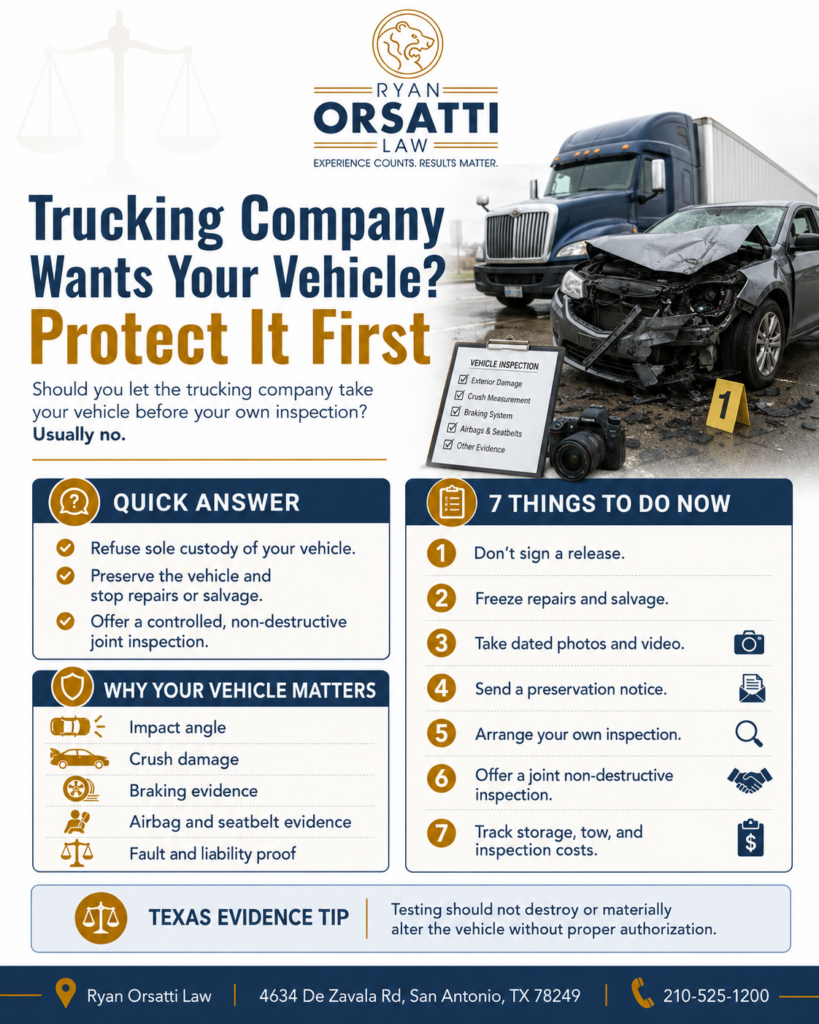
Quick Answer
Usually, yes, you should refuse to let the trucking company take sole possession of your vehicle before your own independent examiner can document it. But you should not hide, repair, sell, or destroy the vehicle. The safer move is to preserve the vehicle, stop repairs or salvage, send written notice, and offer a controlled, non-destructive inspection where both sides can attend.
Key Takeaways
- Do not give the trucking company or its insurer sole custody of your vehicle before your side has documented it.
- Do not repair, tear down, sell, or transfer the vehicle to salvage until key evidence is preserved.
- Offer a written inspection protocol that controls the time, place, scope, data downloads, custody, and handling of the vehicle.
- Your damaged vehicle may contain proof about speed, impact angle, braking, crush damage, airbag deployment, seatbelt use, and fault.
- Texas discovery rules allow inspection and testing of tangible things, but testing generally should not destroy or materially alter evidence without court authorization. (Texas Courts)
- In serious San Antonio truck crashes, the inspection issue often needs attention within days, not weeks.
Why does my vehicle matter after an 18-wheeler crash in Texas?
Your vehicle can show impact angle, crush depth, speed-related evidence, airbag deployment, seatbelt loading, and whether the trucking company’s version fits the physical damage.
After a commercial truck crash, the trucking company may move quickly. Its insurer, investigator, reconstruction consultant, or defense representative may ask to inspect your vehicle, photograph it, download data, or take it to a facility. That request may sound routine, but the first inspection can shape the entire liability dispute.
According to TxDOT’s 2024 commercial motor vehicle crash data, Texas had 39,393 crashes involving commercial motor vehicles, including 546 fatal crashes and 1,261 suspected serious injury crashes. Bexar County alone had 2,684 commercial motor vehicle crashes in 2024, including 18 fatal crashes and 34 suspected serious injury crashes. (Texas Department of Transportation)
That matters because a truck case is rarely just “driver A hit driver B.” Liability may involve the truck driver, motor carrier, trailer owner, maintenance vendor, cargo loader, broker, shipper, or another driver. Your vehicle may help prove or disprove issues like lane position, underride, sideswipe movement, rear-end force, evasive steering, braking, and visibility.
For a broader discussion of how these cases are built, see our page on San Antonio truck accident lawyerrepresentation.
Should I refuse to let the trucking company take my vehicle?
You should usually refuse to surrender sole custody, but you should offer a controlled inspection instead of a blanket refusal.
A flat “no” can create unnecessary problems if the other side later claims you kept them from seeing important evidence. A better written response is: the vehicle is preserved, no repairs or salvage will occur yet, your side is arranging its own inspection, and the trucking company may participate in a coordinated, non-destructive inspection under written conditions.
In a Texas 18-wheeler case, the safer answer is not just yes or no. Refuse sole custody, preserve the vehicle, and propose a written non-destructive inspection protocol. That protects your evidence while reducing the argument that you hid the vehicle from the carrier or insurer.
Once a lawsuit is filed, Texas Rule of Civil Procedure 196.1 allows a party to request inspection, sampling, testing, photographing, or copying of tangible things. The request must identify the items and describe the testing or sampling procedure with reasonable specificity. (Texas Courts)
Texas Rule of Civil Procedure 192.6 also allows a person affected by discovery to seek a protective order controlling the time, place, method, scope, or conditions of discovery. In plain English, the court can set ground rules if inspection becomes unreasonable or risky. (Texas Courts)
What should the written inspection protocol say?
A good inspection protocol should control who attends, where the vehicle stays, what can be touched, how data is downloaded, and whether anything may be altered.
The point is not to prevent inspection. The point is to prevent one-sided control. A fair protocol lets the trucking company document the vehicle while protecting your ability to prove what happened.
| Inspection issue | What to require | Why it matters |
|---|---|---|
| Custody | Vehicle remains at a neutral storage yard, body shop, or agreed inspection location | Prevents one side from controlling the evidence |
| Notice | Written date, time, location, and attendee list | Avoids surprise inspections |
| Scope | Photos, measurements, scans, visual inspection, and agreed data downloads only | Keeps the inspection from turning into a tear-down |
| Destructive testing | No cutting, removing, powering, resetting, or altering parts without written agreement or court order | Protects the original condition of the vehicle |
| Electronics | Identify the device, tool, software, operator, and files downloaded | Helps preserve data integrity |
| Chain of custody | Sign-in sheet, photo log, tool list, and handling notes | Shows who touched the vehicle and when |
| Sharing | Exchange non-privileged photos, measurements, and raw download files as agreed | Reduces later disputes about what was captured |
Texas Rule of Civil Procedure 196.5 states that testing, sampling, or examination may not destroy or materially alter an item unless previously authorized by the court. That rule is one reason the inspection protocol should say “non-destructive” unless everyone agrees otherwise in writing. (Texas Courts)
What evidence can be lost if the trucking company takes my vehicle first?
The main risk is not just repair cost, it is losing physical proof before anyone aligned with you documents it.
Important vehicle evidence can include:
- Crush depth and deformation patterns
- Paint transfer and scrape marks
- Tire marks, wheel damage, and sidewall cuts
- Headlight, taillight, and turn-signal damage
- Seatbelt stretch marks and latch condition
- Airbag deployment evidence
- Event data recorder information, if the vehicle has one
- Dashcam footage, if installed
- Infotainment data or connected-device records, where legally and technically appropriate
- Cargo intrusion, underride evidence, or bumper-height evidence
- Repair estimates, total-loss photographs, tow records, and storage records
Federal event data recorder standards apply to vehicles equipped with EDRs and identify categories of crash data such as speed, throttle, braking, and change in velocity. Not every vehicle has the same data, and commercial tractors may involve different systems such as engine control modules, telematics, dashcams, and electronic logging devices. (eCFR)
Commercial truck cases also involve trucking records outside your vehicle. Federal regulations require motor carriers to maintain certain inspection, repair, and maintenance records, and drivers often must use electronic logging devices or record duty status information unless an exception applies. (eCFR)
For more on those records, see our guide to trucking company records after a San Antonio 18-wheeler accident.
Can the trucking company argue spoliation if I do not hand it over?
Yes, the trucking company may argue spoliation if you destroy, repair, sell, hide, or materially alter the vehicle after a claim is reasonably likely, but a documented preservation plan helps protect against that argument.
Spoliation means the loss, destruction, or material alteration of evidence that should have been preserved. In Texas, the trial court decides whether spoliation occurred and whether a remedy is appropriate. The Texas Supreme Court’s decision in Brookshire Brothers, Ltd. v. Aldridge explains that the analysis focuses on whether there was a duty to preserve evidence, whether that duty was breached, and what remedy is proportionate. (Justia Law)
Spoliation in Texas is evidence loss after a party has a duty to preserve material proof. In vehicle cases, the practical defense is simple: freeze repairs and salvage, photograph the vehicle, send written notice, and make the vehicle available for a documented, non-destructive inspection.
That is why the safest response is not “you can never see my vehicle.” It is “the vehicle is preserved, my examiner must inspect it first or at the same time, no destructive testing is allowed, and we will coordinate a reasonable inspection.”
What if storage fees are piling up or the insurer wants to total the vehicle?
Storage and total-loss pressure should be managed without giving up the evidence.
After a serious truck crash on I-35, I-10, Loop 410, Loop 1604, US-281, or another San Antonio corridor, the damaged vehicle may sit at a tow yard charging daily fees. Your own insurer, the trucking insurer, or the storage lot may pressure you to move quickly. That pressure is real, but speed can create evidence problems.
Before a vehicle is moved or released to salvage, you should try to:
- Photograph and video the vehicle where it sits.
- Confirm the current storage location in writing.
- Instruct the yard not to release, repair, tear down, or dispose of the vehicle.
- Move it to a secure lower-cost location if fees are unreasonable.
- Give written notice to the trucking company and insurer before any move.
- Complete your independent inspection as quickly as practical.
- Avoid signing any release that could affect your injury claim.
A property-damage payment is not the same as a bodily-injury settlement. If paperwork mentions a “release,” “all claims,” “indemnity,” “full and final settlement,” or “bodily injury,” do not treat it as routine property paperwork.
If the trucking company is pushing a quick property-damage resolution while your injuries are still being evaluated, our article on quick property-damage-only settlements from a trucking company explains why the wording matters.
After a trucking company asks to inspect your vehicle, do these 7 things
The safest practical response is to preserve the vehicle immediately and put every inspection term in writing.
- Do not sign a release authorizing removal, repair, disposal, or destructive testing. Ask for the request in writing and save every email, letter, and text.
- Tell the storage yard or body shop to freeze the vehicle. Give written instructions that there should be no repairs, tear-down, towing, title transfer, salvage release, or disposal without your written approval.
- Take dated photos and video. Capture all four sides, roof, undercarriage if visible, interior, airbags, seatbelts, tires, wheels, license plates, VIN plate, odometer, cargo area, child seats, and personal items.
- Send a preservation notice. Send it to the trucking company, insurer, truck owner, trailer owner, known maintenance company, storage yard, and any other involved entity you can identify.
- Arrange your own inspection. Have an independent reconstruction professional or vehicle examiner document the vehicle, download available data where appropriate, and preserve photos, measurements, scans, and notes.
- Offer a coordinated non-destructive inspection. Invite the trucking company to inspect at a neutral location with written terms that protect custody, data, parts, and chain of custody.
- Track every evidence-related cost. Keep tow bills, storage bills, inspection invoices, total-loss paperwork, repair estimates, and rental records.
How does this play out in San Antonio and Bexar County truck claims?
In San Antonio truck claims, the inspection fight often moves faster than the medical claim because vehicles are repaired, moved, or totaled within days.
A person injured in a crash on I-35 near downtown, Loop 410 near the airport, Loop 1604 on the North Side, I-10 near Leon Springs, or US-281 near Stone Oak may still be treating at the ER or following up with doctors when the truck insurer starts asking for the vehicle. That timing can put the injured person at a disadvantage.
Truck cases in Bexar County and nearby counties such as Comal, Guadalupe, Medina, Atascosa, Wilson, and Kendall often involve multiple layers of evidence. Your vehicle is one piece. The truck’s electronic control module, electronic logging device, dashcam, maintenance file, driver qualification file, dispatch records, broker communications, and bill of lading may also matter.
This is why vehicle preservation should be paired with a broader evidence plan. Our commercial vehicle accident claims page explains how commercial vehicle cases can involve more parties and records than a typical car crash.
Attorney Insight: The inspection issue is usually less about “who gets to see the car” and more about “who controls the first download, first photos, and first tear-down.” In matters we handle, we try to avoid unnecessary standoffs. We preserve the vehicle, invite a reasonable inspection, and put bright lines around custody, data, and destructive testing before anyone touches the evidence.
When should a lawyer get involved?
A lawyer should usually get involved before the vehicle is moved, inspected, repaired, totaled, or released to salvage in a serious truck crash.
Texas Civil Practice and Remedies Code § 16.003 generally gives two years to file a personal injury or property-damage lawsuit, but evidence deadlines are much shorter in real life. A vehicle can be repaired, sold, moved to auction, or released to salvage long before the legal filing deadline approaches. (Texas Statutes)
Fault also matters because Texas uses proportionate responsibility. Under Texas Civil Practice and Remedies Code § 33.001, a claimant may not recover damages if the claimant’s percentage of responsibility is greater than 50 percent. Vehicle evidence can matter when the trucking company argues you were partly or mostly at fault. (Texas Statutes)
For serious injury claims involving vehicle preservation, truck inspections, and disputed fault, early documentation can make a practical difference. You can learn more about serious injury claims or contact Ryan Orsatti Law to discuss the next steps.
FAQ
Can the trucking company force me to give them my vehicle before my inspection?
Usually, the trucking company cannot simply take sole custody of your vehicle before suit just because it wants to inspect it. After a lawsuit is filed, Texas discovery rules may allow inspection, testing, or photographing of tangible things. The better response is to preserve the vehicle and offer a controlled, non-destructive inspection with written conditions. (Texas Courts)
Is it spoliation if I keep my damaged car after a truck crash?
No. Keeping your damaged car in a secure location is not spoliation by itself. The risk comes from repairing, selling, scrapping, hiding, or materially altering the vehicle after you know it may be important evidence. Protect yourself by documenting the vehicle, stopping repairs, sending written notice, and offering reasonable inspection access.
Can I let my insurance company total the vehicle?
You can often resolve property damage, but do not transfer title, release the vehicle to salvage, or allow disposal before key evidence is preserved. Total-loss paperwork may move the vehicle out of your control. Before signing, confirm your side has photos, measurements, available data downloads, and written documentation of the vehicle’s condition.
What is destructive testing in a truck accident vehicle inspection?
Destructive testing means any inspection step that removes, cuts, disassembles, powers, resets, downloads improperly, or materially changes part of the vehicle. In a crash case, that may include cutting components, removing modules, or altering damaged parts. Texas Rule of Civil Procedure 196.5 addresses testing that would destroy or materially alter an item. (Texas Courts)
What vehicle data should be preserved after an 18-wheeler crash?
Potential vehicle data may include event data recorder information, airbag control module data, dashcam footage, infotainment records, GPS data, and connected-device information. On the truck side, evidence may include electronic logging device data, engine control module data, telematics, dispatch records, and maintenance records. The available data depends on the vehicle, equipment, and software.
How fast should I act after a San Antonio commercial truck crash?
You should act within days if the vehicle is in storage, the insurer wants an inspection, or anyone is discussing repair, salvage, or title transfer. The lawsuit deadline may be much later, but vehicle evidence can disappear quickly. Preserve the vehicle first, then coordinate inspections and property-damage issues in writing.
Should I attend the trucking company’s inspection?
You should not attend alone if the crash caused serious injury or fault is disputed. A proper inspection may involve measurements, photographs, data downloads, and evidence-handling decisions. Your lawyer, reconstruction professional, or vehicle examiner can help document what happens and object if the inspection goes beyond the agreed scope.
What if the trucking insurer says it only wants photos?
Even a photo-only request should be handled carefully. Ask for the request in writing, confirm who will attend, and specify that no one may touch, move, download, open modules, remove parts, or alter the vehicle. Photos are usually less risky than custody transfer, but the inspection should still be documented.
Ryan Orsatti Law
4634 De Zavala Rd, San Antonio, TX 78249
Phone: 210-525-1200
ryanorsattilaw.com
This blog is for informational purposes only, not legal advice. Reading it does not create an attorney-client relationship. Past results do not guarantee future results.
Hurt in an accident in San Antonio? Learn how a San Antonio personal injury lawyer can help with your claim. Call 210-525-1200 or request a free consultation.
The firm works on a contingency fee. You pay nothing unless the firm recovers money for you, and that covers case expenses as well as the fee: if there is no recovery, you owe no attorney's fee and no case expenses. Ask for the fee agreement and read the fee and expense section before you sign anything.
Related San Antonio legal resources
Primary legal and public-data sources
- Texas Civil Practice and Remedies Code Chapter 16: limitations
- Texas Civil Practice and Remedies Code Chapter 33: proportionate responsibility
Ryan Orsatti Law
4634 De Zavala Road, San Antonio, TX 78249
General reference links. Consult each source for its current text.