
Quick Answer
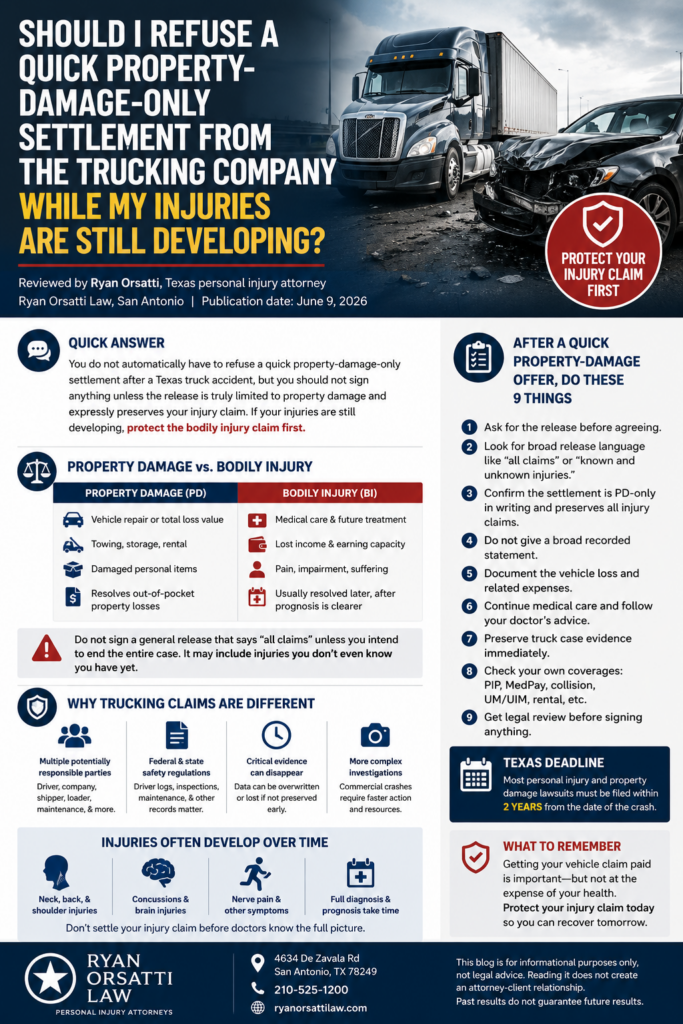
You do not automatically have to refuse a quick property-damage-only settlement after a Texas truck accident, but you should not sign anything unless the release is truly limited to property damage and expressly preserves your injury claim. A trucking company or insurer may call it “property damage only,” while the paperwork releases “all claims” from the crash. If your injuries are still developing, protect the bodily injury claim first.
Key Takeaways
- A property damage (PD) settlement should cover vehicle repair, total loss value, towing, storage, rental, and damaged personal items—not medical bills or pain.
- A bodily injury (BI) claim includes medical care, future treatment, lost income, impairment, pain, and other injury-related losses.
- Do not sign a general release—a settlement document that gives up all claims—unless you intend to end the entire case.
- In Texas, most personal injury and property damage lawsuits must be filed within two years, but deadlines can vary by defendant and facts.
- Trucking cases often require early preservation of driver logs, electronic control module data, maintenance records, dispatch records, and company safety documents.
If you were hit by an 18-wheeler or commercial vehicle in San Antonio, Bexar County, or anywhere in Texas, the property damage claim may move fast. The injury claim should usually move slower. That timing gap creates a common trap: the trucking company offers to pay for the vehicle before doctors know the full injury picture.
For more on the broader claims process, see our pages on San Antonio truck accident cases, commercial vehicle accident claims, and car accident injury claims in San Antonio.
Why a “Property-Damage-Only” Trucking Settlement Can Be Risky
A property-damage-only settlement sounds narrow. In a clean version, it resolves only the damage to your vehicle and related out-of-pocket losses. The problem is not the concept. The problem is the paperwork.
A release is a written agreement where you give up legal claims in exchange for money. If the release says you are settling “any and all claims arising from the accident,” that language may reach far beyond the vehicle. It may include injuries that are not fully diagnosed yet.
The Texas Department of Insurance warns that when another driver’s insurer offers a medical settlement, the company will usually ask the injured person to sign a release promising not to file more claims for the accident. TDI also tells injured people to talk with their doctor about future treatment before signing a release. See the Texas Department of Insurance Auto Insurance Guide.
That same caution applies when a trucking company tries to close part of a claim early. The title of the document matters less than the actual words.
Property Damage and Bodily Injury Are Different Claims
After a Texas truck wreck, the claim often splits into two tracks.
| Claim Track | What It Usually Covers | When It Can Be Resolved | Main Risk |
|---|---|---|---|
| Property damage | Vehicle repair, total loss value, towing, storage, rental, car seats, damaged personal property | Sometimes early, once the vehicle value and repair issues are known | Signing a broad release that gives up injury claims |
| Bodily injury | ER care, follow-up treatment, surgery, injections, therapy, lost wages, future care, pain, impairment | Usually later, after diagnosis, treatment, and prognosis are clearer | Settling before the full medical picture is known |
| Injury-related insurance benefits | PIP, MedPay, UM/UIM, health insurance, workers’ compensation if applicable | Depends on policy language and claim facts | Missing coverage, reimbursement, or lien issues |
| Trucking liability evidence | Driver logs, maintenance, inspections, dispatch, onboard data, hiring and training records | Should be preserved immediately | Evidence may be overwritten, lost, or disputed |
Actual cash value means the fair value of the vehicle immediately before the crash, usually accounting for depreciation. TDI explains that insurers pay vehicle repair or replacement only up to actual cash value in many auto claim situations.
Subrogation means an insurer or benefit plan may seek repayment from a later recovery after paying benefits. This can matter if your health insurance, PIP, MedPay, or another coverage pays crash-related bills.
PIP, or personal injury protection, is Texas auto coverage that may pay medical expenses and certain other losses. TDI states that Texas auto policies include PIP unless the insured rejects it in writing. MedPay, or medical payments coverage, may also pay medical bills depending on the policy.
Should I Refuse a Quick Property-Damage-Only Settlement?
The safer answer is: do not refuse simply because it is quick, but do not accept until the release is reviewed and limited.
A property-damage settlement may help you get transportation, stop storage charges, and move forward with replacing or repairing your vehicle. But the release should say, in plain terms, that it resolves only property damage and does not release bodily injury claims.
Language to watch for includes:
- “all claims”
- “known and unknown injuries”
- “bodily injury”
- “personal injury”
- “medical expenses”
- “pain and suffering”
- “loss of earning capacity”
- “full and final settlement”
- “any and all claims arising out of the collision”
If those phrases appear in a document presented as property-damage-only, slow down. Ask for clarification in writing. Do not rely on the adjuster’s verbal assurance that “this won’t affect your injury claim.”
What a Narrow Property-Damage Release Should Do
A safer property-damage release should be narrow. It should identify only the property being resolved and reserve all injury claims.
For example, the concept should be:
This release resolves only property damage to the vehicle and related property-damage expenses. It does not release any bodily injury, medical expense, lost income, pain and suffering, impairment, disfigurement, future medical care, or other personal injury claim arising from the crash.
That is not magic language for every case. The actual document should be reviewed in context. But the point is simple: the release must match the limited settlement.
Attorney Insight
In matters we handle, one of the biggest red flags is a check or release that arrives before the client has finished treating. Adjusters sometimes separate the conversation verbally—“this is just for the car”—but the document may not be separated at all. In truck cases, that risk is higher because a commercial carrier, insurer, third-party administrator, and defense counsel may all touch the claim early.
Why Trucking Claims Are Different From Ordinary Car Claims
A crash with a commercial truck is not just a bigger car accident. It can involve multiple defendants and layers of evidence.
Possible responsible parties may include the truck driver, trucking company, trailer owner, cargo loader, maintenance contractor, broker, shipper, or a parts manufacturer. The answer depends on the facts.
Truck cases also involve federal and state safety rules. For example, interstate motor carriers may be subject to Federal Motor Carrier Safety Regulations. Those rules can involve records such as hours-of-service logs, inspection documents, accident registers, and maintenance records. The Federal Motor Carrier Safety Administration publishes regulations and safety information through the U.S. Department of Transportation at FMCSA.gov.
That evidence can matter to liability. It can also disappear if no one asks for preservation early.
The Injury Timeline Often Runs Behind the Vehicle Timeline
Vehicle damage is visible right away. Injuries are not always that clear.
After a truck crash on I-35, I-10, Loop 1604, Highway 281, I-45, I-20, or another Texas freight corridor, a person may feel sore at the scene and much worse days later. Neck injuries, back injuries, concussions, shoulder injuries, knee injuries, and nerve symptoms can develop over time.
A doctor may need imaging, referrals, therapy, injections, or specialist evaluation before giving a reliable prognosis. Prognosis means the expected course of recovery. Settling the injury portion before prognosis is clear can leave a person responsible for later care.
This is especially important in cases involving suspected traumatic brain injury. For more information on that practice area, see our page on San Antonio traumatic brain injury claims.
Texas Deadlines Still Matter
In Texas, most personal injury and property damage claims are subject to a two-year statute of limitations under Texas Civil Practice & Remedies Code § 16.003. A statute of limitations is the legal deadline to file a lawsuit.
That does not mean you should wait two years to act. Trucking evidence may need to be preserved quickly. Witness memories fade. Dashcam or surveillance video may be overwritten. The police crash report, repair estimate, medical records, and photos should be gathered early.
Texas also uses proportionate responsibility in many injury cases. Under Texas Civil Practice & Remedies Code Chapter 33, fault can be allocated among parties. Section 33.001 is often described as Texas’s 51% bar rule: a claimant generally cannot recover damages if the claimant’s percentage of responsibility is greater than 50%.
That means early statements matter. A casual comment to the trucking insurer can later become a liability argument.
After a Quick Property-Damage Offer From a Trucking Company, Do These 9 Things
- Ask for the release before agreeing. Do not accept based only on a phone call, email summary, or adjuster explanation.
- Look for broad release language. Search the document for “all claims,” “injury,” “medical,” “known or unknown,” and “full and final.”
- Confirm the settlement is property-damage-only in writing. The document should preserve all bodily injury claims.
- Do not give a broad recorded statement. If the insurer needs vehicle information, keep the conversation limited to property damage.
- Document the vehicle loss. Keep repair estimates, total loss valuation reports, tow bills, storage invoices, rental receipts, photos, and title or loan documents.
- Continue medical care. Follow reasonable medical advice and report symptoms accurately. Gaps in care can become disputes later.
- Preserve truck case evidence. Ask that the trucking company preserve driver logs, electronic data, maintenance records, inspection records, dashcam video, dispatch communications, and post-crash investigation materials.
- Check your own coverages. Review PIP, MedPay, collision, rental, and UM/UIM coverage. Texas minimum liability limits may not be enough in serious injury crashes. TDI describes Texas minimum auto liability coverage as 30/60/25 in its Auto Insurance Guide.
- Get legal review before signing. A short document can have major consequences if it releases the wrong claims.
What to Say to the Adjuster
You can be direct without being hostile. Consider language like this:
I am willing to discuss property damage, but I am not resolving any bodily injury claim. Please send the proposed release and confirm in writing that it applies only to property damage and does not release any injury, medical, wage loss, impairment, pain and suffering, or future damage claim.
If they refuse to put that in writing, treat that as a warning sign.
You can also say:
My medical treatment is ongoing. I am not in a position to evaluate any bodily injury settlement at this time.
Those statements help separate the property claim from the injury claim.
What If the Trucking Company Sends a Check Without a Release?
Do not assume a check is harmless. Look at the memo line, letter, email, and any attached documents. If the check says “full and final settlement” or references “all claims,” depositing it may create an argument that you accepted a broader settlement.
Ask for written clarification before depositing or endorsing any settlement check.
What If You Need the Property Damage Money Now?
That is common. A wrecked vehicle creates immediate pressure: no transportation, work problems, school drop-offs, medical appointments, storage fees, and loan payments.
The goal is not to delay the vehicle claim for no reason. The goal is to resolve it safely. In many cases, a property damage claim can be resolved while the injury claim remains open. But the release must be limited.
If the insurer will not agree to a limited release, consider other routes. You may be able to use your own collision coverage, rental reimbursement, PIP, MedPay, or UM/UIM benefits depending on the policy and facts. Your insurer may later seek recovery from the trucking company through subrogation.
When a Lawyer Should Get Involved Quickly
Legal review is especially important when:
- the crash involved an 18-wheeler, dump truck, delivery truck, company pickup, box truck, or oilfield vehicle;
- you went to the ER, urgent care, chiropractor, orthopedic doctor, neurologist, or physical therapy;
- symptoms are worsening or spreading;
- the truck insurer asks for a recorded statement;
- the trucking company disputes fault;
- there are multiple vehicles;
- your vehicle was totaled;
- you missed work;
- you may need injections, surgery, imaging, or specialist care;
- the adjuster says the release is “standard” but will not revise it.
A lawyer can also send a preservation letter. A preservation letter is a written demand that the trucking company keep evidence that may be relevant to the crash.
FAQ
Can I settle my vehicle damage claim and keep my injury claim open?
Yes, it may be possible to settle only the property damage claim while keeping the bodily injury claim open. The key is the wording of the release. It should clearly state that only vehicle and property losses are being resolved and that all injury-related claims are preserved.
What if the adjuster says the release is only for property damage?
Do not rely only on what the adjuster says. Ask for the document and read the actual release language. If the written release says “all claims” or mentions injury-related damages, it may be broader than the adjuster’s explanation. Written settlement language controls the risk.
Should I sign a release while I am still treating?
You should be very cautious about signing any release while medical treatment is ongoing. Your doctors may not yet know whether you need future treatment, imaging, injections, surgery, or long-term care. Once a valid injury release is signed, reopening the claim can be difficult.
What does “full and final settlement” mean?
“Full and final settlement” usually means the insurer believes the claim is over after payment. In a property damage context, that phrase should be limited to property damage only. If it applies to the whole crash, it may affect your bodily injury claim.
Can the trucking company delay my vehicle payment because I will not settle my injury claim?
A trucking insurer may try to control the timing, but property damage and bodily injury are different categories of loss. You can ask the insurer to process the vehicle damage separately and provide a limited property-damage-only release. If the insurer refuses, get advice before signing anything broader.
How long do I have to bring a Texas truck accident lawsuit?
Most Texas personal injury and property damage lawsuits must be filed within two years under Texas Civil Practice & Remedies Code § 16.003. Some situations may involve shorter notice rules or different deadlines, especially if a government entity is involved. The safest approach is to evaluate deadlines early.
What evidence should be preserved after a truck crash?
Important trucking evidence can include driver qualification files, hours-of-service records, electronic logging device data, electronic control module data, maintenance records, inspection reports, dispatch messages, bills of lading, dashcam video, and post-crash investigation materials. Early preservation can be important because some data may be overwritten or lost.
Should I talk to the trucking company’s insurer before hiring a lawyer?
You can report basic facts, but be careful with recorded statements, injury descriptions, and fault discussions. Trucking insurers often investigate quickly. If your injuries are developing or the release language is unclear, legal review before a detailed statement or settlement is a safer course.
Ryan Orsatti Law
4634 De Zavala Rd, San Antonio, TX 78249
Phone: 210-525-1200
ryanorsattilaw.com
This blog is for informational purposes only, not legal advice. Reading it does not create an attorney-client relationship. Past results do not guarantee future results.
Hurt in an accident in San Antonio? Learn how a San Antonio truck accident lawyer can help with your claim. Call 210-525-1200 or request a free consultation.
The firm works on a contingency fee. You pay nothing unless the firm recovers money for you, and that covers case expenses as well as the fee: if there is no recovery, you owe no attorney's fee and no case expenses. Ask for the fee agreement and read the fee and expense section before you sign anything.
Related San Antonio legal resources
Primary legal and public-data sources
Ryan Orsatti Law
4634 De Zavala Road, San Antonio, TX 78249
General reference links. Consult each source for its current text.